You open your ad platform dashboard and the numbers look great. ROAS is up, conversions are climbing, and the algorithm is telling you to scale. Then you check your CRM. Or your Stripe revenue. And the story is completely different.
This is one of the most common and costly problems in B2B SaaS marketing: your ad tracking looks fine on the surface, but the data underneath is broken. And when the data is broken, every budget decision you make is built on a foundation that does not hold.
Wrong ad tracking is not a minor inconvenience. It is a strategic liability. It causes teams to pour budget into campaigns that are not actually driving revenue, while simultaneously cutting the ones that are. It inflates ROAS figures that feel encouraging but do not translate to pipeline. It makes optimization feel productive when it is actually just optimizing toward a distorted signal.
The good news: the causes are not mysterious. There are specific, identifiable reasons why ad tracking breaks, and most of them are fixable. This article walks through each one, from the structural gap between platform reporting and real revenue, to the technical failures that cause events to go missing, to the attribution model choices that quietly distort your view of performance. By the end, you will know exactly what to look for and what accurate tracking actually requires.
The Gap Between Platform Reports and Real Revenue
Here is a scenario that will feel familiar. You run campaigns on both Meta and Google. At the end of the month, Meta reports 40 conversions and Google reports 35. But when you look at your CRM, you only closed 30 new customers. Somehow, your ad platforms collectively claimed credit for 75 conversions that produced 30 actual customers.
This is not a glitch. It is a structural feature of how ad platforms report performance.
Each platform measures conversions using its own attribution windows and counting logic. Meta, by default, may attribute a conversion to any user who clicked an ad within the last seven days or viewed one within the last day. Google uses different defaults. When a single customer interacts with both platforms before converting, both platforms claim full credit for that conversion. There is no coordination between them, and no automatic deduplication across platforms.
The result is platform self-reporting bias: every ad platform is financially incentivized to show you the most favorable version of its own performance. The attribution windows are set to maximize the number of conversions each platform can claim. This is not malicious, but it is worth understanding clearly. The numbers inside any single platform are not a neutral measurement of reality. They are that platform's interpretation of reality, filtered through its own counting rules.
This problem is especially pronounced in B2B SaaS. A typical B2B buyer does not click one ad and immediately convert. They might discover you through a LinkedIn post, see a retargeting ad on Meta two weeks later, search your brand name on Google, attend a webinar, and then finally request a demo after a sales call. Every platform that touched that journey will attempt to claim the conversion. None of them will tell you the full story on their own.
When you make budget decisions based on platform-reported ROAS figures, you are comparing numbers that were calculated using different rules, different windows, and different definitions of what counts as a conversion. That is not a data problem you can solve by looking more carefully at the dashboards. It requires a fundamentally different approach to marketing measurement.
Technical Failures That Break Tracking at the Source
Even if you accept that platform-reported numbers are imperfect, you still need the underlying event data to be as complete and accurate as possible. Unfortunately, the most common tracking setup, a client-side pixel firing in the browser, is increasingly unreliable for reasons that have nothing to do with how well you configured it.
Browser-based pixel degradation: Ad blockers prevent pixels from firing entirely for a meaningful portion of your traffic. Safari's Intelligent Tracking Prevention limits the lifespan of first-party cookies and strips certain URL parameters. iOS privacy changes have further restricted the data that can be passed from apps and mobile browsers. The result is a growing population of users whose conversion events simply never get recorded. You do not see a warning when this happens. The data just disappears quietly. Understanding pixel tracking problems on iOS is essential for any team running mobile campaigns.
Duplicate conversion events: Many teams, trying to improve tracking reliability, add server-side Conversion API events alongside their existing client-side pixels. This is the right instinct, but it creates a new problem if deduplication is not properly configured. When both a browser pixel and a server-side event fire for the same conversion, the platform counts it twice. For Meta, this requires a consistent event_id parameter shared between the client and server events. For Google Enhanced Conversions, a consistent transaction_id serves the same purpose. Without these, your reported conversion volume is inflated, your optimization algorithms receive corrupted signals, and your cost-per-conversion figures become meaningless.
UTM parameter loss: UTM parameters are the strings appended to your URLs that tell analytics tools which campaign, source, and ad drove a click. They are fragile in ways that are easy to overlook. Safari's tracking prevention can strip them. Redirect chains, where a URL passes through one or more intermediate destinations before reaching the final landing page, often drop them entirely. Some email clients rewrite links in ways that remove query strings. If a user bookmarks a page and returns later, the UTMs are gone. Any of these scenarios severs the connection between the original ad click and the downstream conversion. Learning how UTM tracking works and where it breaks down is a critical step toward fixing attribution gaps.
These are not edge cases. For most B2B SaaS companies running multi-channel campaigns, some combination of these failures is happening right now, quietly degrading the quality of the data that marketing decisions are based on.
How Your Attribution Model Is Distorting Performance
Even with technically sound tracking, the attribution model you choose determines which version of performance you see. And different models tell dramatically different stories about the same campaigns.
Last-click attribution assigns 100% of conversion credit to the final touchpoint before a conversion. This sounds logical until you think about what it actually rewards. In most B2B funnels, the last click is often a branded search, a retargeting ad, or a direct visit. These are touchpoints that capture intent that was built by earlier interactions. Last-click attribution makes retargeting and branded campaigns look extraordinarily effective, while systematically undervaluing the awareness campaigns, content ads, and organic social posts that created the demand in the first place. If you optimize based on last-click data, you will tend to cut the top-of-funnel activity that feeds the entire system.
First-touch attribution has the opposite distortion. It assigns all credit to the very first interaction a prospect had with your brand. This makes awareness campaigns look powerful, but it ignores the retargeting, nurture sequences, and bottom-funnel touchpoints that actually moved the prospect to a decision. A prospect who discovered you through a LinkedIn ad but converted three months later after a demo sequence did not convert because of that LinkedIn ad alone. First-touch attribution tells you they did.
The deeper issue is that no single attribution model is universally correct. The right model depends on your sales cycle length, your channel mix, and what question you are actually trying to answer. A company with a 90-day average sales cycle needs a fundamentally different attribution framework than one with a 7-day trial-to-paid conversion path. Using a model designed for short e-commerce funnels on a complex B2B buying journey produces numbers that feel precise but measure the wrong thing.
The most useful approach is to compare multiple attribution models side by side, understand what each one emphasizes, and use that comparison to inform decisions rather than relying on any single model as the definitive truth. That requires a platform that can apply multiple models to the same underlying data, which is something most ad platform dashboards cannot do on their own. Reviewing the best marketing attribution software options can help you find a tool built for this kind of multi-model analysis.
Why B2B SaaS Funnels Break Standard Tracking
Standard tracking setups were largely designed around simpler, shorter conversion paths. A user clicks an ad, lands on a page, fills out a form or makes a purchase, and the conversion fires. The whole journey might take minutes. B2B SaaS buying journeys rarely work this way, and the gap between how tracking is designed and how B2B funnels actually operate is a major source of inaccurate data.
B2B purchases typically involve multiple stakeholders. The person who clicks your ad might be a junior analyst doing initial research. The actual decision-maker might never interact with your ads at all, coming in through a referral or a direct sales conversation. Standard pixel-based tracking has no way to connect these separate individuals into a single buying journey. Each person looks like an independent prospect, and the attribution logic treats them that way.
Long sales cycles create a different kind of problem. Most ad platform attribution windows max out at 30 days, and many default to 7. If your average deal takes 60 to 90 days from first touch to closed-won, the conversion event that actually matters, the signed contract or the first payment, will fall completely outside the attribution window of the original ad interaction. The platform will not connect the two. Your tracking will record the form fill or the trial signup as the conversion, but that is not the event that represents real revenue. You end up optimizing toward early-funnel activity while remaining blind to which of those leads actually became customers. Tracking closed-won revenue back to the originating ad is what separates meaningful attribution from vanity metrics.
Free trial and freemium models add another layer of complexity. The trial signup is trackable. But the conversion that matters, when a trial user upgrades to a paid plan, often happens weeks later through a direct login, not through any ad click. Without a system that connects the original ad interaction to the downstream revenue event, you cannot close that loop. You will see plenty of trial signups attributed to your campaigns, but you will have no reliable way to know which campaigns drove paying customers versus free users who never converted.
These are not problems you can solve with a better pixel configuration. They require connecting your ad data to your CRM and your revenue source, and building an attribution tracking setup that can hold the full length and complexity of a B2B buying journey.
What Accurate Ad Tracking Actually Requires
Fixing broken ad tracking is not about finding one setting you missed. It requires rethinking the architecture of how your tracking data flows from ad click to revenue. There are three foundational components that accurate tracking depends on.
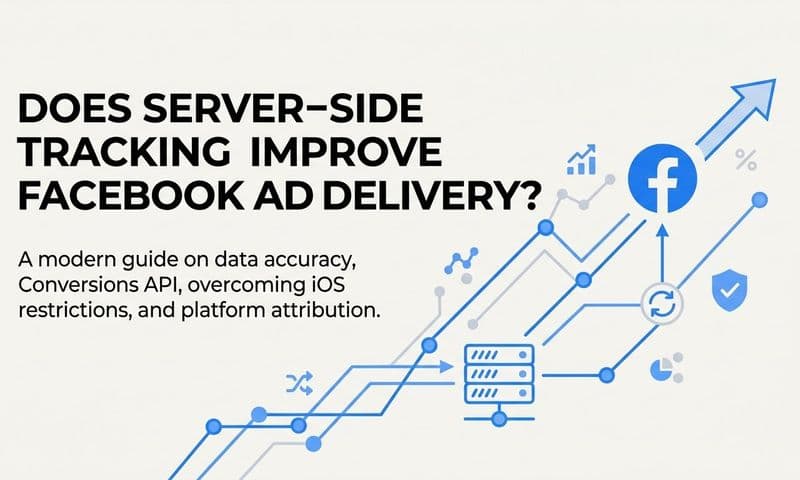
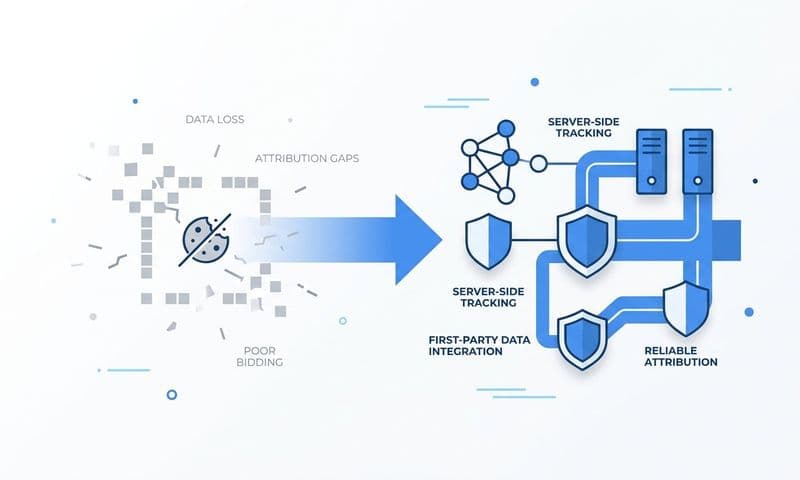
Server-side tracking via Conversion APIs: Sending conversion events from your server directly to ad platforms, rather than relying on a browser pixel, bypasses the browser-level restrictions that degrade client-side tracking. Meta's Conversion API and Google's Enhanced Conversions both work this way. Because the data travels server-to-server, it is not affected by ad blockers, Safari's tracking prevention, or cookie restrictions. Server-side events also allow you to pass hashed first-party data like email addresses, which improves event match quality significantly. This means the platform can more reliably connect the event to an actual user, improving the accuracy of both reporting and optimization. Server-side tracking is more accurate than client-side pixels and is the current industry standard for maintaining data reliability in a privacy-first environment, and running it alongside proper deduplication logic is the baseline for any accurate tracking setup.
Closed-loop attribution connecting ads to revenue: Tracking a form fill or a trial signup is not the same as tracking revenue. For B2B SaaS teams, accurate attribution requires connecting ad platform data to your CRM and your payment processor, such as Stripe. When these systems are integrated, you can trace a closed-won deal back through the sales process, through the lead stage, all the way to the specific campaign, ad set, and creative that generated the first interaction. This closes the loop that most tracking setups leave open. You stop optimizing toward proxy metrics and start optimizing toward actual pipeline and revenue.
A single source of truth across all channels: When each ad platform reports its own numbers using its own rules, you end up with conflicting data that cannot be reconciled. A unified attribution platform that ingests data from all your channels and applies consistent attribution logic solves this. Instead of comparing Meta's version of performance against Google's version, you have one dataset, one set of rules, and one view of how each channel contributed to revenue. Implementing cross-channel tracking is what makes budget decisions reliable rather than speculative.
Platforms like Cometly are built specifically to do this for B2B SaaS teams. By connecting your ad platforms, CRM, and revenue data into a single attribution layer, Cometly captures every touchpoint across the customer journey and gives you the closed-loop view that standard tracking setups cannot provide.
From Accurate Data to Decisions That Compound
Fixing your tracking is not just about having cleaner numbers. It changes what you are able to do with those numbers, and the downstream effects compound over time.
When you have reliable data across all channels, you can compare attribution models side by side and understand how different frameworks change the apparent performance of each campaign. A retargeting campaign that looks like your top performer under last-click attribution might look far less impressive under a linear model that distributes credit across the full journey. Seeing both views simultaneously gives you a more nuanced understanding of what each channel is actually contributing, which leads to more thoughtful budget allocation rather than decisions driven by whichever metric happens to look best in a given dashboard.
AI-driven insights also become meaningfully more useful when the underlying data is clean. Identifying high-performing ads, flagging campaigns that are consuming budget without driving pipeline, and surfacing scaling opportunities all depend on accurate conversion signals. When your conversion data is inflated by duplicates, degraded by pixel failures, or misattributed because of broken UTMs, AI recommendations are built on a corrupted foundation. Ad tracking tools that use accurate data are what make AI actionable rather than misleading.
There is also a compounding effect that comes from feeding enriched, verified conversion events back to ad platform algorithms. Meta and Google use the conversion signals you send them to optimize targeting and bidding. When those signals are accurate and complete, the algorithm learns which users are most likely to convert and adjusts delivery accordingly. When the signals are noisy or incomplete, the algorithm optimizes toward the wrong patterns. Better data going in means better ad delivery coming out, which means better results, which generates better data. Over time, the gap between teams running on accurate tracking and those running on broken tracking becomes significant.
The Bottom Line on Broken Ad Tracking
Wrong ad tracking is not bad luck. It is the predictable outcome of relying on browser-based pixels in an environment that has moved on from them, using attribution models that do not match your sales cycle, and running disconnected data systems that cannot talk to each other. For B2B SaaS teams, where sales cycles are long, buying committees are real, and the distance between a form fill and closed revenue can be measured in months, these structural problems are especially costly.
The fix is not a single tweak. It is a tracking architecture that uses server-side events to capture what pixels miss, connects ad data to CRM and revenue data to close the lead-to-revenue gap, and applies consistent attribution logic across all channels in one place. That is what gives marketing teams a reliable compass instead of a broken one.
Cometly is built to do exactly this for B2B SaaS companies. It connects your ad platforms, CRM, and revenue data into a single attribution layer, captures every touchpoint from first ad click to closed-won deal, and gives your team the accurate, actionable data needed to make confident budget decisions and scale what is actually working.
Ready to stop guessing and start scaling with confidence? Get your free demo today and see what your ad performance actually looks like when the data is right.