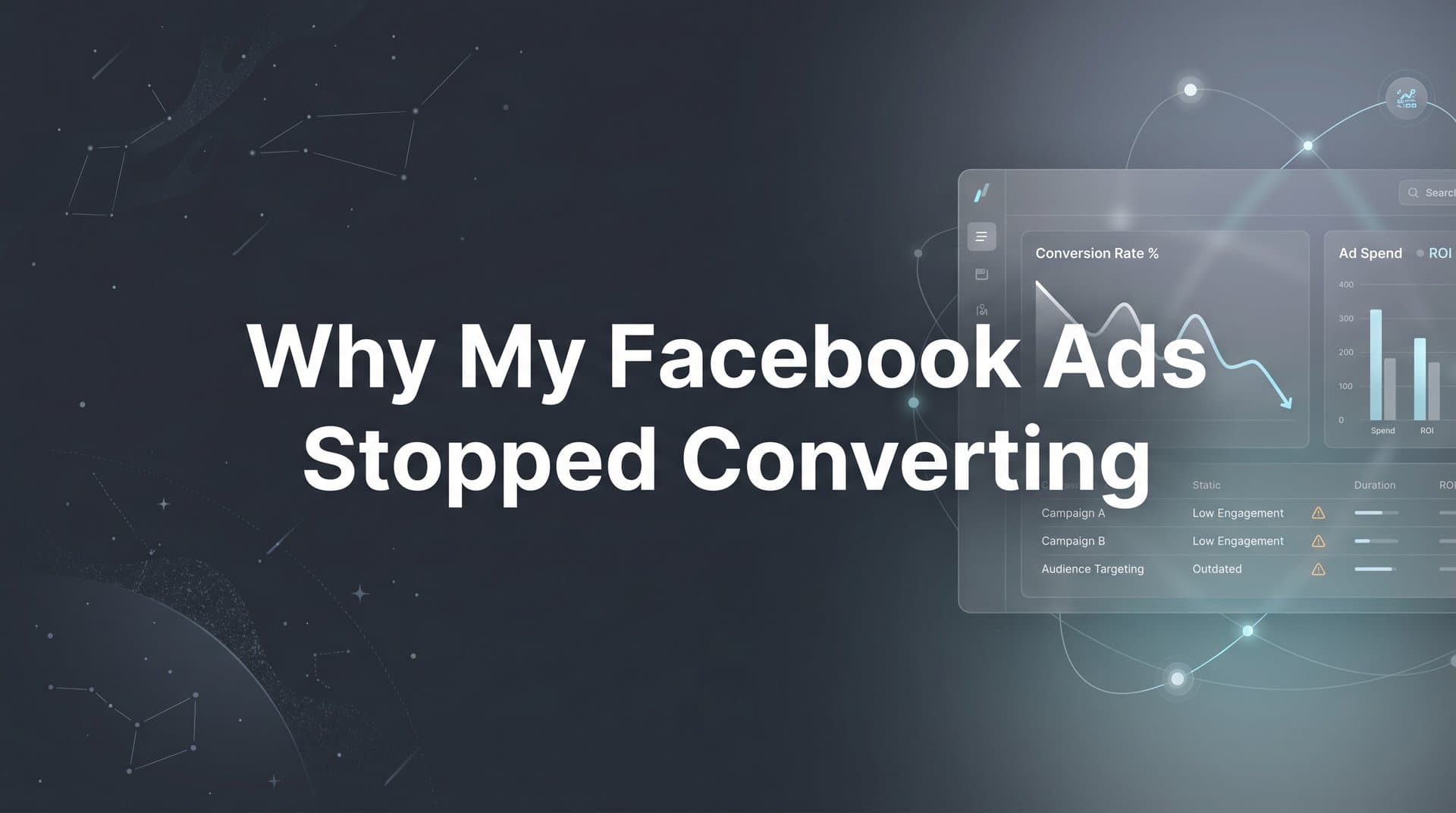
You log into Ads Manager on a Tuesday morning, coffee in hand, ready to check on the campaign that's been printing results for the past two weeks. Then you see it. Conversions: zero. Cost per acquisition: through the roof. Click-through rate: falling off a cliff. Nothing changed. You didn't touch the budget. You didn't edit the creative. Yet somehow, the campaign that was crushing it last week is completely flatlined today.
Sound familiar? This is one of the most frustrating experiences in paid advertising, and it happens to marketers at every level, from solo operators running lean budgets to agency teams managing millions in monthly spend. The instinct is usually to panic, make a bunch of changes, and hope something sticks. That approach almost always makes things worse.
Here's the good news: Facebook ads stopping converting is almost never a random event. There are specific, diagnosable causes behind every performance drop, and with the right framework, you can identify the root problem and fix it systematically. This article walks through the most common reasons why your Facebook ads stopped converting, how to spot each issue, and what to do about it. The key is accurate data and a clear head. Let's dig in.
The Silent Killer: Ad Fatigue and Creative Exhaustion
If your campaign has been running for a while without creative changes, ad fatigue is the first place to look. Ad fatigue happens when your target audience sees the same ad too many times. Engagement drops, people start ignoring or hiding the ad, and Facebook's algorithm responds by raising your costs to maintain delivery. The result is a gradual, then sudden, collapse in performance.
The metric to watch here is frequency, which measures how many times the average person in your audience has seen your ad. You can find this directly in Ads Manager by adding the frequency column to your campaign view. Many experienced media buyers treat a frequency above 3 to 4 for cold audiences as a warning sign. Once you're consistently above that threshold, you're likely paying more to show the same ad to the same people who have already decided not to convert.
The fix isn't complicated, but it does require creative discipline. Refreshing your creative doesn't mean starting from scratch every time. It means systematically testing new angles, formats, and copy variations to find combinations that re-engage your audience. If you've been running static images, test video. If you've been running long-form copy, try a punchy two-liner. If your angle has been benefit-focused, test a problem-aware hook instead. Learning how to create a successful Facebook ad with fresh angles can dramatically extend the life of a campaign.
Format diversity matters more than most marketers realize. Carousel ads let you showcase multiple products or multiple angles within a single unit. Video ads capture attention differently than static images and often perform well with audiences that have already seen your static creative. User-generated content and testimonial-style ads can feel fresh to an audience that's grown blind to polished brand creative. The goal is to give the algorithm new material to test while keeping your core message consistent.
Audience saturation compounds the problem, especially in tightly defined or small audiences. If your total audience size is under 500,000 people and you're running significant spend, you can saturate that pool faster than you expect. When frequency climbs and performance drops, broadening your audience targeting or introducing new audience segments can give the algorithm more room to find converters. Lookalike audiences based on recent purchasers, interest expansions, or Advantage+ audience settings can all help extend your reach without abandoning what's been working.
The key takeaway: monitor frequency weekly, set internal thresholds for when you'll refresh creative, and build a testing pipeline so you always have new variations ready to deploy before fatigue sets in rather than after.
Tracking Gaps That Make Winning Ads Look Like Losers
Here's a scenario that trips up even experienced advertisers. Your ads are actually driving conversions, but your Ads Manager shows almost nothing. The problem isn't the campaign. The problem is that your tracking is broken, and you're flying blind without knowing it.
Since Apple's iOS 14.5 App Tracking Transparency update rolled out in 2021, pixel-based tracking has become significantly less reliable. When users opt out of cross-app tracking on iOS devices, Facebook's pixel can no longer follow them from the ad click through to the conversion on your website. The result is that a meaningful portion of your actual conversions simply go unreported in Ads Manager. You see low conversion numbers, assume the campaign isn't working, and either cut it or make changes that disrupt what was actually performing.
Browser-based restrictions and ad blockers add to the problem. Many users run browsers that block third-party tracking scripts by default, and ad blockers prevent the pixel from firing entirely. The cumulative effect is that pixel-based tracking, which relies on a small piece of JavaScript code running in the user's browser, misses a significant share of conversions in most advertising accounts today. Understanding the full scope of Facebook ads reporting discrepancies is essential for interpreting your data correctly.
This is where the distinction between client-side and server-side tracking becomes critical. Client-side tracking, like the Facebook pixel, runs in the user's browser and is subject to all the restrictions described above. Server-side tracking, like Meta's Conversions API, sends conversion data directly from your server to Facebook's servers, bypassing the browser entirely. Because the data travels server to server, it isn't affected by browser restrictions, ad blockers, or iOS privacy settings. The result is more complete, more accurate conversion data reaching your Ads Manager.
The downstream consequences of incomplete tracking go beyond just inaccurate reporting. Facebook's algorithm relies on conversion signals to understand who is responding to your ads and to find more people like them. When conversions go unreported, the algorithm is essentially learning from incomplete information. It may start optimizing toward audiences that are easier to track rather than audiences that are actually converting. Over time, this creates a self-reinforcing problem: bad data leads to poor optimization, which leads to worse performance, which leads to even fewer conversions being reported.
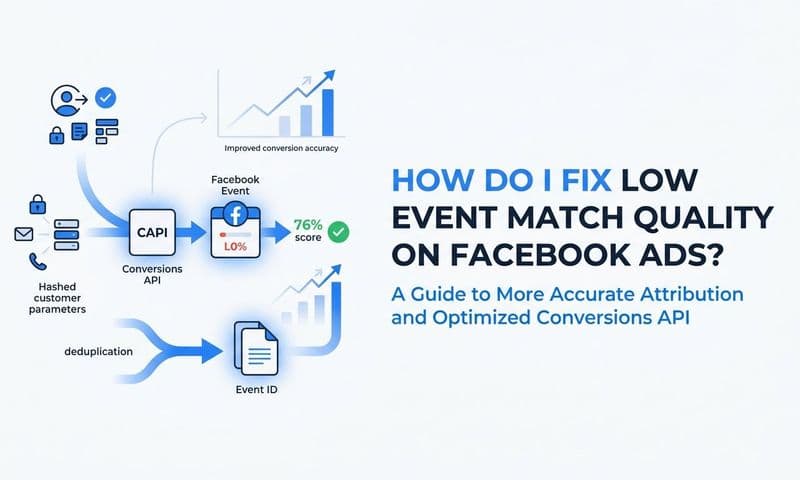
If you suspect tracking gaps are distorting your results, start by auditing your pixel implementation and checking event match quality scores in Events Manager. Then look at whether you have server-side tracking in place. If you're only relying on the pixel, you're working with partial data. Implementing a server-side solution that sends enriched conversion events, including customer data like email addresses and phone numbers that help Facebook match conversions to users, is one of the highest-leverage improvements you can make to your Facebook advertising infrastructure.
Accurate tracking isn't just about better reporting. It's about giving the algorithm the signals it needs to actually work for you.
When the Algorithm Loses Its Way: Learning Phase and Optimization Issues
Facebook's delivery algorithm is sophisticated, but it needs time and data to work properly. When it doesn't have what it needs, performance becomes volatile and unpredictable. Understanding how the learning phase works is essential for diagnosing certain types of conversion drops.
Every time you create a new ad set or make significant changes to an existing one, Facebook enters a learning phase. During this period, the algorithm is testing different audience segments, placements, and times of day to figure out how to deliver your ad most efficiently. Performance during the learning phase is often inconsistent, with costs fluctuating and conversion rates swinging. This is normal. The problem is when campaigns get stuck in the learning phase or are repeatedly reset before they can exit it. Knowing what delivery status means in Ads Manager helps you interpret these signals correctly.
Meta's guidance suggests that ad sets need roughly 50 optimization events per week to exit the learning phase and move into stable delivery. Campaigns that consistently fall below this threshold will show "Learning Limited" status in Ads Manager, which is a signal that the algorithm doesn't have enough data to optimize effectively. If your campaign is generating only a handful of conversions per week, you'll see inconsistent results almost by definition.
Frequent edits are one of the most common causes of learning phase resets. Changing your budget by more than 20 to 25 percent, swapping out creative, editing audience targeting, or adjusting your bid strategy can all trigger a reset. Each reset sends the campaign back to square one, and if you're making changes every few days in response to short-term fluctuations, you may be preventing the algorithm from ever stabilizing. The discipline here is to give campaigns enough time to generate data before intervening, even when early numbers look rough.
Choosing the wrong optimization event is another common culprit. If you're optimizing for link clicks or landing page views when your goal is purchases, you're telling the algorithm to find people who click, not people who buy. Those are often very different audiences. A deeper understanding of Facebook ads optimization can help you select the right events and bid strategies for your goals.
If conversion volume is genuinely too low to optimize for purchases, consider moving up the funnel temporarily. Optimizing for add-to-cart or initiate checkout events gives the algorithm more signal to work with while still targeting users who show buying intent. As volume grows, you can shift back to purchase optimization.
Your Landing Page Changed (Even If You Didn't Touch It)
One of the most overlooked causes of conversion drops has nothing to do with your ads at all. The problem is what happens after the click. Your landing page experience can degrade in ways that have nothing to do with your ad creative or targeting, and if you're only looking at in-platform metrics, you'll miss it entirely.
Page load speed is a major factor. If your landing page takes more than a few seconds to load on mobile, a significant portion of your traffic will bounce before they even see your offer. This can happen suddenly if a new plugin is installed, an image file size increases, or a third-party script starts loading slowly. The ad gets the click, but the landing page loses the conversion, and Ads Manager shows a performance drop with no obvious cause.
Broken forms, checkout errors, and mobile rendering issues fall into the same category. A form that doesn't submit correctly on certain devices, a checkout flow that breaks on iOS, or a page that renders poorly on smaller screens can silently kill your conversion rate. Using Facebook conversion tracking properly helps you pinpoint exactly where users are dropping off in your funnel.
External factors matter too, and they're often completely outside your control. Competitors may have introduced a stronger offer. Seasonal demand may have shifted. Market conditions may have changed in ways that affect how receptive your audience is to your message. A campaign that was converting well in a certain market context may underperform when that context changes, even with identical creative and targeting.
The discipline here is to analyze the full funnel, not just what happens inside Ads Manager. Look at your landing page analytics: what is the bounce rate, average time on page, and conversion rate from visit to action? If traffic is arriving but not converting, the problem is post-click. If traffic itself has dropped, the problem is pre-click. Separating these two questions narrows your diagnosis considerably and prevents you from making ad-level changes to solve a landing page problem.
A Step-by-Step Diagnostic Framework to Find the Real Problem
When conversions drop, the worst thing you can do is make multiple changes at once. You'll create a situation where you don't know what fixed the problem, or worse, you'll make things worse while thinking you're helping. A structured diagnostic approach lets you isolate variables and identify the actual root cause.
Step 1: Check frequency and creative metrics. Start in Ads Manager. Pull your frequency data and look at trends over the past 14 to 30 days. Is frequency climbing? Has your click-through rate been declining even as impressions hold steady? These are signs of creative fatigue. Also check your relevance diagnostics: quality ranking, engagement rate ranking, and conversion rate ranking. Reviewing your Facebook marketing metrics holistically gives you a clearer picture of what's degrading.
Step 2: Verify tracking and conversion data accuracy. Open Events Manager and check your pixel health and event match quality. Are events firing correctly? Is your event match quality score above 6 out of 10? If you're not running server-side tracking, this is the moment to seriously evaluate it. Compare your Ads Manager conversion data against your website analytics or CRM data. If there's a large discrepancy, tracking gaps are likely distorting your results.
Step 3: Review algorithm status and optimization events. Check whether your ad sets show "Learning" or "Learning Limited" status. Review your optimization event and confirm it matches your actual conversion goal. Look at your weekly conversion volume per ad set and assess whether you're meeting the threshold needed for stable delivery. If you've made recent edits, note when they happened and whether the performance drop correlates with those changes.
Step 4: Audit landing page performance and full-funnel metrics. Pull your landing page data from your website analytics tool. Check load times, bounce rates, and on-page conversion rates. Test the page yourself on mobile and on different browsers. If you're running a checkout flow, walk through it end to end to check for friction or errors.
This is also where multi-touch attribution becomes valuable. A conversion drop in Facebook Ads Manager doesn't always mean conversions have stopped. Sometimes, users are converting through other touchpoints, and those conversions are being credited elsewhere. Understanding Facebook ads attribution gives you a complete picture of the customer journey, showing whether Facebook is still influencing conversions even if it's not receiving last-click credit. Without this visibility, you may cut campaigns that are actually contributing to revenue.
The goal of this diagnostic process is a single source of truth: a unified view of your ad platform data, website behavior, and CRM outcomes that lets you pinpoint exactly where the breakdown is happening. When you have that, the fix becomes obvious.
Feeding Better Data Back to Facebook for Stronger Results
Once you've diagnosed the problem, there's a longer-term opportunity worth addressing: building the kind of data infrastructure that prevents these conversion drops from becoming recurring crises.
The most impactful thing you can do for Facebook ad performance is improve the quality of the conversion signals you send back to the platform. Facebook's algorithm is only as good as the data it learns from. When you send enriched, accurate conversion events through a server-side integration, including customer attributes like hashed email addresses and phone numbers, you help Facebook match more conversions to the users who actually took action. Better matching means the algorithm has a clearer picture of who your best customers are, which means it can find more of them.
This is the mechanism behind Meta's Conversions API and why advertisers who implement it well often see improved campaign performance over time, not just more accurate reporting. Investing in robust Facebook ads tracking platforms ensures the algorithm learns from better data and optimizes more effectively, which creates a compounding advantage as your campaigns mature.
AI-powered ads optimization tools take this further by surfacing patterns across your entire marketing data set that would be difficult or impossible to spot manually. Instead of reviewing dozens of metrics across multiple campaigns and trying to draw conclusions from raw numbers, you can get recommendations that identify which campaigns are genuinely driving revenue, which audiences are showing signs of saturation, and where budget should be reallocated to maximize return. This removes a significant amount of guesswork from the recovery process and from ongoing campaign management.
The long-term approach is about building consistency. Conversion drops often happen because tracking is fragile, creative pipelines are reactive rather than proactive, and data is siloed across platforms that don't communicate with each other. When your ad platform data, website analytics, and CRM are connected in a single view, you can see the full customer journey and catch problems early, before they become full-scale performance crises.
Marketers who invest in this infrastructure spend less time firefighting and more time scaling what works. That's the real competitive advantage: not just fixing the problem in front of you, but building a system that makes future problems easier to catch and correct.
Putting It All Together
If your Facebook ads have stopped converting, take a breath. This is a diagnosable, fixable problem. The mistake most marketers make is treating a performance drop as a single issue when it's almost always one of several distinct causes: creative fatigue, tracking gaps, algorithm disruption, or post-click friction. Each requires a different solution, and making the wrong fix wastes time and budget.
Start with the diagnostic framework. Check your frequency and creative metrics. Audit your tracking setup and compare in-platform data against your actual conversion records. Review your algorithm status and optimization events. Then look beyond the ad and evaluate your landing page and full-funnel performance. Work through each variable systematically before making changes.
Once you've identified the root cause, invest in the infrastructure that prevents the problem from recurring. Implement server-side tracking to capture conversions that the pixel misses. Build a creative testing pipeline so you're never caught flat-footed by fatigue. Use multi-touch attribution to understand the real contribution of each channel. And connect your data sources so you have a single, accurate view of what's driving revenue.
Cometly is built for exactly this kind of work. It captures every touchpoint across your customer journey, from ad click to CRM event, and feeds enriched conversion data back to platforms like Facebook and Google to improve algorithm performance. Its AI-powered recommendations help you identify which campaigns to scale and which to cut, without the guesswork. If you're tired of diagnosing performance drops in the dark, Get your free demo today and start building the attribution infrastructure your ad strategy deserves.