ABM promises something most B2B SaaS marketers desperately want: focused resources, tighter sales and marketing alignment, and higher returns from a defined list of target accounts. The pitch is compelling. The execution, however, is where things get complicated.
The biggest gap between ABM theory and ABM reality is not strategy. It is visibility. Most teams running account based marketing programs cannot actually see the full picture of how their target accounts move from first touch to closed-won. They have fragments: a CRM record here, a LinkedIn campaign report there, a handful of email clicks in their marketing automation tool. But the complete account journey? That remains frustratingly out of reach.
Here is why that matters. Unlike traditional demand generation, the account based marketing customer journey is not a straight line. It involves multiple stakeholders at the same account, each consuming different content across different channels, often at different times. A CFO might engage with a thought leadership ad on LinkedIn while a VP of Engineering is reading a technical blog post and a Director of Operations is watching a product demo video. All three interactions belong to the same account journey. But if your tracking infrastructure cannot connect those dots, you are flying blind.
This article is a practical explainer for B2B SaaS marketers who want to understand how the ABM customer journey actually works, how to map it across channels, and how to measure it with the precision that modern attribution tools make possible. We will walk through the four stages of an ABM journey, the attribution challenges that break most measurement approaches, and what it looks like to build a truly measurable ABM engine from the ground up.
Why the ABM Journey Looks Nothing Like Traditional Marketing Funnels
Traditional demand generation is built around individual leads. Someone fills out a form, enters your funnel, and moves through a sequence of stages until they convert or churn out. The tracking model is person-centric: one email address, one cookie, one journey.
ABM works on an entirely different logic. Instead of tracking individual leads, you are tracking buying committees, typically five to ten stakeholders at a single target account, each with distinct roles, motivations, and information needs. The economic buyer cares about ROI and risk. The technical evaluator wants to know about integrations and security. The end user wants to understand workflow impact. And procurement wants to talk about contract terms.
Each of these stakeholders will interact with your brand in different ways and through different channels. That means the account journey is not a single path. It is a web of parallel touchpoints happening simultaneously across multiple people, all of which ultimately feed into one buying decision.
This multi-stakeholder reality creates an immediate problem for standard analytics tools. Most of those tools were designed to track individual users, not accounts. When a CFO clicks a LinkedIn ad and a VP of Engineering reads a blog post, those interactions appear as two separate, unrelated user sessions in your analytics platform. There is no connection drawn between them. The account-level story is invisible.
The implications for attribution are significant. If you are relying on last-click attribution, you are crediting only the final touchpoint before conversion. In an ABM context, that might be a sales call or a demo request. Every earlier interaction, the awareness campaigns, the content engagement, the retargeting ads that kept your brand visible across the buying committee, receives zero credit. You end up with a deeply distorted picture of what actually influenced the deal.
This is not just a measurement inconvenience. It is a strategic problem. When attribution models misrepresent what drove a deal, budget decisions follow the wrong signals. Teams cut top-of-funnel ABM spend because it appears to produce no results, not realizing that those early touchpoints were essential to warming up the buying committee before the sales team ever made contact.
Getting ABM measurement right starts with accepting that the journey is account-level, not person-level. Every touchpoint across every stakeholder needs to be connected to a single account view. That is the foundation on which accurate attribution is built.
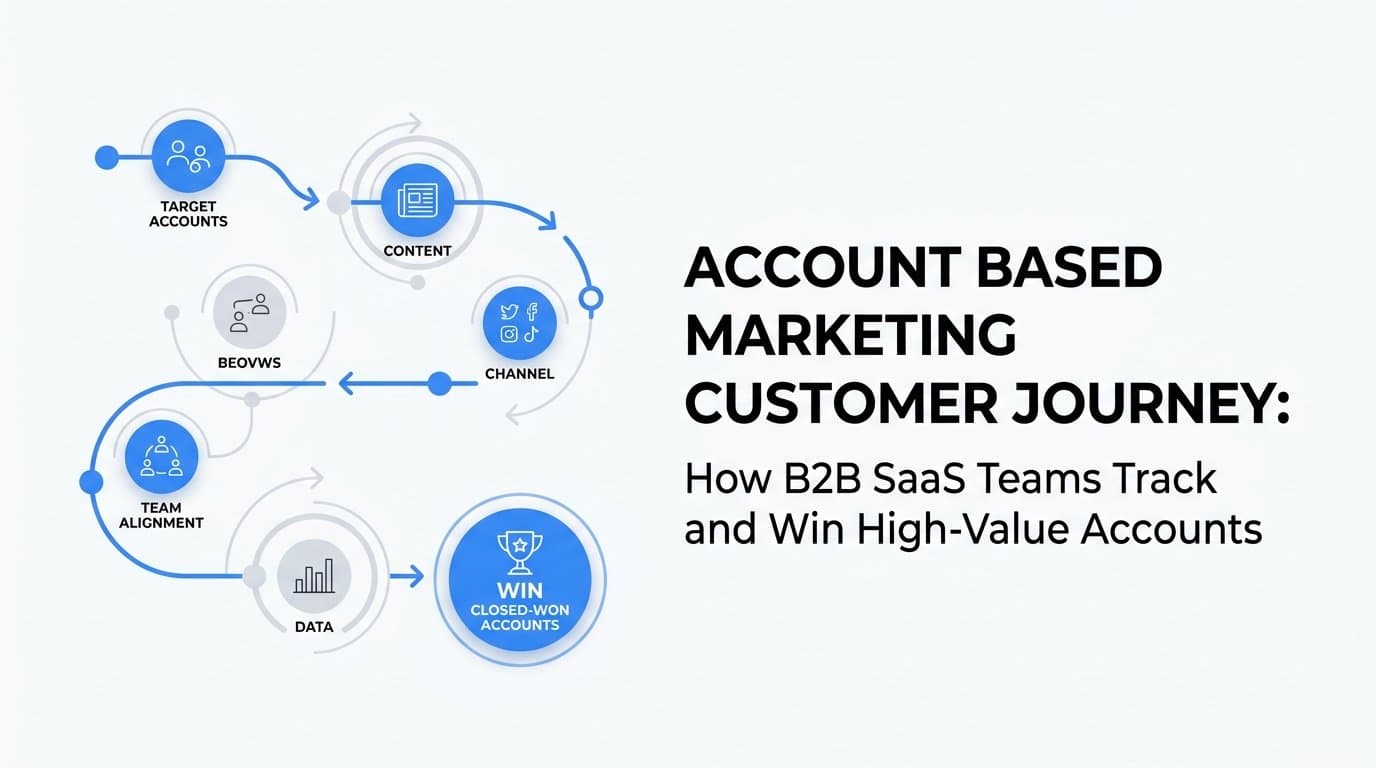
The Four Stages of an ABM Customer Journey
While the ABM journey is non-linear in practice, it is useful to think about it in four broad stages. Understanding these stages helps you design the right touchpoints, allocate budget appropriately, and know what signals to look for at each phase.
Stage 1: Identification and Awareness
The ABM journey begins before the target account knows you exist. Your team identifies high-fit accounts based on ICP criteria: company size, industry, tech stack, growth signals, and other firmographic or behavioral data. Once the account list is defined, the goal is to create brand presence across the channels where your target stakeholders spend time.
At this stage, touchpoints are primarily outbound and paid: LinkedIn ads targeting specific job titles at named accounts, display retargeting, cold outreach sequences, and content syndication. The account has not raised its hand yet. You are planting seeds. Measuring this stage requires tracking ad impressions and early engagement signals at the account level, not just individual clicks.
Stage 2: Engagement and Education
Something shifts. Stakeholders within the target account begin actively engaging with your content. They click on ads, visit your website, download resources, attend a webinar, or respond to a sales sequence. These are intent signals, and they indicate that the account is moving from passive awareness into active consideration.
This stage often involves multiple stakeholders engaging in parallel, sometimes with very different content. Your job is to nurture each persona with relevant messaging while ensuring that all of that engagement is being captured and connected at the account level. This is where many tracking setups start to break down.
Stage 3: Evaluation and Consideration
The buying committee is now actively comparing solutions. This stage typically involves the highest density of touchpoints: demo requests, product walkthroughs, pricing conversations, procurement reviews, and competitive research. Stakeholders are visiting your site repeatedly, sharing content internally, and asking detailed questions.
From an attribution perspective, this is also the stage where last-click models do the most damage. The final touchpoint before a demo request might be a direct visit to your pricing page, which tells you almost nothing about the campaign or channel that generated the original interest weeks earlier.
Stage 4: Decision and Expansion
The account converts. But the ABM journey does not end at closed-won. Post-sale touchpoints feed expansion revenue, upsell conversations, and renewal signals. A complete ABM measurement framework captures what happens after the initial deal closes, connecting marketing activity to expansion pipeline and long-term account value. Teams that track only to the initial conversion are leaving significant revenue insight on the table.
Mapping Touchpoints Across Every Channel in Your ABM Program
One of the most practical challenges in ABM is that the customer journey spans a wide range of channels, and those channels rarely talk to each other by default. Building a complete picture requires deliberately mapping every touchpoint type and ensuring each one feeds into a unified account view.
Paid Channels: LinkedIn Ads is the dominant paid channel for most ABM programs because of its ability to target by company, job title, and seniority. Google Ads and display retargeting add reach across the web, keeping your brand visible as stakeholders research solutions outside of LinkedIn. These paid channels generate awareness and mid-funnel engagement touchpoints that are often completely invisible in CRM-only reporting. If your sales team closes a deal and the CRM shows only the demo request as the origin, all of the paid channel activity that preceded it goes uncredited.
Owned Channels: Email sequences, gated content, product demos, and webinars generate high-intent signals that sit in the middle and bottom of the ABM funnel. A stakeholder who downloads a technical whitepaper and then attends a live demo is showing strong purchase intent. But these owned channel interactions only become actionable for attribution when they are tied back to the originating campaign or ad that first brought that stakeholder to your content. Without that connection, you cannot answer the question of which paid investment drove the most engaged prospects.
Sales-Assisted and Offline Touchpoints: Direct outreach calls, field events, executive dinners, and partner referrals are all part of the ABM journey for many B2B SaaS companies. These interactions happen outside of any digital tracking system, which means they can create significant gaps in your account journey data. Connecting these offline and sales-assisted touchpoints to your digital data requires deliberate process design: logging calls and meetings in CRM with campaign context, tagging event attendees to specific ABM programs, and ensuring that sales reps are capturing the source of their conversations.
The goal of mapping all of these touchpoints is not just completeness for its own sake. It is about creating a single account journey timeline that shows every meaningful interaction, across every channel and every stakeholder, in the sequence it actually occurred. That timeline is what makes it possible to understand which combinations of touchpoints are most effective at moving target accounts forward.
Attribution Challenges That Break ABM Measurement
Even teams with strong ABM strategies often struggle with measurement. The attribution challenges in ABM are real, and they compound on each other in ways that can make the data feel hopelessly fragmented.
Cross-Stakeholder Identity Resolution: Cookie-based tracking assigns a unique identifier to each browser session. When five different stakeholders at the same account visit your website from five different devices, your analytics tool sees five unrelated users. There is no mechanism to stitch those sessions together into a single account journey. This means that the collective engagement of a buying committee is invisible, and campaigns that influenced multiple stakeholders receive no credit for their cumulative impact.
Long Sales Cycle Attribution Windows: B2B SaaS sales cycles can span many weeks or months. A first-touch LinkedIn ad that generated initial awareness in January might not result in a closed deal until April. Under last-click attribution, that January ad receives zero credit. The entire budget that funded top-of-funnel ABM awareness appears to have produced nothing. This distortion causes teams to underinvest in the early-stage touchpoints that are essential for warming up buying committees before sales engagement begins.
Degraded Conversion Signals: Browser-based pixel tracking has become less reliable as privacy regulations tighten and browsers restrict third-party cookies. When your conversion signals are incomplete, ad platforms like Meta and Google receive degraded data about which accounts and individuals are converting. Their targeting algorithms then optimize toward the wrong audiences, reducing the efficiency of your ABM campaigns. You end up paying more to reach less relevant stakeholders.
The solution to this last challenge is server-side tracking. By sending conversion events directly from your server to ad platforms via Conversion API integrations, you bypass the browser entirely. The signal is cleaner, more complete, and more accurate. Ad platforms receive the data they need to optimize toward your actual ABM audiences, which improves targeting precision and reduces wasted spend.
These three challenges are interconnected. Fragmented identity data leads to incomplete journey records. Incomplete journey records make long-cycle attribution inaccurate. Inaccurate attribution produces degraded signals that weaken ad platform performance. Solving ABM measurement means addressing all three, not just one.
How to Track the Full ABM Journey with Multi-Touch Attribution
Multi-touch attribution is the measurement approach designed for exactly this kind of complexity. Rather than assigning all credit to the first or last touchpoint, multi-touch models distribute credit across every interaction in the account journey. This gives you a far more accurate view of which channels and campaigns actually contributed to moving a deal forward.
Think about what this looks like in practice. A target account might interact with your brand through a LinkedIn awareness ad, a retargeting display ad, a gated content download, a webinar attendance, a sales outreach sequence, and a product demo before converting. Under last-click attribution, only the demo gets credit. Under a multi-touch model, credit is distributed across all six touchpoints in proportion to their role in the journey. You can then see that LinkedIn awareness ads consistently appear in the journeys of accounts that eventually convert, even if they are never the last touchpoint.
Closing the Loop Between Ad Spend and Revenue: Multi-touch attribution only delivers its full value when ad platform data is connected to CRM pipeline and revenue data. Without that connection, you can see which campaigns generate clicks and form fills, but you cannot see which campaigns generate pipeline or closed-won revenue. Closing that loop allows you to calculate true ROI at the campaign and account level: cost per pipeline opportunity, cost per closed deal, and return on ad spend tied to actual revenue rather than proxy metrics.
Improving Ad Platform Performance with Enriched Signals: Sending enriched, first-party conversion events back to ad platforms via Conversion API integration does more than improve attribution accuracy. It also feeds better data into the targeting algorithms that power your ABM campaigns. When Meta or Google understands which types of accounts and stakeholders are actually converting, they can optimize your campaigns to reach more of them. This creates a compounding effect: better data leads to better targeting, which leads to more efficient spend, which generates more high-quality account engagement to feed back into the attribution model.
Implementing multi-touch attribution for ABM requires an infrastructure that can track at the account level, connect data across channels and systems, and present the full journey in a way that both marketing and sales teams can act on. That infrastructure is not optional. It is the foundation of any ABM program that wants to scale with confidence rather than guesswork.
Building a Measurable ABM Engine
All of the concepts covered in this article point toward a single practical goal: building an ABM program where every dollar of spend is connected to a measurable outcome, and every team member is working from the same account journey data.
That starts with a single source of truth. When ad spend data, web behavior, CRM events, and revenue data all live in separate tools, you end up with competing versions of reality. Marketing reports one set of numbers. Sales reports another. Leadership has to reconcile them manually before making any decision. A unified attribution platform eliminates that friction by pulling all of those data sources into one account-level view that everyone can trust.
The next layer is speed. ABM optimization should not wait for end-of-quarter reviews. AI-driven analytics can surface real-time insights about which campaigns and channels are generating pipeline from target accounts, which content types are driving the most engagement among buying committee members, and where accounts are stalling in the journey. That kind of visibility allows teams to shift budget toward what is working within days, not months.
This is exactly what Cometly is built to do for B2B SaaS teams running ABM programs. Cometly connects your ad platforms, CRM, and website to track every touchpoint across the full account journey in real time. Its multi-touch attribution models show you which campaigns are actually driving pipeline and revenue, not just clicks. Server-side conversion tracking and Conversion API integration ensure that your ad platforms receive clean, enriched signals to optimize toward your highest-value accounts. And AI-driven recommendations surface the insights your team needs to make faster, more confident optimization decisions.
With Cometly, the account based marketing customer journey stops being a black box and becomes a clear, measurable picture of exactly how your target accounts move from first ad impression to closed-won revenue.
The Bottom Line on ABM Journey Measurement
The account based marketing customer journey is inherently complex. Multiple stakeholders, long sales cycles, and fragmented channel data create measurement challenges that simpler demand gen programs never face. But that complexity is not a reason to accept poor visibility. It is a reason to invest in the right attribution infrastructure.
The four stages of the ABM journey, from identification and awareness through engagement, evaluation, and expansion, each generate distinct touchpoints that need to be captured, connected, and credited accurately. Multi-touch attribution is the model that makes that possible. And server-side tracking, first-party data enrichment, and CRM-to-revenue connection are the technical foundations that make multi-touch attribution reliable in real-world ABM conditions.
When your team can see the full account journey, you can make smarter decisions about where to invest, which campaigns to scale, and which channels are genuinely moving your most valuable accounts forward. That is the difference between an ABM program that feels productive and one that demonstrably is.
Ready to elevate your marketing game with precision and confidence? Discover how Cometly's AI-driven recommendations can transform your ad strategy. Get your free demo today and start capturing every touchpoint to maximize your conversions.