
Broad campaigns feel productive. They generate impressions, clicks, and a steady stream of leads filling up your CRM. But if you're a B2B SaaS marketer, you've probably noticed something frustrating: most of that activity doesn't translate into pipeline. You're generating noise, not revenue.
This is the core tension that account based marketing (ABM) was built to solve. Instead of casting a wide net and hoping the right fish swim in, ABM flips the model entirely. You identify the accounts most likely to become high-value customers, then build every campaign, message, and touchpoint around engaging those specific organizations and the people within them.
ABM has become a dominant approach for growth-focused B2B SaaS teams because it aligns with how enterprise buying actually works: multiple stakeholders, extended sales cycles, and decisions made by committees rather than individuals. Broad demand generation strategies weren't designed for that reality. ABM is.
This article is a practical guide to implementing and measuring ABM as a B2B SaaS marketing strategy. We'll walk through how the model works, which channels and tactics drive results, how to measure performance beyond surface-level metrics, and how to build the infrastructure that makes ABM both scalable and attributable. Let's get into it.
The Shift From Lead Volume to Account Intelligence
Traditional demand generation is built around a simple premise: generate as many leads as possible, qualify them, and pass the good ones to sales. It's a volume game. And for a certain kind of business, it works reasonably well.
For B2B SaaS companies with complex products, longer sales cycles, and higher average contract values, it often doesn't. Here's why: when your ideal customer profile is narrow and your sales process involves multiple stakeholders and months of evaluation, flooding your pipeline with low-fit leads creates more problems than it solves. Sales teams spend time chasing contacts who were never going to buy. Marketing celebrates MQL volume while sales complains about lead quality. The two teams end up misaligned, optimizing for different definitions of success.
ABM reframes the fundamental goal. Instead of generating contacts, the objective becomes engaging entire buying committees within a defined set of target accounts. You're not trying to attract anyone who might be interested. You're trying to reach the right people at the right companies with messaging that speaks directly to their situation.
This shift has a profound effect on how marketing resources are allocated. Rather than spreading budget across broad audiences and hoping for conversion, ABM concentrates effort on accounts that fit your ICP, have the right company characteristics, and show signals of buying readiness. Every dollar of ad spend, every piece of content, and every sales outreach is pointed at a specific target.
The core principle is straightforward: identify the right accounts first, then build campaigns around them. This sounds simple, but it requires a different kind of marketing infrastructure. You need account-level data, not just contact-level data. You need to understand who the buying committee is at each target account, what their priorities are, and where they spend their attention. You need sales and marketing working from the same account list with a shared definition of what success looks like.
For B2B SaaS teams that make this shift, the payoff is significant. Pipeline quality improves because you're only engaging accounts that fit your ICP. Sales cycles can shorten because marketing has already warmed up the buying committee before the first sales conversation. And revenue attribution becomes cleaner because you're tracking engagement at the account level, not just the individual contact level.
The challenge is that ABM demands more precision than traditional demand generation. Sloppy targeting, weak ICP definition, or poor sales and marketing alignment will undermine the entire strategy. That's why understanding how ABM actually works, from the ground up, is essential before investing in execution.
How Account Based Marketing Actually Works
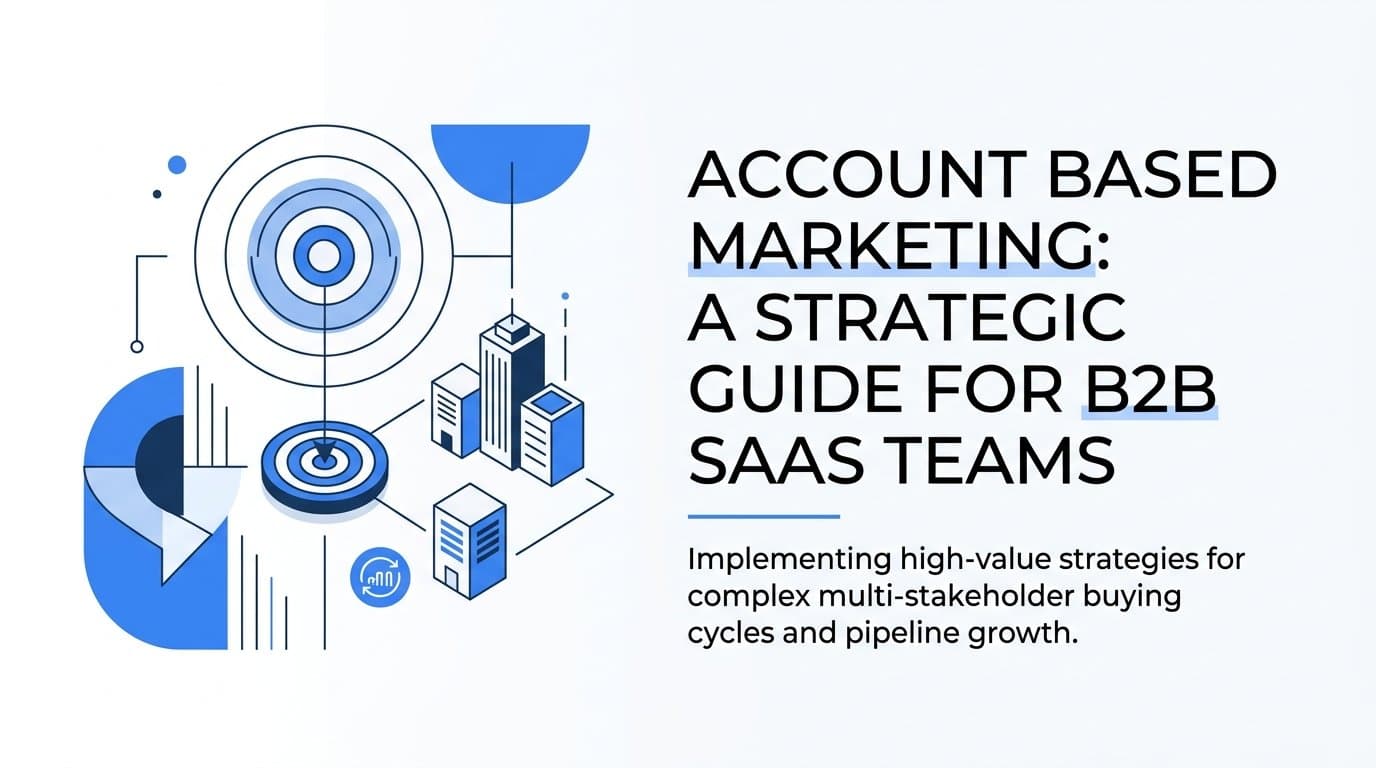
ABM isn't a single tactic. It's a strategic framework that can be applied at different levels of personalization depending on the size and strategic importance of your target accounts. Understanding the three-tier model is the starting point for any ABM program.
One-to-one (Strategic ABM): This is the most resource-intensive tier, reserved for your highest-value, most strategic target accounts. Each account gets a fully customized experience: bespoke content, personalized outreach, dedicated sales resources, and campaigns built specifically around that organization's challenges and priorities. This approach makes sense when a single account could represent significant contract value and warrants the investment.
One-to-few (ABM Lite): Here, you cluster accounts that share common characteristics, typically in the same industry, segment, or facing similar challenges, and build campaigns tailored to that cluster. The personalization isn't as deep as one-to-one, but it's far more targeted than broad demand generation. This tier works well for mid-market accounts where you want meaningful personalization without the overhead of fully bespoke campaigns.
One-to-many (Programmatic ABM): This is ABM at scale, using paid advertising and automation to serve targeted content and ads to a larger list of accounts that fit your ICP. The personalization is lighter, but the targeting is still account-specific rather than demographic. This tier is effective for top-of-funnel awareness and account warming across a broader set of potential customers.
Underneath all three tiers is a strong ideal customer profile. Most B2B SaaS companies have an ICP that covers firmographics: company size, industry, geography, revenue. But effective ABM requires going deeper. Behavioral signals matter. Is the account actively researching solutions like yours? What does their tech stack tell you about their sophistication and current tooling? Are there intent signals suggesting a buying cycle is underway?
Intent data platforms can surface accounts that are consuming content related to your category, even before they've engaged with your brand directly. Layering this onto firmographic fit gives you a much sharper picture of which accounts to prioritize at any given time.
Sales and marketing alignment is not optional in ABM. It's structural. Both teams need to be working from the same account list, coordinating outreach so that sales conversations and marketing touchpoints reinforce each other rather than creating a disjointed experience. Shared success metrics are critical: pipeline influenced by ABM activity, account engagement scores, and deal velocity matter more than MQL volume.
The mechanics of alignment typically involve regular account reviews where sales and marketing assess which accounts are engaging, which are stalling, and where to focus resources. When this coordination works well, marketing is accelerating accounts that sales is already working, and sales is following up on accounts that marketing has warmed up. The two motions become one.
The Channels and Tactics That Drive ABM Results
Knowing which accounts to target is only half the equation. The other half is reaching them effectively across the channels where they actually spend their attention. ABM isn't limited to a single channel, and the most effective programs combine multiple touchpoints into a coordinated engagement plan.
Paid advertising is one of the most powerful tools in the ABM toolkit because modern ad platforms allow you to serve ads to specific companies and job titles. LinkedIn is particularly well-suited for B2B ABM because its targeting capabilities let you define audiences by company name, job function, seniority level, and industry. You can upload a target account list and serve ads exclusively to people who work at those organizations, ensuring your budget reaches the buying committee you care about rather than a broad audience.
Google and Meta also play a role in ABM paid strategies. Google allows you to target audiences based on intent signals, reaching prospects who are actively searching for solutions in your category. Meta, with its large user base and sophisticated audience matching, can be effective for retargeting and awareness campaigns that keep your brand visible to contacts at target accounts even outside of professional contexts.
Content personalization at the account level is what separates ABM from standard paid advertising. When a contact from a target account clicks an ad and lands on a generic product page, you've lost the personalization advantage. Effective ABM programs tailor landing pages, ad creative, and outreach messaging to reflect the specific context of the buying committee they're targeting. This might mean referencing the prospect's industry, their likely pain points, or even specific challenges common to companies at their stage of growth.
Email sequences and direct sales outreach need to be coordinated with paid campaigns. If a target account has been seeing your LinkedIn ads for two weeks, the sales email that follows should acknowledge that context, not arrive cold. This is where multi-channel orchestration becomes important: the goal is to create a coherent experience across every touchpoint so that each interaction reinforces the others.
Direct mail has also made a comeback in ABM programs, particularly for high-value one-to-one accounts. A well-timed physical package can cut through digital noise in a way that another email simply cannot. When combined with a coordinated digital campaign, it adds a memorable dimension to the account engagement plan.
The underlying principle across all channels is consistency and coordination. Each touchpoint should feel like part of a single, intentional conversation with the target account, not a series of disconnected marketing activities. That requires planning, sequencing, and a clear view of what each channel is contributing to the overall account engagement journey.
Measuring ABM Performance: Beyond Clicks and Impressions
One of the biggest mistakes ABM practitioners make is measuring their programs with the same metrics they used for traditional demand generation. Click-through rates, impression volume, and MQL counts are not useful indicators of ABM success. They measure activity, not impact. And in ABM, the impact you care about is pipeline and revenue, not engagement metrics.
The metrics that actually matter in ABM operate at the account level. Account engagement score tracks how actively a target account is interacting with your brand across channels: ad views, content downloads, website visits, email opens, and sales interactions. A rising engagement score across multiple contacts within a target account is a meaningful signal that the buying committee is warming up.
Pipeline influenced is another critical metric. This measures the dollar value of opportunities in your pipeline that have had meaningful contact with ABM campaigns. It's a way of attributing marketing activity to revenue outcomes without requiring marketing to claim sole credit for deals that sales also worked hard to close.
Deal velocity, the speed at which target accounts move through your pipeline stages, is a useful indicator of whether ABM is doing its job. If accounts that have been engaged through your ABM program are moving faster than accounts that weren't, that's evidence that your campaigns are shortening the sales cycle.
The attribution challenge in ABM is real and worth addressing directly. Buying committees involve multiple people, and each person may interact with your brand through different channels over an extended period. Last-click attribution, which assigns credit to the final touchpoint before a conversion, is particularly misleading in this context. It systematically undervalues the early-stage touchpoints that built awareness and trust long before a prospect was ready to talk to sales.
Multi-touch attribution models are far more appropriate for ABM measurement. They distribute credit across all the touchpoints that contributed to a conversion, giving you a more accurate picture of which channels and campaigns are actually influencing pipeline. Linear attribution, time-decay models, and data-driven attribution each have their place depending on your sales cycle length and the complexity of your buying committee.
The ultimate measurement goal in ABM is connecting campaign activity to closed-won revenue. This means tracking the full customer journey from the first ad impression a contact at a target account sees, through every subsequent touchpoint, to the signed contract. That kind of end-to-end visibility requires more than a standard analytics setup. It requires a purpose-built attribution infrastructure that can handle account-level tracking across multiple contacts, channels, and time periods.
Without this infrastructure, you're making budget decisions based on incomplete information. You might cut a channel that was actually warming up key accounts early in the funnel, simply because it didn't show up in last-click reports. Or you might over-invest in a channel that generates visible engagement but doesn't actually influence pipeline. Accurate attribution is what separates informed optimization from expensive guesswork.
Building the Tech Stack That Makes ABM Measurable
ABM execution without the right technology is like running a precision campaign with blunt instruments. The good news is that the core tools needed for effective ABM are well-established. The challenge is making them work together in a way that gives you a coherent, account-level view of what's happening across your entire program.
Intent data platforms are often the starting point. These tools monitor content consumption patterns across the web and surface accounts that are actively researching topics related to your category. When an account that fits your ICP starts showing intent signals, that's your cue to activate targeted campaigns and alert your sales team. Intent data transforms your target account list from a static spreadsheet into a dynamic, signal-driven prioritization engine.
Your CRM is the connective tissue of your ABM program. It's where account and contact data lives, where pipeline stages are tracked, and where sales activity is recorded. For ABM to work, your CRM needs to be clean, well-structured at the account level, and integrated with your marketing tools so that engagement data flows in both directions.
Ad platforms, particularly LinkedIn, Google, and Meta, handle the paid activation layer. But their native reporting has significant limitations for ABM measurement. Platform-reported metrics are siloed, don't account for cross-channel influence, and can't tell you which ad impressions contributed to a deal that closed six months later. That's where attribution software becomes essential.
Server-side tracking and first-party data are increasingly important in this context. As third-party cookies continue to lose reliability, ABM programs that depend on cookie-based tracking are seeing data gaps that distort their measurement. Server-side tracking sends event data directly from your server to ad platforms and analytics tools, bypassing browser-level limitations and ensuring that conversion events are captured accurately. This is particularly important for ABM because you're tracking long buying journeys where any gap in data can misrepresent which touchpoints actually mattered.
A marketing attribution platform ties the entire stack together. Platforms like Cometly connect your ad spend across LinkedIn, Google, Meta, and other channels to your CRM pipeline and revenue data, giving you a single source of truth for ABM ROI. Instead of reconciling reports from five different tools, you get a unified view of which campaigns are influencing which accounts, how much pipeline has been created, and what the revenue impact of your ABM investment actually is.
This kind of end-to-end visibility is what enables confident budget decisions. When you can see that a specific LinkedIn campaign targeting a cluster of mid-market accounts has influenced a meaningful portion of your pipeline, you have the evidence to scale that campaign. When a channel isn't showing up in pipeline attribution despite generating clicks, you have the data to reallocate that budget elsewhere.
Scaling ABM With Data-Driven Decisions
Getting an ABM program off the ground is one challenge. Scaling it intelligently is another. The difference between teams that plateau and teams that compound their ABM results over time usually comes down to how well they use data to make decisions about where to focus next.
The first priority is identifying which target accounts are actually engaging and which campaigns are driving that engagement. Account engagement scores give you a real-time view of where momentum is building. If a cluster of accounts in a specific industry segment is showing rising engagement scores while another cluster is flat, that's a signal to shift budget and attention toward where traction is happening.
Pipeline influence data tells you which campaigns are actually contributing to revenue outcomes. This is different from engagement: an account can engage heavily with your content without ever entering serious buying conversations. Pipeline influence connects the dots between marketing activity and sales outcomes, showing you which channels and messages are moving accounts through the funnel rather than just generating surface-level interaction.
AI-driven insights are increasingly useful at this stage. Modern attribution platforms can analyze patterns across your account data to surface which ads are performing best, which account segments are most receptive, and which signals predict buying readiness. This kind of analysis would take a data analyst weeks to produce manually. AI surfaces it continuously, giving your team the ability to act on insights in near real time.
There's also a feedback loop worth understanding. When your attribution platform sends enriched conversion data back to your ad platforms, those platforms can use it to improve their own targeting algorithms. Meta and Google's optimization engines work better when they receive accurate, event-level data about which ad interactions led to real pipeline and revenue. By feeding your ad platforms better data, you improve their ability to find more accounts that look like your best customers. Over time, this compounds: better data leads to better targeting, which leads to better results, which generates more data to learn from.
Scaling ABM also means knowing when to expand your target account list and when to go deeper with existing accounts. If your program is generating strong pipeline from a specific ICP segment, that's a signal to add more accounts that fit that profile. If a high-priority account has been engaging but hasn't entered a sales conversation, that's a signal to increase personalization and sales outreach intensity rather than adding new accounts to the mix.
The teams that scale ABM most effectively treat their program as a living system, continuously updated with new account signals, campaign performance data, and revenue outcomes. They don't set and forget. They iterate, reallocate, and refine based on what the data is actually telling them.
Putting It All Together
ABM represents a fundamental shift in how B2B SaaS marketing teams think about their job. The goal isn't to generate the most leads. It's to engage the right accounts with enough precision and persistence that buying committees move from awareness to pipeline to closed-won revenue.
But execution without measurement is guesswork. You can build a beautifully orchestrated ABM program across LinkedIn, Google, email, and direct outreach, and still have no idea which elements are actually driving pipeline if your attribution infrastructure isn't up to the task. Connecting every ABM touchpoint to revenue is what separates high-performing teams from those stuck optimizing vanity metrics.
That's exactly what Cometly is built for. As a marketing attribution platform designed for B2B SaaS teams, Cometly connects your ad spend across every channel to your CRM pipeline and revenue data, giving you a single source of truth for ABM performance. You can see which campaigns are influencing which accounts, track the full customer journey from first impression to closed deal, and use AI-driven insights to identify where to scale and where to cut. Cometly also sends enriched conversion data back to your ad platforms, improving their targeting and making every dollar of ABM spend work harder over time.
If you're running ABM without accurate attribution, you're leaving critical decisions to intuition. Get your free demo and start tracking your ABM performance with the precision your strategy deserves.