
Account based marketing has shifted from a niche tactic to a core growth strategy for B2B SaaS companies. Instead of casting a wide net and hoping the right buyers convert, ABM flips the funnel. You identify your best-fit accounts first, then build personalized campaigns designed to win them.
The challenge most marketing teams face is not understanding ABM conceptually. It is building a repeatable, scalable system for executing it. Without a structured template, ABM efforts often stall at the target account list stage, never progressing into coordinated campaigns that sales and marketing can run together.
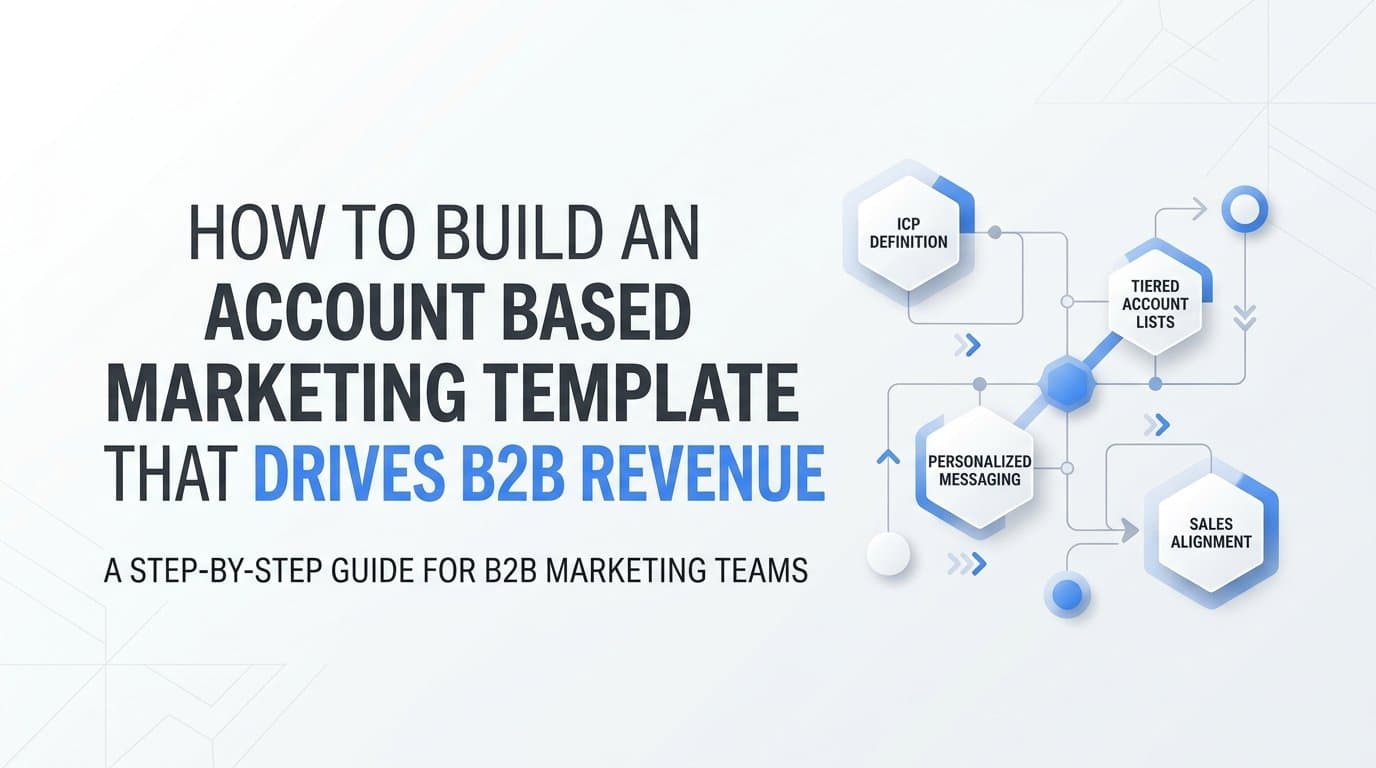
This guide walks you through how to build an account based marketing template from the ground up. You will learn how to define your ideal customer profile, build a tiered account list, create personalized messaging frameworks, map content to the buying journey, coordinate with sales, and measure what is actually working.
Each step is designed to be practical and immediately usable. By the end, you will have a working ABM template that connects marketing activity to pipeline and revenue, not just impressions and clicks. Whether you are launching ABM for the first time or rebuilding a program that has lost momentum, this framework gives you a clear starting point.
The goal is not just to run ABM campaigns. It is to build a system where every touchpoint is tracked, every account interaction is visible, and every dollar of ad spend can be tied back to real revenue outcomes.
Step 1: Define Your Ideal Customer Profile
Every effective account based marketing template starts in the same place: a precise, data-validated picture of who you are actually trying to win. Without a sharp ICP, your account list will be too broad, your messaging will be too generic, and your campaigns will underperform no matter how well they are executed.
Start by pulling firmographic data from your CRM. Look at your best closed-won accounts and identify the patterns. What company size do they share? Which industry verticals appear most often? What is the revenue range? What does their team structure look like, and what tools are already in their tech stack? This is your starting point, because it is grounded in what has actually worked rather than who you think you should be selling to.
Next, layer in behavioral signals that indicate buying readiness. Job postings can reveal when a company is scaling a function your product supports. Funding rounds signal growth and budget availability. Product category searches and content consumption patterns show active research behavior. These signals help you identify accounts that are not just a good fit but are also likely to be in a buying window right now.
Once you have the firmographic and behavioral picture, document the pain points your product solves for this profile. Map each pain point to the specific roles involved in the buying decision. In B2B SaaS, this typically means an economic buyer focused on ROI and business outcomes, a technical evaluator focused on integration and reliability, and end users focused on day-to-day workflow. Each of these personas needs to see your product as solving something real and specific to them.
Bring this together into a one-page ICP summary that both marketing and sales review and agree on. This document becomes the filter for every account you consider adding to your ABM list. If an account does not meet the criteria, it does not belong on the list, regardless of how well-known the company is or how much a sales rep wants to pursue it.
Common pitfall: Avoid defining your ICP too broadly. Tighter criteria produce better account lists and higher conversion rates. If your ICP could describe half the companies on LinkedIn, it is not specific enough.
Success indicator: Sales and marketing can both describe your ideal customer in the same terms without referencing a document. That alignment is the foundation everything else is built on.
Step 2: Build and Tier Your Target Account List
Once your ICP is locked in, the next step is translating it into an actual account list, then organizing that list in a way that reflects how much investment each account deserves. This is where the three-tier model becomes essential to your account based marketing template.
Tier 1 accounts are your highest-priority targets. These are the accounts with the greatest revenue potential and the strongest strategic fit. They receive fully personalized, high-touch treatment: custom content, direct one-to-one outreach, and dedicated attention from both marketing and sales. Keep this list small enough that you can genuinely invest in each account.
Tier 2 accounts receive semi-personalized treatment at the segment level. You are not writing custom content for each company, but you are tailoring messaging and campaigns to their industry vertical, company size, or specific use case. This tier allows you to scale personalization without sacrificing relevance entirely.
Tier 3 accounts are handled programmatically. These accounts match your ICP but are not yet ready for high-touch investment. They receive broader campaigns, retargeting ads, and content that moves them toward engagement without requiring significant manual effort.
Use your ICP criteria to score and qualify accounts before adding them to any tier. Pull data from LinkedIn, intent data platforms, or CRM enrichment tools to validate fit. Do not add accounts based on gut instinct or a sales rep's personal preference. Every account on the list should earn its place through the criteria you defined in Step 1.
Before you finalize the list, define the maximum number of accounts per tier that your team can realistically support with quality outreach. A Tier 1 list of 200 accounts is not a Tier 1 list. It is a Tier 2 list being called something it is not. Quality always outweighs volume in ABM.
For every Tier 1 account, document key account intelligence: the stakeholders involved in the buying decision, recent company news or initiatives, competitive context, and any existing relationship your team has with the account. This intelligence becomes the foundation for the personalized outreach you will build in the next step.
Assign account ownership clearly between sales and marketing. Every account should have a named owner on both sides so there is no ambiguity about who is responsible for each relationship and who is accountable for progression.
Success indicator: Every account on your list has a tier designation, a named owner, and at least three pieces of account intelligence documented. If any of those three elements are missing, the account is not ready to receive outreach.
Step 3: Build Your Messaging and Personalization Framework
Most ABM programs stumble here. Teams understand the concept of personalization but default to surface-level tactics like inserting a company name into an email subject line and calling it done. A real messaging framework goes much deeper than that, and it is one of the most valuable components of any account based marketing template.
Start by building a messaging matrix. Map your core value propositions to each buyer persona involved in the decision. For a B2B SaaS product, this typically means three distinct audiences: the economic buyer who controls budget and cares about ROI and business risk, the technical evaluator who cares about integration, reliability, and implementation complexity, and the end user who cares about how the product fits into their daily workflow. Each of these personas has different priorities, and your messaging needs to speak directly to each one.
From there, develop three to five core message pillars that address the specific pain points of your ICP. These pillars are the through-line of all your ABM campaigns. They do not change from account to account, but the language, examples, and framing around them should.
For Tier 1 accounts, take the time to write account-specific messaging. Reference the company's industry, their known challenges, their size and stage, or something specific from recent news. If a target company just raised a Series B and is scaling their sales team, your outreach should acknowledge that context and connect it directly to the problem your product solves. That level of specificity signals that you have done your homework, and it dramatically increases response rates.
For Tier 2 accounts, build segment-level messaging templates that can be lightly customized without starting from scratch each time. A template for mid-market SaaS companies in fintech will be different from one for enterprise logistics companies, even if the core message pillars are the same. The goal is to make customization fast without making it feel automated.
Document your entire messaging framework in a shared template that sales reps can access and use directly. Include suggested outreach emails, call scripts, and LinkedIn message templates for each persona and each tier. The easier you make it for sales to personalize their outreach, the more consistently they will do it.
Common pitfall: Generic personalization is not personalization. If your "personalized" email could be sent to any company in your ICP without changing a word, it is not personal enough. Reference something specific and relevant to that account's situation.
Success indicator: A sales rep can open your messaging template and write a personalized outreach email for a Tier 1 account in under ten minutes. If it takes longer than that, the template needs more structure.
Step 4: Map Content and Ads to the Buying Journey
Having the right message is only half the equation. Delivering it at the right moment in the buying journey is what turns account engagement into pipeline. This step is about building the content and channel strategy that moves target accounts from awareness to decision.
Start by identifying the three stages of the ABM buying journey for your target accounts. In the awareness stage, accounts recognize they have a problem but may not yet be actively evaluating solutions. In the consideration stage, they are researching options and comparing approaches. In the decision stage, they are evaluating specific vendors and moving toward a purchase.
Assign specific content assets to each stage. Thought leadership pieces, problem-framing articles, and educational content belong at the awareness stage. They help accounts understand the problem more clearly and begin to see your perspective as credible. Comparison guides, ROI frameworks, and detailed use case content belong at the consideration stage. Demos, customer proof points, and implementation guides belong at the decision stage where accounts need confidence to move forward.
Your paid ad strategy should be built around your target account list, not broad audience targeting. Use LinkedIn matched audiences or similar account-based targeting capabilities to serve ads only to people at your target accounts. This keeps your spend focused on the accounts that matter and prevents budget from leaking to audiences that will never convert.
Build retargeting sequences that serve different ad creative based on which stage of the journey an account is in. An account that has visited your pricing page should see decision-stage content, not top-of-funnel awareness ads. Using engagement signals to trigger progression through your ad sequences makes your campaigns feel relevant rather than repetitive.
Coordinate content delivery across every channel your target accounts use. Paid ads, direct outreach, email sequences, and personalized landing pages should all reinforce the same core message at the same stage of the journey. When an account sees consistent, relevant messaging across multiple touchpoints, it builds credibility and accelerates the buying process.
Success indicator: You can map every active content asset and ad campaign to a specific stage of the buying journey and a specific tier of accounts. If a piece of content does not have a clear stage and audience assignment, it should not be in your ABM program.
Step 5: Align Sales and Marketing on Plays and Handoffs
This is where many ABM programs fall apart. The ICP is defined, the account list is built, the messaging is sharp, and the content is mapped. But if sales and marketing are not operating from shared data and agreed-upon processes, the template breaks down at the moment it matters most: when an account is ready to talk to sales.
Start by defining what a marketing-qualified account looks like versus a sales-ready account. This threshold determines when marketing hands off to sales and is one of the most important agreements your two teams will make. A marketing-qualified account might be a Tier 1 target that has engaged with two or more content assets. A sales-ready account might be one that has visited the pricing page or requested a demo. Whatever the criteria, document them explicitly and make sure both teams agree before you launch any campaigns.
Build a library of ABM plays: specific sequences of actions that marketing and sales execute together when an account reaches a trigger point. For example, when a Tier 1 account visits your pricing page, marketing triggers a retargeting ad sequence while sales sends a personalized follow-up email within 24 hours. When an account engages with three or more content assets in a week, a sales rep requests a connection on LinkedIn and references the content the account has been consuming. Each play should have a defined trigger, a defined sequence of actions, and clear ownership for each step.
Document the exact handoff process. What information does marketing pass to sales when an account reaches the handoff threshold? What does sales do within the first 24 hours? How do both teams update account status in the CRM so everyone is working from the same picture? These details sound administrative, but they are what prevents accounts from falling through the cracks.
Set up a shared account view in your CRM or ABM platform so both teams can see every touchpoint an account has had across marketing and sales channels. Sales reps should be able to see which ads an account has engaged with, which content they have downloaded, and which pages they have visited before picking up the phone. That context transforms a cold outreach into a warm, informed conversation.
Schedule a weekly or bi-weekly ABM sync between marketing and sales to review account progression, share new intelligence, and adjust plays based on what is working. These meetings keep the program dynamic and prevent it from becoming a set-it-and-forget-it exercise.
Common pitfall: ABM fails when sales and marketing operate in silos. The template only works if both teams are actively updating it and acting on shared data. If one team is not contributing, the whole system degrades.
Success indicator: Sales reps can see every marketing touchpoint an account has had before their first conversation, with no manual reporting required. That visibility is what makes the handoff feel seamless to the account rather than disjointed.
Step 6: Track Attribution and Measure ABM Performance
You cannot improve what you cannot measure, and in ABM, measurement is more complex than in traditional demand generation. Longer sales cycles, multiple stakeholders, and multi-channel campaigns mean that simple last-click attribution will consistently mislead you about what is actually driving results. This step is about building a measurement framework that reflects the reality of how B2B buying decisions get made.
Define your ABM metrics at three levels. Account-level engagement metrics tell you whether target accounts are interacting with your content and ads. Are the right people at your Tier 1 accounts clicking on your LinkedIn ads? Are they visiting your website, downloading your content, or attending your webinars? These metrics tell you whether your targeting and messaging are landing.
Pipeline metrics tell you whether engaged accounts are converting to opportunities. What percentage of your Tier 1 accounts have moved from awareness to active consideration? How many have converted to a qualified opportunity in your CRM? These metrics connect engagement activity to business outcomes and are the most direct indicator of whether your ABM program is generating real pipeline.
Revenue metrics tell you whether opportunities are closing and at what deal value. Are the accounts that went through your ABM program closing at a higher rate than accounts that came through other channels? What is the average deal size? How long is the sales cycle? These metrics help you evaluate the long-term ROI of your ABM investment.
Set up multi-touch attribution to understand which touchpoints across the buying journey are contributing to pipeline and closed revenue. In a typical B2B ABM campaign, an account might see a LinkedIn ad, download a piece of content, receive a personalized email from a sales rep, attend a webinar, and then request a demo. Last-click attribution would give all the credit to the demo request and ignore every earlier touchpoint that built the relationship. Multi-touch attribution distributes credit across the full journey, giving you a much more accurate picture of what is working.
Use server-side conversion tracking to capture events that browser-based pixels miss. In B2B contexts, buyers often research solutions over weeks or months, across multiple devices and sessions. Cookie limitations and ad blockers frequently cause browser-based pixels to drop events entirely. Server-side tracking captures these events more reliably, which is especially important for accurate attribution in longer sales cycles where every touchpoint matters.
Connect your ad spend data to pipeline and revenue data so you can calculate the true ROI of your ABM campaigns, not just cost per click or cost per lead. When you can see that a specific LinkedIn campaign contributed to three closed-won deals worth a combined amount of significant pipeline value, you have the data you need to make confident budget decisions.
Review your attribution data monthly to identify which channels, messages, and content assets are contributing most to account progression. Use those insights to reallocate budget toward what is working and away from what is not.
Success indicator: You can answer the question of which specific campaigns and channels drove your last five closed-won accounts, with data to back it up. If you cannot answer that question, your attribution setup needs work before you scale your ABM investment.
Putting Your ABM Template Into Practice
Building an account based marketing template is not a one-time project. It is a system that gets sharper over time as you feed it better data, tighter account intelligence, and clearer feedback from the market. The six steps in this guide give you the foundation. What you do with that foundation is what determines whether your ABM program drives real revenue or just generates activity.
Here is a quick-start checklist to assess where you stand today:
1. ICP Definition: Have you validated your ideal customer profile against closed-won data, and do sales and marketing agree on the criteria?
2. Tiered Account List: Does every account have a tier designation, a named owner, and documented account intelligence?
3. Messaging Framework: Do you have persona-specific messaging and account-level personalization templates ready for each tier?
4. Content and Ad Mapping: Is every content asset and ad campaign assigned to a specific buying stage and account tier?
5. Sales and Marketing Alignment: Are your handoff thresholds defined, your plays documented, and your shared account view set up in your CRM?
6. Attribution and Measurement: Do you have multi-touch attribution and server-side tracking in place to connect every touchpoint to pipeline and revenue?
If you can check all six boxes, your ABM template is operational. If you are missing one or more, start there before scaling your campaigns. A program built on shaky foundations will not improve with more budget. It will just fail faster.
The attribution layer is where many ABM programs lose visibility. Cometly connects every ad click, content interaction, and conversion event to pipeline and revenue, giving your team a single source of truth for what is actually driving account progression. From multi-touch attribution to server-side tracking to real-time campaign analytics, Cometly is built for exactly the kind of complex, multi-channel measurement that ABM requires.
Ready to make your ABM campaigns measurably more effective? Get your free demo today and start connecting every touchpoint to real revenue outcomes.