Marketing teams are in the middle of a quiet but significant shift. For the past few years, AI meant having a smarter assistant: something that could draft copy, summarize reports, or suggest audience segments when you asked it to. That era is not over, but something more consequential is emerging alongside it.
Agentic AI is changing the fundamental operating model of marketing. Instead of responding to prompts, agentic systems can set goals, plan sequences of actions, use tools like ad platform APIs and CRMs, and execute tasks without waiting for human approval at every step. This is not a faster version of the automation you already use. It is a different category of capability entirely.
For B2B SaaS marketing teams specifically, the implications are substantial. These teams manage complex, multi-channel funnels with long sales cycles, where the difference between a timely budget reallocation and a missed quarter can be significant. Agentic AI workflows promise to close that gap by acting on data signals in real time, without requiring a human to notice, decide, and execute at each turn.
But here is the part that often gets skipped in the excitement around autonomous AI: these systems are only as good as the data feeding them. An agent optimizing toward distorted attribution signals will make confident, autonomous decisions that systematically move you in the wrong direction. That is why understanding agentic AI marketing workflows requires understanding the attribution infrastructure that makes them reliable.
This article covers what agentic AI workflows actually are, how they differ from traditional automation, where they sit inside a modern marketing stack, and what B2B SaaS teams need to have in place before deploying them effectively.
From Copilot to Autonomous Agent: The Core Distinction
The easiest way to understand agentic AI is to contrast it with what most marketers already use. Tools like ChatGPT, Claude, or built-in AI writing assistants are reactive. You provide a prompt, the model generates a response, and the interaction ends there. The AI does not take further action unless you ask it to. It has no memory of what happened before, no ability to use external tools on your behalf, and no mechanism to observe whether its output actually worked.
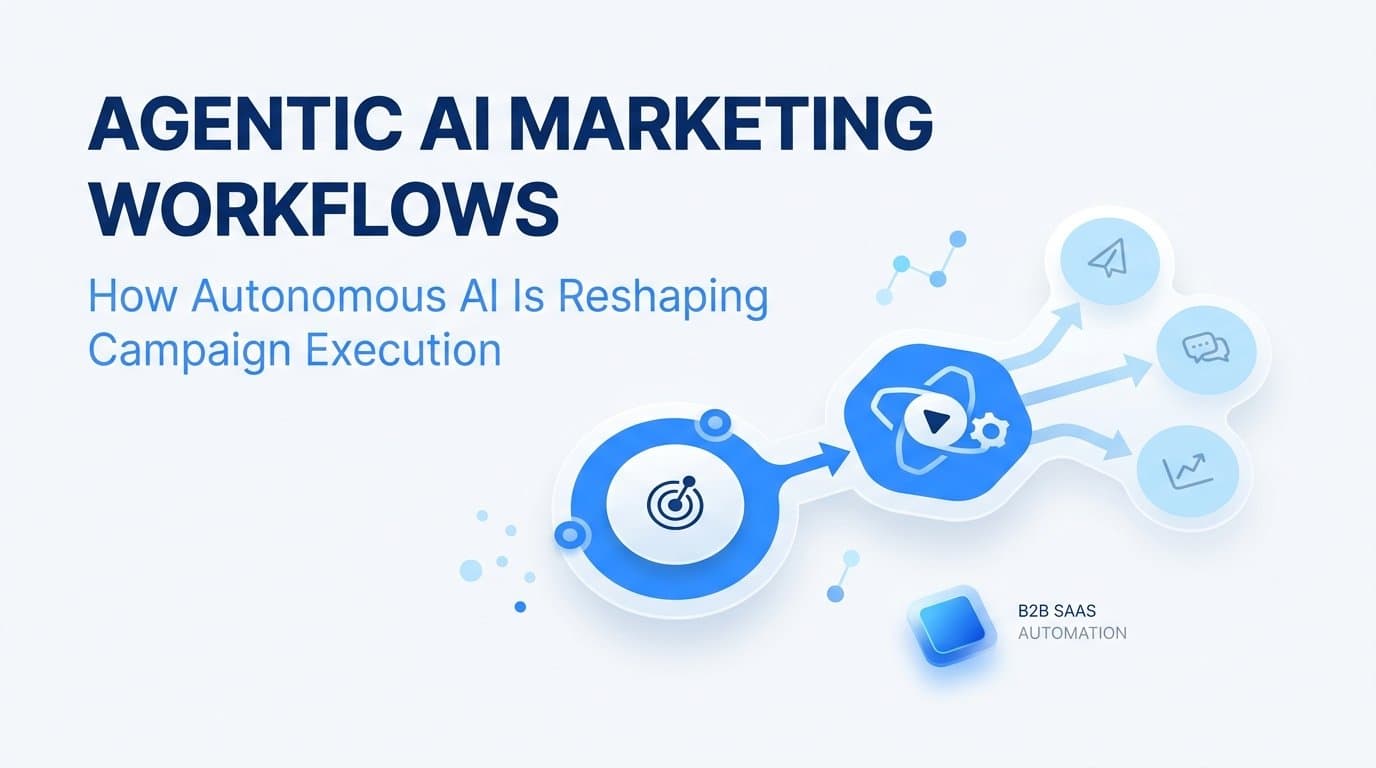
An agentic AI system operates on a fundamentally different model. It is goal-directed, meaning it receives a high-level objective rather than a single-turn instruction. It then decomposes that objective into a sequence of sub-tasks, selects the tools it needs to complete them, executes those tasks, observes the results, and adjusts its approach based on what it learns. This loop continues until the goal is achieved or a defined threshold triggers a human review.
Three traits define a genuinely agentic system:
Goal-directed behavior: The agent works toward an outcome rather than completing a single request. "Improve conversion efficiency for our paid search campaigns this week" is a goal an agentic system can pursue across multiple steps and decisions.
Tool use: Agentic systems can interact with external services, including ad platform APIs, CRM databases, analytics tools, and communication systems. They do not just generate text about what should be done; they actually do it.
Iterative decision-making: Agents observe feedback from their actions and adjust. If a new ad variant underperforms, the system detects that signal and responds, either by rotating creatives, adjusting bids, or escalating for human review, without waiting for a marketer to notice.
To make this concrete: imagine a marketer asking ChatGPT to write three new ad headlines for an underperforming campaign. That is a useful prompt-response interaction. Now imagine an agentic workflow that monitors campaign performance continuously, detects when a specific ad set drops below a defined cost-per-lead threshold, generates new creative variants based on historical top performers, submits them to the ad platform, and reallocates a portion of the budget toward the new variants once they pass a minimum spend threshold. No human approval is needed at each step. The marketer set the parameters; the agent executes within them.
That gap, between generating a suggestion and autonomously executing a multi-step workflow, is the defining line between copilot AI and agentic AI. For B2B SaaS marketing teams managing campaigns across multiple channels simultaneously, that distinction has real operational consequences.
Where Agentic AI Fits Inside a Modern Marketing Stack
Agentic AI does not replace your marketing stack. It operates on top of it, and its effectiveness depends entirely on the layers beneath it functioning well. Understanding where agentic orchestration sits helps teams make smarter decisions about what to build and in what order.
Think of the modern marketing stack in three layers:
The foundation layer handles data ingestion and event tracking. This includes your website tracking, server-side event collection, CRM data capture, and ad platform pixel or API integrations. This is where raw behavioral and conversion data enters the system. Without this layer functioning accurately, nothing above it can be trusted.
The middle layer handles attribution and analytics. This is where raw events get organized into meaningful signals: which touchpoints contributed to a conversion, which channels are driving pipeline, which campaigns are generating closed-won revenue rather than just clicks. This layer transforms data into decisions-ready intelligence.
The execution layer is where agentic AI operates. It consumes the signals from the attribution and analytics layer and takes action: adjusting bids, rotating creatives, updating audience segments, reallocating budgets, or triggering lead handoff workflows. The quality of its decisions is a direct function of the quality of the signals it receives from below.
This architecture matters because agentic workflows are particularly sensitive to data quality problems. A human marketer reviewing a dashboard can notice when something looks off and apply judgment before acting. An autonomous agent cannot do that unless it has been explicitly designed with anomaly detection and escalation rules. When an agent acts on incomplete or misattributed conversion data at scale, errors do not stay contained. They compound across every autonomous decision the system makes.
The types of marketing tasks where agentic systems are being applied today reflect this architecture. Budget pacing decisions require real-time spend and conversion data. Audience segmentation updates depend on CRM signals and behavioral data. Creative rotation relies on performance signals from the ad platform. Bid strategy adjustments need accurate cost-per-outcome data. Lead scoring handoffs to sales require conversion and engagement data from multiple sources.
Each of these tasks sits at the execution layer, but each one draws from the foundation and middle layers to make its decisions. Teams that invest in agentic orchestration before solidifying their data and attribution infrastructure will find that their autonomous systems are confidently optimizing toward the wrong outcomes. Getting the stack order right is not a technical detail. It is a strategic prerequisite.
The Attribution Foundation That Makes Agentic Workflows Reliable
Here is the uncomfortable truth about agentic AI in marketing: autonomy amplifies whatever is already in your data. If your attribution is accurate, an agentic system can make faster, smarter decisions than any human team could manage manually. If your attribution is broken, that same system will make those wrong decisions faster and at greater scale.
Most B2B SaaS marketing teams are working with attribution data that is at least partially flawed. Browser-side tracking has become less reliable as cookie restrictions tighten and privacy-focused browsers block or limit tracking scripts. Platform-reported conversion data from Meta, Google, and LinkedIn is often inflated because each platform takes credit for conversions that multiple channels touched. Last-click attribution, still the default in many setups, assigns all credit to the final touchpoint and systematically undervalues the channels that built awareness and intent earlier in the journey.
When an agentic system operates on this kind of data, the consequences are predictable. An agent optimizing for cost-per-lead based on last-click attribution will over-invest in bottom-of-funnel channels and reduce spend on the awareness and consideration campaigns that were actually driving qualified demand. It will do this confidently, automatically, and repeatedly, because the feedback loop it is observing confirms its decisions are working, at least according to the distorted signal it is receiving.
Multi-touch attribution and server-side tracking change this dynamic fundamentally. Server-side event tracking captures conversion signals directly from your server rather than relying on browser-based scripts, which means it is not affected by cookie restrictions, ad blockers, or browser privacy settings. The result is more complete, deduplicated conversion data. Multi-touch attribution distributes credit across all the touchpoints in a customer journey, giving the agentic system an accurate picture of which channels and campaigns are actually contributing to outcomes.
The most important shift, particularly for B2B SaaS, is connecting attribution data to revenue rather than just lead volume. An agentic workflow that can see which campaigns are driving closed-won revenue, not just MQLs or demo requests, is operating with fundamentally different intelligence. It can prioritize budget toward the channels that produce customers, not just contacts. It can deprioritize high-volume campaigns that generate leads that never close. It can recognize that a campaign generating fewer but higher-quality leads is outperforming one with stronger top-of-funnel numbers.
This connection between revenue attribution and autonomous optimization is what separates agentic workflows that grow a business from those that optimize toward metrics that feel good but do not translate to pipeline. The attribution foundation is not a supporting element of an agentic marketing deployment. It is the control system that determines whether autonomous decisions are moving the business forward or confidently in the wrong direction.
Building Agentic Marketing Workflows: Key Components and Design Principles
Understanding agentic AI conceptually is one thing. Designing workflows that actually function reliably in production is another. The architecture of an effective agentic marketing workflow has four core components, and skipping any one of them creates failure modes that compound over time.
Trigger and goal definition: Every agentic workflow begins with a clearly defined objective and the conditions that activate it. A trigger might be a campaign's cost-per-acquisition exceeding a defined threshold, a creative's click-through rate dropping below a benchmark, or a weekly budget pacing check. The goal definition specifies what success looks like: reduce cost-per-pipeline-opportunity by a defined percentage, maintain impression share above a minimum level, or rotate to the top-performing creative variant within 48 hours. Vague goals produce unpredictable agent behavior.
Planning layer: Once triggered, the agent needs a mechanism to sequence the tasks required to achieve the goal. This might involve querying the attribution system for current performance data, comparing against historical benchmarks, identifying which variables to adjust, and determining the order of operations. More sophisticated agentic systems can dynamically replan when they encounter unexpected data or when an initial action does not produce the expected result.
Tool integrations: The agent's ability to act depends entirely on the tools it can access. In a marketing context, this typically means ad platform APIs for bid and budget adjustments, a CRM integration for lead scoring and pipeline data, an analytics or attribution platform for performance signals, and potentially a content or creative system for generating or rotating ad variants. Each integration point needs to be reliable and well-authenticated, because an agent that cannot access a tool mid-workflow will either stall or make decisions with incomplete information.
Feedback and evaluation mechanism: After the agent acts, it needs to observe whether its action moved the metrics in the right direction. This feedback loop is what distinguishes agentic systems from simple rule-based automation. A rule fires and forgets; an agent fires, observes, and adjusts. Building this feedback mechanism requires defining the right evaluation metrics and the time windows over which they are measured.
Beyond architecture, the design principles that separate effective agentic workflows from chaotic ones are worth stating directly. Narrow task scope matters enormously in early deployments. An agent with a tightly defined responsibility, adjusting bids for a single campaign type, for example, is far easier to audit and course-correct than one managing all campaign decisions simultaneously. Explicit success metrics tied to revenue or pipeline, rather than vanity metrics, ensure the agent is optimizing toward outcomes that matter. And clear escalation rules, defining exactly when the agent should pause and request human review, preserve strategic oversight without eliminating the efficiency benefits of autonomous execution.
Human-in-the-loop checkpoints are not a sign of an immature agentic deployment. They are a design feature of a mature one. Budget changes above a defined ceiling, creative approvals for brand-sensitive campaigns, and anomalies in conversion data are all appropriate triggers for human review. Teams that design these guardrails thoughtfully get the best of both worlds: autonomous efficiency within defined parameters and human judgment where it is genuinely needed.
Practical Applications for B2B SaaS Marketing Teams
Agentic AI marketing workflows are not theoretical. The building blocks exist today, and B2B SaaS teams with solid data infrastructure can begin deploying them in focused, high-value areas. Three workflow scenarios illustrate what this looks like in practice.
Autonomous budget reallocation based on pipeline attribution: A B2B SaaS marketing team running campaigns across paid search, LinkedIn, and content syndication wants to continuously shift budget toward the channels generating the most closed-won revenue, not just the most leads. An agentic workflow connected to revenue attribution data can monitor pipeline contribution by channel on a defined cadence, compare cost-per-opportunity across channels, and automatically shift budget within defined parameters toward the highest-performing sources. This happens without a weekly review meeting or a manual spreadsheet analysis. The agent acts on real pipeline data, not platform-reported conversions.
AI-driven audience refresh using CRM and conversion data: Audience segments in paid campaigns decay over time as the market shifts and customer profiles evolve. An agentic workflow can pull closed-won customer data from the CRM, identify common firmographic and behavioral characteristics of recent customers, and update lookalike audience definitions or exclusion lists in connected ad platforms. This creates a self-improving targeting system where the definition of a high-value prospect is continuously updated based on actual revenue outcomes rather than static persona documents.
Automated creative testing with performance-based rotation: Creative fatigue is a persistent challenge in B2B SaaS campaigns where audiences are relatively small and ads are seen repeatedly. An agentic workflow can monitor engagement and conversion metrics across active ad variants, identify when a creative is underperforming against defined benchmarks, generate new variants based on the characteristics of top performers, and rotate them into active campaigns automatically. Human approval can be built in as a checkpoint before new creatives go live, preserving brand control while eliminating the manual overhead of creative management.
Each of these workflows depends on the same prerequisite: a closed loop between sales and marketing data. When CRM pipeline stages and closed-won revenue are connected to ad touchpoints, the agent has the intelligence it needs to optimize toward outcomes that grow the business. Without that connection, the agent is optimizing toward signals that may not correlate with revenue at all.
The readiness question for B2B SaaS teams considering agentic workflows is straightforward. You need first-party data infrastructure that captures events server-side, reliable conversion tracking that reflects the full customer journey, CRM data that is clean and consistently updated, and KPIs defined in terms of pipeline and revenue rather than clicks and impressions. Teams that have these foundations in place are ready to begin with narrow, well-defined agentic workflows and expand scope as they build confidence in the system's behavior.
Maintaining Visibility When Your Campaigns Run Themselves
There is a risk that comes with agentic automation that does not get enough attention in the excitement around autonomous AI: the risk of losing visibility into why decisions are being made. When a human marketer adjusts a budget or rotates a creative, there is an implicit record of reasoning. When an agent does the same thing across dozens of campaigns simultaneously, that reasoning can become opaque unless the system is specifically designed to make it interpretable.
This opacity creates real problems. If an agentic workflow shifts significant budget away from a channel and performance drops, you need to understand whether the agent made a sound decision based on accurate data or whether it acted on a data anomaly. If you cannot answer that question, you cannot course-correct effectively, and you cannot learn from the decision to improve future workflow design. Autonomous execution without interpretability is not a feature. It is a liability.
The solution is not to limit what agentic systems can do. It is to ensure that every autonomous action is logged against the data signal that triggered it, and that the attribution layer providing those signals is accurate and auditable. A centralized attribution and analytics platform is not an optional add-on in an agentic marketing environment. It is the control plane that keeps autonomous actions accountable and interpretable.
This is where Cometly fits directly into the agentic marketing workflow architecture. Cometly tracks every touchpoint from first ad click to closed-won revenue, connecting your ad platforms, CRM, and website into a single source of truth for marketing performance data. When agentic workflows draw on Cometly's attribution data, they are operating on enriched, deduplicated signals that reflect the full customer journey rather than the partial, platform-reported view that leads to compounding optimization errors.
Cometly's server-side conversion tracking ensures that the conversion signals feeding your autonomous systems are complete and accurate, even as browser-side tracking becomes less reliable. Multi-touch attribution gives agentic workflows a realistic picture of which channels and campaigns are contributing to pipeline, rather than over-crediting the last touchpoint. And because Cometly connects ad spend data directly to Stripe revenue and CRM pipeline, agentic systems built on top of it can optimize toward outcomes that actually matter: closed-won revenue, not just lead volume.
The AI-driven recommendations within Cometly also create a natural bridge between analytics and autonomous action, surfacing which campaigns and audiences are performing and providing the enriched data that ad platform AI needs to optimize targeting and bidding more effectively. That combination of accurate attribution and AI-driven insight is what makes agentic marketing workflows reliable rather than risky.
The Bottom Line on Agentic AI in Marketing
Agentic AI represents a genuine shift in how marketing teams can operate, not just a faster version of the automation already in your stack. The ability to set a goal, let an intelligent system plan and execute across multiple tools, observe outcomes, and adjust without waiting for human approval at each step is a meaningful change in what a lean marketing team can accomplish.
But the quality of every autonomous decision an agentic system makes is entirely dependent on the quality of the attribution data it consumes. Incomplete conversion signals, last-click attribution, and platform-reported data that inflates performance are not just analytics problems. In an agentic marketing environment, they become operational risks that scale with every autonomous action the system takes.
The teams that will get the most from agentic AI marketing workflows are the ones that build the data foundation first: server-side tracking, multi-touch attribution, CRM integration, and revenue-connected KPIs. With that foundation in place, agentic workflows become a genuine competitive advantage, executing faster, learning continuously, and optimizing toward the outcomes that actually grow the business.
If you are ready to build that foundation, Cometly provides the accurate, real-time attribution data that makes agentic marketing workflows reliable and revenue-focused. From first ad click to closed-won revenue, every touchpoint is captured, enriched, and ready to power the autonomous systems your team is building toward. Get your free demo and see how Cometly gives your marketing the data infrastructure that autonomous AI actually needs to perform.