

You're running mobile app install campaigns across Meta, Google, TikTok, and maybe a few other networks. Your dashboard shows thousands of installs, but here's what keeps you up at night: which ads actually drove those downloads? More importantly, which users went on to make purchases, subscribe, or become valuable long-term customers? And which marketing dollars are you completely wasting?
This isn't just about vanity metrics anymore. When you're spending serious money on user acquisition, you need to know the truth about what's working. That's where mobile app attribution comes in—the technology that connects every ad impression, click, and touchpoint to actual app installs and revenue.
But here's the challenge: mobile attribution has gotten exponentially more complex. Apple's privacy changes disrupted traditional tracking methods. Users bounce between devices and platforms before installing. And ad networks each tell a different story about who deserves credit for conversions.
This guide cuts through the confusion. You'll learn how modern attribution actually works behind the scenes, why iOS privacy updates changed everything, and how to build an attribution stack that gives you confidence in your marketing decisions. By the end, you'll understand not just what attribution is, but how to implement it in a way that drives real business results.
How Mobile Attribution Actually Works Behind the Scenes
Think of attribution as a detective story. A user sees your ad, clicks it, downloads your app, and makes a purchase three days later. Attribution is the technology that connects all those dots and tells you which marketing touchpoint deserves credit.
Here's what happens in those crucial milliseconds: When someone clicks your ad, the ad network captures information about that interaction—timestamp, device details, campaign parameters. When they land on the App Store and download your app, your Mobile Measurement Partner (MMP) tries to match that install back to the original ad click.
The matching process relies on device identifiers. On Android, that's the Google Advertising ID (GAID). On iOS, it used to be the Identifier for Advertisers (IDFA). These unique IDs allowed for deterministic attribution—a perfect match between ad click and install with near-100% accuracy.
When device IDs are available, attribution is straightforward. Your MMP sees the same identifier in both the ad click data and the install event, creating an exact match. This is the gold standard—no guesswork, just facts.
But when device IDs aren't available (which is increasingly common on iOS), attribution gets trickier. That's where probabilistic matching comes in. Instead of a unique identifier, the system looks at device fingerprints—combinations of IP address, device model, OS version, screen resolution, and other characteristics. If these match closely enough between the click and install, the system makes an educated guess about attribution.
This is where Mobile Measurement Partners earn their keep. Companies like AppsFlyer, Adjust, Branch, and Singular act as neutral third parties between you and your ad networks. They collect data from all your marketing channels, apply consistent attribution logic, and give you a unified view of performance. Understanding how app marketing attribution works at this technical level helps you evaluate MMP capabilities more effectively.
Here's the data flow in practice: Your ad runs on Meta. A user clicks it. Meta sends click data to your MMP. The user downloads your app. Your app's SDK (software development kit) fires an install event to the MMP. The MMP matches the click to the install, attributes it to Meta, and reports that data back to both you and Meta's algorithm.
This real-time feedback loop is crucial. When ad platforms receive accurate attribution data, their algorithms learn which audiences and creative approaches drive actual installs. This makes your campaigns progressively better over time.
But there's a critical piece many marketers miss: attribution doesn't stop at the install. The real value comes from tracking post-install events—purchases, subscriptions, level completions, whatever matters for your business model. Your MMP continues following that user's journey, connecting every meaningful action back to the original marketing source.
The iOS Privacy Shift That Changed Everything
April 2021 marked a turning point for mobile marketers. Apple released iOS 14.5 with App Tracking Transparency (ATT), fundamentally breaking traditional attribution methods. Overnight, the IDFA—the backbone of deterministic iOS attribution—became effectively optional.
Here's what changed: Every app now must explicitly ask users for permission to track them across other apps and websites. That permission prompt appears before any tracking can happen. And users, unsurprisingly, often decline. While opt-in rates vary by app category and implementation, many apps see consent rates well below 50%.
For the majority of iOS users who decline tracking, IDFA becomes unavailable. This means no deterministic attribution. No perfect matching. No clear line from ad click to install for more than half your iOS audience.
Apple's solution? SKAdNetwork (SKAN), a privacy-preserving attribution framework that provides conversion data without exposing individual user information. But SKAN comes with significant limitations that fundamentally change how mobile attribution works.
First, the data is delayed. Instead of real-time attribution, SKAN introduces random delays between 24-48 hours before reporting conversions. This makes same-day optimization impossible and slows down your ability to react to campaign performance.
Second, the data is aggregated. SKAN doesn't tell you about individual users—it reports conversion counts at the campaign level. You can't build detailed user-level cohorts or track specific customer journeys through your funnel.
Third, conversion values are limited. SKAN originally allowed only 64 possible conversion values (0-63) to represent post-install activity. While SKAN 4.0 expanded this somewhat, you still face significant constraints in encoding the richness of user behavior into these limited values.
Think about what this means practically. You might encode your conversion values to represent: installs (value 0), registration (value 1-10 based on timing), first purchase (value 11-30 based on revenue tier), and subscription (value 31-63 based on plan type). But you're constantly making trade-offs about what to measure and how granularly.
Many marketers initially hoped probabilistic fingerprinting would fill the gap. But Apple has explicitly pushed back against fingerprinting techniques, threatening to reject apps that attempt to circumvent ATT through device fingerprinting. This makes probabilistic attribution a risky strategy for iOS.
The industry's response? Server-side tracking. Instead of relying entirely on client-side SDKs and device identifiers, sophisticated attribution platforms now send conversion data directly from servers. When a user completes a purchase or subscription in your app, your server sends that event to your attribution platform and ad networks.
Server-side tracking helps maintain attribution accuracy in several ways. It's not subject to the same privacy restrictions as client-side tracking. It provides more reliable data because it's not affected by users clearing cookies or app data. And it allows you to enrich conversion events with additional context from your CRM or database before sending them to ad platforms.
This server-side approach has become essential for feeding quality conversion signals back to ad platform algorithms. When Meta or Google receives enriched, server-verified conversion data—even if it's aggregated through SKAN—their optimization improves dramatically compared to relying solely on limited client-side signals. Implementing robust mobile app attribution tracking requires understanding these server-side capabilities.
Attribution Models for the Mobile Customer Journey
Not all attribution is created equal. The model you choose determines which marketing touchpoints get credit for conversions—and that choice dramatically affects how you interpret performance and allocate budget.
Last-click attribution is the simplest approach. Whichever ad or channel the user interacted with immediately before installing gets 100% credit. If someone sees your TikTok ad, later clicks your Google search ad, then installs, Google gets full credit. This model is clean and straightforward, which explains its popularity.
But last-click has a massive blind spot: it ignores the entire customer journey leading up to that final click. Your TikTok ad might have introduced the user to your app and created intent. Your Instagram retargeting might have reinforced the message. Your email might have brought them back. Last-click gives all those touchpoints zero credit.
Multi-touch attribution attempts to solve this by distributing credit across multiple interactions. Linear models split credit evenly across all touchpoints. Time-decay models give more credit to recent interactions. Position-based models emphasize the first and last touchpoints while giving some credit to middle interactions. Our multi-touch marketing attribution platform complete guide explores these models in greater depth.
In mobile contexts, multi-touch attribution faces unique challenges. Users often interact across devices—seeing an ad on their phone during their commute, researching on their laptop at work, then downloading on their tablet at home. Connecting these cross-device interactions to a single user journey is technically complex and often impossible without deterministic IDs.
Then there's view-through attribution, which credits ad impressions that users saw but didn't click. This matters because many users see your ad, remember it, then later search for your app directly or install through another channel. Should that original impression get any credit?
View-through attribution is controversial because it's easy to game. Every user sees thousands of ad impressions daily. Giving credit to impressions can inflate performance numbers without reflecting genuine influence. But completely ignoring view-through impact undervalues brand awareness campaigns and upper-funnel advertising.
This is where lookback windows become critical. A lookback window defines how far back in time to consider touchpoints when attributing a conversion. Industry standards have emerged: typically 7 days for click-through attribution and 24 hours for view-through attribution.
Why these specific windows? Seven days captures most considered purchase behavior without extending so far that attribution becomes meaningless. Someone who clicked your ad a week ago and installs today likely made a connection. Someone who clicked three months ago probably didn't.
The 24-hour view-through window is more conservative because impression-only impact fades quickly. If someone saw your ad yesterday and installed today, there's reasonable chance the ad influenced them. If they saw it last week, the connection becomes tenuous.
Different ad networks use different default windows, which creates reporting discrepancies. Meta might use a 7-day click, 1-day view window while Google uses 30-day click, 1-day view. When you're comparing performance across platforms, these attribution differences can make direct comparison misleading. Understanding what attribution model approach is mainly used in marketing helps you navigate these platform-specific differences.
The model you choose should match your business reality. If you run primarily direct-response campaigns with short consideration cycles, last-click might be sufficient. If you invest in brand awareness and nurture users over time, multi-touch attribution gives you a more complete picture. If you're running video campaigns where view-through impact matters, you need view-through attribution with appropriate windows.
Connecting In-App Events to Marketing Spend
Getting attribution right at the install level is just the starting line. The real money question is: which marketing channels drive users who actually generate revenue?
This is where post-install event tracking becomes critical. An install means nothing if the user opens your app once and never returns. You need to track the actions that matter for your business model—purchases for e-commerce apps, subscriptions for SaaS, level completions for games, bookings for travel apps.
Setting up meaningful event tracking starts with defining your conversion events. What user actions indicate real value? For most apps, this includes registration or account creation, first meaningful action (adding items to cart, completing a tutorial, making a search), and revenue events (purchases, subscriptions, in-app purchases).
Each event needs to be instrumented in your app code and configured in your attribution platform. When a user completes a purchase, your app fires an event to your MMP with relevant parameters—purchase amount, currency, product category, subscription tier. Your MMP then connects this event back to the original marketing source.
This creates a complete picture: you can see that the $500 you spent on that Meta campaign generated 100 installs, 40 registrations, 15 purchases totaling $750 in revenue. Now you're making decisions based on actual ROI, not just install volume. Platforms focused on marketing attribution platforms revenue tracking specialize in connecting these revenue events to marketing spend.
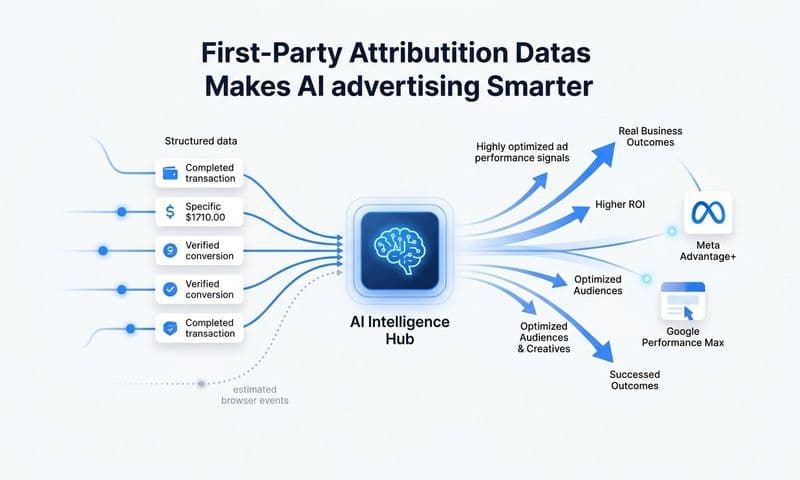
But here's where it gets sophisticated: feeding this conversion data back to ad platforms. When Meta's algorithm receives signals that users from a specific campaign made purchases, it learns to find more users like them. This feedback loop is how modern advertising optimization works.
The quality of your conversion signals directly impacts campaign performance. Generic "install" events give ad platforms basic information. Rich conversion events with value data—"user completed purchase of $49.99 premium subscription"—give algorithms much more to work with.
This is especially crucial in the post-ATT world. With limited user-level data, ad platforms rely heavily on aggregated conversion signals to optimize. The more meaningful and accurate your conversion data, the better their algorithms perform.
The revenue attribution challenge extends beyond immediate in-app events. For subscription apps, lifetime value (LTV) matters more than first purchase. For apps with complex user journeys, connecting CRM data and payment processor information to marketing touchpoints reveals the full picture.
Consider a fitness app: A user installs from a Meta ad, completes the free trial, subscribes for $9.99/month, and remains subscribed for 18 months—$180 in total revenue. Traditional attribution might only capture the install and initial subscription. Sophisticated attribution connects the entire revenue stream back to that original Meta campaign.
This requires integrating your attribution platform with your CRM, payment processor, and analytics systems. When a user makes their sixth monthly payment, that revenue event should flow back to your attribution system and update the LTV metrics for their original acquisition channel.
These long-term value insights change everything about budget allocation. You might discover that TikTok drives high install volume but low LTV, while Google drives fewer installs but users who stick around and spend more. Without this depth of attribution, you'd optimize for the wrong metrics. Leveraging mobile attribution marketing analytics helps surface these LTV patterns across channels.
Building Your Attribution Stack for Accurate Data
Effective mobile attribution isn't about a single tool—it's about building an integrated stack that captures data accurately and makes it actionable.
The foundation is your Mobile Measurement Partner integration. Your MMP (whether AppsFlyer, Adjust, Branch, or another provider) connects to all your ad networks through their APIs. This creates a centralized hub where attribution data from Meta, Google, TikTok, Apple Search Ads, and other channels flows together.
Your app's SDK is the next critical component. The MMP's SDK embedded in your app code tracks installs, session data, and in-app events. This client-side tracking captures user behavior in real-time and sends it to your MMP for attribution matching.
But as we've discussed, client-side tracking alone isn't enough anymore. Server-side event tracking adds a crucial layer of accuracy and reliability. Your servers send conversion events directly to your attribution platform and ad networks, bypassing client-side limitations and privacy restrictions.
Server-side tracking is especially valuable for high-value events. When a user completes a $1,000 purchase or signs an annual contract, you want that conversion data to be bulletproof. Server-side confirmation ensures these critical events are captured accurately, even if client-side tracking fails due to network issues, app crashes, or privacy settings.
CRM integration completes the picture by connecting marketing attribution to customer lifecycle data. When your attribution platform can see not just initial conversions but ongoing customer behavior, support interactions, and long-term revenue, you gain true ROI visibility.
Cross-platform attribution introduces additional complexity. Users don't live in neat silos—they see ads on mobile web, interact on desktop, then download your app. They might use your app on both phone and tablet. Connecting these cross-device interactions to a single user journey requires sophisticated identity resolution. Implementing cross-channel marketing attribution software helps unify these fragmented user journeys.
Some platforms use deterministic matching through logged-in user data. If someone logs into your website on desktop and your app on mobile with the same email, you can definitively connect those devices. Others use probabilistic techniques, though these are increasingly limited by privacy restrictions.
Data hygiene practices matter more than ever in this complex environment. Attribution fraud remains a persistent challenge—fraudsters generate fake clicks or installs to steal attribution credit and marketing budget. Your MMP should include fraud detection capabilities that identify suspicious patterns like click flooding, click injection, and SDK spoofing.
Separating organic from paid installs requires careful implementation. Users who would have installed anyway shouldn't be attributed to paid campaigns. This means properly excluding branded search terms from paid campaigns, using organic attribution logic for direct App Store traffic, and avoiding over-attribution to channels that capture existing intent rather than creating it.
UTM parameter consistency creates cleaner attribution data. When every campaign uses consistent naming conventions—standardized source, medium, and campaign parameters—your attribution reporting becomes exponentially more useful. Inconsistent tagging creates data chaos that makes performance analysis nearly impossible.
A unified analytics dashboard brings everything together. You need a single source of truth where attribution data, in-app analytics, revenue metrics, and customer lifecycle information converge. Reviewing the best software for tracking marketing attribution helps you identify platforms that consolidate these data sources effectively.
Putting Attribution Insights Into Action
Data without action is just expensive noise. The real value of attribution comes from using insights to make smarter marketing decisions.
Budget allocation is the most direct application. Attribution data reveals which channels drive quality users versus just volume. You might discover that Channel A delivers installs at $2 each with 30% converting to paid users, while Channel B delivers installs at $4 each with 60% conversion to paid. Channel B is actually more efficient despite higher install costs.
This kind of insight only emerges when you track beyond installs to meaningful conversion events and revenue. Without it, you'd optimize for the wrong metric and waste budget on low-quality traffic.
Creative performance analysis becomes dramatically more powerful with proper attribution. You can see which ad creative approaches drive not just clicks and installs, but users who actually engage and convert. That video ad with lower install rates might actually drive higher LTV users. Attribution data reveals these patterns.
The feedback loop to ad platforms is where attribution creates compounding returns. When you feed enriched conversion signals back to Meta, Google, and TikTok—showing them which users completed purchases, subscriptions, or other high-value events—their algorithms learn to find more users like them.
This is particularly powerful with server-side conversion events. When ad platforms receive server-verified purchase data with actual revenue values, they can optimize for revenue rather than just installs or basic conversions. This shifts optimization from volume to value.
Consider how this works in practice: You send Meta detailed conversion events showing that users who purchase within 24 hours of install have 5x higher LTV than those who take a week. Meta's algorithm learns this pattern and starts prioritizing audiences likely to convert quickly. Your campaign performance improves automatically. This approach aligns with performance marketing attribution best practices.
Building a testing framework around attribution insights lets you run meaningful experiments. You can test different attribution models to understand how they affect budget decisions. You can run incrementality tests—turning off specific channels temporarily to measure true incremental impact versus attributed impact.
Incrementality testing is crucial because attribution shows correlation, not necessarily causation. Just because a channel gets attribution credit doesn't mean it created incremental value. Testing helps you understand which channels genuinely drive growth versus which ones just capture existing intent.
Attribution data also powers audience refinement. When you know which user characteristics correlate with high LTV, you can build lookalike audiences based on your best customers rather than all customers. You can exclude audiences that consistently deliver low-quality installs. You can create retargeting segments based on specific in-app behaviors.
The most sophisticated marketers use attribution insights to build predictive models. By analyzing patterns in user behavior during the first few days after install, you can predict likely LTV and adjust bidding strategies accordingly. This lets you pay more to acquire users who show early signals of high value. Combining attribution with data visualization tools for marketing analytics makes these patterns easier to identify and communicate.
Your Path Forward in Attribution
Mobile app attribution isn't just another marketing tool—it's the foundation for making confident decisions about where to invest your budget. In a privacy-first world where traditional tracking methods have broken down, sophisticated attribution has become the competitive advantage that separates marketers who scale profitably from those who waste budget on vanity metrics.
The shift from simple last-click tracking to comprehensive, server-side attribution represents a fundamental evolution in how we understand marketing performance. You're no longer limited to surface-level data about which ad got the last click. You can now see the complete customer journey, connect every touchpoint to revenue, and feed intelligence back to ad platforms that makes your campaigns progressively better.
The marketers winning in this environment are those who've built attribution stacks that capture accurate data across the entire funnel—from first impression through install to long-term revenue. They're using server-side tracking to maintain data quality despite privacy restrictions. They're connecting attribution platforms to CRMs and payment systems to understand true ROI. And they're leveraging AI-powered insights to turn attribution data into action.
This is where modern platforms like Cometly transform attribution from a reporting exercise into a growth engine. By capturing every touchpoint across ad platforms, website, and CRM, Cometly provides the complete view you need to understand what's actually driving results. The AI analyzes patterns across all your channels to surface high-performing campaigns and optimization opportunities you'd miss in manual analysis. And the conversion sync capabilities feed enriched, accurate data back to Meta, Google, and other platforms—making their algorithms work harder for you.
Ready to elevate your marketing game with precision and confidence? Discover how Cometly's AI-driven recommendations can transform your ad strategy—Get your free demo today and start capturing every touchpoint to maximize your conversions.