
You've probably seen it before. Your paid campaigns look healthy on the surface: solid click-through rates, reasonable cost-per-click, and platform-reported conversions that seem to justify the spend. But when you cross-reference those numbers against your CRM, the picture shifts. Fewer leads than reported. Attribution gaps you can't explain. Revenue that doesn't trace back to the channels that claimed credit.
This disconnect isn't a coincidence. It's the direct result of browser tracking limitations, and it's affecting nearly every team running paid advertising today. The browsers your prospects use have quietly become less cooperative with the tracking infrastructure that ad platforms depend on, and most marketing teams are still operating as if nothing has changed.
Browser tracking, in the context of digital advertising, refers to the collection of user behavior data through browser-based mechanisms: cookies, JavaScript pixels, and client-side scripts that fire when someone visits a page, clicks a link, or completes a conversion action. For years, this was the backbone of digital marketing measurement. It powered attribution, informed bidding algorithms, and told marketers which campaigns were working.
That foundation is cracking. A combination of browser privacy updates, mobile tracking restrictions, and widespread ad blocker adoption has systematically degraded the quality and completeness of browser-based data. The result is a measurement environment where platforms are optimizing on incomplete signals, attribution models are producing distorted outputs, and marketing budgets are being allocated based on a partial view of reality.
This article breaks down how we got here, what specifically breaks when browser tracking fails, and what a modern tracking architecture looks like for teams that want accurate data regardless of what any browser decides to block.
How Pixel-Based Tracking Became the Default Standard
To understand why browser tracking limitations matter so much today, it helps to understand how browser-based tracking became the default measurement layer in the first place.
When digital advertising scaled rapidly in the early 2000s and 2010s, ad platforms needed a way to connect ad clicks to downstream actions: form fills, purchases, sign-ups. The solution was elegant in its simplicity. A small piece of JavaScript, called a pixel, would be placed on an advertiser's website. When a user clicked an ad and landed on the site, the pixel would fire, write a cookie to the user's browser, and track their behavior from that point forward. If they converted, the platform received the signal and attributed it to the original ad.
This client-side tracking model worked because it required no complex server infrastructure from the advertiser. Drop a tag on your site, configure your events, and the platform handles the rest. Meta's pixel, Google's global site tag, and similar tools from LinkedIn, TikTok, and others all operate on this same fundamental architecture.
Ad platforms built their entire optimization infrastructure on top of this data layer. Conversion signals fed into bidding algorithms that learned which audiences, placements, and creative combinations drove results. ROAS calculations depended on pixels accurately capturing purchase events. Lookalike audiences were built from the behavioral profiles that cookies helped construct.
In a simpler web environment, this worked reasonably well. Users browsed on desktop browsers, third-party cookies persisted across sessions, and platforms could reliably stitch together a user's journey from ad click to conversion. The model was never perfect, but it was consistent enough to make decisions on.
The critical vulnerability was always there, though: the entire system depended on the browser cooperating. If the browser blocked a cookie, the pixel couldn't track the session. If a script was suppressed, the conversion event never fired. The tracking layer lived entirely in an environment the advertiser didn't control, and that dependency was always a structural weakness waiting to be exposed.
The Privacy Shifts That Changed Everything
Several major technical and policy changes have converged to make browser-based tracking significantly less reliable. They didn't happen all at once, but their cumulative effect has fundamentally changed the measurement landscape.
Safari's Intelligent Tracking Prevention, first introduced by Apple and continuously tightened since, was one of the earliest signals that browsers were going to start pushing back. ITP restricts how long cookies can persist in the browser and blocks third-party cookies entirely by default. For advertisers, this means that conversion windows shrink dramatically on Safari. A user who clicks an ad and converts days later may never be attributed, because the cookie that would have connected those two events has already expired or was never written.
Firefox followed with its own Enhanced Tracking Protection, which blocks known tracking scripts and third-party cookies by default. While Firefox has a smaller market share than Chrome or Safari, its protections signal the direction the broader browser ecosystem is heading.
Google's Chrome, which holds the largest share of browser usage globally, has been slower to act but has been moving toward restricting third-party cookies as well. The direction of travel across the entire browser ecosystem is clearly toward less cross-site tracking, not more.
Apple's App Tracking Transparency framework, introduced with iOS 14, changed the mobile tracking landscape dramatically. ATT requires apps to explicitly ask users for permission before tracking them across apps and websites. When users decline, which a significant portion do, ad platforms like Meta receive far fewer mobile conversion signals. This created an immediate and measurable gap in attribution data for any business with a meaningful share of mobile traffic. Teams running Facebook campaigns felt this acutely, and understanding how Facebook pixel tracking breaks down under these conditions is essential context for any paid social strategy.
Ad blockers add another layer of signal loss. A substantial portion of web users, particularly in tech-savvy demographics common in B2B markets, run browser extensions or standalone tools that block tracking scripts from firing entirely. When a pixel is blocked, the conversion event it would have reported simply disappears. There is no error message, no warning in your dashboard. The data is just gone.
What makes this particularly challenging is that these losses are not uniform or predictable. Different browsers behave differently. Different users have different privacy settings. The result is a patchwork of tracking gaps that vary by audience segment, device type, and geography, making it nearly impossible to understand the true scale of data loss from pixel-only measurement alone. A cookieless tracking solution is increasingly necessary to bridge these gaps reliably.
The Measurement Failures That Follow
When browser tracking degrades, the downstream effects on marketing measurement are specific and serious. Understanding exactly what breaks helps clarify why this is more than a technical inconvenience.
The most immediate impact is underreported conversions. When pixels are blocked or cookies expire before a conversion occurs, the platform never receives the signal. Your actual conversion volume is higher than what your dashboard shows, but you have no way to know by how much. This leads directly to inflated cost-per-acquisition figures. If your platform reports ten conversions when you actually drove fifteen, your calculated CPA looks worse than it is, and you may pull back on campaigns that are actually performing.
ROAS calculations suffer the same distortion. Revenue that was genuinely influenced by your paid campaigns doesn't get attributed, so your return on ad spend looks lower than it actually is. For teams making budget allocation decisions based on these numbers, this creates a systematic bias toward underinvesting in channels that are working. Fixing conversion tracking gaps is often the fastest way to recover accurate ROAS data and restore confidence in channel-level reporting.
The impact on ad platform algorithms is arguably the most damaging, because it compounds over time. Modern ad platforms use conversion signals to train their bidding and targeting systems. Meta's advantage campaigns, Google's smart bidding, and similar automated systems learn from the conversion data they receive. When that data is incomplete, the algorithms are optimizing toward a distorted version of your actual customer. They may deprioritize audiences that convert well but whose conversions aren't being captured, and over-index on the subset of conversions that happen to be trackable.
Multi-touch attribution models face a specific kind of failure when browser tracking breaks down. These models attempt to assign credit across multiple touchpoints in a customer journey: the first ad that introduced someone to your product, the retargeting ad that brought them back, the branded search that closed the deal. When browser limitations remove intermediate touchpoints from the record, those touchpoints appear to have contributed nothing. A channel that consistently influences early-stage consideration may look completely ineffective in your attribution data simply because the cookie that would have recorded its contribution was blocked or expired.
The customer journey, as it appears in your attribution platform, becomes a distorted version of what actually happened. Channels get misattributed credit. Budget flows toward the channels that happen to be easiest to track rather than the ones that are actually driving revenue.
Server-Side Tracking and Conversion APIs: The Architectural Fix
The solution to browser tracking limitations doesn't involve finding a better pixel. It involves moving the tracking layer out of the browser entirely.
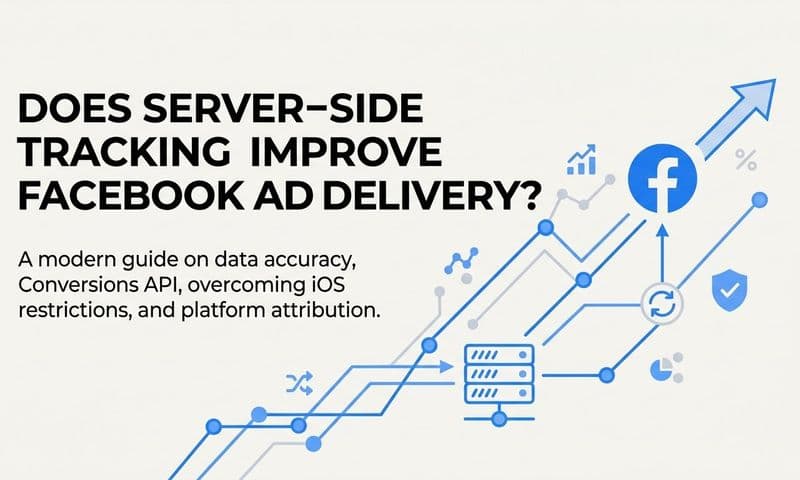
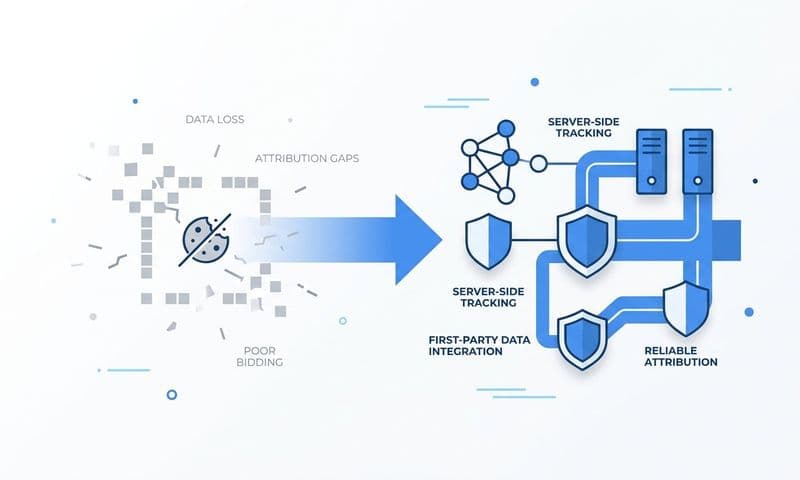
Server-side tracking works by sending conversion data from your own server directly to ad platforms, rather than relying on a browser-based script to do it. When a conversion event occurs, your server captures the relevant data and sends it to Meta's Conversions API, Google's Enhanced Conversions, or other platform equivalents. The browser is no longer in the loop. Ad blockers can't suppress a server-to-server call. ITP can't expire a cookie that was never written in the browser. iOS privacy settings can't block a signal that never passed through an app. Understanding why server-side tracking is more accurate than pixel-only approaches is the starting point for any modern measurement strategy.
Conversion APIs represent a fundamental architectural shift in how conversion data flows from advertiser to platform. Meta's Conversions API (CAPI) and Google's Enhanced Conversions are now considered best practice for any business that wants accurate, complete conversion measurement. They allow you to send the same events you were tracking via pixel, but through a server-side pathway that is immune to browser restrictions.
First-party data plays a central role in this model. When your business collects customer event data through your own properties, your website, your CRM, your product, you own that data. It isn't subject to third-party cookie restrictions because it was never a third-party relationship to begin with. Server-side tracking leverages this first-party data by using identifiers you've collected directly from users, such as hashed email addresses or phone numbers, to match conversion events to user profiles on the ad platform side.
Meta measures this matching effectiveness through a metric called Event Match Quality (EMQ). When you send enriched conversion events with strong first-party identifiers, your EMQ score improves, which means more of your conversion events are successfully matched to user profiles. Better matching leads to better attribution and gives Meta's algorithm more accurate signals to optimize against. The practical outcome is that your campaigns perform better because the platform is learning from a more complete and accurate picture of who is converting.
Running server-side events alongside your existing pixel creates a redundant, more complete data collection system. The pixel still captures what it can from cooperating browsers. The server-side event captures what the pixel misses. Together, they reduce the gap between what actually happened and what your platform reports. Reviewing a comprehensive server-side tracking implementation guide can help teams deploy this architecture correctly from the start.
Attribution Models Under Pressure
Not all attribution models are equally affected by browser tracking limitations, and understanding the differences helps you make better decisions about how to measure your campaigns.
Last-click attribution is the most vulnerable. It assigns all credit to the final trackable touchpoint before conversion. When browser restrictions remove that final event from the record, the entire conversion disappears from the attribution model. There is no fallback, no partial credit. The conversion simply doesn't exist in the data. This makes last-click attribution particularly unreliable in a privacy-first environment, even though it remains the default in many platforms.
Multi-touch attribution models lose touchpoints silently. When an intermediate touchpoint is blocked or untracked, the model doesn't know it's missing. It distributes credit across the touchpoints it can see and presents the result as if it were complete. The danger here is that you don't get an error message telling you the data is incomplete. You get a clean-looking report that simply omits channels that were actually contributing to the journey.
Data-driven attribution becomes more valuable in this environment because it can work with probabilistic signals rather than requiring a complete deterministic chain of events. Instead of needing every touchpoint to be tracked precisely, data-driven models use statistical patterns across large volumes of conversion data to infer channel contributions. This approach is more resilient to gaps in individual user-level tracking.
When evaluating an attribution platform, look for specific capabilities that indicate it was built for the current tracking environment. Server-side event collection is non-negotiable. CRM integration matters because it allows you to connect ad spend to pipeline and closed revenue, creating an attribution chain that doesn't depend on any browser-based signal for its final, most important data point. Exploring the best marketing attribution platforms for revenue tracking can help you identify tools that are genuinely built for this environment. The ability to compare attribution models side by side helps you understand how different measurement approaches interpret the same underlying data, which is essential when any single model may be showing you an incomplete picture.
Building a Tracking Architecture That Holds Up
Knowing that browser tracking is unreliable is only useful if you act on it. Here's how to build a measurement foundation that gives you accurate data regardless of what any individual browser decides to block.
Layer your tracking: Don't abandon your pixels, but don't rely on them exclusively. Run server-side conversion events in parallel with your existing pixel implementation. This creates redundancy. When a pixel fires successfully, you have the browser-side event. When it doesn't, the server-side event covers the gap. The combined signal is more complete than either approach alone.
Use UTM parameters consistently: UTM parameters are appended to your ad URLs and captured by your analytics platform when a user lands on your site. Unlike cookies, they don't expire or get blocked by ITP. They give you campaign-level source attribution that persists in your CRM from the moment of first touch, independent of browser behavior. Consistent UTM tagging across every paid channel is one of the simplest and most durable tracking practices you can implement.
Integrate your CRM as a data source: The most important conversion events in B2B SaaS aren't purchases on a website. They're demo requests, qualified leads, pipeline opportunities, and closed-won deals. These events live in your CRM, not in your browser tracking layer. Connecting your CRM to your attribution platform creates a measurement chain that runs from first ad click to closed revenue, and that chain is not dependent on any browser cooperating at any point along the way.
Connect ad spend to revenue, not just conversions: Platform-reported conversions are a proxy metric. Revenue is the real measure. When you can connect your ad spend data directly to CRM revenue data, you can calculate true ROI without relying on platform attribution that may be inflated, incomplete, or simply measuring the wrong thing. Tracking closed-won revenue back to its originating ad campaigns is the clearest signal of what's actually working.
This is the architecture that Cometly is built around. It captures every touchpoint from ad click to closed-won revenue by combining pixel tracking, server-side event collection, CRM integration, and direct connections to ad platforms. Enriched conversion events are sent back to Meta and Google, improving event match quality and feeding platform algorithms with more accurate signals. Marketing teams get a single dashboard that shows true ROI across all channels, with attribution that doesn't collapse when a browser decides to block a cookie.
For B2B SaaS teams running paid acquisition, this kind of unified tracking architecture isn't a nice-to-have. It's the difference between making budget decisions on real data and making them on a systematically incomplete version of reality.
The Path Forward for Data-Driven Marketing Teams
Browser tracking limitations are not a bug that will be patched in the next browser update. They are the result of deliberate, structural decisions by browser vendors and platform providers to restrict cross-site tracking, and those decisions are moving in one direction. The privacy-first web is not a temporary phase. It's the new baseline.
Marketers who continue relying exclusively on pixel-based tracking will consistently undercount conversions, misallocate budget, and feed poor signals to ad platform algorithms. The compounding effect of those poor signals means campaigns that could be performing better are held back by optimization systems working from incomplete data.
The path forward is clear: combine server-side tracking with first-party data, integrate your CRM to close the loop from lead to revenue, and use an attribution platform that was built to operate in this environment rather than one that was designed for a web that no longer exists.
Accurate measurement is a competitive advantage. When your competitors are optimizing on 60% of their conversion data and you're operating on 95%, you make better decisions, allocate budget more effectively, and scale what's actually working with confidence.
Ready to close the gap between what your ad platforms report and what's actually driving revenue? Get your free demo and see how Cometly helps B2B SaaS marketing teams capture every touchpoint, connect ad spend to closed-won revenue, and make confident decisions regardless of browser restrictions.