
Most B2B SaaS marketing teams are spending money across multiple channels without a clear picture of which ones actually drive pipeline and revenue. The result is a budget that grows by habit rather than by data, with spend decisions made on intuition, historical patterns, or whoever made the strongest case in the last planning meeting.
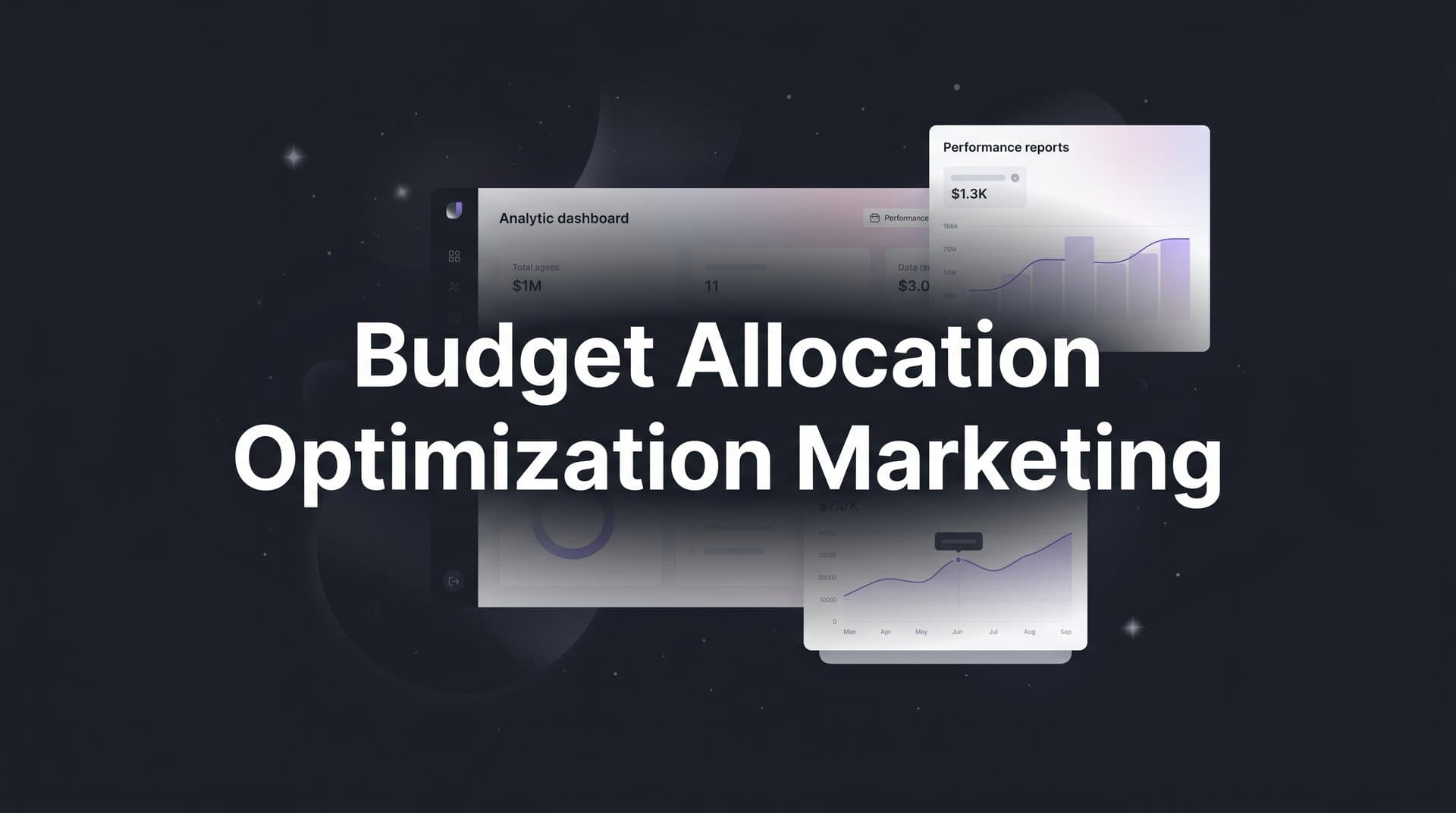
Budget allocation optimization marketing is the process of systematically analyzing your ad spend, attribution data, and conversion performance to move money toward what works and away from what does not. It is a discipline that replaces guesswork with evidence, and it is one of the highest-leverage activities a B2B SaaS marketing team can invest time in.
This guide walks you through a repeatable, six-step process to take control of your marketing budget. By the end, you will know how to audit your current spend, set attribution-backed benchmarks, identify your highest-performing channels, reallocate budget with confidence, feed better data back to ad platforms, and build a review cadence that keeps your allocation sharp over time.
Whether you are managing a lean growth team or overseeing a multi-channel paid strategy, these steps give you a structured framework grounded in real data rather than gut instinct. Let's get into it.
Step 1: Audit Your Current Marketing Spend and Channel Mix
Before you can optimize anything, you need a clear picture of where your money is actually going. This sounds obvious, but many teams are surprised by what they find when they do a thorough audit. Spend often accumulates across channels over time, with budgets renewed by default rather than by deliberate choice.
Start by pulling a full breakdown of current spend across every active channel. This includes paid search, paid social, content, events, sponsorships, and any other line items in your marketing budget. Do not rely on memory or high-level summaries. Go into each platform and pull the actual numbers.
Once you have the spend data, map each channel to the stage of the funnel it primarily targets. Is this channel driving awareness, nurturing consideration, or converting intent? This mapping matters because channels at different funnel stages require different performance benchmarks. Holding an awareness channel to a direct revenue standard will lead you to cut something that is actually contributing to pipeline in ways that are harder to see.
Next, identify channels where you have incomplete or unreliable conversion data. These are the channels where optimization is most dangerous, because any decision you make will be based on a distorted picture. Flag them clearly and note what data is missing.
Look for channels that have been running on autopilot. If a campaign has not had a meaningful performance review in the past 90 days, it belongs on your watchlist regardless of how it looks at a surface level.
Where data is available, document your current cost per lead and cost per opportunity by channel. These two numbers will anchor every comparison you make in later steps. Cost per lead tells you about volume efficiency. Cost per opportunity tells you about quality efficiency. Both matter, but cost per opportunity is the more important signal for B2B SaaS teams with longer sales cycles.
Finally, note which channels are connected to your CRM and which are not. Disconnected channels make attribution impossible, which means they will be invisible in any downstream analysis. This is not a reason to cut them immediately, but it is a reason to prioritize fixing the integration before making any major spend decisions.
The goal of this step is to create a clear, honest baseline. You are not making decisions yet. You are building the foundation that every subsequent step depends on.
Step 2: Establish Attribution Tracking Across Every Touchpoint
Here is the hard truth about budget optimization: you cannot optimize what you cannot measure. If your attribution data is incomplete, every decision you make in the following steps will be built on a shaky foundation. This step is not glamorous, but it is the most important one in the entire process.
The goal is to connect your ad platforms, CRM, and website into a single attribution system so that every touchpoint in the customer journey is captured. When a prospect clicks a LinkedIn ad, visits your website three times over two weeks, downloads a piece of content, and then converts on a Google search ad before becoming a qualified opportunity, you need to see all of that. Not just the last click.
Start by implementing server-side tracking and Conversion API integrations. Browser-level tracking has become increasingly unreliable due to cookie restrictions, privacy regulations, and ad blockers. A significant portion of conversion events are lost when you rely solely on pixel-based tracking. Server-side tracking routes conversion data directly from your server to ad platforms, recovering signal that would otherwise disappear and giving you a more accurate view of what is actually happening.
Choosing the right attribution model is also critical for B2B SaaS teams. Last-click attribution is the default in many platforms, but it systematically undervalues top-of-funnel channels that introduce prospects to your product long before they are ready to convert. For longer B2B sales cycles, linear or time-decay attribution models typically give a more complete and accurate picture of how channels work together. The right model for your business depends on your average sales cycle length and the number of touchpoints in a typical journey.
Once your tracking is in place, verify that conversion events are firing correctly at every stage. Check that data is flowing from ad click through to closed-won revenue in your CRM. This end-to-end verification is often where teams discover gaps, such as a CRM stage that is not being passed back to the attribution system, or a conversion event that fires inconsistently.
This is where a platform like Cometly becomes particularly valuable. Cometly connects your ad platforms, CRM events, and website data into a single, real-time view of the customer journey. Rather than stitching together data from multiple disconnected sources, you get a complete attribution picture that updates continuously, giving your team the foundation it needs to make confident budget decisions.
Without this step fully in place, every reallocation decision in the steps ahead is a guess dressed up as analysis. Get the attribution right first, and everything else becomes significantly more reliable.
Step 3: Identify Your Highest-Performing Channels and Campaigns
With accurate attribution in place, you can now do the analysis that most teams skip: ranking your channels by what actually matters. Not impressions. Not lead volume. Pipeline contribution and revenue influence.
Pull your attribution data and sort channels by the number of opportunities they have influenced, the revenue they have contributed to, and their cost per closed deal. This ranking will often look very different from a ranking based on lead volume alone. A channel that generates a high volume of leads but converts poorly into pipeline is not a high-performing channel. It is an expensive one.
This distinction is one of the most important insights in B2B SaaS marketing. Teams that optimize to lead volume end up feeding their CRM with contacts that never become customers. Teams that optimize to pipeline and revenue end up with fewer but better leads, and a budget that compounds over time.
Look at cost per opportunity and cost per closed deal by channel. These are your primary optimization metrics. If one channel consistently produces opportunities at a lower cost and those opportunities close at a higher rate, that channel deserves more budget. If another channel produces a high volume of leads that rarely progress past the first sales stage, it deserves scrutiny.
Go one level deeper and analyze campaign-level data within each channel. A channel might look average in aggregate but contain one or two campaigns that are significantly outperforming the rest. Conversely, a channel might look strong overall while quietly carrying a few campaigns that are dragging down its efficiency. Campaign-level analysis reveals these nuances.
Use multi-touch attribution to understand which channels are assisting conversions even when they are not the last touchpoint. In B2B SaaS, the channel that introduces a prospect to your brand is often different from the channel that captures the final conversion. Cutting a top-of-funnel channel because it does not show direct conversions in a last-click model is a common and costly mistake.
The output of this step is your evidence base: a clear, data-backed ranking of which channels and campaigns are driving the most meaningful outcomes. This is what you will use to make every reallocation decision in the next step.
Step 4: Build a Data-Backed Budget Reallocation Framework
Now you have the data. The next step is building a framework that turns that data into clear, defensible allocation decisions. Without a framework, budget conversations become political rather than analytical. With one, every decision has a documented rationale.
Start with a simple scoring approach. For each channel, assess three dimensions: revenue contribution (how much pipeline and closed revenue it has influenced), conversion rate efficiency (how well it converts spend into qualified opportunities), and scalability potential (whether increasing spend in this channel is likely to produce proportional returns or whether it has already reached diminishing returns).
Establish a minimum spend threshold for each channel you intend to keep active. This threshold should be high enough to generate statistically meaningful data. Channels running on very small budgets often show volatile performance metrics that do not reflect their true potential. If a channel cannot receive enough budget to generate reliable data, consider whether it belongs in your current mix at all.
Define clear rules for scaling. A channel should receive increased budget when its cost per opportunity is consistently below your target threshold and its conversion rates are stable over a defined review period. Both conditions matter. A low cost per opportunity that is trending upward is a warning sign, not a green light.
Define equally clear rules for cutting. A channel should have its budget reduced or paused when its cost per opportunity consistently exceeds your target and performance has not shown meaningful improvement over your review period. Set the review period before you make the cut, not after. This prevents reactive decisions based on short-term noise.
Reserve a portion of your total budget, typically somewhere in the range of 10 to 20 percent, for testing new channels, audiences, or creative approaches. This test budget serves two purposes. First, it prevents your channel mix from becoming stagnant by creating space for new opportunities. Second, it ensures you never commit significant spend to an unvalidated channel before you have evidence that it works for your specific audience.
Document every reallocation decision with the rationale behind it. When you revisit your allocation in 30 or 90 days, you want a record of why you made the changes you made. This documentation also makes it easier to identify patterns over time, such as channels that consistently underperform in certain quarters or audience segments that respond differently than expected.
Finally, avoid reallocating too aggressively at once. Large, sudden budget shifts can destabilize the machine learning algorithms that ad platforms use to optimize delivery. These algorithms are trained on historical spend patterns, and significant changes disrupt that training. Make incremental moves, measure the impact over a defined window, and then decide on the next adjustment.
Step 5: Feed Enriched Conversion Data Back to Ad Platforms
Most teams think of budget optimization purely as a question of where to move money. But there is a second dimension that is just as important and often overlooked: improving how ad platform algorithms spend the money you have already allocated.
Ad platforms like Meta and Google use machine learning to optimize delivery toward users who are most likely to convert. The quality of that optimization depends entirely on the quality of the conversion signal you send them. If you are only passing browser-based pixel events, you are giving these algorithms an incomplete and increasingly inaccurate picture of what a valuable conversion looks like.
The solution is to send enriched, first-party conversion events back to ad platforms using server-side APIs. This means passing not just form fills or website events, but downstream CRM events like marketing qualified leads, sales qualified leads, and closed-won deals. When a platform's algorithm knows what a real revenue-generating conversion looks like, it can optimize delivery toward users who are more likely to become actual customers rather than just leads.
Offline conversion imports and Conversion API integrations are the technical mechanisms for doing this. By connecting your CRM to your ad platforms through these integrations, you create a feedback loop where every closed deal informs future targeting. Over time, this feedback loop compounds. The algorithm gets smarter, your targeting improves, and your cost per qualified opportunity decreases even without changing your bid strategy or creative.
Think of it this way: budget reallocation tells your money where to go. Conversion signal quality tells the algorithm how to spend it once it gets there. Both levers matter, and the best results come from pulling them together.
Cometly is built to enable exactly this kind of feedback loop. It allows teams to send conversion-ready events back to Meta, Google, and other platforms, giving ad platform AI better signal to find high-value users. This turns your attribution data into a performance multiplier rather than just a reporting tool. The enriched data you collect does not just inform your internal decisions. It actively improves the efficiency of every dollar you spend.
Step 6: Build a Recurring Budget Review Cadence
Budget optimization is not a one-time exercise. Marketing performance shifts constantly. New campaigns launch, audience saturation sets in, competitive dynamics change, and seasonal patterns affect conversion rates. A budget allocation that was optimal three months ago may be significantly misaligned today.
The solution is a structured, tiered review cadence that keeps your allocation aligned with current performance data rather than historical assumptions.
Weekly campaign-level reviews: At the campaign level, check in weekly. Look for anything that is significantly over or under your target cost per opportunity. Flag campaigns that are burning budget without producing pipeline. This is not the time for major decisions. It is the time to catch problems early before they compound.
Monthly channel-level reviews: Once a month, step back and assess your channel-level allocation. Has the distribution of pipeline contribution shifted? Is a channel that was performing well starting to show signs of saturation? Are your test campaigns generating enough data to make a scaling decision? Monthly reviews are where you make incremental reallocation decisions based on a full month of data.
Quarterly strategic reviews: Every quarter, revisit your overall channel mix, your test budget allocation, and your growth targets. This is where you make larger strategic decisions: entering a new channel, exiting one that has consistently underperformed, or shifting the balance between acquisition and retention spend. Quarterly reviews should also include a reassessment of your attribution model to ensure it still reflects your current sales cycle dynamics.
Beyond the scheduled cadence, define the triggers that would prompt an immediate reallocation outside of the normal review cycle. For example, if a channel's cost per opportunity doubles over a two-week window, that warrants immediate attention rather than waiting for the next monthly review. Establish these thresholds in advance so the team knows when to act without waiting for a calendar prompt.
Assign clear ownership for each layer of the review. Someone should be accountable for the weekly campaign check, someone for the monthly channel review, and a senior stakeholder for the quarterly strategic discussion. Without ownership, reviews get skipped when things get busy, and budget drift sets in.
Use a marketing attribution dashboard that updates in real time so the team is always working from current data. Decisions made from last month's report are already outdated. A live dashboard connected to your ad platforms, CRM, and conversion data ensures that every review starts from an accurate, current baseline. This is where Cometly's real-time customer journey analytics give teams a meaningful operational advantage, providing the visibility needed to act on data as it happens rather than after the fact.
Putting It All Together
Budget allocation optimization marketing is a discipline, not a one-time decision. When you audit your spend, build accurate attribution, identify what is actually driving revenue, reallocate based on evidence, feed better data back to ad platforms, and review consistently, your marketing budget becomes a compounding asset rather than a fixed cost.
The teams that get this right are not necessarily the ones with the largest budgets. They are the ones who know exactly where every dollar is going and what it is returning. They make incremental, evidence-backed decisions. They close the feedback loop between their CRM and their ad platforms. And they review performance often enough to catch drift before it becomes waste.
Each step in this guide builds on the one before it. Attribution enables analysis. Analysis enables reallocation. Reallocation combined with enriched signal improves platform performance. And a consistent review cadence ensures the whole system stays calibrated over time.
Cometly gives B2B SaaS marketing teams the attribution data, customer journey visibility, and AI-powered insights needed to make these decisions with confidence. From capturing every touchpoint across your ad platforms and CRM to sending enriched conversion events back to Meta and Google, Cometly is built to be the single source of truth your budget optimization process depends on.
If you are ready to stop guessing and start optimizing, the first step is getting your attribution right. Get your free demo today and see how Cometly connects your ad platforms and CRM to give you a complete, real-time picture of what is actually driving your revenue.