
You're running paid ads, spending real budget across Google, Meta, LinkedIn, or TikTok, and your dashboard shows clicks and impressions. But when you ask which campaign actually drove that closed deal last month, the answer is a shrug.
This is one of the most common and costly problems in B2B SaaS marketing: you can't track sales from paid ads with any confidence. The gap between ad click and closed revenue feels like a black box. You know ads are doing something, but you can't prove what, which means you can't scale what's working or cut what's wasting budget.
This guide walks you through exactly how to close that gap. You'll learn why paid ad sales tracking breaks down in the first place, what infrastructure you need to fix it, and how to connect every touchpoint from the first ad impression to closed-won revenue.
By the end, you'll have a clear, actionable system for attributing sales to the ads that earned them. Whether you're a marketing leader trying to justify ad spend to your CFO, or a growth operator tired of flying blind, these steps give you the foundation to make confident, data-driven decisions.
No more guessing. No more disconnected data. Just a clear line between your ad investment and your revenue outcomes.
Step 1: Diagnose Why Your Paid Ad Tracking Is Broken
Before you can fix anything, you need to know exactly where the breakdown is happening. Most teams assume they have a tracking problem but can't pinpoint where the data actually disappears. That ambiguity is what keeps the problem alive.
There are three common failure points that cause teams to lose visibility into paid ad sales. The first is pixel-only tracking. Browser-based pixels were never designed to capture offline conversions like a deal closing in your CRM weeks after an ad click. They capture page views and button clicks, but the moment a lead moves into a sales conversation, the pixel loses the thread.
The second failure point is broken UTM parameters. UTMs are the backbone of source tracking, but they're fragile. A redirect that strips parameters, a team member who skips the utm_campaign field, or a form that doesn't pass UTM data into your CRM means the lead enters your pipeline as "direct" or "unknown." That data loss compounds over time.
The third failure point is the CRM disconnect. Even when UTM data is captured correctly in your analytics tool, it often never makes it into the CRM contact or deal record. So when sales closes a deal, there's no way to trace it back to the originating campaign.
Beyond these structural issues, there's the attribution model problem. If your current setup relies entirely on last-click attribution, you're only seeing the final touchpoint before a conversion, not the full picture of what influenced a deal. In B2B SaaS, where sales cycles can span weeks or months across multiple decision-makers, last-click attribution is particularly misleading. The ad that gets "credit" is often not the one that started the conversation.
Privacy changes have added another layer of complexity. iOS privacy updates and the widespread adoption of ad blockers have significantly reduced the reliability of pixel-based tracking. First-party data collection has become essential, not optional.
To complete this diagnostic step, audit your funnel from top to bottom. Trace a lead from the moment they click an ad to the moment they appear in your CRM. Ask: does that contact record show an original source? Does it show the campaign name? If the answer is no, you've found your drop-off point. Understanding how to track sales leads effectively starts with knowing exactly where your data trail goes cold.
Success indicator: You can name the exact stage in your funnel where ad source data gets lost, whether that's at the form submission, the CRM import, or the deal closure stage.
Step 2: Set Up Consistent UTM Tracking Across Every Campaign
UTM parameters are the simplest and most foundational layer of paid ad tracking. When they're set up correctly and consistently, they give you a reliable thread to follow from click to conversion. When they're inconsistent, everything downstream breaks.
A complete UTM structure covers five parameters. The utm_source identifies where the traffic came from, such as google or linkedin. The utm_medium describes the channel type, like cpc or paid-social. The utm_campaign names the specific campaign. The utm_content differentiates between ad creatives or variations. And utm_term captures the keyword or targeting detail for search campaigns.
The challenge isn't knowing what these parameters are. It's enforcing consistency across your entire team and every campaign. One person writing "Google" while another writes "google" creates two separate data buckets that can't be combined in reporting. Capitalization matters. Spacing matters. Abbreviations matter.
Build a standardized UTM naming convention document that your entire team uses. Include approved values for each parameter, examples for each ad channel, and a clear rule for how to handle edge cases. Then build a spreadsheet-based UTM builder that auto-generates correctly formatted URLs so no one is typing parameters by hand. If you need a starting point, a marketing campaign tracking spreadsheet can serve as the foundation for enforcing this consistency across your team.
The next critical step is making sure UTM parameters are passed through to your CRM on every form submission. Many teams capture UTMs in their analytics tool but never route that data into the CRM contact record. This is where the disconnect happens. Your landing page or form tool needs to be configured to read UTM values from the URL and write them into hidden fields that populate CRM properties on submission.
Watch out for these common UTM mistakes that quietly destroy your data quality:
Inconsistent capitalization: Treat all parameter values as lowercase by default to avoid fragmented data in reporting.
Missing parameters on retargeting ads: Retargeting campaigns are often set up quickly and UTMs get skipped. Every paid link needs full parameter coverage, not just prospecting campaigns.
UTMs stripped by redirects: If your landing page URL goes through a redirect, test whether the UTM parameters survive. Many don't, and you'll only discover this by checking your CRM for leads with missing source data.
UTM tracking connects naturally to lead attribution, which is the broader process of understanding which channels and campaigns are generating your most valuable leads.
Success indicator: Every new lead in your CRM has a populated utm_source field that traces back to a specific ad campaign, with no unexplained "direct" or "unknown" sources for paid traffic.
Step 3: Implement Server-Side Tracking to Capture What Pixels Miss
Even with perfect UTM setup, you're still missing conversions if you're relying solely on browser-based pixels. This is the reality of tracking in 2026: ad blockers, cookie restrictions, and browser privacy settings are causing pixels to fail silently, and you often have no idea how much data you're losing.
Server-side tracking solves this by sending conversion data directly from your server to ad platforms, bypassing the client-side limitations entirely. Instead of a pixel firing in a user's browser, your server sends the event data directly to Meta or Google after a conversion occurs. The user's privacy settings and browser extensions become irrelevant to the data transmission.
For Meta, this means setting up the Conversion API, commonly referred to as CAPI. For Google, it means configuring Enhanced Conversions. Both solutions allow you to send enriched, first-party event data back to each ad platform, improving the quality of the conversion signals those platforms use for optimization and targeting. Getting your Google Ads conversion tracking configured correctly is a critical part of this server-side setup.
Setting up server-side tracking involves a few key components. You need a way to capture the event on your server, which typically happens through your backend application or a tag management solution with server-side capabilities. You then need to map the event data, including user identifiers like hashed email addresses, to the format each platform expects. Finally, you need to send that data via the platform's API in near real time.
One critical technical requirement is event deduplication. When you run both a browser pixel and server-side tracking simultaneously, the same conversion can be reported twice: once by the pixel and once by the server event. Both Meta and Google have deduplication mechanisms, but they require you to pass a consistent event ID that matches between the browser event and the server event. Skipping this step leads to inflated conversion counts and misallocated budget.
The payoff for getting this right is significant. Cleaner, more complete conversion signals improve ad platform machine learning, which means better targeting and more efficient optimization. You'll also see improvement in your event match quality scores in Meta Events Manager and your conversion accuracy in Google Ads.
Understanding how this connects to your broader ad tracking management strategy helps you see server-side tracking not as a standalone fix but as a foundational layer of a complete system.
Success indicator: Your event match quality scores in Meta Events Manager show improvement, and your Google Ads conversion data more closely aligns with your CRM lead volume after server-side setup is complete.
Step 4: Connect Your CRM to Your Ad Data for Full-Funnel Visibility
This is the step most B2B SaaS teams skip, and it's the one that matters most for tracking actual sales. Getting a lead into your CRM is only half the job. The other half is making sure that when a deal closes, that revenue event flows back to the ad platform that originated the journey.
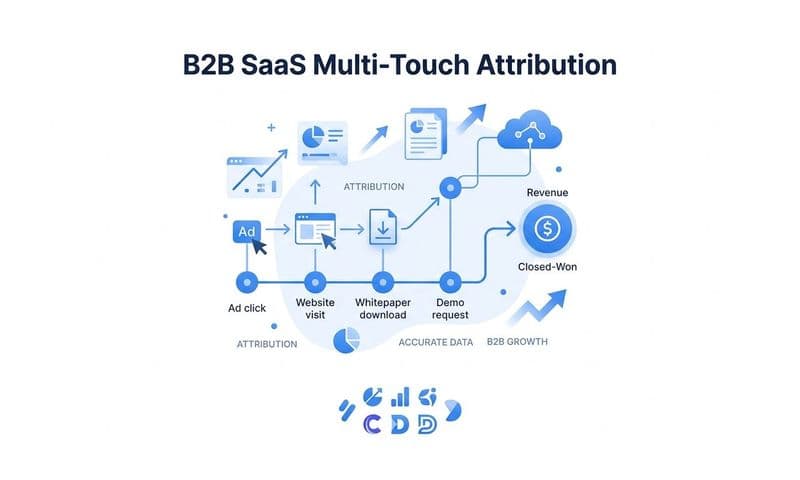
Start by mapping your CRM pipeline stages to marketing touchpoints. You want visibility into which ads are influencing leads at every stage, not just at the initial form fill. A deal that started from a LinkedIn ad, nurtured through a Google remarketing campaign, and closed after a demo request represents multiple touchpoints. Your CRM needs to capture that history.
The specific CRM fields that need to be populated for attribution to work are: original source, lead source, campaign name, ad content or creative identifier, and deal value. These fields need to be populated automatically at the moment a lead enters the system, using the UTM data you set up in Step 2. Don't rely on manual entry. Manual entry is inconsistent and incomplete.
The most powerful piece of this step is offline conversion imports. Both Google Ads and Meta Ads support the ability to upload CRM conversion events, including deal closures, back to the ad platform. This means when a deal closes in your CRM, you can send that revenue event, along with the original click ID that tied the lead to a specific ad, back to Google or Meta as an offline conversion. Learning how to track offline conversions is what separates teams that optimize toward lead volume from those that optimize toward actual closed revenue.
This closes the loop between ad spend and actual closed revenue, not just lead volume. Without this, ad platforms optimize toward the leads that are easiest to generate, which are often not the leads that convert to paying customers. With offline conversion imports, you're telling the platforms to optimize toward the leads that actually close.
Many B2B SaaS teams track MQLs and SQLs carefully but never connect that data back to the original ad source. The result is optimization toward lead cost rather than customer acquisition cost. That's a costly mistake when your average deal value is significant.
For a deeper look at how this connects to the broader B2B customer journey, understanding the full path from awareness to closed revenue helps you see why CRM integration is non-negotiable for accurate attribution.
Success indicator: You can pull a CRM report showing closed-won revenue filtered by original ad source or campaign name, and that data matches what you're seeing in your ad platform conversion reports.
Step 5: Choose and Apply the Right Attribution Model for Your Sales Cycle
Even with perfect tracking infrastructure in place, the numbers you see depend entirely on which attribution model you're using. Choosing the wrong model doesn't just give you inaccurate data. It actively leads you to make wrong budget decisions.
Last-click attribution is the default for most ad platforms, and it's also the most misleading model for B2B SaaS. It gives 100% of the credit to the final touchpoint before a conversion, ignoring every ad, email, and content piece that built awareness and moved the prospect toward a decision. In a sales cycle that spans multiple weeks and involves several decision-makers, the last click is rarely the most influential one.
Here's a quick breakdown of the core attribution models and when each makes sense:
First-touch attribution: Assigns all credit to the first interaction. Useful for understanding which channels are best at generating initial awareness and bringing new prospects into your funnel.
Last-touch attribution: Assigns all credit to the final interaction before conversion. Useful for understanding which channels are best at closing, but misleading as a standalone model for budget decisions.
Linear attribution: Distributes credit equally across all touchpoints. Simple and fair, but doesn't account for the fact that some touchpoints are more influential than others.
Time-decay attribution: Gives more credit to touchpoints closer to the conversion. Useful for shorter sales cycles but can undervalue early awareness-building campaigns in longer B2B cycles.
Data-driven attribution: Uses machine learning to assign credit based on which touchpoints actually correlate with conversions. The most accurate model when you have sufficient conversion volume, but unreliable with small data sets.
For most B2B SaaS teams, multi-touch attribution is the right framework. It acknowledges that multiple campaigns contributed to a deal and distributes credit accordingly. The specific model you choose within multi-touch depends on your sales cycle length and data volume.
A practical approach is to use different models for different decisions. Use first-touch to evaluate brand awareness campaigns. Use multi-touch for budget allocation across channels. Use last-touch to assess bottom-of-funnel conversion campaigns. Applying a single model to all decisions is where teams go wrong. The best marketing attribution software will let you toggle between models so you can compare results before committing to a budget decision.
Exploring the five most common ad attribution models in depth gives you the context to make this decision with confidence rather than guessing.
Success indicator: You can compare attribution models side by side in your reporting and explain to stakeholders why a specific model best reflects your sales cycle and marketing mix.
Step 6: Use a Centralized Attribution Platform to Connect Every Data Source
You've diagnosed the problem, set up UTMs, implemented server-side tracking, connected your CRM, and selected an attribution model. Now the question is: where does all of this data actually live, and how do you see it in one place?
Native ad platform reports are siloed by design. Google Ads shows you Google's version of performance. Meta shows you Meta's version. LinkedIn shows you LinkedIn's version. Each platform uses its own attribution logic and claims credit for the same conversions. When you add up the conversions across platforms, the total often exceeds your actual lead or revenue count. This is the attribution overlap problem, and it makes cross-channel budget decisions nearly impossible without a neutral, centralized view. Reviewing your paid ads analytics through a single neutral lens is the only way to make reliable cross-channel comparisons.
Spreadsheets are the common workaround, but they don't scale. Manual data exports, VLOOKUP formulas, and stitched-together reports are time-consuming and error-prone. They also can't give you real-time visibility or the ability to drill down from a channel-level metric to a specific ad creative.
A centralized attribution platform solves this by pulling data from your ad accounts, CRM, website, and payment systems into a single source of truth with consistent attribution logic applied across all channels.
This is exactly what Cometly is built for. B2B SaaS teams use Cometly to track the full customer journey from first ad click through pipeline stages to closed-won revenue, connecting ad spend directly to revenue outcomes. Instead of toggling between five different dashboards and trying to reconcile conflicting numbers, you get one view that shows you exactly what's happening across every channel.
Cometly's AI analyzes performance across every ad channel and surfaces recommendations on which campaigns to scale and which to cut. Rather than manually reviewing performance data and forming opinions, you get data-driven guidance that's grounded in what's actually driving revenue.
Connecting your billing system, such as Stripe, with your ad data takes this a step further. You can see actual revenue generated per campaign, not just lead counts or pipeline estimates. That's the difference between knowing a campaign generated 40 leads and knowing it generated a specific amount in closed revenue. One number justifies budget. The other just creates more questions.
With 70+ native integrations, Cometly connects your existing stack without requiring custom engineering work. Your CRM, ad platforms, website analytics, and payment systems all feed into one place. For teams that have been struggling with fragmented data, this kind of centralization is transformative.
Understanding the broader landscape of B2B revenue attribution software helps you see what to look for in a platform and why purpose-built solutions outperform generic analytics tools for this specific use case.
Success indicator: You can open a single dashboard and see cost per acquisition, pipeline influenced, and closed revenue by campaign, channel, and ad creative, without exporting a single spreadsheet.
Putting It All Together: Your Paid Ad Tracking Checklist
If you've followed these six steps, you've moved from a broken, fragmented tracking setup to a complete attribution system. Let's recap the framework and give you a quick checklist to verify everything is in place.
The six-step framework covers: diagnosing where your tracking breaks down, standardizing UTM parameters across every campaign, implementing server-side tracking to capture what pixels miss, connecting your CRM to your ad data with offline conversion imports, selecting the right attribution model for your sales cycle, and centralizing everything in a single attribution platform.
Here's your implementation checklist:
UTM parameters: Every paid ad link has a complete, consistently formatted UTM string covering source, medium, campaign, content, and term.
CRM field population: Every new lead record in your CRM is automatically populated with original source, campaign name, and ad content from UTM data passed through form submissions.
Server-side events: Meta CAPI and Google Enhanced Conversions are configured and firing for key conversion events, with deduplication logic in place.
Offline conversion imports: Closed-won deals in your CRM are being sent back to Google Ads and Meta as offline conversion events, connecting revenue to original ad clicks.
Attribution model documented: Your team has selected and documented the attribution model used for budget decisions, and you can explain the rationale to stakeholders.
Centralized dashboard: A single platform shows cost per acquisition, pipeline influenced, and closed revenue by channel and campaign in real time.
Tracking sales from paid ads is not a one-time setup. It's an ongoing system that needs regular auditing as campaigns evolve, new channels are added, and privacy standards continue to shift. Schedule a quarterly review of your tracking infrastructure to catch drift before it corrupts your data.
Cometly handles this entire system in one place, purpose-built for B2B SaaS marketing teams who need accurate attribution without stitching together multiple tools. Ready to stop guessing and start knowing exactly what drives revenue? Get your free demo and see how Cometly connects every ad touchpoint to closed-won revenue.