You're running paid ads across multiple channels, nurturing leads through email sequences, and closing deals with a skilled sales team. But when someone asks which campaign actually drove that enterprise deal, you're left piecing together fragments from three different dashboards. Sound familiar?
This is the central frustration for most B2B SaaS marketing teams. The investment is real, the activity is constant, but the connection between a prospect's first touchpoint and their eventual signature on a contract remains murky at best. The client experience journey is the framework that changes this. It maps every interaction a prospect has with your brand, from the first ad impression to the moment they become a paying customer and beyond.
But here's what separates high-performing marketing teams from everyone else: they treat the client experience journey not as a customer satisfaction exercise, but as a revenue-critical measurement discipline. When you can see the full journey with accurate data, you can allocate budget smarter, optimize campaigns faster, and grow with far more confidence. This article will show you how to map, track, and optimize every stage of that journey using attribution data.
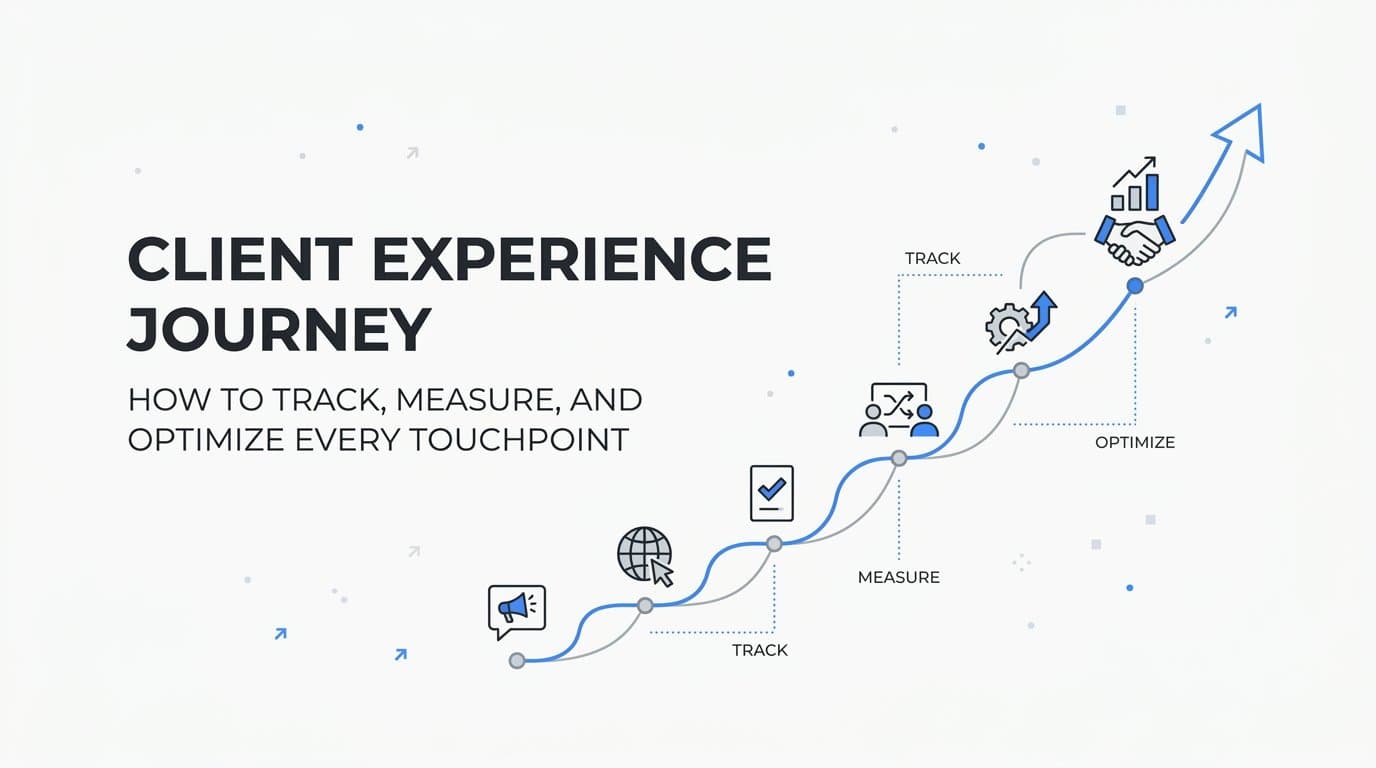
The Stages That Define the Client Experience Journey
Think of the client experience journey as a series of distinct mental states your prospect moves through before, during, and after they become a customer. Each stage represents a different mindset, a different set of questions, and a different set of touchpoints that your marketing needs to address.
Awareness: At this stage, a prospect realizes they have a problem worth solving. They encounter your brand through a paid ad, an organic search result, a LinkedIn post, or a referral. They are not evaluating you yet. They are simply becoming aware that a solution like yours exists.
Consideration: Now the prospect is actively researching. They are comparing options, reading reviews, watching demos, and engaging with your content more deliberately. This stage often involves multiple stakeholders in B2B contexts, each with their own questions and concerns.
Decision: The buying committee narrows its choices and begins evaluating specific vendors. Sales calls, product trials, security reviews, and pricing discussions all happen here. The journey becomes highly personalized and often sales-assisted.
Onboarding: The deal is closed, but the journey is not over. How a new client experiences their first days with your product shapes their likelihood of expanding, renewing, and referring others. Marketing and customer success both play a role here.
Retention and Expansion: Long-term value is built in this stage. Engaged customers become advocates. Expansion revenue flows from accounts that experienced a strong journey from the start.
The B2B client experience journey differs from B2C in important ways. Sales cycles often stretch across weeks or months. Multiple decision-makers each have their own journey through awareness and consideration before converging on a shared decision. And the mix of digital self-serve touchpoints and human sales interactions makes the data trail far more complex to follow.
This complexity is precisely why tracking matters so much. Each stage generates different signals: ad clicks, content downloads, demo requests, CRM stage progressions, and billing events. Missing data at any one stage creates a blind spot that distorts your understanding of what is actually driving revenue. When you cannot see the full picture, budget decisions get made on incomplete information, and that is where marketing efficiency quietly erodes.
Why Most Teams Lose Sight of the Journey
The problem is not that the data does not exist. It does. The problem is that it lives in separate systems that do not natively communicate with each other.
Your ad platforms capture impressions, clicks, and platform-reported conversions. Your CRM tracks lead status, sales activity, and deal outcomes. Your website analytics records sessions, page views, and form submissions. Each system tells a partial story, but none of them tells the whole one. The result is that marketers are constantly trying to reconcile reports that were never designed to align, and the client experience journey appears fragmented even when the actual customer experience was not.
Last-click attribution makes this worse. It is still the default model in many ad platforms and analytics tools, and it assigns 100 percent of the credit for a conversion to the final touchpoint before the conversion event. This sounds logical until you consider what it ignores.
A prospect might discover your product through a LinkedIn ad, spend two weeks reading your blog content, attend a webinar, and then convert after clicking a branded search ad. Last-click attribution gives all the credit to the branded search ad and zero credit to the LinkedIn ad, the blog, or the webinar. Every one of those earlier touchpoints played a role in building the intent that led to the conversion, but they are invisible in last-click reporting.
The downstream consequence is significant. Marketing teams using last-click attribution systematically undervalue awareness and consideration-stage channels because those channels rarely get the last click. Over time, budget shifts toward bottom-funnel channels that look efficient on paper: branded search, retargeting, and direct response campaigns. The top-funnel channels that generate qualified demand in the first place get defunded.
This creates a slow-moving pipeline crisis. The bottom of the funnel keeps converting, but the top of the funnel is no longer being fed at the same rate. Months later, pipeline slows and it is not immediately obvious why. The attribution model made the decision for you, silently and without warning.
The fix requires a fundamentally different approach to data: one that connects all your systems, tracks touchpoints across the entire journey, and distributes credit in a way that reflects how B2B buyers actually make decisions.
Mapping Touchpoints Across Every Channel
Every interaction a prospect has with your brand leaves a data trail. The challenge is collecting those signals consistently and connecting them to a single customer record. Let's walk through where those touchpoints live and what they tell you.
Paid Ads: Impressions and clicks from Meta, Google, and LinkedIn mark the beginning of many B2B journeys. These touchpoints establish initial awareness and drive traffic into your funnel. They are measurable at the platform level, but platform-reported conversions often overcount due to view-through attribution windows and cross-device gaps.
Organic Search: Blog content, landing pages, and comparison articles capture prospects who are actively researching. Organic touchpoints often appear in the middle of the journey, reinforcing awareness built through paid channels or generating new demand from high-intent queries.
Email Sequences: Once a prospect is in your system, email becomes a key nurture channel. Opens, clicks, and reply rates signal where a prospect is in their evaluation process and can trigger CRM stage changes or sales alerts.
Sales Calls and Demos: These are high-value touchpoints that often happen late in the journey but are rarely captured in marketing attribution models. When a CRM is properly integrated, these interactions can be connected back to the original marketing source that brought the prospect in.
Product Trials: For self-serve SaaS products, trial behavior is one of the strongest signals of purchase intent. Activation events, feature usage, and trial-to-paid conversion rates all feed back into the journey picture.
Multi-touch attribution is the methodology that makes sense of all these signals. Rather than assigning credit to a single touchpoint, multi-touch models distribute credit across all the interactions that contributed to a conversion. This gives you a far more accurate picture of what actually influenced the decision, and it allows you to invest in channels that build intent early, not just those that capture it at the end.
Server-side tracking has become essential for making this work reliably. Browser-based tracking has become increasingly unreliable as browsers restrict third-party cookies and ad blockers become more common. Server-side tracking collects data directly from your server rather than relying on a browser pixel, which means it captures events that would otherwise be missed. Combined with first-party data strategies, where you collect and own the data rather than depending on third-party sources, server-side tracking gives you a more complete and durable foundation for journey visibility. This is not a future consideration. It is a current requirement for any team serious about accurate attribution.
Connecting Journey Data to Pipeline and Revenue
Tracking clicks and form fills is a starting point, but it is not the destination. The real value of the client experience journey comes when you connect those early touchpoints to what actually happens downstream: pipeline stages, closed-won deals, and customer lifetime value.
This is where revenue attribution enters the picture. Revenue attribution is the practice of tying every marketing touchpoint back to a dollar amount. Instead of measuring success by the number of leads generated, you measure it by the revenue those leads eventually produced. This shift changes how you evaluate channel performance, how you justify budget decisions, and how you communicate marketing's contribution to the business.
Consider the difference between these two reporting scenarios. In the first, you report that a LinkedIn campaign generated 150 leads at a cost of $40 per lead. In the second, you report that the same campaign generated $180,000 in closed-won revenue at a cost of $6,000, producing a 30x return on ad spend. The second report tells a fundamentally different story, and it is only possible when your journey data connects all the way to revenue.
Achieving this requires integrating data from multiple systems into a single source of truth. Your ad platform data needs to connect to your CRM so that lead source information follows a prospect through every pipeline stage. Your CRM data needs to connect to your billing system so that when a deal closes, the revenue is tied back to the original marketing touchpoints. For B2B SaaS companies using Stripe, this means linking subscription revenue directly to the campaigns and channels that influenced the customer's journey.
When this integration is in place, you can answer questions that were previously unanswerable. Which campaigns produce customers with the highest lifetime value? Which channels generate pipeline that actually closes, rather than just leads that stall? Which touchpoints appear most consistently in the journeys of your best customers? These are the questions that drive smarter budget allocation and more efficient growth.
Platforms like Cometly are built specifically to make this connection. By integrating ad platform data, CRM records, and revenue data from tools like Stripe, Cometly creates a unified view of the client experience journey from first ad click to closed-won revenue. Marketing teams get a single dashboard where pipeline and revenue attribution are visible in real time, rather than assembled manually from disconnected reports.
Using Attribution Insights to Optimize the Journey
Once you have a connected view of the client experience journey, the next step is using that data to make better decisions faster. Attribution insights are most powerful when you use them to compare models, surface patterns, and feed your findings back into your campaigns.
Different attribution models tell different stories about the same journey, and comparing them is one of the most revealing exercises a marketing team can do. First-touch attribution highlights which channels are best at generating initial awareness. Last-touch attribution shows what channels are closing deals. Linear attribution spreads credit evenly and gives you a baseline view of which channels appear most consistently. Data-driven attribution uses statistical modeling to assign credit based on actual influence, accounting for the fact that some touchpoints matter more than others even when they are not first or last.
Running these models side by side reveals where your channel investments are aligned with your business goals and where they are not. A channel that looks weak under last-touch attribution might look strong under first-touch, suggesting it plays a critical awareness role that deserves continued investment even if it never gets the conversion credit. This kind of insight is not available when you rely on a single attribution model.
AI-driven analysis accelerates this process significantly. Rather than manually reviewing reports across channels and campaigns, AI can surface high-performing ads and underperforming segments within the journey, flagging opportunities and inefficiencies that would take hours to find manually. Cometly's AI ads manager applies this kind of analysis across your full campaign portfolio, giving you actionable recommendations without requiring you to build custom reports from scratch.
The feedback loop is the final piece. When you send enriched conversion data back to ad platforms like Meta and Google through their Conversion APIs, you are giving their algorithms a more accurate picture of what a valuable conversion looks like. Instead of optimizing toward surface-level events like form fills, the platform can optimize toward the deeper signals you care about: qualified pipeline, closed deals, or high-value customers. This improves targeting, reduces wasted spend, and helps the platform find more prospects who match the profile of your best clients. It is one of the highest-leverage actions a B2B SaaS marketing team can take to improve ad efficiency at scale.
Putting the Client Experience Journey to Work
The shift required here is a mental one as much as a technical one. Most marketing teams are trained to measure campaigns in isolation: this ad drove these clicks, this email drove these opens, this landing page drove these conversions. The client experience journey framework asks you to view every one of those activities as part of a connected, measurable system where each touchpoint influences the next.
When you adopt this perspective, budget decisions change. You stop defunding channels because they do not show up in last-click reports and start investing based on where each channel fits within the full journey. You stop optimizing for volume metrics and start optimizing for revenue outcomes. You stop guessing which campaigns are working and start knowing.
A practical starting point is an audit of your current data connections. Map out where your journey data lives today: your ad platforms, your CRM, your website analytics, your billing system. Identify where the visibility breaks down. Is it between your ads and your CRM? Between your CRM and your revenue data? Between your website and your ad platforms? Each gap is a place where journey data is being lost, and closing those gaps is where the highest-value work begins.
Cometly is built for exactly this. It connects your ad platforms, CRM, and revenue data into a single source of truth, giving B2B SaaS marketing teams a complete, real-time view of the client experience journey. With 70+ native integrations, server-side tracking, multi-touch attribution, and AI-powered recommendations, Cometly gives you the infrastructure to track every touchpoint and the intelligence to act on what you find.
The Bottom Line
The client experience journey is not a soft concept reserved for customer success teams. It is a measurable, optimizable system that sits at the center of how B2B SaaS companies grow. Every touchpoint is a data point. Every stage is an opportunity to understand what is working and what is not. And every gap in your journey visibility is a place where budget is being wasted or opportunity is being missed.
Teams that track the full journey accurately spend smarter. They invest in the channels that build real demand, not just the ones that capture it. They can prove marketing's contribution to revenue with confidence. And they grow with a clarity that their competitors, still stitching together disconnected reports, simply do not have.
The technology to do this exists. The methodology is proven. What it takes is the commitment to connect your data, choose the right attribution approach, and view every campaign as part of a larger, measurable journey.
Ready to see your own client experience journey mapped in real time? Get your free demo and start capturing every touchpoint so you can maximize conversions and grow with confidence.