
Most ad platforms are making million-dollar optimization decisions based on data that would embarrass a first-year analyst. A form submission fires, a pixel records a "lead," and the algorithm nods along, satisfied. But that pixel has no idea whether that lead became a $60,000 ARR customer or ghosted your sales team after the first email. It just knows someone clicked a button.
This is the quiet crisis inside most B2B SaaS paid campaigns. The data flowing back to Meta, Google, and LinkedIn is technically accurate but strategically useless. It tells ad platforms that conversions happened, but nothing about what those conversions were actually worth. The result is bidding algorithms trained to find more of the wrong people, at scale, with your budget.
Conversion data enrichment is how you fix that. It is the practice of appending meaningful business context to your conversion events before sending them back to ad platforms, so the algorithms optimizing your campaigns actually understand what a good customer looks like. For B2B SaaS marketing teams running paid acquisition, this has shifted from a nice-to-have technical upgrade to a foundational requirement for competitive performance.
This article breaks down exactly how conversion data enrichment works, why it matters for both attribution and ad performance, which data points create the most impact, and how to build an enrichment strategy that scales with your growth.
Why Your Ad Platforms Are Flying Blind
When a prospect fills out a demo request form on your website, your browser-based pixel fires a "Lead" event. That event travels to Meta or Google carrying a handful of fields: a timestamp, a URL, maybe a click ID. What it does not carry is anything your CRM knows about that person. No lead score. No company size. No indication that this is a VP of Engineering at a 500-person SaaS company versus a student doing research for a class project.
Ad platforms are not passive recipients of this data. They are actively using every conversion signal you send to train their bidding algorithms. The machine learning models behind Google's Smart Bidding and Meta's Advantage+ are constantly asking: who converted, and what patterns can I find among them? When the conversion signal is shallow, the model builds shallow patterns. It learns to find more people who click buttons, not more people who buy software.
This matters enormously for B2B SaaS companies because lead quality variance is extreme. In most B2B pipelines, a small percentage of leads generate the vast majority of revenue. If your ad platform cannot distinguish between a high-intent enterprise prospect and a low-quality lead, it will optimize toward volume rather than value. You end up with more leads and less pipeline, which is exactly the wrong direction.
The privacy landscape has made this problem significantly worse. iOS privacy changes have reduced the visibility of post-click behavior for a substantial portion of mobile users. Third-party cookie deprecation continues to erode the reliability of browser-based attribution. Ad blockers intercept pixel fires before they even reach the platform. The result is not just incomplete data but systematically biased data: the conversions that do get reported are a non-representative sample of your actual customer base.
Server-side tracking via Conversion APIs has emerged as the industry-accepted technical solution to signal loss. But the infrastructure that solves signal loss also happens to be the same infrastructure that makes enrichment possible. When you move conversion data off the browser and into a server-to-server pipeline, you gain the ability to attach any data your backend systems know about that conversion before it reaches the ad platform. That is the opening that enrichment exploits.
The bottom line is this: ad platforms are only as smart as the data you feed them. If you feed them shallow pixel events, you get shallow optimization. If you feed them enriched, context-rich conversion signals, you give their algorithms a genuine shot at finding your best customers. Understanding conversion tracking gaps in your current setup is the essential first step toward fixing them.
What Conversion Data Enrichment Actually Means
Conversion data enrichment is the process of adding meaningful business context to a conversion event before or when sending it to an ad platform. Instead of sending a bare "Lead" event that says a form was submitted, you send an enriched event that says a lead was submitted, scored at 85 in your CRM, flagged as an SQL, associated with a company in the mid-market segment, and tied to an expected deal value of $24,000.
That is a fundamentally different signal. And it produces fundamentally different algorithmic behavior.
Enrichment happens in the data layer that sits between your CRM or backend systems and the ad platform. This is why it cannot be done with a standard browser pixel. A pixel only knows what is visible in the browser at the moment the event fires. It cannot reach into your CRM, pull a lead score, attach a deal value, and package all of that into the event payload. That requires a server-side process.
The primary delivery mechanism for enriched conversion data is the Conversion API, or CAPI. Both Meta and Google offer Conversion APIs that allow you to send event data directly from your server to the ad platform, bypassing the browser entirely. This approach is more reliable, more complete, and far more flexible in terms of what data you can include in each event. A detailed Conversion API implementation tutorial can walk you through the exact steps for recovering lost attribution data in the process.
There are two primary timing models for enrichment, and both serve different purposes in a B2B SaaS context.
Real-time enrichment: The conversion event is enriched and sent to the ad platform at the moment it occurs. For example, when a lead is created in your CRM, your system immediately appends the lead score and company firmographics, then sends the enriched event to Meta via CAPI. This is ideal for top-of-funnel events where you have enough data at the time of conversion to add meaningful context.
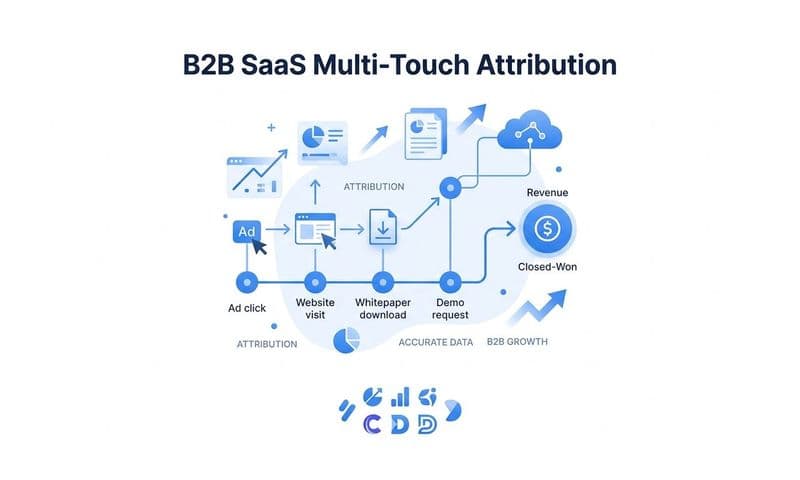
Retroactive enrichment via offline conversions: The initial conversion event is sent with basic data, but as the lead progresses through your funnel and more information becomes available, additional enriched events are sent back to the platform. When a lead becomes an opportunity, you send an "Opportunity Created" event with deal value. When a deal closes, you send a "Closed Won" event with actual revenue. This approach is essential for B2B SaaS companies with longer sales cycles where the most valuable conversion signals happen weeks or months after the original ad click.
The combination of both approaches gives ad platforms a complete, continuously updated picture of which campaigns and creatives are generating real business outcomes, not just form fills. This is the foundation that makes value-based bidding, accurate attribution, and intelligent budget allocation possible.
The Data Points That Make Enrichment Powerful
Not all enrichment fields are created equal. Some data points have an outsized impact on algorithm performance and attribution accuracy. Understanding which fields to prioritize helps you focus your implementation effort where it will generate the most return.
Deal value and predicted revenue: Passing actual or estimated deal value with your conversion events is among the highest-leverage enrichment you can do. Both Meta and Google support value-based bidding strategies that optimize toward conversion value rather than conversion volume. This only works if you are passing values. For B2B SaaS, this means connecting CRM deal values or predicted ARR back to the original ad events. When the algorithm knows that Campaign A generates $50,000 opportunities and Campaign B generates $8,000 opportunities, it can allocate budget accordingly. Without that signal, it treats both campaigns as equally valuable because both generated "leads."
Funnel stage signals: Sending downstream funnel events back to ad platforms gives the algorithm a much more accurate picture of campaign quality. SQL status, opportunity created, demo completed, and closed-won events are all signals that carry far more business meaning than a top-of-funnel lead event. When you send these events with the original click ID attached, the platform can trace them back to the specific ad that drove the original interaction and update its optimization model accordingly.
Lead scores from your CRM: If your CRM assigns lead scores based on behavioral signals, firmographic fit, or engagement depth, that score is a powerful enrichment field. Passing lead score as a conversion value allows the bidding algorithm to distinguish between a high-intent prospect and a casual browser, even at the top of the funnel before any sales qualification has occurred.
First-party identifiers: Hashed email addresses, phone numbers, and CRM contact IDs are critical for improving match rates between your conversion data and the ad platform's user graph. A strong first-party data strategy ensures that when the platform matches your conversion event to a specific user profile, it can attribute that conversion to the correct campaign touchpoint and incorporate that user's characteristics into its optimization model. Higher match rates mean better attribution and more accurate lookalike audiences.
Company firmographic data: For B2B SaaS companies targeting specific company sizes, industries, or geographies, passing firmographic attributes with conversion events helps ad platforms understand the profile of your highest-value customers. This feeds directly into audience expansion and lookalike modeling, helping the algorithm find more companies that look like your best accounts.
The common thread across all of these enrichment fields is that they replace generic conversion signals with specific business intelligence. The more accurately your conversion data reflects real revenue outcomes, the more effectively ad platforms can optimize toward those outcomes.
How Server-Side Tracking Enables Enrichment at Scale
Browser-based pixels have a fundamental constraint: they can only capture what is visible in the browser at the moment an event fires. A pixel on your thank-you page knows the URL, the referring source, and perhaps a few URL parameters. It has no connection to your CRM, no access to your billing system, and no way to attach the business context that makes enrichment valuable.
Server-side tracking removes that constraint entirely. When you send conversion events from your server or a middleware layer directly to an ad platform's Conversion API, you control the entire event payload. You can pull data from any system your backend has access to, including your CRM, your product database, your billing platform, and your lead scoring engine, and package all of it into a single enriched event before it ever reaches the ad platform.
Meta's Conversions API and Google's Enhanced Conversions are the two primary server-side channels for B2B SaaS marketers. Meta CAPI allows you to send web, app, and offline events with custom data fields including value, currency, lead score, and any custom parameters you define. Google's server-side tagging and Enhanced Conversions for leads support similar functionality, enabling you to send enriched events that improve both bidding performance and attribution accuracy. Reviewing how Google Ads conversion tracking works at a technical level helps clarify exactly where enriched data slots into the measurement pipeline.
Server-side tracking also solves the signal loss problem that has plagued browser-based measurement. Because the event originates from your server rather than the user's browser, it is not affected by ad blockers, iOS privacy restrictions, or browser cookie limitations. Events that would have been silently dropped by a pixel arrive reliably via CAPI, giving ad platforms a more complete and accurate picture of your conversion activity.
One critical technical consideration when running both browser pixels and server-side tracking simultaneously is event deduplication. If both your pixel and your server-side integration fire for the same conversion event, the ad platform will count that conversion twice, inflating your reported numbers and corrupting your bidding signals. Ad platforms address this through deduplication keys, typically an event ID that you generate and include in both the pixel event and the server-side event. When the platform receives two events with the same ID, it deduplicates them and counts only one, while still using the richer data from the server-side event for optimization purposes.
Proper deduplication implementation is not optional. Without it, your conversion data becomes unreliable, and the bidding algorithms you are trying to improve will be working from inflated, inaccurate signals. Getting this right is a prerequisite for any serious enrichment strategy.
The infrastructure investment in server-side tracking pays dividends beyond enrichment alone. It improves overall data reliability, reduces attribution gaps, and creates a durable measurement foundation that is not dependent on browser behavior or third-party cookies.
Connecting Enriched Data to Attribution and Revenue Tracking
Conversion data enrichment does not just improve ad platform performance. It also transforms the quality of your marketing attribution. When every conversion event carries meaningful business context, your attribution models can do something they could never do with shallow pixel data: connect ad spend directly to revenue.
In a standard pixel-based setup, multi-touch attribution models assign credit to touchpoints based on which campaigns a user interacted with before submitting a form. The problem is that all form submissions are treated as equally valuable. A touchpoint that contributed to a $100,000 deal gets the same attribution weight as one that contributed to a lead that never responded to outreach. This produces attribution data that is technically accurate but strategically misleading.
When your conversion events are enriched with deal values, funnel stage signals, and revenue outcomes, attribution models can weight touchpoints by the actual business value they influenced. A campaign that consistently appears in the journeys of high-value, closed-won customers gets more credit than one that drives volume but not revenue. This is the difference between attribution that tells you what happened and attribution that tells you what mattered.
The practical impact on budget decisions is significant. Marketing teams using revenue-weighted attribution can move beyond cost-per-lead as their primary efficiency metric and start reporting on cost-per-opportunity and cost-per-revenue-dollar. These metrics connect directly to business outcomes and give leadership teams the visibility they need to make confident budget allocation decisions. Learning how to fix attribution discrepancies in your data ensures those budget decisions are built on a reliable foundation.
This is where a platform like Cometly becomes central to the strategy. Cometly connects your ad platforms, CRM, and website data to create a single source of truth for marketing performance. By integrating with your CRM and billing data, it can associate every ad click, campaign, and creative with the actual pipeline and revenue it generated. Every touchpoint in the customer journey is tracked and attributed with real business context, not just surface-level event data.
Cometly's AI-driven analytics layer sits on top of this enriched data, identifying which campaigns and channels are genuinely driving revenue and surfacing recommendations for where to scale and where to cut. When your attribution data reflects real revenue outcomes, the recommendations that come out of it are grounded in business reality rather than vanity metrics.
The connection between enriched conversion data and accurate attribution is not incidental. Enrichment is what makes revenue attribution possible at scale. Without it, you are attributing to events that do not represent real business value. With it, every attribution decision is anchored to what actually happened in your pipeline and your billing system.
Building an Enrichment Strategy That Scales
Understanding the value of conversion data enrichment is one thing. Building a strategy that actually works in your marketing stack is another. Here is a practical framework for getting started and scaling over time.
Start with an audit of your current conversion signals: Before adding anything, document exactly what you are sending to each ad platform today. List every conversion event, the data fields included in each event, and what your CRM or backend systems know about those same conversions that is not being passed along. This gap analysis is the foundation of your enrichment roadmap. In most B2B SaaS setups, the gap between what the CRM knows and what the ad platform receives is substantial. Reviewing top conversion tracking platforms can help you benchmark your current setup against what best-in-class measurement looks like.
Prioritize the highest-impact fields first: Not every enrichment field needs to be implemented at once. Focus first on the fields that have the most direct impact on bidding performance and attribution accuracy. Deal value or predicted ARR, lead score, and funnel stage signals (SQL, opportunity created, closed-won) are the three categories that move the needle most quickly. Implement these before investing time in lower-priority firmographic fields or custom parameters.
Implement server-side infrastructure: If you are not already using server-side tracking, this is the technical prerequisite for enrichment. Set up Conversion API integrations for the platforms where you spend the most budget. Ensure proper event deduplication is in place from day one to avoid data inflation. This infrastructure investment protects your existing measurement quality while enabling enrichment.
Automate the CRM-to-ad-platform data flow: Manual enrichment processes are fragile and do not scale. The goal is a real-time, automated pipeline where CRM events trigger enriched conversion signals to ad platforms without human intervention. When a lead becomes an SQL in your CRM, that event should automatically flow to your ad platforms with the appropriate enrichment fields attached. When a deal closes, the revenue data should sync back within hours, not weeks.
This is exactly where a marketing attribution platform built for B2B SaaS pays for itself. Cometly automates the connection between your ad platforms, CRM, and website data, handling the enrichment pipeline so your team does not have to build and maintain custom integrations. With 70-plus native integrations and real-time data syncing, it creates the automated enrichment infrastructure that most teams would otherwise spend months building manually.
The Bottom Line on Conversion Data Enrichment
The marketers who consistently outperform their competitors in paid acquisition are not necessarily spending more. They are feeding their ad platforms better data. Conversion data enrichment is how they do it.
For B2B SaaS teams, this is no longer an advanced optimization tactic reserved for companies with large engineering teams. It is a foundational requirement for running paid campaigns in a privacy-first world where browser-based signals are degrading and algorithm quality depends entirely on the richness of the conversion data you provide.
When you send enriched conversion signals, ad platform algorithms learn to find your best customers, not just any customers. Your attribution models reflect real revenue outcomes rather than generic lead events. Your budget decisions are grounded in cost-per-revenue rather than cost-per-click. And your entire paid acquisition engine becomes more efficient because it is optimizing toward what actually matters to your business.
The gap between teams that have implemented enrichment and those still relying on shallow pixel data will only widen as ad platforms lean further into machine learning and value-based optimization. The signal you send today is training the algorithm that will drive your results tomorrow.
Cometly is built to make this entire process automatic. It connects your ad platforms, CRM, and revenue data into a single source of truth, captures every touchpoint from first ad click to closed-won revenue, and feeds enriched, conversion-ready events back to Meta, Google, and more to improve targeting and ad ROI. Get your free demo and see how Cometly transforms shallow conversion data into the kind of rich, revenue-connected signals that scale paid campaigns with confidence.