
Poor conversion data quality is one of the most common reasons B2B SaaS marketing teams make bad budget decisions. When your tracking is broken, duplicated, or incomplete, every attribution report becomes unreliable. You end up scaling campaigns that look good on paper but are actually draining budget, while cutting channels that are quietly driving pipeline.
This guide walks you through a practical, step-by-step process for conversion data quality improvement from the ground up. You will learn how to audit your current tracking setup, eliminate data gaps caused by browser restrictions and ad blockers, implement server-side tracking to capture events your pixel misses, and connect your conversion data to actual revenue outcomes.
By the end of this process, your marketing team will have a clean, reliable data foundation that feeds better decisions, improves ad platform optimization, and gives you a clear view of which campaigns are genuinely driving growth.
Whether you are running paid search, paid social, or a multi-channel mix, the quality of your conversion data directly determines how well your ad platform algorithms optimize delivery, how accurately you can attribute pipeline to specific campaigns, and how confidently your team can allocate budget.
This is not a one-time fix. Conversion data quality improvement is an ongoing discipline. But following these steps in order will give you the fastest path from unreliable tracking to actionable, trustworthy attribution data.
Step 1: Audit Your Current Conversion Tracking Setup
Before you can fix anything, you need a clear picture of what you are actually measuring and where the gaps are. Most B2B SaaS teams are surprised by what they find during a proper audit. Events that seem to be working often are not firing correctly, and platforms frequently report inflated or deflated numbers for reasons that are not obvious on the surface.
Start by mapping every conversion event you are currently tracking across all ad platforms. This includes Meta, Google Ads, LinkedIn, and any other platform where you are running paid campaigns. For each event, note the firing method (pixel-based, server-side, or both), whether deduplication logic is in place, and how complete the data looks compared to your actual lead or signup volume.
Next, cross-reference your ad platform conversion data against your CRM pipeline stages. If your CRM shows 50 demo requests in a given week but your Meta Ads account is reporting 90 lead events, something is wrong. Either your pixel is firing on page load rather than on actual form submission, or you have duplicate tracking firing without deduplication. Both scenarios corrupt your data and mislead your optimization.
Common Pixel Misfires: This is one of the most frequent issues teams discover during audits. A pixel configured to fire on page load instead of on confirmed form submission will count every visit to a thank-you page, including refreshes and bot traffic, as a conversion. The result is inflated conversion counts that make campaigns look far more efficient than they actually are.
Mismatched Event Values: Check whether your lead or purchase events are passing accurate revenue values. Many setups fire conversion events with zero or placeholder values, which means your ad platform cannot optimize for value-based bidding even if you want it to.
Missing Events: Compare your full CRM funnel, from lead to opportunity to closed-won, against what is actually being tracked in each platform. Most teams track top-of-funnel conversions reasonably well but have no downstream events connected to later pipeline stages.
Document everything in a tracking matrix. Include the event name, platform, firing method, deduplication status, and a simple data completeness score. This becomes your reference point for every improvement you make in the steps that follow.
Success indicator: You have a complete inventory of every conversion event and can identify at least one gap or quality issue per platform. If you cannot find any issues, look harder. They are almost always there.
Step 2: Implement Server-Side Tracking to Fill Data Gaps
Browser-based pixel tracking was the standard for years, but it is no longer sufficient on its own. Privacy changes, browser-level cookie restrictions, and the widespread use of ad blockers have significantly reduced the reliability of client-side tracking. In many B2B SaaS environments, a meaningful portion of conversions never get recorded by pixel alone.
Server-side tracking solves this by sending conversion events directly from your server to the ad platform, bypassing browser-level limitations entirely. The two most important implementations for most B2B SaaS teams are Meta's Conversion API (CAPI) and Google's Enhanced Conversions. Both allow you to send event data server-to-server, which dramatically improves the completeness of your conversion signals.
If you want to understand more about why this shift became necessary, the impact of conversion tracking gaps is a useful starting point for context.
Setting Up Server-Side Events: Your server-side implementation should mirror your pixel events at minimum. Every event your pixel fires should also have a corresponding server-side event. The key is making sure both fire with the same event ID so the platform can deduplicate them correctly.
Configuring Deduplication: This step is non-negotiable. When you run pixel and server-side tracking simultaneously without deduplication, the same conversion gets counted twice. This inflates your reported performance and trains your ad algorithms on false signals. The standard approach is to generate a unique event ID at the moment of conversion and pass that same ID in both the pixel event and the server-side event. The ad platform uses this ID to identify and discard the duplicate.
Prioritizing High-Value Events First: Do not try to implement server-side tracking for every event at once. Start with your highest-value conversions: demo requests, trial signups, and qualified lead form submissions. These are the events that most directly influence budget decisions and campaign optimization. Micro-conversions can follow once the critical events are clean.
Using First-Party Data to Improve Match Rates: Ad platforms use match rates to connect your server-side events back to specific users in their systems. The more first-party data you include in your server events, the better the match rate. Pass hashed email addresses, phone numbers, and IP addresses where you have consent to do so. Higher match rates mean more of your conversions get attributed correctly, which improves both reporting accuracy and audience modeling.
Success indicator: Your server-side events are appearing in the ad platform dashboard and your event match quality score improves within 48 to 72 hours of setup. A rising match quality score is a reliable signal that your server-side implementation is working correctly.
Step 3: Standardize Your Conversion Event Taxonomy
Clean tracking infrastructure means nothing if your events are named inconsistently across platforms. Without a standardized taxonomy, cross-channel attribution becomes nearly impossible, and you end up manually reconciling data that should aggregate automatically.
Think of your event taxonomy as the shared language your entire marketing stack speaks. When every platform uses the same event names, categories, and values, you can compare channel performance directly, build accurate multi-touch attribution models, and connect ad data to CRM outcomes without translation layers.
Define Your Event Categories: Start by organizing events into four clear tiers. Awareness events capture early engagement signals like content downloads or webinar registrations. Lead generation events capture form submissions and demo requests. Pipeline events track trial activations, opportunity creation, and sales-qualified lead designations. Revenue events capture trial-to-paid conversions and closed-won deals. Every conversion event in your stack should map cleanly to one of these tiers.
Align With CRM Lifecycle Stages: Your event taxonomy should mirror your CRM pipeline stages directly. If your CRM uses stages like Marketing Qualified Lead, Sales Qualified Lead, Opportunity, and Closed Won, your conversion events should map to those same stages. This alignment is what makes it possible to trace a specific campaign's contribution from first click all the way through to closed revenue.
For a deeper look at how to structure this alignment, reviewing a lead tracking process framework can help you build the connection between ad platform events and CRM data more systematically.
Assigning Monetary Values to Non-Purchase Events: Not every conversion has an obvious dollar value, but assigning estimated values to events like demo requests and trial signups is important for value-based optimization. Use your average deal value and funnel conversion rates to calculate a reasonable value for each event type. Even rough estimates are better than zero, because zero tells the algorithm that every conversion is equally worthless.
Creating a Shared Reference Document: Document your taxonomy in a central reference that your marketing, sales, and data teams all use. This prevents the common problem of different teams creating new events with slightly different names that fragment your data over time.
Success indicator: Every conversion event has a documented name, category, assigned value, and corresponding CRM stage. Any team member can look up an event and immediately understand what it represents and where it sits in the funnel.
Step 4: Connect Conversion Data to Pipeline and Revenue
Most B2B SaaS marketing teams measure success at the lead level because connecting ad data to closed revenue has historically been technically complex. But lead volume is a poor proxy for revenue impact. Lead quality varies significantly by channel, campaign, and audience segment, and optimizing for lead volume without visibility into downstream quality is one of the most reliable ways to misallocate budget.
This step is where conversion data quality improvement starts to directly change business outcomes. When you can see which campaigns generated leads that actually closed versus which campaigns generated high volume but low-quality pipeline, your budget allocation decisions change materially.
Integrating Your CRM With Ad Data: The first requirement is a direct integration between your CRM and your attribution platform. This connection allows you to pass CRM lifecycle events, including opportunity creation and closed-won status, back to your attribution layer where they can be matched against the original ad touchpoints that drove those prospects.
Connecting Payment Data: If you use Stripe or another payment processor, integrating that revenue data with your ad attribution gives you a direct line from ad spend to actual closed revenue. This is the clearest possible signal of campaign ROI and removes the ambiguity that comes from measuring only at the lead or opportunity stage.
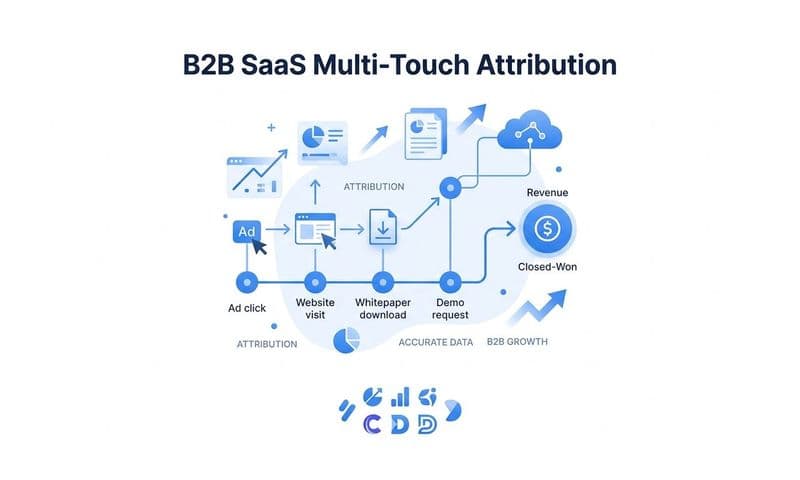
Using Multi-Touch Attribution: B2B customer journeys typically involve multiple touchpoints across a longer sales cycle. Last-click attribution systematically undercredits early-funnel channels that introduce prospects to the brand. Multi-touch attribution models distribute credit across touchpoints, giving a more accurate picture of what is actually driving pipeline. For a detailed comparison of how different models work, reviewing the most common ad attribution models is a useful reference before choosing your approach.
Understanding the full B2B customer journey, from first ad impression through trial, opportunity creation, and closed-won deal, is what separates teams that allocate budget confidently from teams that are essentially guessing. You can explore how this journey maps in practice in a dedicated B2B customer journey breakdown.
Success indicator: You can pull a report showing ad spend by campaign alongside pipeline generated and closed revenue attributed to that campaign. If you can see that number, you have moved from lead attribution to revenue attribution, and your budget decisions just became significantly more defensible.
Step 5: Validate Data Accuracy Across Your Attribution Stack
Implementing clean tracking is only half the job. The other half is making sure the data flowing through your stack is actually accurate, and building a monitoring system that catches problems before they compound into significant misallocation.
Start with a reconciliation check. Compare conversion counts in your ad platforms against your CRM and your attribution platform for the same time period. Some variance is expected because of attribution window differences and platform-specific counting methodologies. But large discrepancies, anything that looks like a 20 percent or greater gap, signal a tracking problem that needs investigation.
Common Sources of Discrepancy: Double-counted events are the most frequent culprit, usually caused by deduplication logic that is not working correctly. Delayed CRM syncing can also create apparent discrepancies when data pulls happen at different times. Attribution window mismatches between platforms are another common source: one platform may use a 7-day click window while another uses 28 days, making direct comparisons misleading without normalization.
Setting Up Ongoing Monitoring: Create alerts for sudden drops in conversion volume. A 50 percent drop in reported conversions overnight almost never reflects a real performance decline. It almost always signals a tracking break, such as a pixel that stopped firing after a website update or a server-side integration that lost its authentication token. Catching these breaks quickly prevents days or weeks of bad data from corrupting your optimization.
Testing End-to-End: Run controlled test conversions through your actual funnel and verify that they appear correctly in every platform within the expected time window. This is the most reliable way to confirm your tracking is working as intended. Do this after any significant website update, CRM change, or tracking configuration modification.
Watching for Spikes as Well as Drops: A sudden spike in conversions is also a red flag. Unexpected volume increases often indicate duplicate firing rather than genuine performance improvement. Both directions signal a data quality problem and should trigger an investigation.
Success indicator: Your conversion counts across your CRM, ad platforms, and attribution platform are within an acceptable variance range, and you have monitoring in place to catch future breaks quickly rather than discovering them during a quarterly review.
Step 6: Feed Clean Data Back to Ad Platform Algorithms
Once your conversion data is clean, complete, and connected to revenue outcomes, you have something genuinely valuable: high-quality signals that ad platform algorithms can use to optimize delivery toward the users most likely to become actual customers, not just visitors or low-intent leads.
Modern ad platforms use machine learning to optimize delivery toward users most likely to complete the conversion event specified in the campaign objective. The quality of the conversion signal directly determines the quality of the optimization. Teams that send clean, high-value conversion signals consistently get better algorithmic performance than teams sending incomplete or inaccurate data.
Sending Offline Conversion Data: Many B2B SaaS conversions happen outside the ad platform tracking window. A prospect clicks a LinkedIn ad, enters a 60-day evaluation cycle, and converts to a paying customer weeks after the attribution window closed. Offline conversion uploads and Conversion API integrations allow you to pass these late-stage pipeline events and revenue data back to the platform retroactively, giving the algorithm a much more accurate picture of which users actually converted.
Improving Audience Quality With First-Party Data: Sending enriched server-side events with first-party data, including hashed emails and phone numbers from your actual customers, allows platforms to build better lookalike audiences. When your lookalike source is built from closed-won customers rather than from early-funnel visitors, the quality of the audience the algorithm targets improves significantly. For more on activating this data effectively, see how first-party data activation works in practice.
Upgrading Your Optimization Goals: Many teams optimize campaigns for top-of-funnel events like page views or clicks because their downstream conversion data was too unreliable to use as an optimization signal. Clean data changes this. Once you have reliable demo request, trial signup, and qualified lead data flowing through your server-side integrations, you can shift your campaign optimization goals to these higher-value events. This is one of the most direct ways that conversion data quality improvement translates into better campaign performance.
Platforms like Cometly make this loop practical by connecting your ad platforms, CRM, and revenue data in one place, then sending enriched conversion signals back to Meta, Google, and other channels automatically. Instead of managing this manually across five different integrations, you have a single system feeding clean data to every platform simultaneously.
Success indicator: Your ad platform event match quality scores are high, your campaigns are optimizing toward qualified leads or revenue events, and your cost per qualified conversion improves in the weeks following the upgrade. The improvement is not always immediate, but it is consistent as the algorithm recalibrates on better signals.
Putting It All Together: Your Conversion Data Quality Checklist
Conversion data quality improvement is not a project with a finish line. It is an operational discipline that compounds over time. Cleaner data trains better algorithms, better algorithms drive more efficient spend, and more efficient spend generates more revenue from the same budget. Each cycle reinforces the next.
Here is the six-step checklist you can run quarterly to keep your conversion data in good shape:
1. Audit your tracking setup. Map every conversion event across all platforms, identify duplicate or misfiring events, and check for missing downstream pipeline events.
2. Implement server-side tracking. Deploy Conversion API and Enhanced Conversions integrations, configure deduplication with consistent event IDs, and prioritize high-value events first.
3. Standardize your event taxonomy. Align event names, categories, and values across all platforms and map them to your CRM lifecycle stages in a shared reference document.
4. Connect conversion data to revenue. Integrate your CRM and payment data with your attribution platform so you can see closed revenue attributed to specific campaigns, not just lead volume.
5. Validate and monitor data accuracy. Run reconciliation checks, set up conversion volume alerts, and test your tracking end-to-end after any significant change.
6. Feed clean signals back to ad platforms. Use offline conversion uploads and enriched server-side events to improve match rates, upgrade optimization goals, and build better lookalike audiences.
Cometly is built to support every layer of this process. It connects your ad platforms, CRM, server-side tracking, and revenue data into a single source of truth, so your team can see exactly which campaigns are driving pipeline and closed revenue, and feed that data back to ad platforms for better optimization.
If your team is ready to move from unreliable tracking to a clean, revenue-connected attribution foundation, Get your free demo and see how Cometly helps B2B SaaS teams capture every touchpoint, connect ad spend to revenue, and build the data quality that drives compounding marketing performance.