You are spending real budget on paid campaigns. Traffic is coming in. But when someone asks why conversion rates moved last quarter, the honest answer is: you are not entirely sure. Maybe the landing page improved. Maybe the audience targeting shifted. Maybe one channel quietly started sending lower-quality traffic while the metrics on the surface looked fine.
This is the reality for most B2B SaaS marketing teams. They have access to more data than ever, yet the connection between that data and actual conversion decisions remains fuzzy. Conversion rate optimization without analytics is not optimization at all. It is iteration based on instinct, and instinct does not scale.
Conversion rate optimization analytics changes that. It is the practice of using behavioral data, attribution modeling, and funnel performance measurement to systematically understand why prospects convert, where they drop off, and which channels and campaigns are genuinely moving the needle. It brings rigor to what has traditionally been a creative and intuitive discipline.
This guide is for marketing leaders and growth managers who want to move beyond surface-level reporting and build a data-driven system for improving conversions across every stage of the funnel. If you manage paid channels, own pipeline targets, and want to make smarter optimization decisions with confidence, this is where to start.
The Data Gap That Kills Conversion Rate Improvements
Most marketing teams are measuring the wrong things. Click-through rates, cost per click, impressions, reach. These metrics are easy to pull and easy to report on, but they describe what happened before the click, not after it. And everything that matters in B2B SaaS happens after the click.
When you cannot see what happens post-click, you are operating with a critical blind spot. You might know that a campaign drove 500 clicks at a reasonable cost, but you have no visibility into whether those clicks turned into form fills, demo requests, trial signups, or anything else. You are optimizing the front end of the funnel while the back end remains invisible.
This blind spot has a direct cost. Without connecting ad touchpoints to downstream conversion events, budget allocation becomes unreliable. You end up investing more in channels that generate traffic volume rather than channels that generate converting traffic. The two are often very different things, and aggregate metrics will not tell you which is which.
The shift toward first-party data and server-side tracking has made this problem both more urgent and more solvable. Browser-based pixels have become increasingly unreliable. Cookie restrictions, ad blockers, and iOS privacy changes mean that a meaningful portion of conversion events never get recorded when you rely on client-side tracking alone. Industry observers have widely noted that browser-based pixels can underreport conversion events significantly, which means the data you are using to make optimization decisions may already be incomplete.
Server-side tracking and Conversion API integrations address this directly by capturing conversion events at the server level rather than relying on a browser to fire a pixel. This is not just a technical upgrade. It is a foundational requirement for accurate conversion rate optimization analytics. Teams that have made this shift are working with more complete data, which means their optimization decisions are grounded in reality rather than a partial picture.
The gap between teams that have this infrastructure and teams that do not is widening. If your conversion data is incomplete, every CRO decision downstream is built on a shaky foundation. Closing that data gap is the first step toward building a system that actually works.
What Conversion Rate Optimization Analytics Actually Measures
Traditional CRO tends to focus on on-page behavior: heatmaps, session recordings, A/B tests on headlines and button colors. These tools have their place, but they only answer a narrow set of questions. Conversion rate optimization analytics operates at a broader level, connecting on-page behavior to attribution data, funnel stage performance, and channel-level quality metrics.
Think of it as the difference between asking "did visitors click the CTA?" and asking "which traffic sources produce visitors who click the CTA, move through the funnel, and eventually generate revenue?" The second question is harder to answer, but it is the one that actually drives business outcomes.
The core metrics in a CRO analytics framework fall into a few categories:
Micro-conversion rates: These are the leading indicators. Form completions, demo requests, free trial signups, content downloads. They tell you whether your top and mid-funnel touchpoints are doing their job of moving prospects toward a buying decision.
Macro-conversion rates: The metrics that connect marketing activity to revenue. Closed-won deals, pipeline generated, customer acquisition. These are the outcomes that CRO ultimately needs to influence, even if they take longer to materialize in B2B SaaS.
Funnel drop-off rates by stage: Where are prospects disengaging? Between the ad and the landing page? Between the landing page and the form? Between the demo and the sales conversation? Knowing the drop-off rate at each stage tells you where to focus optimization energy.
Conversion rate by traffic source and campaign: Not all traffic converts equally. A channel that drives high volume at low cost may produce leads that stall in the funnel, while a smaller, more expensive channel may produce leads that close at a higher rate. Segmenting conversion rates by source reveals this distinction.
Attribution models are where this gets nuanced. The model you choose directly shapes the story your conversion data tells. A last-click model assigns all credit to the final touchpoint before conversion, which systematically over-credits bottom-funnel channels like branded search and under-credits the earlier touchpoints that initiated the journey. A linear or data-driven model distributes credit across all touchpoints, giving a more accurate picture of what is actually influencing conversion.
Choosing the wrong attribution model does not just affect reporting. It affects budget decisions. If your model tells you that one channel is driving all your conversions when it is really just closing journeys that started elsewhere, you will over-invest in that channel and starve the channels that are actually building the pipeline. This is one of the most common and costly mistakes in B2B SaaS marketing, and it is entirely a data interpretation problem.
Building a Conversion Analytics Framework for B2B SaaS
A framework for conversion rate optimization analytics starts with a clear definition of what you are measuring and where. In B2B SaaS, the funnel spans a longer timeline and more touchpoints than most other business models, which means the measurement architecture needs to match that complexity.
Start by mapping conversion events across the full funnel. Top-of-funnel events include ad clicks, content downloads, and landing page visits from paid channels. Mid-funnel events include demo bookings, free trial activations, and sales-qualified lead designations in your CRM. Bottom-of-funnel events include pipeline creation, opportunity progression, and closed-won revenue. Each of these is a conversion event worth measuring, and each tells you something different about funnel health.
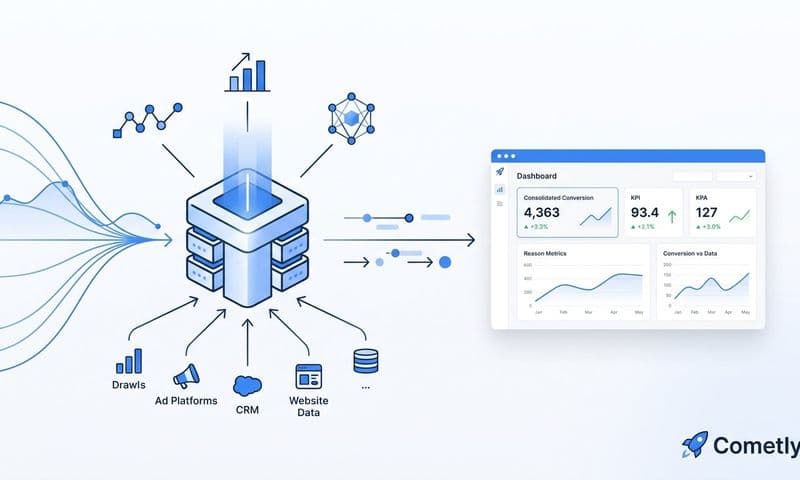
The next step is connecting the data sources that capture these events into a unified layer. Your ad platforms are capturing click and impression data. Your website is capturing behavioral and form data. Your CRM is capturing lead and pipeline data. Your payment or billing system is capturing revenue data. When these sources operate in silos, you can see each piece in isolation but cannot connect them into a coherent picture of the customer journey.
Connecting these sources requires intentional infrastructure. Every conversion event needs to be tagged with source, campaign, and touchpoint data so that when a lead closes six weeks after their first ad click, you can trace the full path back to its origin. Without this, attribution is either missing or inaccurate, and your CRO decisions are based on incomplete information.
Server-side tracking and Conversion API integrations are critical components of this infrastructure. As browser-based tracking becomes less reliable due to cookie restrictions and privacy changes, server-side event capture ensures that conversion data is complete. This is particularly important for B2B SaaS teams running paid campaigns across Meta, Google, and LinkedIn, where conversion signal quality directly affects algorithmic bidding and targeting performance.
A practical way to think about this framework is as a three-layer system. The first layer is data capture: ensuring every touchpoint and conversion event is recorded accurately. The second layer is data connection: linking events across platforms so the full customer journey is visible. The third layer is data analysis: using that connected data to answer specific questions about funnel performance, channel quality, and conversion drivers.
Teams that build this framework create a durable foundation for CRO. Every optimization decision, whether it is a landing page test, a campaign budget shift, or a messaging change, can be evaluated against real conversion data rather than assumptions.
How Attribution Data Powers Smarter CRO Decisions
Here is where conversion rate optimization analytics starts to generate real strategic value. Attribution data does not just tell you where conversions came from. It tells you which channels and campaigns are generating high-intent traffic that actually converts versus channels that drive volume without producing qualified pipeline.
This distinction matters enormously for CRO. If you are optimizing a landing page for traffic that was never going to convert in the first place, you are solving the wrong problem. Attribution analysis helps you identify which traffic sources deserve optimization investment and which need to be reconsidered at the channel or targeting level.
Multi-touch attribution takes this further by revealing the full sequence of touchpoints that precede a conversion. In B2B SaaS, a prospect might see a LinkedIn ad, read a blog post through organic search, attend a webinar, and then click a retargeting ad before requesting a demo. A last-click model would credit only the retargeting ad. A multi-touch model would show the entire journey, making it possible to understand which combinations of channels and messages are most effective at moving prospects through the funnel.
This has direct implications for CRO strategy. If attribution data shows that prospects who engage with thought leadership content before seeing a paid ad convert at a higher rate than those who see the ad first, that is a signal to invest in content that warms audiences before they hit your paid campaigns. You would never surface that insight from on-page analytics alone.
Pipeline and revenue attribution closes the loop in a way that is particularly important for B2B SaaS teams. Conversion volume is a useful metric, but it is not the final measure of CRO success. A channel that generates many demo requests but produces low-value deals or long sales cycles may be less valuable than a channel that generates fewer but higher-quality opportunities. Revenue attribution connects marketing activity to actual deal outcomes, allowing CRO decisions to be evaluated on the quality and value of conversions, not just the quantity.
This is the shift from optimizing for conversion rate as an isolated metric to optimizing for revenue per visitor, pipeline generated per dollar spent, or customer lifetime value by acquisition channel. These are the metrics that align marketing optimization with business outcomes, and they are only accessible when attribution data is connected to CRM and revenue data.
Using Analytics to Identify and Fix Funnel Leaks
Funnel drop-off analysis is one of the most actionable techniques in conversion rate optimization analytics. Rather than guessing where prospects are losing interest, you measure conversion rates at each stage of the funnel and identify exactly where the biggest gaps are. Then you focus optimization resources there rather than spreading effort evenly across every touchpoint.
The stages worth measuring vary by business model, but for most B2B SaaS companies they include: ad impression to click, click to landing page engagement, landing page to form submission, form submission to sales-qualified lead, and sales-qualified lead to closed-won. A significant drop at any one of these stages is a signal that something is breaking down, and the nature of the drop-off points toward the likely cause.
Segmentation is where funnel analysis becomes genuinely powerful. Aggregate conversion rates can mask wide variation across traffic sources, campaigns, audiences, and devices. A landing page may convert well for branded search traffic but poorly for cold paid social traffic. A form may perform well on desktop but create friction on mobile. An offer may resonate with one audience segment and fall flat with another.
When you segment conversion data by source, campaign, audience, and device, patterns emerge that aggregate data hides. These patterns are the inputs to targeted optimization. Instead of redesigning a landing page for everyone, you can identify the specific traffic segments where conversion is breaking down and address the specific barriers those audiences face.
Velocity metrics add another dimension to funnel analysis that is often overlooked in B2B SaaS. Time-to-convert measures how long it takes a prospect to move from first touch to conversion. Pipeline velocity measures the speed at which leads move through the sales funnel. These are not just efficiency metrics. They are quality signals.
A channel that produces leads that convert quickly and move through the pipeline at a faster pace is generating higher-intent traffic than a channel that produces more leads at a slower pace. When you factor velocity into your channel evaluation, you often find that the apparent efficiency of high-volume, low-cost channels disappears when you account for the time and resources required to work those leads to a close.
Putting Conversion Analytics Into Practice With the Right Tools
Having the right analytical framework matters, but it only produces results if the tools supporting it can actually connect your data sources and surface actionable insights. For B2B SaaS teams, the core requirement is a marketing attribution platform that links ad data to CRM and revenue data, creating a single source of truth rather than a collection of siloed reports from each ad platform.
Native ad platform reporting is a structural problem for CRO. Each platform attributes conversions through its own lens, which typically over-credits that platform's role in the customer journey. When you rely on Google Ads to tell you how many conversions Google Ads drove, and Meta Ads to tell you how many conversions Meta drove, you are getting each platform's best argument for its own value. A unified attribution platform provides a neutral view that reflects what actually happened across the full customer journey.
AI-powered analytics is increasingly important for teams managing campaigns across multiple channels and audience segments. The volume of conversion data generated by a mature B2B SaaS marketing program is significant, and manually identifying which campaigns, audiences, and creative combinations are producing the best conversion outcomes takes time that most teams do not have. AI can surface these patterns automatically, flagging high-performing segments and underperforming campaigns in real time.
There is also a compounding benefit to feeding accurate conversion data back to ad platforms. When you use Conversion API integrations to send enriched, server-side conversion events back to Meta, Google, and LinkedIn, you are improving the quality of the signal those platforms use for algorithmic targeting and bidding. Better conversion data leads to better ad delivery, which leads to higher-quality traffic, which leads to higher conversion rates. It is a reinforcing cycle that starts with data accuracy.
Cometly is built specifically for this use case. It connects your ad platforms, CRM, and website tracking into a unified attribution system, giving B2B SaaS teams visibility into the full customer journey from first ad click to closed-won revenue. With multi-touch attribution, server-side tracking, AI-driven campaign analysis, and Conversion API integrations across 70+ native connections, it provides the infrastructure that conversion rate optimization analytics requires. Teams using Cometly can see which channels are generating high-converting traffic, where the funnel is leaking, and which campaigns are producing the pipeline and revenue that justify continued investment.
Turning Conversion Data Into a Competitive Advantage
Conversion rate optimization analytics is not a project you complete. It is a practice you build and refine over time. The teams that win on paid channels are not necessarily the ones with the largest budgets or the most creative assets. They are the ones with the clearest picture of what is working and the infrastructure to act on that picture faster than their competitors.
The progression is straightforward, even if the execution requires investment. Start by closing the data gap with accurate, server-side conversion tracking. Build a framework that connects ad touchpoints to CRM and revenue events across the full funnel. Use attribution modeling to understand which channels and campaigns are genuinely driving high-quality conversions. Apply funnel drop-off analysis to focus optimization energy where it will have the greatest impact. And use AI-assisted analytics to surface patterns and scale what is working.
Each step builds on the last. Clean data enables accurate attribution. Accurate attribution enables smarter funnel analysis. Smarter funnel analysis enables better optimization decisions. Better optimization decisions produce higher conversion rates and more efficient spend.
Cometly brings this entire system together for B2B SaaS teams, connecting ad spend to pipeline and revenue in real time so that every CRO decision is grounded in complete, accurate data rather than assumptions.
If you are ready to build a conversion analytics practice that connects every touchpoint to real revenue outcomes, Get your free demo today and see how Cometly can help you track, attribute, and optimize every conversion across your marketing stack.