Most paid media teams believe they have a solid handle on what their ads are doing. They check the dashboard, review the conversion counts, and make budget decisions based on what they see. The problem is that what they see is often incomplete. Ad platforms are making optimization decisions based on a partial picture of reality, and that gap between what actually happened and what the platform recorded is quietly costing teams real money.
This is not a niche technical problem. It affects every team running paid campaigns across Meta, Google, and similar channels. Browser-based tracking, which most teams still rely on, has become increasingly unreliable. Privacy changes, ad blockers, and cookie restrictions have chipped away at the signal quality that ad platforms use to optimize bids, find audiences, and report results.
Conversion sync is the mechanism that closes this gap. By sending real conversion events directly from your backend systems to ad platforms via server-side connections, you give those platforms the complete, accurate data they need to make smarter decisions. For B2B SaaS marketers with multi-stage funnels and longer sales cycles, this is not just a nice-to-have technical upgrade. It is the foundation of accurate attribution and efficient ad spend. This article breaks down the conversion sync benefits explained in plain terms, so you understand exactly what it does, why it matters, and how to put it to work.
The Data Gap That's Quietly Draining Your Ad Budget
Browser-based pixel tracking was built for a simpler internet. A user clicked an ad, landed on your site, and the pixel fired. The ad platform recorded the conversion. Clean, simple, and reasonably accurate. That model has been eroding for years, and by now the erosion is significant.
Ad blockers prevent pixels from loading entirely. Safari's Intelligent Tracking Prevention limits the lifespan of tracking cookies to as little as one day, meaning conversions that happen even slightly later in the session go unrecorded. iOS privacy changes have made it harder to track users across apps and browsers. And with third-party cookies being phased out across more browsers, the window for reliable pixel-based attribution keeps shrinking.
The result is that ad platforms are receiving a fraction of the conversion signals that are actually occurring. When a user clicks your Google ad, books a demo three days later, and eventually converts to a paying customer, the pixel may only capture part of that journey, or none of it, depending on how the user's browser handles tracking.
Here is where the real damage happens. Ad platform algorithms, including Meta's Advantage+ and Google's Smart Bidding, are trained on the conversion data they receive. When that data is incomplete, the algorithm does not know what it does not know. It interprets the missing signals as genuine absence of conversions, not as a data collection failure. So it optimizes toward audiences and placements based on a distorted view of what is actually converting.
This leads to inefficient bidding. Campaigns that are genuinely performing well may appear underperforming because their conversions are not being captured. Budget shifts toward campaigns that look better on paper but may only appear that way because their audience happens to use tracking-friendly browsers. CPAs inflate not because the campaigns are actually worse, but because the data feeding the algorithm is incomplete. Understanding how to address conversion tracking gaps is the first step toward reclaiming that lost performance.
Conversion sync addresses this directly. Instead of relying on a browser-based pixel to fire at the right moment under the right conditions, server-side conversion sync captures the event at the source: your CRM, your payment system, your backend. That event is then transmitted directly to the ad platform's servers, bypassing the browser entirely. The platform receives the signal regardless of what browser the user is on, whether they have an ad blocker installed, or how their iOS privacy settings are configured.
The data gap closes. The algorithm gets a more complete picture. And your budget starts working harder because it is being guided by accurate information rather than a partial record.
What Conversion Sync Actually Does Under the Hood
Understanding the mechanics of conversion sync helps you appreciate why it solves problems that pixel tracking simply cannot. At its core, conversion sync is a server-to-server data transfer. When a conversion event occurs in your system, whether that is a form submission, a trial activation, a CRM stage change, or a closed-won deal, that event is captured and sent directly to the ad platform's API rather than through a browser.
Meta calls its version the Conversions API, often abbreviated as CAPI. You can learn more about what the Conversions API is and how it works at a technical level. Google refers to its equivalent as Enhanced Conversions. Both operate on the same fundamental principle: your server sends structured event data to the platform's server, creating a reliable, browser-independent signal.
Compare this to pixel-based tracking. A pixel is a snippet of JavaScript that runs in the user's browser. It depends on the browser loading correctly, not being blocked, and having the right cookies available to identify the user and connect the conversion to the original ad click. Every one of those dependencies is a potential failure point. Server-side event syncing has none of those dependencies because it never touches the browser after the initial click.
The other critical component of conversion sync is event matching. Sending a conversion event to Meta or Google is only useful if the platform can connect that event to a specific ad interaction. This is where first-party data becomes essential. When you sync a conversion event, you include identifiers such as a hashed email address, phone number, or user ID. The platform uses these identifiers to match the conversion back to the user who originally clicked or viewed your ad.
Meta publicly documents a metric called Event Match Quality, or EMQ, which measures how well your conversion events are being matched to user profiles. Higher match quality means more of your conversions are being attributed accurately, which feeds better data into the algorithm. Using multiple first-party data points, such as email combined with phone number and browser data, generally improves match rates.
One important operational detail is deduplication. If you are running both a pixel and server-side conversion sync, which is a common setup during transition periods, you need to ensure the platform does not count the same conversion twice. Both Meta and Google have built-in deduplication logic that uses event IDs to identify and remove duplicate signals, but this requires that your implementation sends consistent event IDs across both tracking methods. Teams evaluating their options should also review available conversion sync tools to find the right fit for their stack.
The overall effect is a more complete, more reliable conversion signal that the ad platform can actually use. It is the difference between giving the algorithm a partial map and giving it a complete one.
How Conversion Sync Sharpens Attribution Across the Funnel
Attribution is only as good as the data it is built on. If your attribution model is only receiving signals from top-of-funnel events like page views, form fills, and landing page visits, it can tell you which ads drove clicks. What it cannot tell you is which ads drove revenue.
For B2B SaaS companies, this distinction is critical. The sales cycle often spans weeks or months. The user who clicked your LinkedIn ad in January might not become a paying customer until March. If your attribution model only captures the initial click and the form submission, it has no visibility into what happened between the lead and the closed deal. It cannot tell you whether that campaign actually drove high-value customers or just a high volume of leads who never converted.
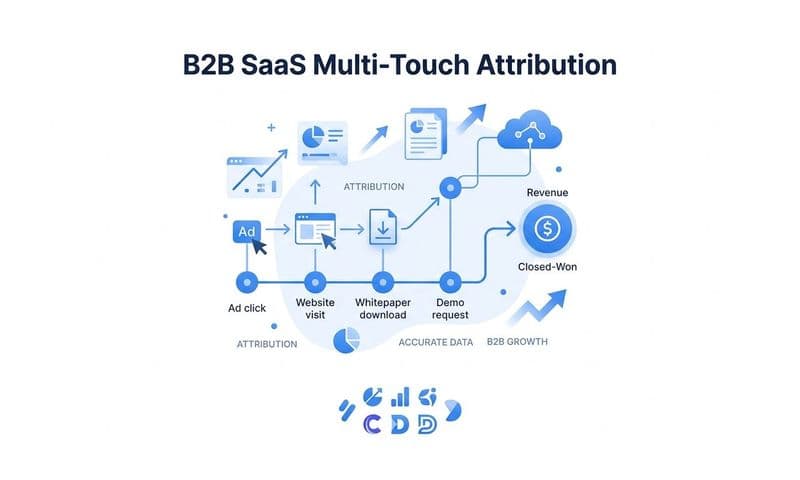
Conversion sync changes this by enabling you to push downstream events back to your attribution system and to the ad platforms themselves. Instead of stopping at the form fill, you sync qualified lead status, MQL-to-SQL transitions, opportunity creation, and eventually closed-won revenue. Each of these events becomes a data point that your attribution model can use to connect the original ad interaction to a real business outcome.
This is what makes multi-touch conversion value genuinely meaningful. When every stage of the funnel is instrumented and synced, you can see which touchpoints appeared across the journeys of customers who actually paid, not just customers who expressed initial interest. A campaign that drives a high volume of leads but a low rate of progression to closed deals looks very different from a campaign that drives fewer leads but with a much higher close rate. Without downstream conversion sync, you cannot see that difference.
The enriched attribution data also enables more honest channel comparisons. Two channels might appear to deliver similar CPLs at the top of the funnel. But when you trace those leads through to revenue, one channel might be contributing significantly more to pipeline and ARR. That insight only exists if the conversion events from those later funnel stages are being captured and attributed back to the original source.
Marketers who have this level of visibility can make budget decisions based on actual revenue contribution rather than surface-level metrics. They can identify which campaigns are generating the customers who expand, renew, and refer others, and allocate accordingly. That is a fundamentally different, and more powerful, way to run paid media.
The Compounding Impact on Ad Platform AI and Bidding
Smart bidding and audience optimization algorithms on Meta and Google are sophisticated, but they are only as smart as the data they receive. This is a point that is easy to underestimate. Marketers often assume that these algorithms will figure things out over time regardless of data quality. In reality, the quality and completeness of your conversion signals is one of the primary levers you have over how well those algorithms perform.
Both Meta and Google use conversion data to train their bidding models. When you run a campaign with a target CPA or target ROAS objective, the algorithm is constantly making micro-decisions about who to show your ads to, how much to bid, and which placements to prioritize. Those decisions are based on historical patterns: which types of users, in which contexts, have converted in the past.
When your conversion signal is incomplete due to pixel limitations, the algorithm is working from a distorted dataset. It may be learning from a subset of your actual converters, specifically those whose browsers happened to allow the pixel to fire. That subset may not be representative of your best customers. The algorithm optimizes toward that biased sample and misses the broader population of high-value users it could be reaching.
Feeding richer, more complete conversion data via conversion sync gives the algorithm a more accurate training set. It can identify patterns in the users who actually converted, including those whose conversions would have been missed by pixel tracking alone. Over time, this leads to better audience targeting, more efficient bidding, and lower effective CPAs for the same or better quality of customer. Setting up Enhanced Conversions in Google Ads is one concrete step teams can take to improve signal quality on that platform.
The compounding effect is real. Better data leads to better optimization in the current campaign cycle. Better optimization generates more conversions from higher-quality audiences. Those conversions feed back into the algorithm as new training data, which improves the next cycle further. The loop reinforces itself, and the gap between teams running clean conversion sync and those relying on degraded pixel data widens over time.
For B2B SaaS teams where the cost of acquiring a customer is high and the value of getting it right is significant, this compounding advantage is worth taking seriously. The investment in setting up proper server-side conversion sync pays dividends not just in attribution accuracy but in the actual performance of every campaign you run going forward.
Connecting Conversion Sync to Revenue, Not Just Leads
Most paid media teams measure success at the lead level. A form fill, a demo request, a trial sign-up: these are the events that show up in dashboards and get reported in weekly reviews. They are easy to count, easy to attribute, and easy to optimize toward. They are also, for many B2B SaaS companies, a poor proxy for what actually matters.
Leads are the beginning of the story. Revenue is the ending. And for teams with any meaningful sales motion, the distance between those two points can be substantial. A campaign that drives a hundred leads at a low cost per lead looks great until you discover that none of those leads had the budget, authority, or intent to actually buy. Meanwhile, a more expensive campaign that drove twenty leads might have closed ten of them into six-figure contracts.
This is why syncing post-lead conversion events is so important for B2B SaaS specifically. Trial activations, product qualified lead scores, MQL-to-SQL handoffs, and ultimately closed-won deals all represent meaningful signals about which campaigns are driving real business value. When these events are synced back to ad platforms, the algorithm can optimize toward users who look like your actual paying customers rather than users who look like your form submitters. Tracking offline conversions is a closely related capability that extends this same logic to sales activity that happens outside the browser.
Revenue-level event syncing becomes even more powerful when it includes data from your payment system. Integrating Stripe or another billing platform with your attribution setup allows you to pass actual revenue values back to ad platforms alongside conversion events. Instead of telling the algorithm that a conversion happened, you are telling it that a conversion worth a specific dollar amount happened. This enables value-based bidding, where the platform optimizes not just for conversion volume but for conversion value. Understanding value per conversion is essential for teams making this shift from volume-based to value-based optimization.
The downstream effect on attribution is equally significant. When closed-won revenue is tied back to the original ad interaction, every marketing dollar can be traced to its contribution to ARR. You move from reporting on cost per lead to reporting on cost per acquired customer and return on ad spend at the revenue level. That is the kind of data that changes how leadership thinks about marketing investment, and it is only possible when the full conversion chain is instrumented and synced.
For B2B SaaS teams trying to demonstrate marketing's contribution to pipeline and revenue, this level of visibility is not optional. It is the difference between being a cost center and being a revenue driver with a clear, defensible ROI story.
Putting Conversion Sync to Work with Cometly
Understanding conversion sync conceptually is one thing. Implementing it reliably across multiple ad platforms, CRM systems, and payment tools is another. This is where having the right infrastructure matters, and it is where Cometly is built to help.
Cometly automates the conversion sync process by acting as the connective layer between your entire marketing and revenue stack. From the moment a user clicks an ad, Cometly captures that touchpoint and begins tracking their journey across every subsequent interaction. When a conversion event occurs, whether it is a form fill, a trial activation, a CRM stage change, or a Stripe payment, Cometly captures it and syncs the enriched event data back to Meta, Google, and other ad platforms via server-side integrations.
This means your ad platforms receive complete, high-quality conversion signals without relying on browser-based pixels that can fail silently. The first-party data signals that improve event match quality are included automatically, giving your campaigns the best possible foundation for algorithmic optimization.
Beyond the mechanics of syncing, Cometly's AI layer uses the enriched conversion data to surface actionable recommendations. Rather than leaving you to manually analyze which campaigns are driving revenue, Cometly identifies the ads and channels contributing most to pipeline and ARR, and flags where budget could be reallocated for better returns. You get the clarity to scale what is working and cut what is not, backed by data that goes all the way from the first ad click to the closed deal.
Cometly also functions as a single source of truth for your marketing data. Instead of reconciling numbers across your ad platforms, CRM, and analytics tools, everything lives in one place. Ad spend, conversion events, pipeline stages, and revenue data are connected and visible in a unified view. For B2B SaaS marketing teams that need to report on ROI with confidence, this eliminates the guesswork and the spreadsheet gymnastics that typically come with trying to piece together a complete picture from multiple disconnected systems.
The 70+ native integrations Cometly offers mean that the setup process does not require custom engineering work for most common stacks. Whether you are using Salesforce, HubSpot, Stripe, or other popular tools, the connections are available out of the box, and the conversion sync starts working as soon as the integrations are live.
For teams that have been running paid campaigns with incomplete data, the impact of switching to a properly instrumented conversion sync setup is often immediate and significant. The algorithm gets better data, the attribution gets more accurate, and the decisions you make about budget allocation start reflecting what is actually happening in your business.
The Bottom Line on Conversion Sync
Conversion sync closes the gap between what ad platforms think is happening and what is actually happening in your business. That gap has grown wider as browser-based tracking has become less reliable, and the cost of ignoring it compounds over time as algorithms optimize on incomplete data and attribution reports paint a distorted picture of performance.
For B2B SaaS teams, the real opportunity goes beyond fixing pixel tracking. It is about syncing the events that matter most: the qualified leads, the pipeline stages, the closed-won deals, and the revenue. When those events are connected back to the ad interactions that started the journey, you gain a level of visibility that changes how you think about every dollar you spend on paid media.
The conversion sync benefits explained throughout this article come down to one core idea: better data in means better outcomes out. Better algorithm performance, more accurate attribution, smarter budget decisions, and a clearer ROI story for every campaign you run.
If you are ready to stop flying partially blind and start making decisions based on the full picture, explore how Cometly brings conversion sync, attribution, and revenue data together in one place. Get your free demo today and see exactly which ads and campaigns are driving the revenue that matters to your business.