
Webinars are one of the most powerful demand generation channels in B2B SaaS. They attract qualified prospects, build trust, and move buyers through the funnel faster than most other content formats. But here is the problem: most marketing teams run webinars without any reliable way to connect registrations, attendees, and post-webinar actions back to the ads and campaigns that drove them there.
That gap in data leads to a familiar frustration. You can see that your webinar had 300 registrants, but you cannot tell which ad drove them, which channel converted best, or whether any of those attendees eventually became paying customers.
Without proper conversion tracking for webinars, you are flying blind on one of your most resource-intensive marketing investments. You pour budget into ads, spend hours producing content, and then walk away with a registration count and an attendance rate that tell you almost nothing about actual ROI.
This guide walks you through exactly how to set up conversion tracking for your webinars from scratch. You will learn how to define the right conversion events, connect your webinar platform to your attribution stack, pass clean data to your ad platforms, and tie webinar engagement back to pipeline and revenue.
Whether you are running webinars through Zoom, Demio, or any other platform, the principles here apply across the board. By the end of this guide, you will have a clear, repeatable system for measuring what your webinars are actually worth and making smarter decisions about where to invest your ad budget next.
Let's get into it.
Step 1: Define Your Webinar Conversion Events Before You Build Anything
Before you touch a single pixel or write a line of tracking code, you need a clear map of what you are actually trying to measure. This sounds obvious, but it is the step most teams skip, and it is the reason their webinar data ends up fragmented and unusable.
A webinar funnel is not a single conversion. It is a sequence of actions, each representing a different level of intent and value. Your job is to identify which actions matter most and define them precisely before you build your tracking infrastructure.
Here are the five conversion events worth tracking in most B2B SaaS webinar funnels:
Registration (micro-conversion): The prospect submits your registration form. This is your top-of-funnel signal. It tells you that your ad or content resonated enough to prompt action, but it says nothing about intent to buy.
Live attendance (mid-funnel signal): The registrant actually shows up to the live event. Attendance rate is a much stronger quality signal than registration volume. Someone who shows up live is more engaged than someone who signed up and forgot.
Replay view (mid-funnel signal): A registrant who missed the live event watches the replay. This still represents meaningful engagement and should be tracked separately from live attendance.
In-webinar or post-webinar CTA click (high-intent signal): The attendee clicks a call-to-action during or after the webinar, such as a link to book a demo or start a trial. This is where intent becomes measurable.
Demo request or trial sign-up (macro-conversion): The attendee takes a downstream action that directly enters your sales pipeline. This is your primary revenue signal and the event you most want to tie back to your original ad spend.
The key distinction here is between micro-conversions and macro-conversions. Micro-conversions like registrations are easy to track and useful for optimizing top-of-funnel ad performance. Macro-conversions like demo bookings are what actually connect your webinar investment to pipeline and revenue.
A common mistake is tracking only registrations and treating that as the measure of webinar success. Registration numbers are easy to inflate with broad targeting and low-friction offers. Attendance rate and post-webinar conversion rate are far more meaningful indicators of campaign quality. Understanding best practices for tracking conversions accurately helps you avoid this trap and build a measurement system that reflects true campaign performance.
Before you move to the next step, write down your conversion event list. Give each event a clear name, a definition, and a funnel stage. This document will guide every technical decision you make in the steps that follow.
Success indicator: You have a written list of three to five conversion events with clear definitions before touching any tracking code.
Step 2: Build a UTM Parameter Structure That Survives the Entire Funnel
UTM parameters are the foundation of source attribution for your webinar campaigns. Without them, you cannot tell whether your registrants came from a LinkedIn ad, a Google search, an email campaign, or organic social. Every link driving traffic to your webinar registration page needs a complete, consistent UTM string.
Use all five standard UTM parameters on every link:
utm_source: The platform or channel driving the traffic. Examples: linkedin, google, newsletter, partner.
utm_medium: The type of traffic. Examples: cpc, email, organic, social.
utm_campaign: The specific campaign name. Use a consistent naming convention like webinar-q3-2026-productlaunch.
utm_content: The specific ad creative or link variant. This helps you distinguish between two different ad creatives running in the same campaign.
utm_term: The keyword or audience segment, particularly useful for paid search campaigns.
Consistency is everything here. If one team member uses "LinkedIn" and another uses "linkedin" as the utm_source value, you will end up with split data that looks like two different channels in your reports. Create a UTM naming convention document and make sure everyone on the team uses it before launching any campaign.
Now here is the critical technical detail most teams miss: UTM parameters need to be captured at the moment of form submission, not just read from the URL when the page loads. Many webinar platforms redirect users through confirmation pages or external flows that strip URL parameters entirely. If you only read UTMs from the browser URL at page load, you will lose source data for a significant portion of your registrants. This is one of the most common conversion tracking gaps that teams encounter when running multi-channel webinar campaigns.
The solution is to capture UTM values via JavaScript when the page loads and store them in hidden form fields on your registration form. When the form is submitted, those hidden fields pass the source data alongside the registrant's name and email. This ensures the UTM data is stored in your webinar platform or CRM record and does not disappear after a redirect.
If your webinar platform does not support hidden form fields natively, you can often handle this through your CRM integration or a tool like Google Tag Manager. The goal is simple: every registrant record should have a source field that tells you exactly which ad or channel brought them to your webinar.
Success indicator: Every ad driving to your webinar has a unique UTM string, and you can see source data appearing in your registration records inside your CRM or webinar platform.
Step 3: Install Pixel and Server-Side Event Tracking on Your Registration Page
Once your UTM structure is in place, you need to set up the actual conversion tracking signals that your ad platforms will use to measure performance and optimize delivery. This is where most teams rely entirely on browser-based pixel tracking, and where they run into serious accuracy problems.
Browser-based pixels like the Meta Pixel or Google Tag fire a conversion event when a user's browser loads a specific page or triggers a specific action. The problem is that browser-based tracking has become increasingly unreliable. Ad blockers prevent pixels from firing. iOS privacy restrictions limit cross-device tracking. Users who switch from mobile to desktop mid-journey create gaps in attribution. In a B2B SaaS context, where buyers often research across multiple devices and sessions, these gaps add up quickly.
The solution is to layer server-side event tracking on top of your browser-based pixels. Server-side tracking sends conversion data directly from your server to the ad platform, bypassing the browser entirely. This means ad blockers and browser restrictions cannot interfere with the signal.
For Meta campaigns, this means implementing the Conversions API (CAPI) alongside your Meta Pixel. For Google campaigns, it means setting up Google Enhanced Conversions. Both approaches allow you to send first-party data, including email address and name, alongside the conversion event, which significantly improves event match quality scores on both platforms.
Higher match quality means the ad platform can attribute more conversions to your campaigns and train its machine learning algorithms more effectively toward your target audience. If you are running webinar registration campaigns on Meta or Google, the difference between low and high event match quality can meaningfully affect how well your campaigns optimize over time.
There is one important technical requirement when running both pixel and server-side tracking simultaneously: event deduplication. If both your browser pixel and your server-side event fire for the same registration, your ad platform will count it as two conversions. To prevent this, you need to pass a unique event ID with every conversion event. The ad platform uses this ID to identify and discard duplicate events, ensuring your conversion counts remain accurate. Teams dealing with this issue can find detailed guidance in a Conversion API implementation tutorial that covers deduplication setup end to end.
Platforms like Cometly handle server-side tracking and first-party data enrichment natively, sending conversion signals to Meta and Google with high match rates without requiring you to build and maintain custom server-side infrastructure yourself. This is particularly valuable for B2B SaaS teams that want accurate attribution without a dedicated engineering resource.
Success indicator: Your ad platform shows conversion events firing on registrations with a high event match quality score, and you are not seeing inflated conversion counts from duplicate events.
Step 4: Connect Your Webinar Platform to Your Attribution Stack
Tracking the registration event is just the beginning. To understand the full value of your webinar campaigns, you need to capture what happens after someone registers: did they attend, how long did they stay, did they click your CTA, and did they take any action after the event ended?
Most webinar platforms offer some combination of native integrations, webhooks, and API access to push this data downstream. The key is getting it into your CRM and attribution platform so it lives alongside your lead records and ad spend data.
Start by connecting your webinar platform to your CRM. Most major platforms, including Zoom Webinars, Demio, WebinarJam, and GoToWebinar, offer direct integrations with popular CRMs like HubSpot and Salesforce. When set up correctly, these integrations will automatically update a lead record when a registrant attends, note how long they stayed, and log any in-webinar actions they took.
For actions that your native integration does not capture automatically, use webhooks or automation tools to fire conversion events when specific triggers occur. For example, you can set up a webhook that fires when a registrant's status changes from "registered" to "attended," or when an attendee clicks a specific CTA link inside your webinar platform. These events can then be passed to your attribution platform as distinct conversion signals. A well-structured attribution tracking setup ensures that every one of these downstream events is tied back to the original traffic source.
Here is the piece that most teams overlook: attribution continuity. When you fire a downstream event like "attended webinar" or "clicked demo CTA," you need to pass the original UTM source data from the registration event through to that new event. If you do not, your attribution platform will not know that this attendee originally came from your LinkedIn campaign. You will see the conversion, but you will not be able to credit it to the right source.
Cometly's 70-plus native integrations are built specifically for this kind of cross-platform data flow. You can pull webinar engagement data from your webinar platform, connect it to your CRM pipeline data, and view it alongside your ad spend in a single attribution dashboard. Every touchpoint in the webinar journey, from the first ad click through to post-webinar pipeline activity, is visible in one place.
Success indicator: Attendance and post-webinar actions are visible in your attribution platform, tied to the original traffic source from the registration event.
Step 5: Track Post-Webinar Actions That Signal Pipeline Intent
Registration and attendance are leading indicators. They tell you that your webinar attracted an audience. But in B2B SaaS, the actions that happen in the days and weeks after a webinar are where pipeline intent becomes measurable, and where your attribution data starts to connect to real revenue.
Set up conversion tracking for the following post-webinar actions, using a 7 to 30 day attribution window depending on your typical sales cycle length:
Replay page views: A registrant who missed the live event but watches the replay is still highly engaged. Track this as a separate conversion event from live attendance.
Resource downloads: If you offer a follow-up resource, like a slide deck, a checklist, or a guide, track downloads as a signal of continued interest.
Demo booking page visits and submissions: This is one of your most important post-webinar signals. Set up conversion tracking on both the page visit and the form submission so you can measure drop-off in the booking flow.
Trial sign-ups: If your product has a self-serve trial, track sign-ups that occur within your attribution window from webinar-sourced leads.
Contact form submissions: Any inbound inquiry from a webinar attendee within your attribution window should be tagged and tracked.
In your CRM, create a segment for webinar-sourced leads and track how they progress through your pipeline stages. This gives you a view of webinar ROI that goes beyond conversion rates and into actual pipeline contribution.
This is also where your attribution model choice matters significantly. Last-touch attribution will under-credit your webinar if the final conversion happens via a direct visit or a branded search days after the event. A multi-touch attribution model, whether linear, time decay, or data-driven, gives a more accurate picture of the webinar's role in the customer journey.
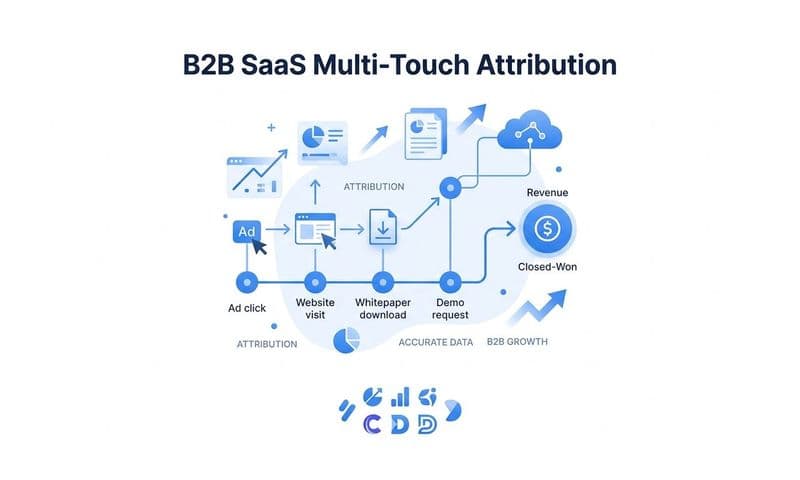
Think about a prospect who clicks a LinkedIn ad, registers for your webinar, attends live, then books a demo three weeks later through a direct visit. Last-touch attribution credits the direct visit. A time-decay model gives significant credit to the webinar attendance because it happened close to the conversion. A linear model spreads credit across every touchpoint, including the original ad click.
For B2B SaaS teams with longer sales cycles, setting a 60-day post-webinar attribution window is often appropriate. A prospect who attends your webinar and closes 60 days later is still a webinar-influenced deal. Your attribution model needs to reflect that reality.
Success indicator: You can see webinar-sourced leads in your pipeline with their original traffic source and all subsequent touchpoints recorded in your attribution platform.
Step 6: Analyze Attribution Data and Reallocate Ad Spend Toward Quality
Now that your tracking infrastructure is in place and data is flowing, it is time to use that data to make smarter decisions about your ad budget. This is where conversion tracking for webinars moves from a technical exercise to a genuine competitive advantage.
Start with a channel-level report that shows cost per registration, cost per attendee, and cost per post-webinar conversion broken down by traffic source. You will likely find that the channel with the lowest cost per registration is not the same channel with the highest attendance rate or the best post-webinar conversion rate.
This is an important insight. Optimizing purely for cost per registration can lead you to scale channels that attract low-quality registrants who never show up or never convert. The metric you actually want to optimize toward is cost per pipeline-qualified lead from your webinar funnel.
Compare attribution models side by side to get a complete picture. First-touch attribution shows you which channel introduced the lead to your brand. Last-touch shows you what drove the final conversion. Multi-touch shows you the full journey and how each channel contributed along the way. Using all three together gives you a nuanced understanding of where your budget is working hardest. Reviewing the best marketing attribution software options available can help you find a platform that supports all three models simultaneously.
Use your attribution data to identify which ad creative, audience segment, and channel drives the highest-quality webinar attendees, not just the most registrants. High-quality attendees are those who stay for most of the webinar, click your CTA, and take a downstream action within your attribution window. Once you identify the characteristics of these high-value attendees, you can use that information to refine your targeting.
Here is where the feedback loop to your ad platforms becomes powerful. By sending enriched conversion data, including attendance events and post-webinar actions, back to Meta and Google via server-side tracking, you are giving their machine learning algorithms a much richer signal to optimize toward. Instead of optimizing toward anyone who submits a registration form, the algorithm learns to find users who are more likely to attend live and take action after the event. Over time, this improves the quality of your audience and reduces wasted spend on registrants who never show up. Using the right ad tracking tools makes this feedback loop significantly more effective.
Cometly's AI-powered insights layer surfaces exactly this kind of analysis, identifying which campaigns and creatives are driving the highest-value webinar attendees and flagging where budget reallocation would improve overall pipeline contribution.
Success indicator: You have a clear view of ROAS and pipeline contribution from each channel running webinar campaigns, and you are making budget decisions based on attendee quality rather than registration volume alone.
Putting It All Together: Your Webinar Tracking Checklist
Conversion tracking for webinars is not a one-time setup. It is a system that gets more accurate and more valuable as you collect more data across more webinars. Here is a quick-reference checklist you can use before every webinar launch:
1. Define your conversion events: registration, attendance, replay view, CTA click, demo request, and trial sign-up. Write them down with clear definitions before building anything.
2. Build your UTM structure and apply it to every ad and link driving to your registration page. Capture UTM values in hidden form fields at submission time so source data survives redirects.
3. Install both browser-based pixel tracking and server-side event tracking on your registration page. Set up event deduplication using unique event IDs to prevent double-counting.
4. Connect your webinar platform to your CRM and attribution stack. Use webhooks or native integrations to fire conversion events for attendance, CTA clicks, and post-webinar actions. Pass original UTM data through every downstream event.
5. Set up post-webinar conversion tracking with an appropriate attribution window, typically 30 to 60 days for B2B SaaS. Track replay views, resource downloads, demo bookings, and trial sign-ups from webinar-sourced leads.
6. Analyze attribution data by channel, creative, and audience. Compare models, identify high-quality attendee segments, and feed enriched conversion data back to your ad platforms to improve targeting over time.
Cometly is built to connect all of these pieces in one place: your ad platform data, webinar engagement events, CRM pipeline records, and revenue attribution. Instead of stitching together reports from five different tools, you get a single source of truth that shows exactly which ads and channels are driving your most valuable webinar attendees and how those attendees contribute to closed revenue.
If you are ready to stop guessing about your webinar ROI and start making data-driven decisions about your ad budget, Get your free demo and see how Cometly handles webinar conversion tracking end to end.