
Inaccurate conversion tracking is one of the most damaging problems a marketing team can face. When your data is wrong, every decision built on top of it is wrong too. You end up scaling campaigns that are actually underperforming, cutting budgets from channels that are quietly driving revenue, and feeding ad platform algorithms with corrupted signals that degrade targeting over time. For B2B SaaS companies running paid acquisition, this is not a minor inconvenience. It directly impacts pipeline, revenue, and growth efficiency.
The frustrating part is that conversion tracking errors are often invisible. Your dashboards look fine. Your pixel fires. Your ad platforms report conversions. But underneath, there are duplicate events, missed touchpoints, browser-blocked pixels, and attribution gaps that quietly distort your data.
This guide walks you through a structured, step-by-step process to diagnose and fix inaccurate conversion tracking. You will learn how to audit your current setup, identify the root causes of bad data, implement server-side tracking to close the gaps, validate your fix, and connect your conversion data to actual revenue.
Whether you are dealing with over-reported conversions from duplicate firing, under-reported conversions from ad blockers and iOS restrictions, or a complete disconnect between your ad data and CRM pipeline, this guide gives you a clear path forward. By the end, your conversion data will be accurate, reliable, and actionable so your team can make confident decisions and your ad platforms can optimize toward the outcomes that actually matter.
Step 1: Audit Your Current Conversion Tracking Setup
Before you can fix anything, you need a complete picture of what you are currently tracking and where things might be going wrong. Most teams are surprised by what they find during this step.
Start by documenting every conversion event you have configured across all ad platforms. That includes Meta, Google Ads, LinkedIn, and TikTok, as well as any analytics tools like Google Analytics 4. List each event by name, the action it tracks, the platform it reports to, and how it is implemented. This single document will become your tracking inventory and the foundation for everything that follows.
Check for duplicate conversion events. This is one of the most common causes of over-reported conversions. Many teams discover they have both a hardcoded pixel embedded directly in their site code and a separate pixel firing through Google Tag Manager, both triggering on the same action. Without deduplication logic in place, every conversion gets counted twice. Open your browser developer tools and navigate through your conversion flows while watching the network tab. Look for the same event firing multiple times in quick succession.
Use platform diagnostic tools to verify what is actually firing. Meta Events Manager shows you a real-time log of events received from your pixel and server-side integrations. Google Tag Assistant lets you inspect which tags are firing on any given page and whether they are configured correctly. These tools give you ground truth about what your conversion tracking setup is actually doing versus what you think it is doing.
Identify which conversions rely on client-side tracking only. Client-side pixels run in the user's browser, which means they are vulnerable to ad blockers, browser privacy settings, and iOS restrictions. Note which of your conversion events have no server-side backup. These are your highest-risk events for under-reporting.
Flag any events with unclear definitions or inconsistent trigger logic. If a conversion event called "Lead" fires on page load for any visitor who lands on your thank-you page rather than only on confirmed form submission, you are likely counting sessions that never actually converted. Review the trigger conditions for every event and confirm they align with the actual user action you intend to track.
When your audit is complete, you should have a clear map of what is firing, where it is firing, and whether it is firing correctly. This is the starting point for diagnosing the root cause of your tracking errors.
Step 2: Identify the Root Cause of Your Tracking Errors
Not all conversion tracking problems look the same. Some inflate your numbers. Some suppress them. Others distort attribution without changing the total count. Identifying which type of error you are dealing with determines the fix you need to apply.
Categorize your errors into three buckets:
Over-reporting happens when conversions are counted more than once. The most common causes are duplicate pixel firing (as covered in Step 1), test conversions that were never filtered out of your live data, and thank-you page pixels that fire on page load rather than on a confirmed action. If your ad platform shows significantly more conversions than your CRM records leads, over-reporting is likely the culprit.
Under-reporting happens when real conversions are not captured. Ad blockers prevent client-side pixels from loading. iOS privacy changes and browser-level tracking prevention intercept or drop third-party tracking scripts. Cookie consent banners that require opt-in before pixels load mean a portion of your converting visitors are never tracked at all. If your CRM records more leads than your ad platforms report, under-reporting is your problem.
Misattribution happens when conversions are counted but credited to the wrong source or time period. Attribution window mismatches between platforms are a major driver here. If Meta uses a 7-day click window and Google uses a 30-day window, a single conversion can be claimed by both platforms, inflating your total reported conversions across channels. Last-click bias compounds this by giving all credit to the final touchpoint and hiding the contribution of earlier channels in the journey.
Cross-reference your numbers to locate the gap. Pull your ad platform conversion totals for a defined time period and compare them against the leads or events recorded in your CRM for the same window. A significant discrepancy in either direction is a reliable signal that something is wrong. For B2B SaaS companies with longer sales cycles, even a moderate gap compounds over time and distorts your understanding of which campaigns are actually performing.
Review your attribution window settings on each platform. Mismatched windows make cross-channel comparison inherently misleading. If you are comparing Meta and Google performance side by side, but each platform is counting conversions over a different time horizon, you are not comparing equivalent data. Understanding conversion window attribution is essential before drawing any cross-platform conclusions.
Check your pixel trigger conditions carefully. A pixel that fires on page load when a visitor lands on a thank-you page will record a conversion even if that visitor arrived by refreshing the page or navigating back to it after a previous session. The pixel should fire only when the form submission action is confirmed, not simply when the page loads.
Finally, investigate the impact of iOS 14+ privacy changes and browser-level tracking prevention on your signal loss. If a large share of your traffic comes from Safari or mobile devices, your client-side pixel is likely missing a meaningful portion of conversions. This is the gap that server-side tracking is designed to close.
Step 3: Implement Server-Side Tracking to Close Signal Gaps
Client-side pixels were built for a different era of the web. Today, ad blockers, browser privacy controls, and iOS restrictions intercept or drop a significant portion of pixel events before they ever reach your ad platforms. If you are relying on client-side tracking alone, you are working with incomplete data by default.
Server-side tracking solves this by sending conversion events directly from your server to the ad platform, bypassing the browser entirely. The two most important implementations for most B2B SaaS marketing teams are the Meta Conversion API (CAPI) and Google Enhanced Conversions. Understanding the full server-side tracking benefits will help you make the case for this investment internally.
Setting up the Meta Conversion API. CAPI allows you to send conversion events from your server directly to Meta. This means that even when a user's browser blocks your pixel, the conversion event still reaches Meta through the server channel. To implement CAPI, you will need to send events using Meta's API with a valid access token tied to your ad account. Events should include standard parameters such as event name, event time, and event source URL, along with first-party data parameters like hashed email, hashed phone number, and external ID to maximize match rates. Follow a detailed Conversion API implementation tutorial to ensure your setup is complete and correctly deduplicated from the start.
Setting up Google Enhanced Conversions. Google Enhanced Conversions works similarly by supplementing your standard Google Ads conversion tag with hashed first-party data. When a user converts, you send their hashed email or other identifiers alongside the conversion event, allowing Google to match the event to a signed-in Google account even when cookie-based tracking is limited.
Include first-party data parameters. The quality of your server-side tracking depends heavily on your event match quality. Platforms use first-party identifiers like hashed email addresses and phone numbers to match server-side events to real users. The more parameters you include, the higher your match rate and the more accurately your conversions are attributed. Review your event match quality scores in Meta Events Manager after implementation. A score in the high range indicates your events are being matched accurately.
Configure event deduplication. This step is critical. When you run both a client-side pixel and server-side tracking simultaneously, the same conversion can be received twice by the platform once from the browser and once from the server. Without deduplication, you are back to double-counting. Both Meta and Google use event ID matching to identify duplicates. Assign a unique event ID to each conversion event and include it in both your pixel event and your server-side event. The platform will then count only one instance of that conversion regardless of how many times it receives it.
Think of server-side tracking not as a replacement for your pixel but as a complement to it. Running both with proper deduplication gives you the highest possible signal quality. Your pixel captures browser-side data that enriches the event. Your server-side integration ensures the event reaches the platform even when the browser cannot deliver it.
Step 4: Fix Attribution Configuration Across Ad Platforms
Even with clean event tracking, your attribution data can still mislead you if your configuration is inconsistent across platforms. This step is about making sure you are comparing apples to apples and that your attribution model reflects how your customers actually buy.
Standardize attribution window settings. Each ad platform has default attribution windows that differ from one another. Meta may default to a 7-day click and 1-day view window. Google may use a different window entirely. When you compare performance across platforms without accounting for these differences, you are comparing data measured over different time horizons. Align your attribution windows as closely as possible across platforms, and document the settings you have chosen so your team interprets the data consistently.
Understand the default attribution model on each platform. Most ad platforms default to some form of last-click or data-driven attribution. Last-click attribution gives all conversion credit to the final touchpoint before conversion, which systematically undervalues top-of-funnel and mid-funnel channels. For B2B SaaS companies with longer sales cycles, this creates a misleading picture where bottom-of-funnel retargeting campaigns appear to drive all revenue while awareness campaigns appear to drive none.
Adopt a multi-touch attribution approach. Rather than relying solely on the attribution model built into each individual ad platform, consider using a dedicated attribution tool that can track the full customer journey across channels and apply a multi-touch model. Reviewing the best software for tracking marketing attribution can help you identify the right solution for your team's needs. This gives you a more accurate view of which channels and campaigns contribute to pipeline and revenue across the entire buying process, not just the final click.
Audit your UTM parameter structure. UTM parameters are how your analytics tools identify the source, medium, campaign, and ad for every session. If your UTM naming is inconsistent, missing, or broken, your source data will be fragmented and unreliable. Review every active campaign across all platforms and confirm that each campaign, ad set, and individual ad has complete and consistently formatted UTM tags. Establish a naming convention and enforce it across your team and any agency partners. If you are new to this, a primer on what UTM tracking is and how it helps will give you the foundational knowledge to build a reliable structure.
Confirm UTM data is flowing into your CRM. This is a step many teams miss. Your UTM parameters need to be captured at the point of form submission and stored at the lead level in your CRM. If your forms are not passing UTM data through hidden fields, or if your CRM is not storing it, you lose the ability to connect lead source data to downstream pipeline and revenue outcomes. Verify this flow is working end to end.
Step 5: Connect Conversion Data to Pipeline and Revenue
Tracking form fills is a starting point, not an endpoint. For B2B SaaS companies, a lead is only valuable if it becomes a qualified opportunity and eventually a closed deal. If your conversion tracking stops at the top of the funnel, you are optimizing your ad spend toward lead volume rather than revenue, and those two things are often very different.
The goal of this step is to extend your conversion tracking through the full funnel so your team and your ad platforms can optimize toward the outcomes that actually matter.
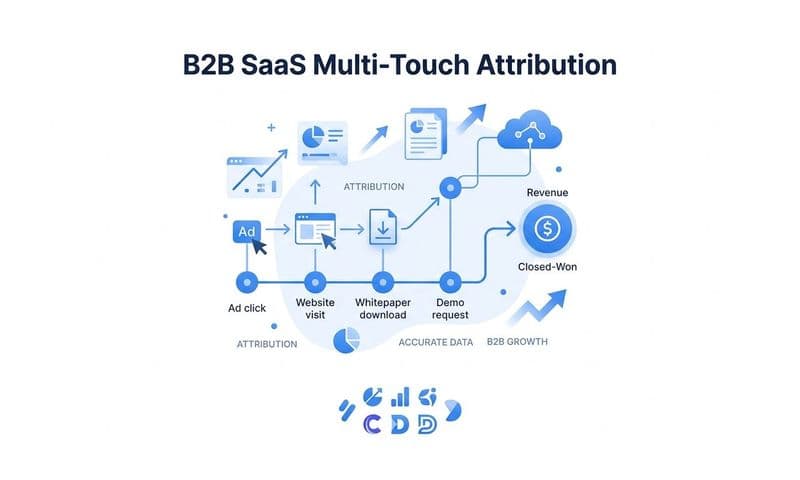
Integrate your ad platform data with your CRM. Connect your ad platforms to your CRM so you can see which campaigns are generating not just leads but qualified pipeline and actual revenue. When a lead progresses to an opportunity or a deal closes, that event should be tied back to the original ad interaction that started the journey. This connection is what transforms attribution from a reporting exercise into a decision-making tool.
Use offline conversion imports or API-based integrations. Both Meta and Google support offline conversion imports that allow you to send downstream CRM events back to the ad platform. When a lead becomes a qualified opportunity or a deal closes, you can send that event back to Meta or Google with the original click ID or user identifier. The platform then uses this signal to understand which types of users actually convert to revenue, improving its targeting and optimization algorithms over time. Learn more about how offline conversion tracking works and how to implement it effectively for your CRM pipeline events.
Connect payment data to your attribution model. If your SaaS product uses Stripe or a similar payment processor, connecting your payment data to your ad attribution data gives you true return on ad spend at the revenue level. Instead of calculating ROAS based on lead volume or estimated deal values, you can see exactly how much revenue each campaign generated from customers who actually paid.
This is the level of attribution that separates growth teams that scale efficiently from those that burn budget on campaigns that generate leads but not revenue. Platforms like Cometly are built specifically for this use case, connecting your ad data, CRM pipeline events, and revenue data into a single attribution view so you can see which ads are driving closed deals, not just top-of-funnel activity.
When your conversion tracking extends through to revenue, your ad platform algorithms also improve. Instead of optimizing toward form fills, they optimize toward the user profiles and behaviors that correlate with actual closed revenue. Over time, this compounds into meaningfully better targeting and lower cost per acquisition.
Step 6: Validate Your Fix and Establish Ongoing Monitoring
Implementing fixes is only half the work. You need to confirm that your changes actually resolved the problem and put a system in place to catch future issues before they corrupt your data.
Run a validation period before making budget decisions. After implementing your tracking fixes, wait at least 7 to 14 days before using the new data to inform budget changes. This gives you enough conversion volume to confirm the fix is working consistently and enough time to identify any edge cases your implementation did not account for.
Compare ad platform counts against CRM counts daily. During your validation period, pull your ad platform conversion totals and your CRM lead counts each day and compare them side by side. The gap between these two numbers should be narrowing toward a reasonable margin. A perfect match is not realistic because some conversions will always fall outside attribution windows, but a large or growing gap signals that something is still broken. Reviewing how to fix attribution discrepancies in data can help you interpret what the remaining gap means and whether further action is needed.
Set up automated alerts for conversion anomalies. Configure alerts in your ad platforms or analytics tools to notify you when conversion volume drops significantly below your baseline or spikes unexpectedly. A sudden drop often means a tracking tag broke due to a site update. An unexpected spike can indicate duplicate firing was reintroduced. Catching these issues within hours rather than weeks protects the integrity of your data and your budget decisions.
Create a monthly tracking audit checklist. Document a recurring audit process that covers pixel health, event match quality scores, UTM parameter consistency across active campaigns, and CRM data completeness for lead source fields. Assign ownership for this audit so it actually happens. Following best practices for tracking conversions accurately gives you a proven framework to structure this recurring review.
Document your entire tracking setup. Write down which events fire, where they fire, how they are triggered, and how they are configured on each platform. When team members change or agency partners rotate, this documentation ensures your tracking setup does not degrade over time due to undocumented changes.
Your success indicator is clear: your ad platform conversion counts and CRM lead counts align within a reasonable margin, your attribution data shows logical multi-touch paths across the customer journey, and your ROAS calculations reflect actual revenue outcomes rather than estimated lead values.
Putting It All Together
Fixing inaccurate conversion tracking is not a one-time task. It is a system you build and maintain. When your tracking is accurate, everything downstream improves: your ad platform algorithms optimize toward real outcomes, your team makes budget decisions based on reliable data, and your attribution model reflects the true customer journey from first ad click to closed revenue.
Here is a quick checklist to confirm your fix is complete:
Audit complete: Your conversion events are documented and free of duplicates.
Root cause identified: You have diagnosed whether your problem is over-reporting, under-reporting, or misattribution and addressed it directly.
Server-side tracking live: CAPI and Google Enhanced Conversions are implemented with proper deduplication and first-party data parameters.
Attribution standardized: Attribution windows are aligned across platforms, UTM parameters are consistent, and CRM lead source data is complete.
Revenue connected: Your conversion tracking extends through to pipeline stages and closed-won revenue, not just form fills.
Monitoring in place: You have automated alerts, a validation process, and a monthly audit routine to catch future issues early.
For B2B SaaS teams that want a single platform to handle all of this, Cometly connects your ad platforms, CRM, and revenue data into one attribution system. It captures every touchpoint from ad click to closed deal, shows which sources actually convert to revenue, and sends enriched conversion signals back to Meta, Google, and other ad platforms to improve targeting and optimization. Accurate conversion tracking is the foundation of every good marketing decision. Build it right and your entire growth engine becomes more efficient.
Ready to stop guessing and start making decisions based on data you can trust? Get your free demo today and see how Cometly gives you complete visibility into every touchpoint, every channel, and every dollar of revenue your campaigns generate.