Picture this: you're a B2B SaaS marketer running paid campaigns across LinkedIn, Google, and Meta. You've got a polished landing page on your marketing site, a product demo environment on a separate app domain, and a billing or checkout flow handled by a third-party payment platform. The funnel looks solid on paper. But when you open your analytics dashboard, the picture falls apart.
Conversions show up as "direct." Paid channels look like they're underperforming. Your ad platforms are reporting results that don't match your CRM. You've got pipeline, but you can't trace it back to the campaigns that created it.
This is what cross domain tracking challenges look like in practice. And for most B2B SaaS teams running multi-step funnels across multiple domains, it's not an edge case. It's the default state of their data.
Cross domain tracking challenges are among the most common and costly blind spots in modern marketing analytics. When attribution data breaks at domain boundaries, marketing teams lose visibility into what's actually driving revenue. Budget decisions get made on distorted signals. High-performing channels get cut. Underperformers get scaled. The damage compounds quietly over time.
This article breaks down exactly why tracking breaks when users cross domains, what it costs your attribution accuracy, where it happens most often in B2B SaaS funnels, and what modern solutions look like. By the end, you'll have a clear picture of the problem and a practical path to fixing it.
The Browser Boundary Problem: Why Sessions Break at Domain Handoffs
To understand why cross domain tracking fails, you need to understand one fundamental browser rule: cookies are scoped to a single domain. When a user visits your marketing site at company.com, the browser sets a first-party cookie tied to that domain. That cookie stores session data, including where the user came from, what campaign they clicked, and what they've done on the site.
The moment that user clicks a link and lands on a different domain, say, app.company.com or company-app.com, the browser does not carry that cookie over. It's a hard boundary. The receiving domain has no visibility into what happened on the originating domain. From its perspective, this is a brand-new visitor arriving with no known source.
It's worth clarifying the subdomain distinction here. Subdomains like app.company.com can technically share cookies with company.com if you configure the cookie's domain attribute correctly. But fully separate domains, such as company.com and company-checkout.com, cannot share cookies under any circumstances. This is not a configuration issue. It's a browser security boundary that exists by design.
What this means in practice is that the original traffic source gets stripped away at every domain handoff. The ad click, the campaign UTM, the session context: all of it disappears. The user's journey continues, but the data thread connecting that journey to its origin is severed.
Modern browser privacy changes have made this problem significantly worse. Safari's Intelligent Tracking Prevention (ITP) has been aggressively limiting cookie lifespans and blocking cross-site tracking since 2017, with restrictions tightening over subsequent years. Firefox has followed a similar path. Chrome, historically more permissive, has also moved toward stricter third-party cookie restrictions.
Third-party cookies, which were historically the workaround for cross-domain identity persistence, are now largely deprecated or restricted across the major browsers. This removes the fallback that many tracking setups relied on for years. What's left is a tracking environment where browser-based identity simply does not survive domain transitions without deliberate engineering. Understanding how link tracking restrictions affect attribution is essential context for any team building a modern funnel.
The result is a fundamental mismatch between how B2B SaaS funnels are architected and how browser-based tracking works. Most modern SaaS products were built for user experience and product isolation, not for analytics continuity. The tracking infrastructure was often bolted on afterward, and it was never designed to handle the domain boundaries that now sit in the middle of every conversion journey.
What Broken Tracking Actually Costs Your Revenue Attribution
When session continuity breaks at a domain boundary, your analytics tools have to make a decision about how to attribute that new session. And they almost always make the wrong one.
The most common outcome is direct traffic inflation. When a user arrives on a new domain without a referrer or recognized source parameter, analytics platforms default to classifying the session as "direct." This means the original ad click, the LinkedIn campaign, the Google search, the email sequence that started the journey gets no credit for the conversion that eventually follows.
For B2B SaaS companies, this distortion compounds across a multi-step funnel. Consider a typical PLG motion: a user clicks a paid ad and lands on your marketing site, then clicks through to a free trial on your product domain, then eventually upgrades via a Stripe-hosted billing page. That's three domain transitions. Each one is a point where the source attribution can break. If it breaks at the first handoff, the entire downstream journey is misattributed.
The downstream effect on budget decisions is significant. Marketing teams look at channel performance reports and see paid search or paid social underperforming. Direct traffic appears to be the top converter. The logical response is to shift budget away from paid channels and toward whatever appears to be working. But the data is wrong. The paid channels were driving the pipeline. The direct attribution was just where the broken tracking sent the credit.
This is one of the most dangerous patterns in marketing analytics: making confident decisions on confidently wrong data. The numbers look clean. The reports look complete. But the underlying attribution chain is fractured, and every optimization decision made on top of it is pointing in the wrong direction. These are among the most costly attribution challenges in marketing analytics that teams face today.
For teams connecting ad spend to pipeline and revenue, the stakes are especially high. If you can't accurately trace which campaigns are generating qualified pipeline, you can't make intelligent scaling decisions. You're essentially flying blind with a dashboard that looks like it's working.
Where Cross Domain Tracking Fails Most Often in SaaS Funnels
Cross domain tracking doesn't fail randomly. It fails at predictable points in the funnel, and most B2B SaaS companies have at least two or three of these risk points built into their standard conversion flow.
Marketing site to product or trial environment: This is the most common failure point in product-led growth motions. The marketing site lives on company.com, but the actual product or trial signup lives on app.company.com or an entirely separate domain like companyapp.io. Users click "Start Free Trial," cross the domain boundary, and the source that drove them there is gone. The trial signup gets attributed to direct traffic instead of the campaign that created the opportunity.
Third-party checkout and billing platforms: When companies use Stripe-hosted payment pages, Paddle, or similar billing platforms, the checkout experience happens on a domain owned by the payment provider, not the SaaS company. The handoff to that payment domain breaks the session, and the purchase event gets orphaned from its original source. This means revenue attribution in your analytics is incomplete even when the conversion itself is tracked. Fixing conversion tracking gaps at these billing handoffs is one of the highest-leverage improvements a SaaS team can make.
Webinar and scheduling tools: Many B2B SaaS companies route prospects through Calendly, Zoom Events, or similar external scheduling and webinar platforms as part of a demo or sales qualification flow. These tools live on their own domains. When a prospect books a demo through Calendly after clicking an ad, that booking event is invisible to your primary tracking infrastructure unless you've specifically engineered a solution.
Partner portals and co-sell environments: Companies with partner or reseller channels often have prospects moving through co-branded portals or partner-hosted environments. Each of these represents another domain handoff and another point where attribution data can be lost.
The common thread across all of these scenarios is that the domain architecture was designed for function, not for tracking continuity. The tracking problem is a consequence of building the funnel the way most SaaS companies build it: with the best tool for each job, regardless of where that tool lives. A proper attribution tracking setup must account for each of these handoff points from the start.
Technical Approaches to Maintaining Session Continuity Across Domains
Solving cross domain tracking challenges requires moving beyond browser-native session management. There are three primary technical approaches, each with different tradeoffs in terms of complexity, reliability, and coverage.
Linker parameters: This approach involves appending a unique identifier as a URL query parameter when linking between domains. Google Analytics 4 uses this natively with the _gl parameter. When a user clicks a link from domain A to domain B, GA4 appends a session identifier to the URL. The receiving domain reads that parameter and reconstructs the session context, preserving the original source attribution.
Linker parameters work reasonably well when configured correctly, but they have meaningful limitations. They only function when users click instrumented links. If a user types a URL directly, copies and pastes a link, or arrives via a redirect that strips query parameters, the linker data is lost. They also require ongoing maintenance: every cross-domain link in your funnel needs to be properly configured, and new links added to the site need to be checked as well. Understanding how UTM tracking works alongside linker parameters helps build a more complete picture of session continuity.
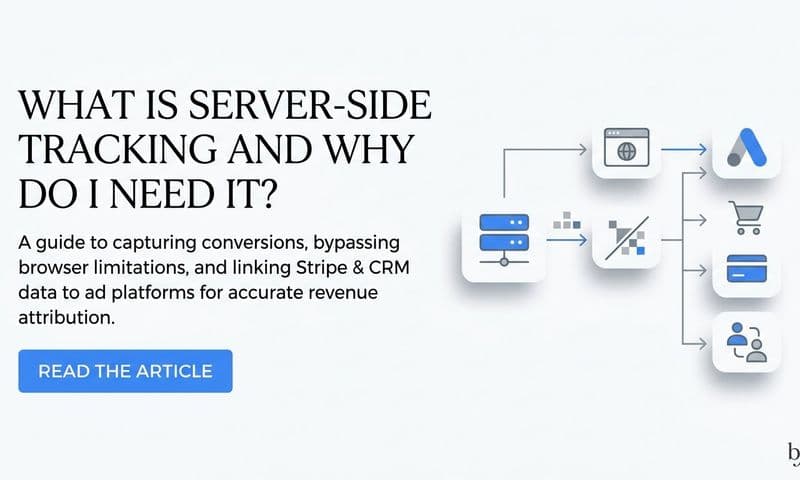
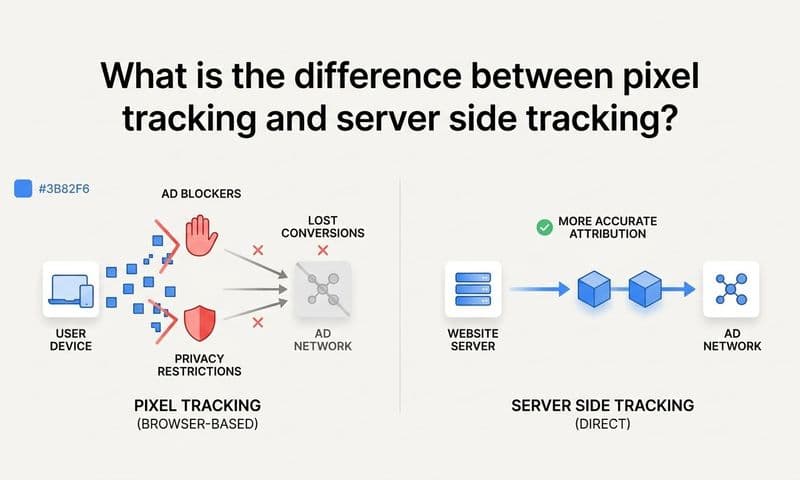
Server-side tracking and Conversion APIs: This is the most resilient approach to cross domain tracking challenges. Rather than relying on browser cookies to maintain identity, server-side tracking captures conversion events at the server level and sends them directly to ad platforms via APIs. Meta's Conversion API (CAPI), Google's Enhanced Conversions, and similar integrations operate entirely outside the browser, making them immune to cookie restrictions, ITP, and domain boundaries.
When a high-value event occurs, such as a trial signup, a demo booking, or a purchase, the server sends that event data directly to the ad platform with whatever identifiers are available: hashed email, phone number, customer ID. The ad platform matches that event to its own user records, bypassing the browser-based tracking gap entirely. The benefits of server-side tracking make it the most reliable method for capturing conversion data across domain transitions.
First-party data strategies and persistent identifiers: The third approach focuses on collecting a consistent user identifier as early as possible in the journey and passing it through every touchpoint. When a user fills out a form on your marketing site, you capture their email. That email, typically hashed for privacy, becomes a persistent identifier that can be passed as a parameter to subsequent domains, included in server-side events, and used to stitch sessions together in your attribution platform.
This approach transforms the problem from a browser tracking problem into a data architecture problem. Instead of relying on the browser to maintain session continuity, you're using a first-party identifier that exists independently of browser state and can survive any domain transition.
How Attribution Platforms Stitch Multi-Domain Journeys Together
Technical tracking solutions capture the events. Attribution platforms make sense of them.
Dedicated attribution platforms are built to ingest events from multiple sources, including ad platforms, CRM systems, website analytics, and product data, and resolve them into a single, coherent customer journey. They act as the central layer that connects data across domain boundaries, making it possible to see a complete picture of how a user moved from first ad click to closed-won revenue, even when that journey crossed three different domains. Reviewing the best marketing attribution software options is a useful starting point for teams evaluating this layer.
The key capability here is identity resolution. When events arrive from different domains with different session identifiers, an attribution platform uses available signals, including email addresses, CRM IDs, IP addresses, and device fingerprints, to determine whether those events belong to the same user. When a match is found, the events are stitched into a unified journey with the original source attribution preserved throughout.
Cometly is built specifically for this use case in B2B SaaS. It connects ad clicks from LinkedIn, Google, and Meta with form submissions, product events, and CRM milestones into one unified view of the customer journey. A user who clicked a paid ad, visited the marketing site, signed up via the product domain, and converted to a paid plan can be tracked as a single continuous journey with the original campaign preserved as the source. That's the difference between knowing which campaigns drive revenue and guessing.
Cometly also integrates directly with Stripe, which means revenue data from billing events can be connected back to the ad data that originated the journey. This closes the loop between marketing spend and actual revenue, not just pipeline or trial signups.
The ability to compare attribution models across a complete multi-domain journey is another critical capability. First touch, last touch, linear, and data-driven attribution models all produce different answers. But those answers are only meaningful if the underlying event data is complete. If domain handoffs have caused data loss, even sophisticated attribution models are working from an incomplete dataset. The model comparisons become misleading rather than illuminating. Teams that want to measure cross-channel marketing attribution accurately must resolve the domain tracking problem first.
Solving cross domain tracking is not just about fixing a technical gap. It's about making the attribution analysis that follows it trustworthy.
Building a Tracking Foundation That Survives Domain Transitions
Understanding the problem is step one. Building the infrastructure to solve it requires a deliberate, structured approach. Here's how to think about it.
Audit every domain handoff in your funnel: Start by mapping the full customer journey from first ad click to closed-won revenue. Identify every point where a user crosses a domain boundary. Marketing site to product domain. Product domain to billing platform. Marketing site to scheduling tool. These are your tracking risk points. Until you've mapped them explicitly, you can't know where your data is breaking.
Prioritize server-side tracking for high-value conversion events: Not every event in your funnel carries the same weight. Focus your server-side implementation on the events that matter most for attribution: trial signups, demo bookings, purchase events, and CRM stage changes. These are the events that connect marketing activity to revenue, and they need to be captured reliably regardless of what's happening in the browser. Server-to-server integrations via Conversion APIs are the most resilient way to ensure these events are recorded and attributed correctly. Following best practices for tracking conversions accurately at each of these points is what separates reliable attribution from guesswork.
Establish a first-party data layer early in the journey: The earlier you can collect a persistent user identifier, the better your ability to stitch the journey together across domain transitions. Build your forms and lead capture mechanisms to collect email addresses or other identifiers at the first opportunity. Pass those identifiers through subsequent touchpoints as URL parameters or server-side event properties. This creates the connective tissue that allows your attribution platform to resolve identity across domains and reconstruct the full customer journey.
Validate your tracking regularly: Domain handoffs don't just break at setup. They break when links change, when new tools get added to the funnel, when redirects are updated, or when third-party platforms change their URL structures. Build a regular audit cadence into your analytics workflow. Check that source attribution is flowing correctly through each handoff point. Monitor your direct traffic percentage as a signal: if it spikes, it often means a tracking gap has opened somewhere in the funnel.
The goal is not a perfect tracking setup on day one. The goal is a foundation that captures the most important signals reliably, can be extended as your funnel evolves, and gives your attribution platform enough data to produce accurate, actionable insights.
The Bottom Line on Cross Domain Attribution
Cross domain tracking challenges are not just a technical inconvenience. They are a strategic liability. When attribution data breaks at domain boundaries, marketing teams lose visibility into what is actually driving revenue. Budget decisions get made on distorted signals. Channels that work get cut. Channels that appear to work because they sit closest to the final conversion get scaled. The compounding effect on marketing efficiency is significant.
The solution path is clear: audit where your funnel crosses domains, implement server-side tracking for critical conversion events, collect first-party identifiers early and pass them through the journey, and use an attribution platform that can stitch the full multi-domain journey into a single coherent view.
Cometly is built to solve exactly this problem for B2B SaaS teams. It connects every touchpoint from first ad click to closed-won revenue, integrates with your ad platforms, CRM, and Stripe billing data, and gives you a single source of truth for attribution across your entire funnel. No more guessing which campaigns drive pipeline. No more inflated direct traffic masking your best-performing channels.
If your attribution data is fractured across domains, the first step is getting the right platform in place. Get your free demo today and see how Cometly captures every touchpoint to give you the accurate, complete attribution data your growth decisions deserve.