Most B2B SaaS marketing teams are not struggling to produce content. They are struggling to prove that any of it matters. Blog posts go live, guides get published, videos get uploaded, and yet the connection between all that effort and actual pipeline remains frustratingly unclear. The content exists. The buyers exist. But somewhere between the two, the signal gets lost.
The root cause is almost always the same: content created without journey context. When you publish an article without knowing where it fits in the buyer's decision process, you are essentially broadcasting into a void and hoping the right person finds the right piece at exactly the right moment. That is not a strategy. That is luck.
Customer journey content marketing is the discipline that fixes this. It is the practice of deliberately aligning your content assets to the specific stages a buyer moves through before making a purchase decision. At each stage, buyers have different questions, different levels of awareness, and different thresholds for what they need to feel confident moving forward. When your content meets them precisely where they are, it stops being noise and starts being a genuine driver of pipeline and revenue.
This article is a practical explainer. We will walk through why so much B2B content fails to move buyers, what each stage of the journey actually demands, which content formats perform at each stage, how to build a content map, and most importantly, how to measure whether any of it is actually working. By the end, you will have a clear framework for turning your content library into a measurable growth lever.
Why Most B2B Content Fails to Move Buyers Forward
There is a persistent myth in content marketing that volume is the answer. Publish more, rank for more keywords, generate more traffic, and the pipeline will follow. The reality is more complicated, and for many B2B SaaS teams, more frustrating.
Publishing more content does not automatically equal converting more buyers. Without intentional stage alignment, additional content simply adds to the noise. A buyer who is ready to choose between two vendors does not need another educational explainer about the problem space. A buyer who just discovered they have a problem does not need a pricing comparison page. Mismatched content does not just fail to help; it actively creates friction that pushes buyers away.
B2B SaaS buyers rarely convert on first contact. The sales cycle is longer, the decision often involves multiple stakeholders, and the research process spans weeks or months. A buyer might read a blog post, attend a webinar three weeks later, search for a competitor comparison, and then finally request a demo. Each of those moments is a content touchpoint. If any one of them delivers the wrong type of content for the stage the buyer is in, the momentum stalls.
This is why a multi-touch content strategy is not optional in B2B SaaS. It is the baseline. You need content that serves buyers at the beginning of their journey when they are just becoming problem-aware, content that supports them during evaluation when they are comparing options, and content that gives them the confidence to commit when they are close to a decision.
The cost of getting this wrong is measurable, even if most teams are not measuring it. When awareness content gets pushed to decision-ready buyers, it signals that you do not understand where they are in the process. When decision-stage content like pricing pages or demo requests gets served to buyers who are still in early research mode, it feels pushy and premature. Both scenarios damage trust and reduce the likelihood of conversion.
The fix is not to produce more content. It is to produce more intentionally aligned content, and then measure what actually moves buyers forward. That starts with understanding the three stages of the journey in detail.
The Three Stages of the Customer Journey and What Buyers Need at Each One
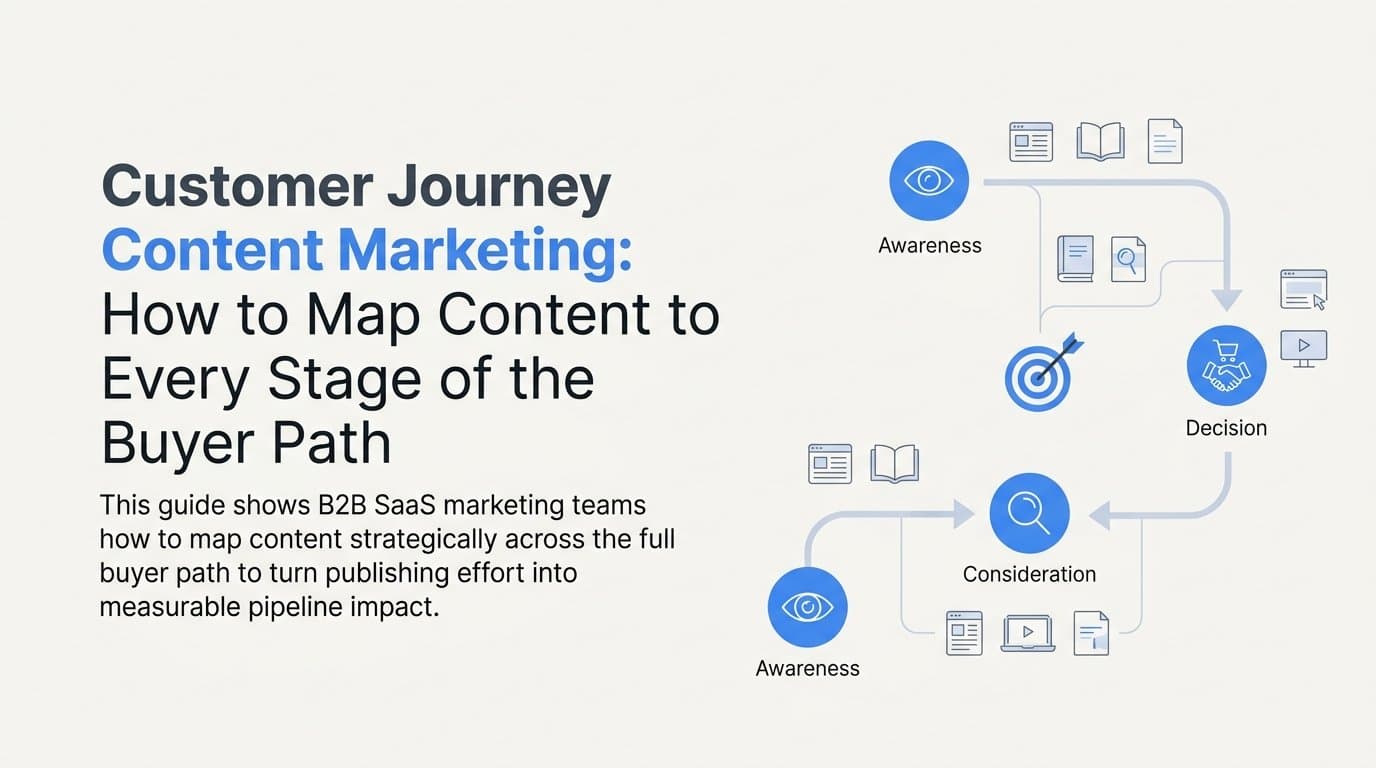
The buyer journey in B2B SaaS is rarely a straight line. Buyers move back and forth between stages, revisit earlier questions as new information surfaces, and often consume content from multiple channels before making a decision. But despite this non-linearity, the three core stages of awareness, consideration, and decision remain the most useful framework for aligning content to buyer intent.
Awareness: Educate Before You Pitch
At the awareness stage, buyers are problem-aware but solution-agnostic. They know something is not working, but they have not yet formed a clear picture of what kind of solution they need, or whether a product like yours even exists. They are searching for context, language to describe their problem, and reassurance that others face the same challenge.
Content at this stage should educate and build trust, not pitch. The moment you lead with your product at this stage, you lose the buyer. They are not ready to evaluate vendors. They are still trying to understand the problem. Your job is to be the most helpful resource in that problem space, which builds the credibility you will need when they are ready to compare solutions.
Consideration: Support the Evaluation Process
At the consideration stage, buyers know what kind of solution they need and are now evaluating their options. They are reading comparison articles, attending webinars, watching demos, and talking to peers. They are trying to narrow a shortlist and understand the meaningful differences between vendors.
Content here needs to provide depth, comparison, and proof. Buyers are asking: how does this solution actually work, how does it compare to alternatives, and what results have others achieved with it? This is the stage where your content needs to position your solution in context, not just describe its features in isolation. Generic marketing language does not work here. Specificity and credibility do.
Decision: Reduce Risk and Build Confidence
At the decision stage, buyers are close to committing. They have usually narrowed their options to two or three vendors and are looking for the final piece of evidence that makes one choice feel clearly right. The emotional driver at this stage is risk reduction. Buyers want to feel confident that they are making the right call.
High-intent content at this stage directly influences revenue. Customer stories, detailed ROI frameworks, live demos, and direct response ads targeting buyers who have already engaged with your brand all serve this moment. The goal is not to introduce new information but to reinforce the right decision and remove the last remaining objections standing between the buyer and conversion.
Content Formats That Actually Work at Each Stage
Understanding the three stages is the foundation. Knowing which content formats actually perform at each stage is where strategy becomes execution. Not all content types are equally effective at every point in the journey. Matching format to stage is one of the highest-leverage decisions a content team can make.
Top-of-Funnel: Build Reach and Trust
At the awareness stage, your primary goals are reach and credibility. You need to show up where buyers are searching, and you need to deliver enough value that they remember you when they move into evaluation mode.
Long-form explainer articles: Search-optimized content that addresses specific problems in depth. These build organic visibility and position your brand as a trusted authority in the problem space. The article you are reading right now is an example of this format in action.
Educational videos: Short to medium-length videos that explain concepts, walk through frameworks, or break down industry challenges. These perform well on YouTube and social platforms where buyers are doing early research.
Organic social content: Posts, threads, and short-form content that surfaces insights and problem framing. The goal is not to sell but to demonstrate that you understand the buyer's world better than anyone else does.
Mid-Funnel: Accelerate Evaluation
At the consideration stage, buyers need content that helps them make sense of their options and understand how your solution fits their specific context.
Comparison pages: Direct, honest comparisons between your product and alternatives. Buyers are going to make these comparisons whether you create the content or not. Owning the narrative on your own site is almost always the better move.
Webinars and live sessions: High-engagement formats that allow buyers to ask questions and see the product in a realistic context. These also create natural opportunities to capture contact information and move buyers into nurture sequences.
Product-led demos and detailed guides: Content that shows the product doing real work, solving real problems. Buyers at this stage want to see the solution in action, not just read about its capabilities.
Bottom-of-Funnel: Close the Gap
At the decision stage, the content job is to remove the final objections and give buyers the confidence to commit.
Customer stories: Detailed accounts of how real customers achieved results with your product. The more specific and relevant to the buyer's situation, the more effective these are.
ROI calculators and frameworks: Tools that help buyers quantify the value of the decision they are about to make. These are particularly effective for B2B SaaS where the economic justification often needs to be communicated internally to multiple stakeholders.
Direct response ads: Retargeting campaigns that reach buyers who have already engaged with your brand and are showing high-intent signals. These are not awareness plays. They are designed to bring decision-stage buyers back to a conversion point.
How to Map Content to Touchpoints Across the Buyer Journey
Knowing which formats work at which stage is useful. Actually mapping your existing content to the buyer journey is where the real strategic work happens. A content map is a practical tool that connects specific assets to specific buyer questions, and it surfaces the gaps that are costing you conversions.
Building a Content Map
Start with a simple matrix. On one axis, list the three journey stages: awareness, consideration, and decision. On the other axis, list the core questions buyers are asking at each stage. Then map every piece of content you currently have to the cell where it belongs.
This exercise almost always reveals the same pattern: a large cluster of content in the awareness column, a thinner layer in consideration, and very little in the decision column. Most content teams default to top-of-funnel production because it is easier to create and easier to justify with traffic metrics. But the content that directly influences revenue tends to live further down the funnel.
Auditing for Gaps
Once you have mapped what exists, the audit becomes about what is missing. Look at the buyer questions in each stage and ask honestly: do we have content that answers this question well? If the answer is no, that is a gap that is likely causing buyers to stall or look elsewhere.
Common gaps include a lack of comparison content in the consideration stage, an absence of specific customer stories in the decision stage, and mid-funnel content that describes the product but does not help buyers understand how it fits their particular use case. Identifying these gaps gives your content team a prioritized production roadmap grounded in buyer need rather than internal preference.
Using Channel Context to Reinforce Stage Alignment
Channel selection matters as much as content type. Paid search tends to capture buyers in the decision and late consideration stages because they are actively searching for solutions. Organic content and social reach buyers earlier in their journey when they are still in problem-exploration mode. Email nurture sequences often bridge the consideration-to-decision gap by delivering targeted content over time. Retargeting ads serve buyers who have already engaged but have not yet converted.
Aligning your content to both the right stage and the right channel is what transforms a content library into a coherent buyer experience. Each channel becomes a deliberate part of the journey rather than an isolated distribution mechanism.
Measuring Whether Your Journey Content Is Actually Driving Revenue
This is the section most content marketing guides skip. They cover strategy and format and mapping, and then stop before answering the most important question: how do you know if any of this is actually working?
Why Last-Click Attribution Falls Short
The default measurement model for most teams is last-click attribution, which assigns all conversion credit to the final touchpoint before a buyer converts. In a short sales cycle, this is a reasonable approximation. In B2B SaaS, where a buyer might interact with your content a dozen times over several months, it is deeply misleading.
Last-click attribution makes your decision-stage content look like the only thing that matters and makes your awareness and consideration content look like it has no impact at all. This leads to systematic underinvestment in top and mid-funnel content, which eventually starves the pipeline because fewer buyers are entering and progressing through the journey.
Multi-Touch Attribution as the Standard
Multi-touch attribution assigns credit to multiple touchpoints across the buyer journey rather than crediting only the first or last interaction. This is the measurement model most aligned with how B2B content actually influences buyers. It gives marketing teams a realistic picture of which content assets are contributing to pipeline at each stage, not just which ones happen to be the last thing a buyer clicked before converting.
With multi-touch attribution in place, you can see that a long-form explainer article is consistently appearing in the early journeys of buyers who eventually convert, even though it never gets credit in a last-click model. You can see that a specific webinar is a reliable mid-funnel accelerator. You can see that your retargeting ads are closing buyers who were already deep in consideration. Each of these insights is invisible without proper attribution.
Metrics That Actually Matter at Each Stage
Awareness stage: Reach, organic impressions, new visitor traffic, and content engagement metrics like time on page and scroll depth. These tell you whether your content is finding the right audience and holding their attention.
Consideration stage: Pipeline influence metrics, which measure how often mid-funnel content appears in the journeys of buyers who become qualified leads or opportunities. Email open and click rates within nurture sequences also belong here.
Decision stage: Closed-won revenue attribution. This is the metric that matters most and the one that is hardest to connect to content without proper attribution infrastructure. When you can see which content assets appear in the journeys of customers who actually signed, you have the data you need to make smarter production decisions.
Turning Journey Data Into Smarter Content Decisions
Attribution data is only valuable if you use it to make better decisions. Once you have a clear picture of which content assets are consistently appearing in the paths of converted customers, the strategic implications become straightforward.
Start by identifying your highest-performing content at each stage. Which awareness articles are generating qualified traffic that eventually converts? Which mid-funnel assets are appearing in the journeys of buyers who become pipeline? Which decision-stage content is showing up in the paths of closed-won customers? These are your proven performers, and they deserve more investment: more promotion, more updates, more adjacent content built around the same themes.
The flip side is equally important. Content that generates traffic but never appears in the journeys of converted customers is a signal worth paying attention to. It may be attracting the wrong audience, serving the wrong stage, or simply not delivering enough value to move buyers forward. Attribution data gives you the evidence to make these calls with confidence rather than relying on gut instinct or vanity metrics.
Reallocating budget and production effort toward content that demonstrably moves buyers through the funnel is one of the highest-ROI decisions a content team can make. It is also one of the most underutilized, because most teams do not have the attribution visibility to know which content deserves more investment.
This is precisely where platforms like Cometly change the game for B2B SaaS marketing teams. Cometly connects every content touchpoint to downstream pipeline and revenue, giving you a single source of truth for understanding which assets are actually driving business outcomes. It tracks the full customer journey from the first ad click or organic visit through to closed-won revenue, and it does this across every channel simultaneously. Instead of guessing which content matters, you can see it clearly in the data.
With that level of visibility, content strategy stops being a creative exercise and becomes a precision growth lever. You know what to build more of, what to stop investing in, and where the gaps in your buyer journey are costing you pipeline.
The Bottom Line
Customer journey content marketing is not about producing more content. It is about producing the right content for the right buyer at the right moment in their decision process. The teams that get this right do not just generate more traffic; they generate more pipeline, shorter sales cycles, and more confident buyers who convert at higher rates.
The framework is clear: understand what buyers need at each stage, match your content formats to those needs, map your assets to the journey, and use channel context to reinforce stage alignment. But none of that optimization is possible without measurement. Without knowing which content touches actually drive pipeline and revenue, every decision you make about what to produce next is guesswork dressed up as strategy.
The missing piece for most teams is attribution infrastructure that connects content performance to business outcomes across the full buyer journey. Traffic and engagement metrics are a starting point, but they are not the finish line. The finish line is closed-won revenue, and the path to it runs through every content touchpoint a buyer encounters along the way.
If you are ready to stop guessing and start knowing which content is actually moving your buyers forward, Get your free demo of Cometly today. See how it connects every touchpoint in your customer journey to the revenue outcomes that actually matter, and start making content decisions backed by real attribution data.