
Most B2B SaaS marketing teams are running paid campaigns, publishing content, and investing in multiple channels simultaneously. But ask them exactly how a prospect moves from seeing a LinkedIn ad to becoming a paying customer, and the honest answer is often: "We're not entirely sure." That visibility gap is not just a curiosity problem. It leads to misallocated budgets, disconnected messaging, and attribution data that tells an incomplete story.
This is precisely where the customer journey map becomes a strategic asset rather than a theoretical exercise. When built correctly and connected to real attribution data, a journey map transforms how marketing, sales, and leadership teams understand the buying process and make decisions about where to invest.
But before any of that value can be unlocked, you need a clear understanding of what a customer journey map actually is, what it contains, and why the standard approach often falls short for B2B SaaS specifically. This article covers all of it: the core definition, the key components, what makes B2B SaaS journeys uniquely complex, and how to connect your journey map to measurable attribution data that drives real decisions.
The Core Concept: What a Customer Journey Map Actually Represents
A customer journey map is a structured, documented representation of every interaction a prospect has with your brand, from the first moment they encounter an ad or piece of content to the point they become a paying customer and beyond. Think of it as a blueprint of the buyer experience, laid out in a way that makes the invisible visible.
The concept originated in UX and product design, where teams used journey maps to understand how users interacted with software interfaces. Over time, it migrated into marketing strategy, and for good reason. The same logic that helps product teams identify friction in an onboarding flow applies directly to understanding why prospects drop off between the consideration and decision stages of a sales funnel.
In B2B SaaS, the journey is rarely linear. Prospects do not simply see an ad, visit a landing page, and convert. They research across multiple channels, return to your website weeks later, involve colleagues in the evaluation process, and make a series of micro-decisions before ever speaking with a sales rep. A customer journey map captures this non-linear reality and gives teams a shared framework for understanding it.
This is an important distinction: a journey map is not just a diagram on a whiteboard. It is a strategic framework that aligns marketing, sales, and product teams around a shared understanding of how buyers think, feel, and act at each stage of the funnel. When those teams are operating from the same map, messaging becomes more consistent, budget allocation becomes more intentional, and handoffs between departments become less chaotic.
The map also serves as a diagnostic tool. When something is not working, whether that is a low demo request rate or a high churn rate in the first 90 days, the journey map provides a structured way to identify where the breakdown is occurring and what might be causing it. Without this framework, teams are left guessing.
Understanding the customer journey map definition is the starting point. But the real leverage comes from building a map that reflects how your buyers actually behave, not how you assume they behave. That distinction separates teams that use journey maps as decorative strategy documents from those that use them to make sharper, faster marketing decisions.
Anatomy of a Journey Map: The Key Components That Make It Useful
A customer journey map is only as useful as the components it includes. A vague, high-level diagram with generic stages and no connection to real buyer behavior will not tell you much. An effective map, on the other hand, is specific, data-informed, and built around the actual touchpoints your prospects encounter.
Every well-constructed journey map includes several core elements. Here is what each one contributes:
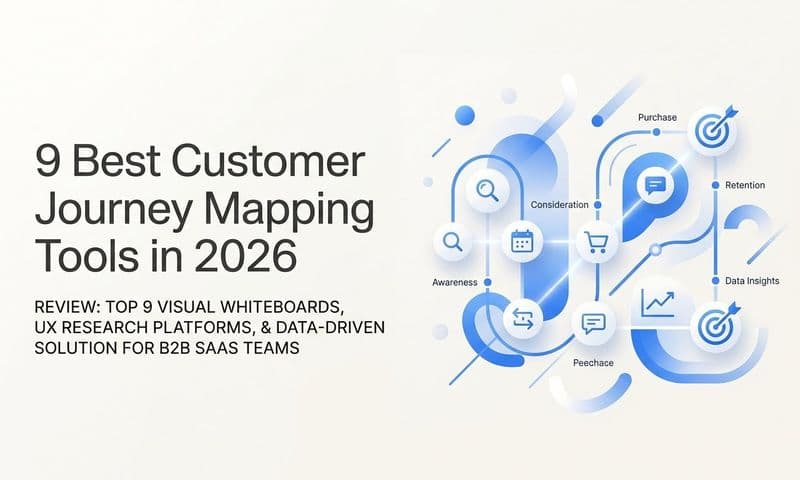
Defined Stages: The most common framework includes awareness, consideration, decision, and retention. These stages represent the buyer's progression from discovering your brand to becoming a loyal customer. In B2B SaaS, you might add stages like evaluation, trial, and onboarding to reflect the extended buying cycle and the importance of post-sale experience.
Buyer Personas: A journey map without a defined persona is a map to nowhere. Your personas should reflect the actual people involved in the buying process, including their job titles, goals, pain points, and the questions they are asking at each stage. In B2B SaaS, this often means creating multiple personas for a single buying committee.
Touchpoints: These are the specific moments of interaction between a prospect and your brand. A Google Ads click, a LinkedIn post view, a demo request form submission, a sales follow-up email, a product trial activation. Each touchpoint is a data point, and mapping them reveals which channels are doing the heavy lifting at each stage of the funnel. This is where journey mapping connects directly to attribution.
Actions and Behaviors: At each stage, what is the prospect actually doing? Are they reading comparison articles? Watching product demos? Requesting pricing? Mapping these behaviors helps you understand what content and campaigns need to exist to support each stage of the journey.
Emotional State and Intent Signals: This component is frequently overlooked, but it is critical in B2B SaaS. A prospect in early research mode is in a fundamentally different mental state than one who is actively evaluating vendors. Understanding whether someone is curious versus ready to decide changes which content, ads, and messaging will resonate. Intent signals, such as multiple visits to your pricing page or repeated engagement with bottom-of-funnel content, are behavioral indicators of where a prospect sits emotionally and logistically in their journey.
When all of these components come together in a single map, something powerful happens: the abstract concept of "the buyer journey" becomes a concrete, navigable framework. Teams can look at the map and immediately identify where they have strong coverage, where they have gaps, and where the prospect experience breaks down.
The challenge is that most teams build journey maps based on assumptions rather than data. The next step is making sure your map reflects what is actually happening, not what you hope is happening.
B2B SaaS Journeys Are Different: Why Standard Templates Fall Short
Pick up any generic marketing resource on customer journey mapping and you will likely find a clean, linear diagram with five stages and a single persona moving neatly from left to right. That model works reasonably well for e-commerce. It falls apart almost immediately when applied to B2B SaaS.
The differences are structural, not superficial. B2B SaaS buying cycles are longer, involve multiple decision-makers, and rarely follow a predictable path. A standard journey map template is not equipped to handle this complexity, and using one without modification leads to blind spots that cost real money.
Consider the multi-stakeholder problem. In a typical B2B SaaS purchase, you might have an end user who discovered your product through a Google search, a technical evaluator who is assessing your security and integration capabilities, and a budget owner who enters the conversation only when a shortlist has been established. These three people are having three different journeys with your brand, and they are intersecting at unpredictable points. A single-persona journey map cannot capture this dynamic. You need a map that accounts for multiple personas interacting with your brand at different stages, often simultaneously.
Then there is the multi-session reality. Unlike e-commerce, where a conversion can happen in a single browser session, B2B SaaS conversions almost never do. A prospect might click a paid search ad, read two blog posts, leave, see a retargeting ad on LinkedIn three weeks later, attend a webinar, and then request a demo. That entire sequence might span 60 to 90 days. A journey map that assumes a linear, single-session path will misrepresent how your buyers actually behave and lead to misaligned campaign strategies.
Perhaps the most significant gap in standard journey maps is where they end. Most templates stop at lead generation or initial conversion. But in B2B SaaS, the distance between a marketing-qualified lead and closed revenue is where the majority of value is created or lost. Pipeline progression, sales handoff quality, trial activation, and closed-won revenue attribution are all part of the journey. A map that ignores these stages gives marketing teams an incomplete picture of their actual impact on the business.
This is why B2B SaaS teams need journey maps that are built specifically for their buying environment: multi-persona, multi-session, and extended all the way through to revenue. Anything less is a simplified abstraction that looks good in a presentation but does not hold up when you try to make real decisions with it.
From Map to Measurement: Connecting Journey Stages to Real Attribution Data
A customer journey map without measurement is a hypothesis. It represents your best thinking about how prospects move through the funnel, but without data to validate it, you cannot know whether your map reflects reality or just reflects your assumptions. This is where attribution becomes the essential partner to journey mapping.
The connection is straightforward in principle: every stage of your journey map should be tied to measurable touchpoints. In practice, this requires tracking infrastructure that captures data across every channel, including paid search, paid social, organic content, email, and direct traffic, and connects those touchpoints to downstream revenue events in your CRM. Without that infrastructure, your journey map is built on incomplete data.
Multi-touch attribution is the analytical layer that brings a journey map to life. Rather than crediting only the first or last interaction a prospect had with your brand, multi-touch attribution models distribute credit across every touchpoint that contributed to a conversion. This gives marketers an accurate picture of which channels and campaigns are influencing conversion at each stage of the funnel, not just at the final moment before a deal closes.
For B2B SaaS teams, this matters enormously. Upper-funnel touchpoints like awareness-stage LinkedIn ads or educational blog content rarely get credit under last-click attribution models. But if those touchpoints are consistently appearing in the journeys of prospects who eventually convert, they are doing meaningful work. Multi-touch attribution surfaces that influence and prevents teams from cutting the campaigns that are quietly driving pipeline.
Server-side tracking and Conversion API integrations add another critical layer of data accuracy. As browser-based tracking becomes less reliable due to ad blockers, cookie restrictions, and privacy changes, pixel-based data collection increasingly misses events that matter. Server-side tracking captures conversion data directly from your server rather than the user's browser, ensuring that touchpoints are recorded even when client-side tracking fails. Conversion API integrations with platforms like Meta and Google allow you to send enriched event data directly to the ad platforms, improving their optimization algorithms and giving you more accurate reporting.
Without complete data, your journey map reflects an incomplete picture of how prospects actually move through the funnel. You might see that a prospect requested a demo, but miss the three touchpoints that preceded it. That gap leads to misattribution, misallocated budget, and a journey map that gradually drifts further from reality.
The goal is a closed loop: your journey map informs which touchpoints to track, and your attribution data continuously validates and refines the map. This relationship between strategic framework and measurement infrastructure is what separates teams that use journey maps effectively from those that treat them as one-time deliverables.
How to Build a Journey Map That Drives Marketing Decisions
Building a customer journey map that actually influences how you allocate budget and design campaigns requires a different starting point than most teams use. Instead of beginning with a whiteboard and a set of assumptions, start with your data.
Pull real touchpoint data before drawing anything: Look at your ad platforms, CRM, and website analytics to identify the actual paths prospects take before converting. Which channels appear most frequently in the journeys of your best customers? Which content pieces show up repeatedly before a demo request? What is the average number of touchpoints before a deal closes? This data tells you what your journey map should reflect, rather than what you hope it reflects.
Segment your journey maps by persona, traffic source, and conversion path: A prospect who finds you through a branded Google search is in a fundamentally different mental state than one who clicks a cold LinkedIn ad. They have different levels of awareness, different questions, and different timelines. Treating them as a single journey leads to generic messaging that resonates with neither. Build separate journey maps, or clearly differentiated segments within a single map, that account for these behavioral differences. This segmentation also helps you identify which channels are most effective at each stage of the funnel for each persona.
Identify drop-off points and coverage gaps: One of the most valuable exercises you can do with a journey map is to look at where prospects stop progressing. If a significant percentage of prospects reach the consideration stage but never request a demo, that is a signal worth investigating. It might indicate a gap in your retargeting strategy, a missing piece of bottom-of-funnel content, or a nurture sequence that is not making a compelling enough case for the next step. The journey map gives you the framework to identify these gaps; your attribution data helps you quantify how significant they are.
Treat your journey map as a living document: Markets shift, buyer behavior evolves, and new channels emerge. A journey map built in the first quarter of a year may not accurately reflect buyer behavior by the fourth quarter. Build in a regular cadence of review, whether quarterly or tied to major campaign cycles, where you revisit the map with fresh data and update it to reflect what you are actually seeing. This practice keeps your map from becoming a static artifact and ensures it continues to drive decisions rather than just decorate strategy decks.
The most effective journey maps are built collaboratively, with input from marketing, sales, and customer success. Each team has visibility into different parts of the buyer experience, and combining those perspectives produces a map that is more accurate and more actionable than any single team could build alone.
Journey Maps as a Foundation for Smarter Attribution
A well-built customer journey map gives marketing teams something that is harder to achieve than it sounds: a shared language for discussing where prospects are in the funnel and what they need at each stage. When everyone on the team is operating from the same map, conversations about budget, content strategy, and campaign priorities become more focused and more productive.
It also makes it easier to align ad spend with the actual buyer experience. If your journey map shows that prospects in the consideration stage are heavily influenced by comparison content and peer reviews, that is where your retargeting budget should be concentrated. If the data shows that webinars are a consistent touchpoint before demo requests, that is a channel worth investing in. The map translates buyer behavior into investment priorities.
This is where a platform like Cometly becomes a direct extension of your journey mapping work. Cometly connects every touchpoint from first ad click to closed-won deal, giving B2B SaaS teams a single source of truth for understanding what is actually driving pipeline and revenue. Instead of stitching together data from multiple platforms and hoping the picture is accurate, you get a unified view of the customer journey with attribution data that reflects the full complexity of how your buyers actually move through the funnel.
Cometly's multi-touch attribution models, server-side tracking, and Conversion API integrations ensure that the touchpoint data feeding your journey map is complete and accurate. Its AI-driven recommendations surface which ads and campaigns are performing at each stage, so you can scale what is working and redirect spend away from what is not. And because it connects directly to your CRM and revenue data, the journey map you build in Cometly extends all the way through to closed-won revenue, not just lead generation.
The next step after mapping the journey is measuring it continuously. Buyer behavior is not static, and neither should your understanding of it be. Ongoing attribution tracking is the mechanism that keeps your journey map accurate and your marketing decisions grounded in real data rather than outdated assumptions.
Moving Forward with Confidence
The customer journey map definition is straightforward: it is a documented representation of how prospects interact with your brand from first touch to conversion and beyond. But the definition is just the entry point. The real competitive advantage comes from connecting that map to accurate, real-time attribution data that tells you what is actually happening at every stage of the funnel.
Static journey maps built on assumptions will only take you so far. The teams that gain a genuine edge are the ones that build living journey maps, continuously informed by touchpoint data across every channel, and use that data to make faster, sharper decisions about where to invest and what to change.
If your current attribution setup is leaving gaps in your understanding of the customer journey, that is the problem worth solving first. Every decision you make about ad spend, content strategy, and campaign design is only as good as the data behind it.
Explore how Cometly helps B2B SaaS teams track every stage of the customer journey and connect ad spend directly to revenue. Get your free demo today and start building a journey map that is grounded in real data, not assumptions.