Most B2B SaaS marketing teams are spending real money on ads, content, and campaigns every single month. But when the CFO asks which channels are actually driving revenue, the honest answer is often: "We're not entirely sure." That gap between marketing effort and measurable revenue is one of the most persistent challenges in the industry, and it does not come from a lack of effort. It comes from a lack of visibility into the full customer journey.
The customer journey is the framework that closes this gap. It is not a theoretical concept reserved for brand strategists or a diagram you draw once and forget. For B2B SaaS teams, understanding the customer journey is a practical requirement for accurate attribution, smarter budget allocation, and sustainable growth. When you can see every step a prospect takes from first exposure to closed deal, you stop guessing and start making decisions grounded in real data.
This article walks you through everything you need to know about the customer journey in marketing, specifically through the lens of B2B SaaS. We will start with a clear definition, move through the mechanics of touchpoints and attribution models, connect the journey to pipeline and revenue, and finish with the data infrastructure and analytics practices that make it all measurable. By the end, you will have a clear picture of how to turn journey data into a genuine competitive advantage.
The Path from Stranger to Paying Customer
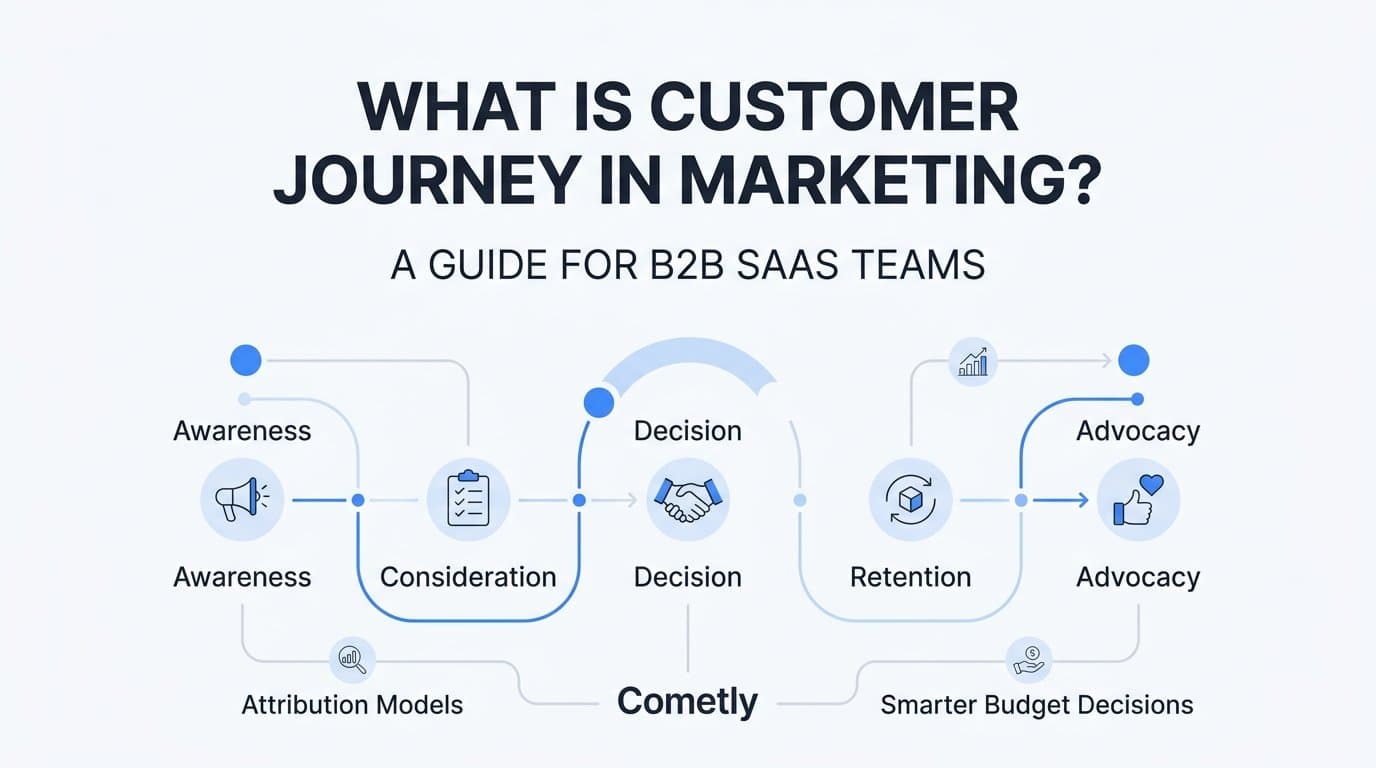
At its core, the customer journey is the full sequence of interactions a prospect has with your brand, from the first moment they become aware you exist all the way through becoming a loyal, paying customer and eventually an advocate. In B2B SaaS, this journey does not end at the point of purchase. It extends into onboarding, product adoption, expansion, and renewal, because the revenue model depends on customers staying and growing over time.
The journey typically moves through five distinct stages, each with its own marketing signals and strategic implications.
Awareness: The prospect recognizes they have a problem or a goal and begins searching for solutions. At this stage, they might encounter a Google search result, a LinkedIn ad, a podcast mention, or a peer recommendation. Your job is to be visible and credible when they start looking.
Consideration: The prospect is now actively evaluating options. They are reading comparison content, browsing review platforms like G2 or Capterra, attending webinars, and consuming case studies. This stage requires depth and trust-building, not just visibility.
Decision: The prospect is ready to choose. They are requesting demos, comparing pricing, looping in stakeholders, and negotiating terms. The marketing and sales handoff becomes critical here, and the quality of earlier touchpoints directly influences conversion rates at this stage.
Onboarding: The customer has signed. But in SaaS, the journey continues. Poor onboarding leads to churn, which means marketing's work is not done at the closed-won stage. Activation campaigns, in-app guidance, and early engagement sequences all play a role.
Retention and Expansion: Long-term revenue in SaaS comes from customers who renew, upgrade, and expand their usage. Marketing contributes here through lifecycle campaigns, product education, and community-building that reinforces the value of staying.
What makes B2B journeys fundamentally different from B2C is their complexity. A B2C purchase might involve one person making a decision in minutes. A B2B SaaS purchase often involves multiple stakeholders across different roles, including a champion, an economic buyer, IT, legal, and sometimes a procurement team. The evaluation cycle can span weeks or months, and it combines self-serve research with sales-assisted conversations. No single touchpoint tells the full story. Any marketing approach that ignores this complexity will produce incomplete and often misleading data about what is actually driving growth.
Why Touchpoints Are the Real Unit of Measurement
If the customer journey is the map, touchpoints are the individual coordinates that give it meaning. A touchpoint is any interaction a prospect has with your brand, and in B2B SaaS, the list is longer than most teams realize.
Think about what a typical journey might include: a paid search ad click, an organic blog post visit, a LinkedIn sponsored post impression, a retargeting ad, a G2 review read, a webinar registration, a follow-up email sequence, a demo booking, a sales call, a proposal review, and a final decision conversation. Each of these is a touchpoint, and each one carries some degree of influence over whether the prospect ultimately converts.
The problem with traditional tracking is that it tends to focus on one or two touchpoints while ignoring the rest. A single-channel view might show that your Google Ads drove a demo request, but it would miss the fact that the prospect had already read three of your blog posts, watched a webinar, and checked your G2 reviews before clicking that ad. Without the full picture, you are crediting the last visible action and ignoring everything that built the trust and intent that made the click meaningful.
Touchpoints also span multiple channels simultaneously, which makes single-channel attribution structurally insufficient. Your prospect is not moving through a neat linear funnel. They are jumping between channels, consuming content on their own timeline, and often involving other stakeholders who have their own separate touchpoint histories with your brand. A buying committee of four people might each have a completely different set of interactions with your marketing before the deal closes.
Here is where touchpoint sequencing becomes important. The order and timing of interactions often matters as much as the interactions themselves. A prospect who sees a brand awareness ad before reading a detailed comparison post before attending a demo converts very differently than a prospect who jumps straight to a demo with no prior exposure. Understanding the sequence helps you identify which combinations of touchpoints create the highest-quality pipeline, and which channels are contributing to momentum even when they do not appear at the final conversion point.
This is why the touchpoint, not the lead or the click, is the real unit of measurement for understanding what is working in your marketing. When you can track touchpoints across the full journey and understand how they sequence together, you gain the insight needed to make genuinely informed budget decisions.
How Attribution Models Interpret the Journey
Capturing touchpoints is only half the challenge. The other half is deciding how to assign credit to them. This is where attribution models come in, and the model you choose will fundamentally shape how you interpret your marketing performance.
An attribution model is a set of rules that determines how credit for a conversion is distributed across the touchpoints in a customer journey. Different models produce very different stories about what is driving results, and choosing the wrong one can lead to significant budget misallocation.
The most common models each have a distinct logic.
First-Touch Attribution: All credit goes to the first interaction a prospect had with your brand. This model is useful for understanding which channels are generating initial awareness and bringing new prospects into your funnel. The limitation is that it ignores everything that happened after that first interaction, which in a long B2B journey is often most of the work.
Last-Touch Attribution: All credit goes to the final touchpoint before conversion. This is the default in many ad platforms and CRM systems, and it tends to overvalue bottom-funnel activities like retargeting ads or demo request forms. The risk is that you start over-investing in channels that capture demand without recognizing that other channels created it.
Linear Attribution: Credit is distributed equally across all touchpoints in the journey. This is more balanced than first or last-touch, but it treats every interaction as equally influential, which is rarely accurate. A brief social media impression probably did not contribute as much as a 45-minute product demo.
Time-Decay Attribution: More credit is assigned to touchpoints that occurred closer to the conversion event. This model reflects the intuition that recent interactions are more influential, but it can undervalue the awareness and consideration work that initiated the journey in the first place.
Data-Driven Attribution: This model uses algorithmic analysis to assign credit based on actual conversion patterns observed across your data. Rather than applying a fixed rule, it learns from your specific journey data to determine which touchpoints and sequences are genuinely predictive of conversion. This is generally the most accurate approach, but it requires a sufficient volume of clean journey data to function well.
The strategic implication here is significant. If you are using last-touch attribution and your data shows that Google Ads is driving most of your conversions, you might cut your LinkedIn budget. But if you switch to a multi-touch model, you might discover that LinkedIn was consistently appearing in the early stages of every high-value deal, and that cutting it would starve your top-of-funnel pipeline. Attribution model selection is not a technical setting. It is a strategic decision that determines how you allocate your marketing budget.
Mapping the Journey to Pipeline and Revenue
Understanding the customer journey conceptually is useful. Connecting it to actual revenue is transformative. For B2B SaaS teams, the most important shift in journey tracking is moving beyond lead volume metrics and connecting journey data directly to CRM pipeline stages and closed-won revenue.
This shift matters because not all leads are equal, and not all channels generate leads that close. A campaign might drive hundreds of demo requests, but if none of those prospects convert to paying customers, the campaign has not contributed to revenue regardless of how impressive the top-line numbers look. Journey mapping at the revenue level reveals the difference between channels that generate volume and channels that generate value.
When you connect journey data to your CRM, you can start asking more precise questions. Which channels are generating leads that reach the proposal stage? Which campaigns produce customers with higher average contract values? Which touchpoint sequences correlate with shorter sales cycles? These are the questions that drive meaningful budget decisions, and you cannot answer them by looking at ad platform metrics alone.
Revenue attribution takes this one step further. Rather than stopping at the closed-won stage, revenue attribution connects every marketing touchpoint to actual subscription revenue, including renewals, expansions, and upgrades. This is particularly important in SaaS because the initial contract value is often not the full picture. A customer acquired through a well-targeted awareness campaign might start on a small plan but expand significantly over time. Revenue attribution captures that full value and attributes it back to the marketing activities that initiated the relationship.
This is also what transforms marketing from a cost center into a measurable growth driver. When you can show that a specific channel or campaign generated a defined amount of recurring revenue, the conversation with leadership changes. You are no longer defending your budget based on impressions and click-through rates. You are presenting a direct line from marketing investment to business outcome.
The practical requirement for this level of insight is integration between your ad platforms, your CRM, and your payment or subscription data. The journey data needs to flow across all three systems so that a touchpoint recorded in your ad platform can be connected to a contact in your CRM and ultimately to a subscription record in Stripe or a similar tool. Without that integration, the journey remains fragmented, and revenue attribution stays out of reach.
The Data Infrastructure Behind Accurate Journey Tracking
Even the best attribution model is only as good as the data feeding it. This is where many B2B SaaS teams hit a wall. They have the conceptual framework and the strategic intent, but their underlying data infrastructure is not built to support accurate journey tracking at scale.
The most significant infrastructure challenge today is the degradation of browser-based tracking. Traditional pixel-based tracking relies on cookies and browser signals to record user interactions, but a combination of ad blockers, iOS privacy changes, and increasingly strict browser cookie policies has made this approach less reliable. A meaningful portion of user interactions simply do not get recorded, which means the journey data you are working with may have significant gaps.
The solution is server-side tracking combined with Conversion APIs. Rather than relying on a browser pixel to fire when a user takes an action, server-side tracking sends event data directly from your server to the ad platform or analytics system. Meta's Conversion API and Google's Enhanced Conversions are the primary implementations of this approach for paid media. Because the data is sent server-to-server rather than through the browser, it is not subject to the same blocking and degradation issues. The result is more complete and more accurate journey data.
Data enrichment is the next layer. Raw event data is often incomplete on its own. A form submission might capture an email address but not connect it to an existing CRM contact. A Stripe subscription event might not automatically link back to the ad campaign that initiated the journey. Enrichment involves appending additional context to raw events, matching them to known contacts, linking them across systems, and filling in the gaps that raw data collection leaves behind. Clean, enriched data is the foundation of trustworthy attribution.
Event deduplication is also critical. When you are running both browser-side and server-side tracking in parallel, the same event can be recorded twice. Without deduplication, your attribution models will overcount conversions and produce inflated performance metrics. Proper deduplication logic ensures that each event is counted once, regardless of how many tracking systems captured it.
The integrations required to support complete journey tracking span several categories. Ad platforms like Meta and Google need to receive enriched conversion events. Your CRM needs to sync contact and pipeline data. Your website needs server-side event tracking for key actions. And your payment or subscription platform needs to feed revenue data back into the attribution system. When these systems are connected and communicating in real time, the full customer journey becomes visible and measurable.
Turning Journey Insights Into Smarter Marketing Decisions
All of this infrastructure and data collection only creates value when it translates into better decisions. Journey analytics is not just a reporting exercise. It is an optimization discipline that helps you identify where your funnel is leaking, which channels are accelerating movement through the journey, and where your marketing investment is generating the highest return.
Funnel analysis at the journey level reveals drop-off points that aggregate metrics hide. You might find that a particular channel is generating strong awareness but that prospects from that channel rarely progress past the consideration stage. Or you might discover that a specific content type consistently accelerates movement from consideration to decision. These insights are invisible in standard channel-level reporting but become clear when you can see the full journey sequence.
AI-driven analysis adds another layer of capability. When you have a large enough volume of journey data, AI can surface patterns that would take a human analyst weeks to identify manually. Which combinations of ad creatives and content touchpoints produce the highest conversion rates? Which early-stage signals are most predictive of a prospect becoming a high-value customer? Which channels are underperforming at specific funnel stages despite strong top-line metrics? AI can process these multi-dimensional patterns across thousands of journeys simultaneously and surface actionable recommendations.
There is also a direct feedback loop between journey insights and ad platform performance. When you send enriched, high-quality conversion events back to Meta and Google, those platforms use that data to improve their algorithmic targeting. Instead of optimizing toward form fills or demo requests, the ad platform learns to find users who look like your actual closed-won customers. Better journey data means better audience modeling, which means better ad performance over time. The investment in data infrastructure pays dividends not just in reporting accuracy but in the quality of the traffic your ads generate.
This is the practical value of journey analytics at scale: it creates a compounding improvement loop where better data leads to smarter decisions, which lead to better campaigns, which generate better data. Platforms like Cometly are built specifically to power this loop for B2B SaaS teams, connecting ad platforms, CRM systems, and revenue data into a single source of truth that makes every stage of the customer journey visible, measurable, and actionable.
Putting It All Together
Understanding the customer journey in marketing is not a one-time exercise. It is an ongoing measurement discipline that requires the right framework, the right data infrastructure, and the right analytical tools working together continuously.
The progression is clear: define the journey and its stages, track every touchpoint across every channel, apply attribution models that reflect the complexity of B2B buying behavior, connect journey data to CRM pipeline and closed-won revenue, build the server-side tracking and integration infrastructure that makes the data trustworthy, and use journey analytics and AI to turn that data into smarter decisions and better-performing campaigns.
Each step builds on the one before it. You cannot do meaningful revenue attribution without clean touchpoint data. You cannot generate clean touchpoint data without proper server-side tracking. You cannot make AI-driven optimization decisions without a complete picture of the journey from first touch to closed deal.
For B2B SaaS teams, this is not optional complexity. It is the baseline requirement for marketing that scales with confidence. When you can see exactly which channels, campaigns, and touchpoint sequences are driving pipeline and revenue, you stop spending on what feels right and start investing in what demonstrably works.
Cometly is built to make this entire workflow possible. It captures every touchpoint from ad click to CRM event, connects your ad platforms and revenue data into a single source of truth, and uses AI to surface the insights that drive better decisions. If you are ready to stop guessing and start tracking the full customer journey with the precision your growth deserves, Get your free demo today and see exactly what your marketing is really driving.