
Most B2B SaaS marketing teams are running paid ads, publishing content, sending nurture emails, and investing in SEO simultaneously. Yet when it comes time to explain which of those efforts actually drove a closed deal, the honest answer is often: we're not entirely sure. That uncertainty is not a minor inconvenience. It is a strategic liability that compounds with every budget cycle.
Customer journey planning addresses this problem directly. It gives marketing teams a structured, data-informed way to understand how prospects move from first awareness to signed contract, which channels and content contribute at each stage, and where the friction points are that slow deals down or kill them entirely.
This is not a UX exercise or a persona workshop. Done properly, customer journey planning is an operational discipline that connects your ad spend to pipeline velocity and revenue outcomes. It changes how you allocate budget, how you build campaigns, and how you measure success. This guide is written for marketing leaders and growth teams who are ready to move from channel-level reporting to full-journey intelligence.
The Hidden Cost of Ignoring the Customer Journey
B2B SaaS buyers rarely convert on a single interaction. A prospect might encounter your brand through a LinkedIn ad, read a blog post weeks later through organic search, attend a webinar, get retargeted with a case study ad, and finally request a demo after a sales development rep sends a cold email. That deal involved five distinct touchpoints across four different channels over the course of a month or more.
Standard analytics tools, especially those relying on last-click attribution, will assign that conversion entirely to the email. The LinkedIn ad, the blog post, the webinar, and the retargeting campaign receive zero credit. Budget decisions made from that data will systematically underinvest in the channels that build awareness and consideration, while over-indexing on whatever sits closest to the conversion event.
This is misattribution, and its effects compound over time. When awareness channels appear to generate no measurable return, they get cut. Demand dries up at the top of the funnel. Pipeline thins out months later. By the time the connection is made between reduced awareness investment and declining pipeline, significant damage has already been done.
The challenge is made worse by journey fragmentation. A typical B2B SaaS buyer touches multiple channels across multiple devices before converting, and each of those channels generates data in a separate silo. Paid ad platforms report on clicks and conversions within their own ecosystems. Google Analytics captures web sessions but loses attribution when cookies are blocked or users switch devices. CRMs track leads and opportunities but often have no connection to the ad spend that generated them.
Without a unified data layer that connects these sources, customer journey planning becomes impossible. You are not looking at a journey. You are looking at disconnected fragments that each tell a partial story. The result is that marketing teams make budget and strategy decisions based on whichever fragment happens to be most visible, rather than what is actually driving revenue.
The cost of this blind spot is not just wasted ad spend. It is also the opportunity cost of campaigns that could have been scaled, channels that could have been optimized, and pipeline that could have moved faster if the journey had been properly understood and supported at every stage.
What Customer Journey Planning Actually Involves
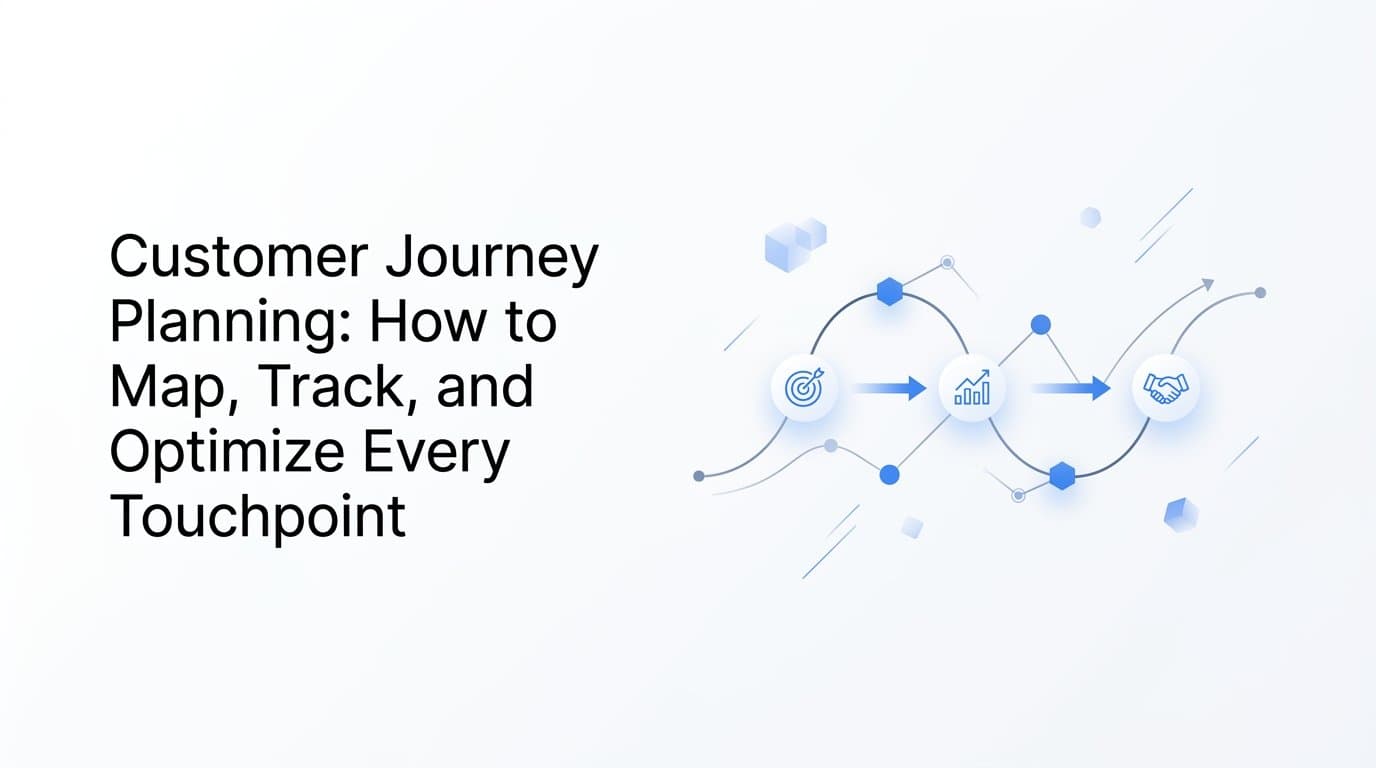
Customer journey planning is the strategic process of identifying, mapping, and continuously optimizing every interaction a prospect has with your brand from first touch to closed revenue. It is worth being precise about this definition because the term is often conflated with journey mapping, which is a different and narrower activity.
Journey mapping is a static exercise. It produces a visual representation of the stages a buyer goes through, often based on qualitative research, customer interviews, or persona assumptions. Journey maps are useful for alignment and communication but they are not operational tools. They do not update automatically as your data changes, and they cannot tell you which specific touchpoints are driving or blocking conversions in real time.
Journey planning is an ongoing, data-informed operational practice. It uses actual behavioral data from your ad platforms, website, email systems, and CRM to understand how prospects are moving through your funnel right now, not how you hypothesize they might move based on a workshop exercise. It requires measurement infrastructure, attribution modeling, and a commitment to iterating on what the data reveals.
The core components of a working customer journey planning practice include several interconnected elements.
Touchpoint identification: Cataloging every channel and content type that a prospect might interact with before converting. This includes paid ads, organic search results, social content, email sequences, webinars, review sites, and direct sales outreach. If it can influence a buying decision, it belongs on the map.
Stage definition: Organizing touchpoints into meaningful funnel stages. For B2B SaaS, this typically means awareness, consideration, and decision, though many teams add sub-stages to reflect the complexity of their specific buying process. Each stage should have a clear definition of what it means for a prospect to be in that stage and what signals indicate progression to the next one.
Channel role assignment: Determining which channels and content types are most effective at each stage. Paid social might be your primary awareness driver. Retargeting with case studies might be your most effective consideration tool. A free trial or pricing page visit might signal decision-stage intent. Assigning roles to channels helps you build campaigns with purpose rather than running generic messaging across all audiences simultaneously.
Conversion event tracking: Defining the specific actions that indicate a prospect has moved from one stage to the next. These events need to be tracked reliably across your entire stack so that attribution models have accurate data to work with. Without clean event data, journey planning is built on a foundation of noise.
Stages of the B2B SaaS Customer Journey and What Drives Each One
Understanding what actually happens at each stage of the B2B SaaS buyer journey is foundational to planning campaigns that move prospects forward rather than simply generating impressions.
The awareness stage is where a prospect first encounters your brand. The primary drivers here are paid social ads on platforms like LinkedIn and Meta, content marketing through SEO, thought leadership, and organic social. The goal at this stage is not conversion. It is recognition and relevance. A prospect at the awareness stage is typically not ready to evaluate vendors. They are becoming aware that a problem exists and that solutions might be available. Campaigns targeting this stage should focus on educational content, problem framing, and building enough brand familiarity that when the prospect enters active evaluation, your brand is already in their consideration set.
The consideration stage is where active evaluation begins. Prospects are researching options, comparing vendors, and seeking social proof. The most effective touchpoints here include demo requests, retargeting campaigns featuring case studies or testimonials, email nurture sequences, and comparison content. This is also the stage where buying committees often expand. Multiple stakeholders get involved, each with their own questions and concerns. Journey planning at the consideration stage needs to account for this multi-stakeholder dynamic and ensure that your content addresses the needs of each decision-maker, not just the initial contact.
The decision stage is where a prospect is ready to choose a vendor. Key touchpoints include pricing page visits, free trial sign-ups, sales calls, and product demonstrations. At this stage, friction is the enemy. Any confusion about pricing, implementation, or contract terms can stall or kill a deal. Journey planning here focuses on removing obstacles and ensuring that sales and marketing are aligned on what a decision-ready prospect looks like.
Across all three stages, attribution model choice significantly shapes how you interpret journey data and where you allocate budget. First-touch attribution assigns all credit to the channel that initiated awareness, making it useful for understanding which channels generate demand but blind to everything that happens afterward. Last-click attribution assigns all credit to the final conversion event, making it useful for understanding what closes deals but systematically undervaluing awareness and consideration investments.
Linear attribution distributes credit evenly across all touchpoints, which is more equitable but can obscure which specific interactions are most influential. Data-driven attribution uses algorithmic weighting based on actual conversion patterns in your data, making it the most accurate model for complex journeys but requiring sufficient data volume to produce reliable results.
Multi-touch attribution, in any of its forms, is what makes genuine customer journey planning possible. When you can see how credit is distributed across all the touchpoints in a winning deal, you can identify which combinations of channels and content actually accelerate movement through the funnel. That insight is what separates journey planning from channel-level reporting.
Building a Tracking Infrastructure That Supports Journey Planning
Accurate customer journey planning depends entirely on the quality of your underlying data. If your tracking infrastructure has gaps, your journey data will be distorted, and the decisions you make based on that data will be systematically flawed. This is not a technical concern that can be delegated entirely to engineering. It is a strategic marketing priority.
The most significant threat to reliable journey tracking today is the degradation of browser-based tracking. Ad blockers, browser privacy restrictions, and the ongoing deprecation of third-party cookies have made client-side tracking increasingly unreliable. When a prospect clicks your ad but their browser blocks the tracking pixel, that touchpoint disappears from your data entirely. Multiply that across a meaningful percentage of your traffic and your journey data develops serious blind spots.
Server-side tracking addresses this problem by moving data collection from the user's browser to your own server infrastructure. Because the tracking happens server-side, it is not subject to browser restrictions or ad blockers. This significantly improves data completeness and accuracy, which in turn improves the reliability of your journey analysis.
Conversion API integrations, including Meta's Conversion API and Google's Enhanced Conversions, work on a similar principle. Instead of relying solely on pixel-based tracking, these integrations send conversion data directly from your server to the ad platform. This closes the gap between what actually happened and what the platform's reporting shows, which is critical for both attribution accuracy and ad platform optimization.
First-party data capture is the third pillar of a reliable tracking infrastructure. When a prospect fills out a form, requests a demo, or starts a trial, you capture identifiable information that can be used to connect their subsequent behavior to that initial interaction. This is what allows you to bridge the gap between an anonymous ad click and an identified lead in your CRM, and eventually to a closed opportunity in your pipeline.
Event tracking is where this all comes together operationally. Every meaningful action a prospect takes should be captured as a named event: ad click, landing page visit, form submission, demo request, trial start, pricing page view, and so on. These events become the data points that attribution models use to assign credit and that journey analysis uses to understand flow and friction.
Data enrichment adds another layer of value by appending firmographic and behavioral context to individual records. When you know not just that a lead converted but also what company they are from, what their role is, and which content they engaged with before converting, your journey planning becomes significantly more precise. You can identify which segments move through the funnel fastest and tailor your campaigns accordingly.
Using Attribution Data to Refine and Optimize the Journey
Once your tracking infrastructure is in place and attribution data is flowing reliably, the real work of customer journey planning begins: using that data to identify where the journey is working, where it is breaking down, and where budget reallocation will produce the greatest return.
Attribution reports tell a story about your funnel that channel-level metrics cannot. When you look at which touchpoints appear most frequently in the journeys of prospects who converted to pipeline, and which appear most frequently in the journeys of prospects who churned out of the funnel, patterns emerge. You might discover that prospects who engaged with a specific piece of content during the consideration stage converted at a significantly higher rate. Or that a particular ad campaign is generating a high volume of leads but those leads rarely progress to opportunity stage. These are insights that last-click reporting will never surface.
Drop-off analysis is one of the most immediately actionable outputs of attribution-informed journey planning. When you can see where prospects are exiting the funnel, you can investigate why. Is the consideration stage content not compelling enough to drive demo requests? Is the demo-to-trial conversion rate low because the product experience does not match the promise of the marketing? Is the trial-to-paid conversion rate suffering because onboarding is too complex? Each of these questions points to a specific intervention.
Connecting ad platform data to CRM and revenue data is what elevates journey planning from a marketing analytics exercise to a business intelligence function. When you can see which specific ad campaigns, ad sets, and individual ads contributed to deals that actually closed, you can make budget decisions based on revenue impact rather than lead volume. A campaign that generates fewer leads but contributes to higher-value deals is more valuable than a campaign that floods the pipeline with leads that never convert. Without the CRM connection, you cannot see this distinction.
AI-powered analytics is changing the speed and depth at which journey optimization is possible. Rather than manually segmenting data and building custom reports to find patterns, AI can surface non-obvious correlations in journey data automatically. Which combinations of touchpoints correlate with faster deal cycles? Which audience segments show the highest lifetime value after conversion? Which content types appear most frequently in the journeys of deals that closed in under 30 days? These are questions that AI can answer continuously, enabling optimization cycles that would be impractical through manual analysis alone.
Platforms like Cometly are built specifically to support this kind of AI-driven journey intelligence for B2B SaaS teams, connecting ad platform data, website behavior, and CRM outcomes into a single attribution layer that surfaces actionable insights in real time.
Turning Journey Insights Into Smarter Ad Decisions
Journey data does not just help you understand what has happened. It actively improves what happens next, particularly when that data is fed back into your ad platforms to sharpen algorithmic targeting and reduce wasted spend.
When you send enriched conversion events back to Meta and Google through Conversion API integrations, you are giving those platforms a more accurate and complete picture of which users are actually converting to pipeline and revenue. Instead of optimizing toward surface-level conversion events like form fills, the ad platform can optimize toward the signals that actually correlate with closed revenue. This improves targeting quality, reduces cost per acquisition, and accelerates the feedback loop between ad performance and business outcomes.
Understanding the full journey also allows marketing teams to build stage-specific ad strategies rather than running the same creative and messaging across all audiences. Prospects who have never heard of your brand need different messaging than prospects who have already visited your pricing page. Prospects who attended a webinar but have not yet requested a demo need different content than prospects who are in active sales conversations. Journey data gives you the segmentation intelligence to build these differentiated campaigns with confidence.
This stage-specific approach typically produces better results across every metric that matters. When awareness campaigns are optimized for reach and relevance rather than direct conversion, they build a larger pool of qualified prospects. When consideration campaigns are built around the specific content and proof points that your attribution data shows are most effective, they move more prospects to decision stage. When decision-stage campaigns are precisely targeted at high-intent signals, they reduce the time between intent and conversion.
The downstream business impact of this kind of journey-informed ad strategy is measurable. Lower cost per acquisition comes from reducing spend on channels and audiences that do not contribute to pipeline. Higher pipeline velocity comes from delivering the right content at the right stage rather than generic messaging that does not accelerate buying decisions. More accurate revenue forecasting comes from understanding the typical journey duration and conversion rates at each stage, which makes pipeline projections significantly more reliable.
Customer journey planning, when executed with the right data infrastructure and attribution tools, transforms marketing from a cost center into a precision revenue engine.
Putting It All Together
Customer journey planning is not a project you complete and move on from. It is a continuous practice that gets more valuable as your data accumulates and your understanding of the journey deepens. The teams that treat it as an ongoing operational discipline, rather than a one-time mapping exercise, are the ones that consistently outperform on pipeline efficiency and revenue growth.
The progression is straightforward even if the execution requires rigor. Start by defining your journey stages and identifying every touchpoint that influences buying decisions. Build a tracking infrastructure that captures reliable, first-party data across those touchpoints without gaps. Implement multi-touch attribution so that credit is assigned accurately across the full journey rather than defaulting to last-click. Use attribution data to identify where prospects are dropping off, which channels are contributing to pipeline without getting credit, and where budget reallocation will produce the greatest return. Then feed that journey intelligence back into your ad platforms to improve targeting and optimization.
Each step builds on the one before it. And each iteration of the cycle produces better data, sharper insights, and more effective campaigns.
If your team is ready to move from fragmented channel reporting to a complete, real-time view of every touchpoint from first ad click to closed revenue, Cometly is built for exactly that. With multi-touch attribution, server-side tracking, Conversion API integrations, and AI-powered recommendations, Cometly gives B2B SaaS marketing teams the data infrastructure and analytical intelligence they need to plan, execute, and optimize the customer journey with confidence. Get your free demo and start capturing every touchpoint that matters.