You're spending real budget on paid search, LinkedIn ads, retargeting campaigns, and content. Leads are coming in. Some deals are closing. But when someone asks which channels are actually driving revenue, the honest answer is: you're not entirely sure.
This is the reality for most B2B SaaS marketing teams. The data exists, but it's scattered across ad platforms, a CRM, website analytics, and email tools that don't talk to each other. Without a way to connect those dots, every budget decision is part logic and part guesswork.
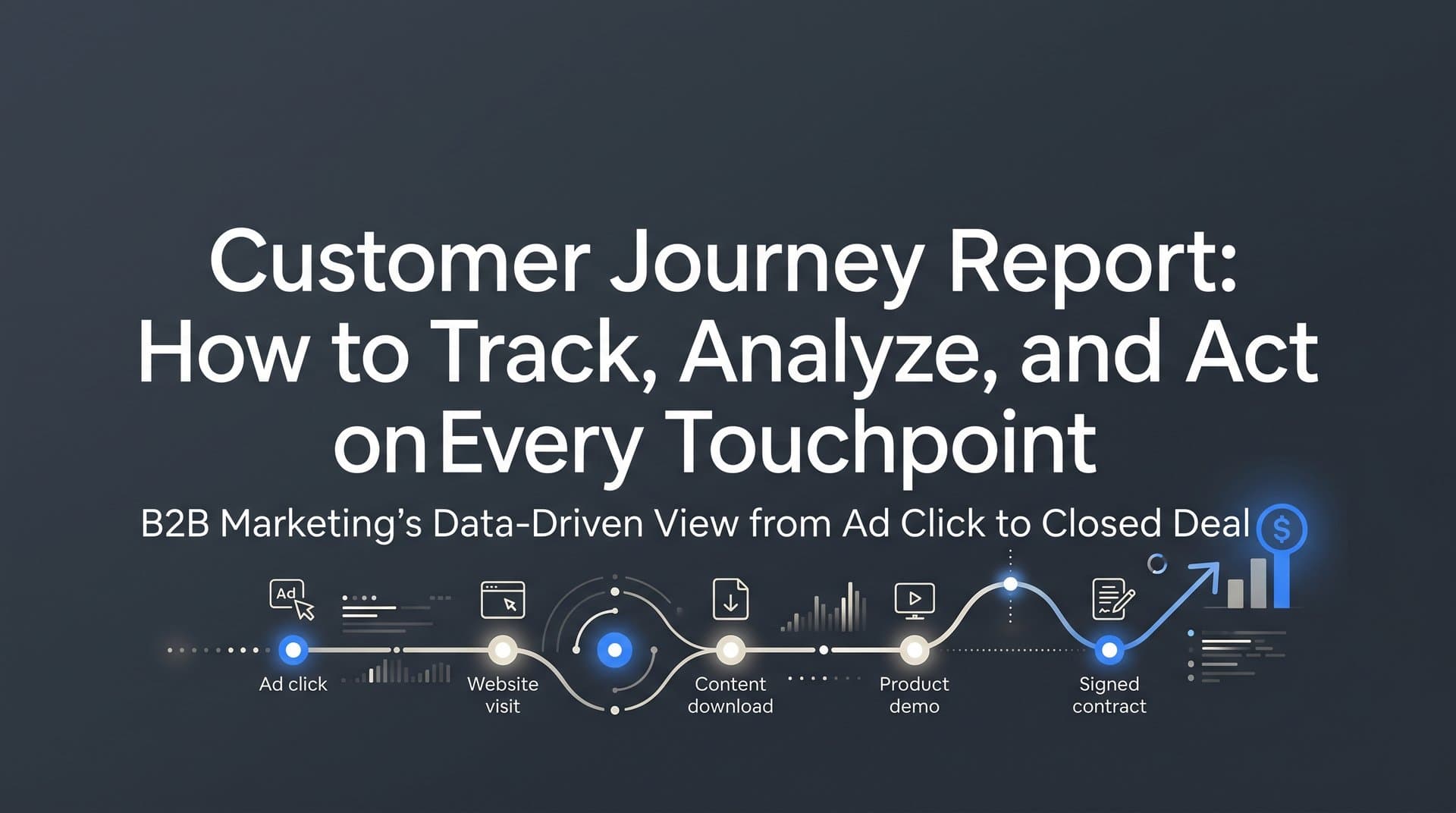
A customer journey report changes that. It maps every interaction a prospect has with your brand, from the first ad click to the moment a deal closes, and gives your team a structured, evidence-based view of what's actually working. Not just which channels drive clicks, but which channels drive revenue.
This article breaks down what a customer journey report is, what it needs to contain, which metrics matter most, and how to turn that data into smarter campaign decisions. If you're a B2B SaaS marketer who wants to stop flying blind, this is where to start.
Why Most Marketing Teams Are Flying Blind Without Journey Data
Here's the problem with last-click attribution: it tells a story, but it's missing most of the chapters. When a prospect clicks a Google search ad and books a demo, last-click gives that ad full credit for the conversion. But what about the LinkedIn ad they saw three weeks ago? The blog post they read twice? The retargeting campaign that brought them back after they went quiet?
In B2B SaaS, those earlier touchpoints often do the heaviest lifting. They build awareness, establish credibility, and create the intent that eventually leads to a demo request. Last-click attribution systematically ignores them, which leads teams to cut spend on upper-funnel channels that are genuinely contributing to pipeline.
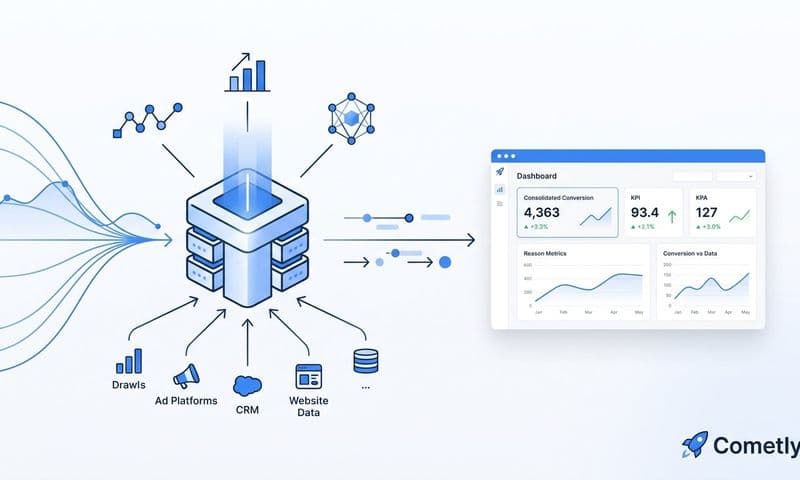
The fragmentation problem makes this worse. Your Google Ads dashboard shows click and conversion data. Your LinkedIn Campaign Manager shows engagement. Your CRM shows leads and deal stages. Your website analytics shows sessions and behavior. Each tool gives you a partial view, and none of them are automatically talking to each other.
The result is a set of blind spots that distort your understanding of campaign performance. A channel might look expensive based on cost-per-click but be responsible for introducing your highest-value prospects. Another channel might show strong conversion volume but be closing deals that were already well into the consideration stage when they arrived.
Without journey data, you can't see these patterns. You're making budget decisions based on siloed metrics that don't reflect how your B2B buyers actually behave. And in B2B SaaS, where sales cycles stretch weeks or months and involve multiple stakeholders, the cost of those blind spots compounds quickly. Budget gets shifted away from channels that matter. Nurture sequences are built on assumptions. Pipeline forecasts are less reliable than they should be.
The fix isn't more dashboards. It's a unified view of the full journey, from first touch to closed-won, with every touchpoint accounted for and connected to a revenue outcome.
What a Customer Journey Report Actually Contains
A customer journey report is a structured record of every interaction a prospect has with your brand across channels and time, mapped to the revenue outcome that interaction contributed to. It's not a campaign performance summary. It's not a traffic report. It's a complete picture of how a prospect moved from stranger to customer.
Think of it like a timeline for each deal. On one end, you have the first touchpoint: maybe a paid search impression, a social ad click, or an organic visit to a blog post. On the other end, you have a closed-won deal with a dollar value attached. In between, you have every session, every conversion event, every CRM stage progression, and every re-engagement that happened along the way.
The core data layers that make a journey report actionable include:
Channel source and campaign data: Where did the prospect first encounter your brand, and which specific campaign or ad drove that interaction? This is the starting point for understanding which channels are generating the right kind of awareness.
Session and behavioral data: What pages did they visit? How many times did they return? Which content did they engage with most deeply? Session data reveals intent signals that campaign data alone can't show.
Conversion events: When did they fill out a form, request a demo, start a trial, or take another high-intent action? These events mark the transitions between funnel stages and are critical for measuring stage velocity.
CRM stage progressions: When did they enter the pipeline? How long did they spend in each stage? When did they close, and at what deal value? CRM data connects marketing activity to actual revenue outcomes.
Revenue outcomes: The final layer. What was the deal worth? Which customer segment did they fall into? This is what transforms a journey report from a marketing tool into a revenue intelligence tool.
The key distinction between a journey report and a standard campaign report is scope. A campaign report tells you how an ad performed in isolation. A journey report tells you how that ad contributed to a specific revenue outcome as part of a larger sequence of interactions. For B2B SaaS teams trying to optimize the full funnel, that distinction is everything. Understanding what customer journey touchpoints are and how they connect is the foundation of this approach.
The Key Metrics Inside a High-Quality Journey Report
Data without structure is just noise. A high-quality customer journey report organizes its data around metrics that actually inform decisions. Here are the three categories that matter most.
Touchpoint Frequency and Sequence
How many interactions does a prospect typically have before converting? Which channels appear most often in the journeys that end in closed deals? Touchpoint frequency tells you how much nurturing your audience requires. Sequence tells you which channels are doing which jobs in the funnel.
For example, you might find that paid social consistently appears early in winning journeys, while branded search tends to appear right before a demo request. That pattern tells you that social is building awareness and intent, while search is capturing it. Cut the social spend and you may see search conversions drop over time, even though the direct connection isn't visible in a last-click model.
Time-to-Convert and Stage Velocity
How long does it take a prospect to move from first touch to closed deal? Where do they stall? Stage velocity metrics reveal the friction points in your funnel and help you understand which channels or campaigns correlate with faster closes.
If prospects who enter through a specific content channel consistently take longer to close, that's a signal worth investigating. Are they less qualified? Are they in a different buying stage when they arrive? Stage velocity data helps you answer those questions with evidence rather than assumptions. Mapping this against the stages of the customer journey makes it easier to pinpoint exactly where momentum slows.
Revenue Attribution Per Touchpoint
This is the metric that connects marketing activity to business outcomes. Revenue attribution assigns credit to the channels and campaigns that contributed to closed deals, distributed across all the touchpoints in a journey rather than concentrated at the first or last click.
When you can see which channels consistently appear in high-value journeys, you have a defensible basis for budget allocation. You're not optimizing for clicks or impressions. You're optimizing for revenue contribution, which is the metric that actually matters to the business.
Together, these three metric categories give marketing teams a complete view of funnel performance: how prospects are engaging, where they're moving quickly or slowly, and which channels are generating real revenue impact.
How Attribution Models Shape What Your Journey Report Reveals
Here's something that surprises a lot of marketers: the same journey data can tell completely different stories depending on which attribution model you apply. Choosing the right model isn't a technical detail. It directly shapes where your budget goes.
First-touch attribution gives all credit to the channel that introduced the prospect to your brand. It's useful for understanding which channels are best at generating awareness, but it ignores everything that happened after that first interaction.
Last-click attribution gives all credit to the final touchpoint before conversion. As discussed earlier, this systematically undervalues the channels that build awareness and nurture intent over time, which is a significant problem in longer B2B sales cycles.
Linear attribution distributes credit equally across all touchpoints in the journey. It's more balanced than first or last touch, but it treats every interaction as equally important, which isn't always accurate.
Data-driven attribution uses machine learning to assign credit based on which touchpoints actually correlate with conversions in your specific dataset. It's the most sophisticated model, but it requires sufficient conversion volume to produce reliable results.
For B2B SaaS teams, multi-touch attribution is typically the most appropriate foundation for a customer journey report. B2B buying decisions involve multiple stakeholders, extended evaluation periods, and a mix of marketing and sales-assisted touchpoints. A model that acknowledges all of those interactions produces a much more accurate picture of what's driving pipeline.
One of the most valuable practices is running model comparisons side by side. When you look at the same journey data through a first-touch lens versus a linear lens versus a data-driven lens, the differences reveal which channels are being overvalued or undervalued in your current reporting setup. Understanding how SaaS revenue attribution works across these models is essential for making those comparisons meaningful.
A channel that looks like a top performer under last-click might look average under linear attribution, while a channel you've been underfunding might emerge as a consistent contributor across multiple models. These comparisons don't just improve your reporting. They change your budget decisions in ways that can meaningfully improve revenue outcomes.
Building a Customer Journey Report That Connects Ads to Revenue
Understanding what a journey report should contain is one thing. Building one that actually works requires getting the data infrastructure right first.
The Data Foundation
A customer journey report is only as good as the data feeding it. That means connecting your ad platforms, website tracking, server-side events, and CRM into a single unified view. When these systems are siloed, you get partial journeys with gaps where touchpoints were missed or attribution was broken.
The integration challenge is real in B2B SaaS. Your prospects might interact with a LinkedIn ad on a work laptop, visit your website on a mobile device, and book a demo from a different browser entirely. Without a robust customer journey tracking system, those interactions look like separate, unconnected events rather than a single continuous journey.
Why Server-Side Tracking Is Non-Negotiable
Browser-based pixel tracking has become increasingly unreliable. Ad blockers, browser privacy restrictions, and the downstream effects of iOS privacy updates mean that a meaningful portion of conversion events are never recorded by client-side pixels. In longer B2B sales cycles, where every touchpoint matters, those gaps add up fast.
Server-side tracking and Conversion API (CAPI) integrations solve this by sending event data directly from your server to ad platforms, bypassing browser-level limitations entirely. The result is more complete data, fewer missed touchpoints, and more accurate attribution across the full sales cycle. For any B2B SaaS team serious about building a reliable customer journey report, server-side tracking isn't optional. It's foundational.
Structuring the Report for Different Stakeholders
Not everyone needs to see the same view of the data. A well-structured journey report surfaces the right information for each audience.
Performance marketers need campaign-level views that show which ads and creative are appearing in high-converting journeys, how touchpoint sequences vary by campaign, and where specific ads are contributing to pipeline.
Revenue leaders need pipeline views that connect marketing activity to deal stage progression, showing which channels produce leads that actually close and at what velocity.
Growth teams need channel comparison views that reveal which acquisition sources produce the highest-value customers over time, informing longer-term investment decisions. Tools built for customer journey analytics make it possible to serve all three audiences from a single shared dataset.
When a single platform can serve all three views from a shared dataset, you eliminate the version-of-truth problem that plagues teams relying on separate tools for each function.
Turning Journey Report Insights Into Campaign Decisions
A customer journey report is only valuable if it changes what you do. Here's how to translate the insights into action.
Reallocate budget toward channels that appear in high-value conversion paths. Journey data lets you see which channels consistently show up in the journeys of your best customers, not just which channels drive the most first clicks. When you shift budget based on revenue contribution rather than volume metrics, you're optimizing for what actually matters.
Identify and address drop-off points. Journey reports reveal where prospects stall or disengage. If a large portion of prospects who reach a specific funnel stage go quiet, that's a signal that your nurture sequence, retargeting strategy, or content at that stage isn't doing its job. Fixing those friction points can improve conversion rates across the entire pipeline. A structured approach to customer journey optimization gives teams a repeatable framework for addressing these gaps systematically.
Align content and messaging to the journey stage. When you can see which content types and channels appear at each stage of the buying journey, you can build a more intentional content strategy. Early-stage prospects need different messaging than prospects who are actively evaluating vendors, and journey data helps you understand exactly where each piece of content fits.
Use AI-driven recommendations to scale what's working. Manually identifying patterns across hundreds of customer journeys is time-consuming and prone to confirmation bias. AI-driven analytics on top of journey data can surface patterns at scale: which channel sequences correlate with faster closes, which campaigns are underperforming relative to their spend, and which audience segments show the highest conversion rates. These recommendations help growth teams act faster and with more confidence.
The shift from campaign-level optimization to journey-level optimization is significant. It moves your team from reacting to individual metrics to understanding the full system that produces revenue, and that's where sustainable growth comes from.
The Bottom Line on Customer Journey Reporting
A customer journey report is not a reporting luxury for teams with extra bandwidth. For B2B SaaS companies that want to connect ad spend to revenue with confidence, it's a strategic necessity.
The quality of your decisions will always be limited by the quality of your data. If your tracking is incomplete, your attribution model is too narrow, or your data sources aren't integrated, your journey report will reflect those gaps. Getting the infrastructure right, server-side tracking, CRM integration, unified attribution, is what separates a report that informs decisions from one that just looks good in a slide deck.
Cometly is built specifically for this. It captures every touchpoint from first ad click to closed-won deal, connects your ad platforms and CRM data in real time, and surfaces AI-driven insights that help your team act on what the data is telling you. Whether you're a performance marketer optimizing campaigns, a revenue leader tracking pipeline velocity, or a growth team making long-term channel investment decisions, Cometly gives you the unified view you need to make those decisions with confidence.
If you're ready to stop guessing and start making budget decisions based on actual revenue attribution, Get your free demo and see how Cometly's customer journey analytics can transform the way your team tracks, analyzes, and acts on every touchpoint.