Most B2B SaaS marketing teams are fighting the wrong battle. They pour budget into acquisition, obsess over cost-per-click, and celebrate when a prospect fills out a demo request form. Then they hand that prospect off and move on. The problem is that the journey is just getting started at that point, and nobody is tracking what happens next.
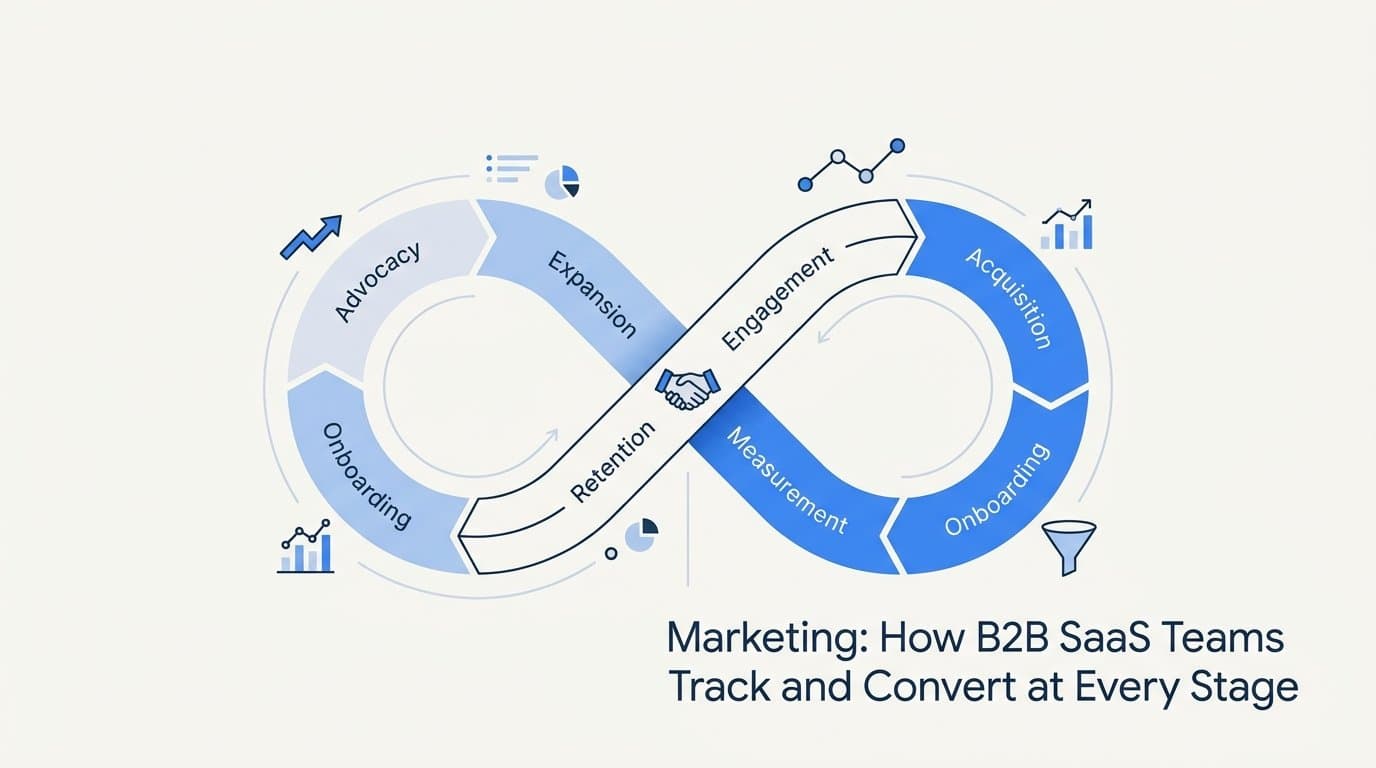
Customer lifecycle marketing is the discipline of treating the entire customer journey as a continuous, measurable loop rather than a linear funnel with a finish line. It means aligning your messaging, channels, and measurement to where a prospect or customer actually sits in their relationship with your product. Not just where you wish they were, and not just the stages your current tools happen to capture.
For B2B SaaS teams specifically, this matters more than almost any other marketing discipline. You are not selling a one-time transaction. You are building a recurring revenue relationship that depends on acquisition, activation, retention, and expansion working together. Optimizing any one of those stages in isolation is like tuning one instrument in an orchestra and wondering why the music sounds off.
This guide is for growth-minded marketers who want to stop operating with lifecycle blind spots. We will walk through the stages that define the B2B SaaS customer journey, explain where most lifecycle strategies fall apart, and show you how to build the measurement infrastructure that connects every touchpoint to real revenue outcomes.
The Stages That Shape Every Buying Decision
The B2B SaaS customer lifecycle runs through five core stages: Awareness, Consideration, Conversion, Retention, and Expansion. Each stage represents a fundamentally different relationship between your brand and the buyer, and each demands a different approach to messaging, channels, and measurement.
Awareness: At this stage, a prospect recognizes they have a problem but may not yet know your product exists. They are searching for information, consuming content, and forming opinions about the category. Your job here is to be present and credible, not to close a deal.
Consideration: The prospect has identified potential solutions and is actively evaluating options. They are comparing vendors, reading reviews, attending webinars, and talking to peers. Intent is rising, and the stakes of your messaging get higher.
Conversion: This is the stage most marketing teams optimize for almost exclusively. The prospect is ready to make a decision. Demo requests, free trials, and direct sales conversations define this stage. It is important, but it is not the end of the story.
Retention: The customer has signed. Now the question is whether they stay. Marketing plays a direct role here through lifecycle email, onboarding campaigns, and re-engagement sequences designed to drive product adoption and reduce churn.
Expansion: Existing customers who see value are candidates for upsells, cross-sells, and contract expansions. In a subscription business, this stage is where a significant portion of revenue growth actually comes from.
What makes B2B SaaS lifecycles genuinely complex is the combination of factors that stretch each stage. Multiple stakeholders are involved in most buying decisions. Evaluation windows can run weeks or months. And because revenue is recurring, a single customer relationship has compounding value over time that a one-time transaction never would.
This complexity means that stage-specific thinking is not optional. The content that creates awareness at the top of the funnel will not move a late-stage evaluator closer to a decision. The campaign that converts a trial user will not prevent churn six months in. Treating all of these stages with the same playbook is one of the most common and costly mistakes in B2B SaaS marketing.
Where Lifecycle Strategies Break Down in Practice
Understanding the stages is the easy part. Executing a lifecycle strategy that actually works is where most teams run into serious trouble, and the root cause is almost always the same: disconnected data.
Think about how most B2B SaaS marketing stacks are structured. Ad platforms like Meta and Google track clicks and conversions. The CRM tracks leads, opportunities, and deals. Product analytics tracks in-app behavior. And revenue data lives in a billing system or ERP. Each of these systems has a partial view of the customer journey, and in most organizations, none of them talk to each other in a meaningful way.
When these systems operate in silos, marketing teams are left making decisions based on incomplete signals. They can see that a campaign generated leads, but they cannot see whether those leads converted to paying customers. They can see that a retargeting campaign drove demo requests, but they cannot see whether those demos turned into deals or churned within 90 days. The lifecycle is happening, but the data to understand it is fragmented across tools that were never designed to work together.
This fragmentation creates attribution gaps that distort strategy in predictable ways. Without knowing which channels drive qualified leads versus low-intent traffic, teams misallocate budget. They scale campaigns that look efficient on the surface because they generate volume, without realizing that the downstream conversion and retention rates for those leads are poor. They under-invest in channels that take longer to show results but consistently produce customers with higher lifetime value.
The downstream impact on revenue is significant. Teams that cannot see the full lifecycle tend to over-invest in top-of-funnel acquisition because that is where their measurement tools are focused. Retention and expansion stages go underfunded because they appear to fall outside the marketing mandate. The result is a growth model that is constantly filling a leaky bucket, spending heavily to acquire customers while losing them at a rate that quietly erodes the compounding revenue growth that makes SaaS businesses valuable.
Here is the thing: this is not a strategy problem. Most marketing leaders understand that retention and expansion matter. It is a measurement problem. When you cannot see which touchpoints are moving prospects through lifecycle stages, you cannot make the case for investing in those stages, and you cannot prove that your campaigns are working even when they are.
Matching Channels and Tactics to Each Lifecycle Stage
Once you understand the stages and why measurement matters, the practical question becomes: what should you actually be doing at each stage, and how do you know if it is working?
Awareness stage tactics: Paid social, content marketing, and SEO are the primary channels for capturing demand at this stage. The goal is reach and relevance. You are trying to get in front of buyers who have the problem you solve before they have started evaluating solutions. Key signals that a prospect is moving toward consideration include repeated engagement with content, branded search activity, and direct traffic to solution-focused pages. These are early intent signals worth tracking.
Consideration stage tactics: Retargeting campaigns, demo request ads, and comparison content become the primary drivers here. The prospect is now actively evaluating, and your job is to be present and persuasive at every touchpoint in that evaluation process. This is where multi-touch attribution becomes critical. A prospect might see a paid social ad, read a case study, attend a webinar, and then request a demo after clicking a retargeting ad. Last-click attribution would give all the credit to that final retargeting click. Multi-touch attribution shows you the full sequence that actually drove the conversion, which is a fundamentally different and more accurate picture.
Conversion stage tactics: Direct response campaigns, free trial offers, and sales-assisted conversion flows are the focus here. The measurement question shifts from reach and engagement to deal velocity and close rates. Which campaigns are producing prospects who convert quickly versus those who drag through a long sales cycle and then churn?
Retention stage tactics: This is where most marketing teams go quiet, and it is a significant missed opportunity. Lifecycle email sequences, product adoption campaigns, and re-engagement flows can meaningfully reduce churn when they are built around behavioral signals from product usage data. A customer who has not logged in for two weeks is a churn risk. A campaign triggered by that signal is lifecycle marketing doing exactly what it should.
Expansion stage tactics: Upsell and cross-sell campaigns targeted at customers who have reached specific usage milestones or contract anniversaries can drive meaningful revenue growth from your existing base. These campaigns are often invisible to marketing teams that only track pre-conversion touchpoints, but they represent some of the highest-ROI opportunities in the entire lifecycle.
Attribution Is the Engine Behind Lifecycle Measurement
You cannot manage what you cannot measure. In lifecycle marketing, measurement means attribution, and the model you choose determines what you can actually see.
Single-touch attribution models, whether first-touch or last-click, are fundamentally misaligned with lifecycle marketing. First-touch gives all the credit to the initial interaction, ignoring everything that happened between that first touchpoint and the final decision. Last-click does the opposite, crediting only the final interaction and making every channel that contributed along the way invisible. Both models were designed for simple, short conversion paths. B2B SaaS buying journeys are neither simple nor short.
Multi-touch attribution distributes conversion credit across multiple touchpoints throughout the journey. Different models do this in different ways. Linear attribution gives equal credit to every touchpoint. Time-decay models weight recent touchpoints more heavily. Position-based models give more credit to the first and last interactions while distributing the remainder across the middle. Data-driven models use machine learning to assign credit based on which touchpoints actually correlate with conversion outcomes.
For lifecycle marketing, data-driven multi-touch attribution is the most powerful approach because it surfaces which channels are genuinely moving prospects through stages versus which ones are simply present in the journey without driving progression. This distinction matters enormously for budget allocation. A channel that appears frequently in customer journeys but does not correlate with stage progression is not contributing the way it appears to be. A channel that consistently shows up at critical transition points, from awareness to consideration, or from consideration to conversion, is doing work that deserves investment.
The other dimension that most attribution tools miss is what happens after conversion. Which acquisition channels produce customers who expand their contracts? Which ones produce customers who churn within the first quarter? When you can connect pre-conversion attribution data to post-conversion revenue outcomes, you have a complete picture of which channels are actually generating value across the full lifecycle. That is the measurement standard that lifecycle marketing requires.
Building a Single Source of Truth for Lifecycle Data
Understanding why unified data matters is one thing. Building the infrastructure to actually achieve it is another. Here is what a practical, unified data layer looks like for a B2B SaaS marketing team.
The foundation is connecting four core data sources: your ad platforms, your CRM, your website behavior data, and your revenue data. When these four sources are integrated into a single view of the customer journey, you can see the full arc of a customer relationship from the first ad impression through to closed-won revenue and beyond. Without this integration, you are always working with partial information.
One of the most important technical components of this infrastructure is server-side tracking. Browser-based tracking has become increasingly unreliable due to ad blockers, iOS privacy changes, and ongoing shifts in how browsers handle third-party cookies. When a prospect interacts with your ads over a multi-week evaluation period, as is common in B2B SaaS, browser-based tracking may miss a significant portion of those touchpoints. Server-side tracking captures events at the server level, bypassing browser limitations and providing a more complete and accurate record of the customer journey.
Conversion API integrations extend this capability to the ad platforms themselves. When you send enriched lifecycle events directly to Meta's Conversions API or Google's enhanced conversions, you are giving those platforms accurate, server-verified data about what happened after the click. This improves the quality of the data the platforms use for optimization, which in turn improves ad performance across the board.
This is where platforms like Cometly become the operational center of lifecycle measurement. Cometly connects ad spend data, CRM touchpoints, and revenue data, including Stripe integration, into a single attribution view. Instead of toggling between your ad platform dashboards, your CRM reports, and your revenue analytics separately, you get one place where you can see how each lifecycle stage contributes to pipeline and closed revenue. That single source of truth is not just convenient. It is the prerequisite for making lifecycle strategy decisions based on evidence rather than assumptions.
When your data infrastructure is unified, questions that were previously unanswerable become straightforward. Which campaigns drove the leads that became your highest-value customers? Which channels contribute most to expansion revenue? Where are prospects dropping out of the lifecycle, and what touchpoints are associated with the ones who stay? These are the questions that drive smarter lifecycle strategy, and they require a complete data picture to answer.
Turning Lifecycle Insights Into Smarter Ad Decisions
Lifecycle data does not just help you understand the past. When fed back into your ad platforms intelligently, it actively improves future performance.
Ad platform algorithms are optimization engines. They optimize toward whatever conversion signal you give them. If you send Meta or Google a form-fill event as your primary conversion signal, the algorithm will find more people likely to fill out forms. That sounds good until you realize that form fills do not always correlate with revenue. Some segments fill out forms readily but convert to paying customers at low rates. Others take longer to engage but become high-value, long-term customers when they do.
When you send enriched, downstream conversion events back to the ad platforms, such as closed-won deals, trial-to-paid conversions, or revenue events from your CRM, you are telling the algorithm to optimize for the profile of your actual customers, not just your form fillers. This shift in signal quality can meaningfully improve the downstream value of the traffic your campaigns generate, because the algorithm is now targeting based on what makes a good customer rather than what makes a good lead.
Cometly supports this feedback loop by enabling you to send enriched conversion events back to Meta and Google, drawing on the full lifecycle data it has captured. The result is ad platform AI that is working with a richer, more accurate picture of what success looks like for your business.
AI-driven analysis of lifecycle performance can also identify which campaigns are genuinely driving prospects through multiple stages versus those that generate top-of-funnel volume without downstream conversion. This distinction is critical for budget allocation. A campaign with a high click-through rate but poor stage progression is not performing as well as it appears. A campaign with modest top-of-funnel metrics but strong progression from consideration to conversion may be significantly undervalued.
When you can see which channels drive progression across the full lifecycle, budget allocation becomes a fundamentally different conversation. Instead of optimizing for the lowest cost per click or even the lowest cost per lead, you are optimizing for the highest revenue per dollar of ad spend across the entire customer relationship. That is the standard that lifecycle-aware marketing teams hold themselves to, and it produces compounding advantages over time as spend shifts toward the paths that consistently generate the most value.
The Bottom Line on Lifecycle-Driven Growth
Customer lifecycle marketing only works when your measurement infrastructure matches the complexity of the journey you are trying to manage. Understanding the stages is the starting point. Knowing where attribution breaks down tells you where your blind spots are. Building the data infrastructure that connects every touchpoint to revenue is what makes the whole system function.
The progression is clear: map the lifecycle stages relevant to your business, identify where your current measurement tools are creating gaps, unify your ad, CRM, and revenue data into a single view, and use that view to make smarter decisions at every stage of the journey. Then feed those insights back into your ad platforms to continuously improve the quality of traffic your campaigns generate.
B2B SaaS teams that invest in full-funnel visibility will consistently outperform those optimizing for isolated metrics. When you can see the complete picture from first ad impression to closed-won revenue and through to expansion, you stop making decisions based on assumptions and start making them based on evidence. That shift compounds over time as budget flows toward the channels and campaigns that actually drive lifetime value.
The teams that build this infrastructure now are not just solving a measurement problem. They are building a durable competitive advantage in an environment where most of their competitors are still optimizing for the wrong signals.
Ready to elevate your marketing game with precision and confidence? Discover how Cometly's AI-driven recommendations can transform your ad strategy. Get your free demo today and start capturing every touchpoint to maximize your conversions.