
You're running paid search, paid social, content marketing, and email nurture simultaneously. Leads are coming in. Some deals are closing. But when someone asks which channels are actually driving revenue, the honest answer is: you're not entirely sure. Sound familiar?
This is the reality for most B2B SaaS marketing teams. They have data everywhere but visibility nowhere. Ad platforms report conversions. The CRM shows pipeline. Website analytics tracks sessions. But none of these tools talk to each other in a way that reveals how a prospect actually moved from first awareness to closed deal.
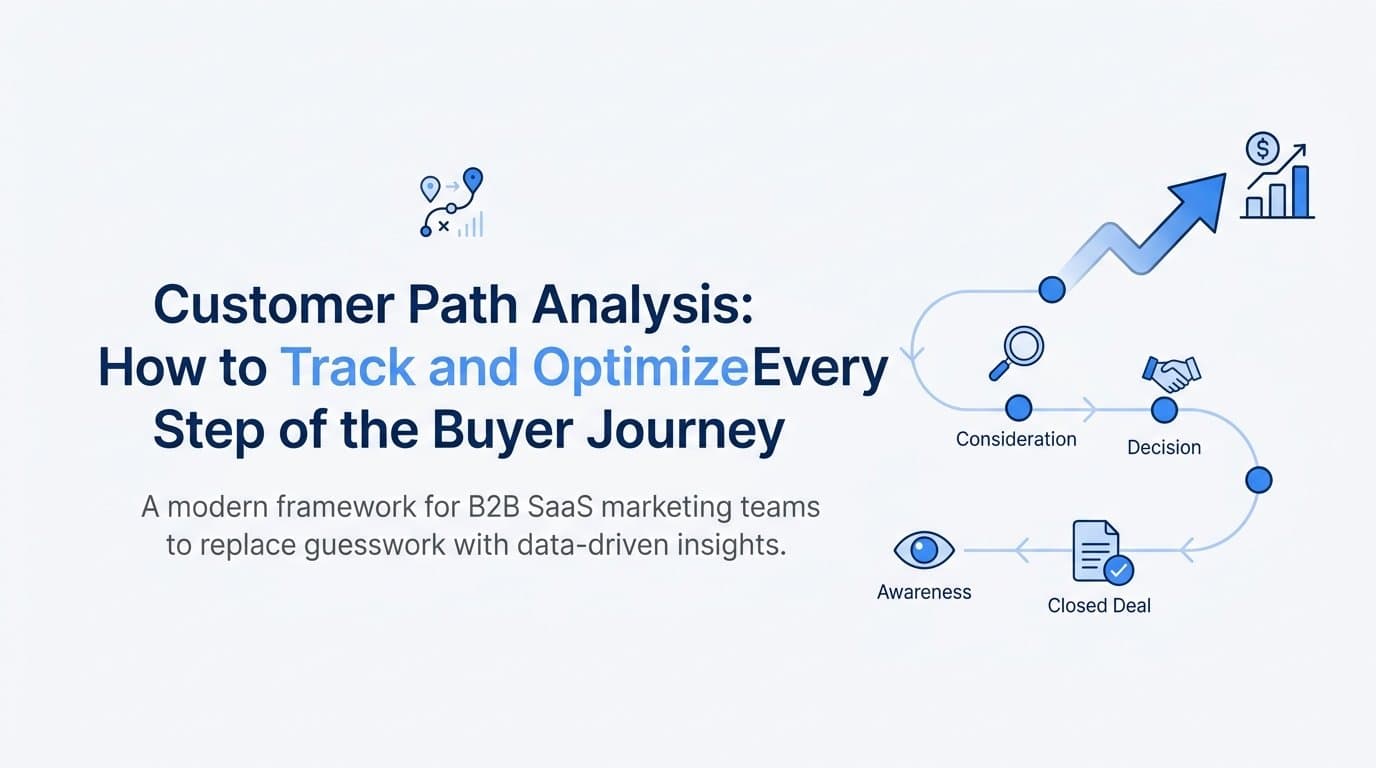
Customer path analysis is the framework that changes this. It makes the invisible visible by mapping every touchpoint a prospect interacts with across their entire buying journey, giving marketers a sequential, evidence-based view of how buyers actually move through the funnel. By the end of this article, you will understand what customer path analysis is, why standard tools fall short, which metrics matter most, how attribution models fit in, and how to build a workflow that connects ad spend directly to revenue. If you are tired of guessing which channels work, this is the place to start.
The Hidden Journey Between Ad Click and Closed Deal
Customer path analysis is the practice of mapping and measuring every touchpoint a prospect interacts with from first awareness to conversion. Rather than looking at individual channel performance in isolation, it gives marketers a sequential view of how buyers move through the funnel, revealing the order, frequency, and timing of each interaction along the way.
In B2B SaaS, this journey is rarely a straight line. A prospect might see a LinkedIn ad, visit your website, leave without converting, read a blog post a week later through organic search, get retargeted on Google, attend a webinar, and then finally book a demo after receiving a nurture email. That is six distinct touchpoints across five different channels, potentially spanning several weeks. If you are only looking at the last click before the demo request, you are crediting the email and ignoring everything that built the relationship before it.
The non-linear nature of B2B buying makes single-touch attribution models fundamentally misleading. Prospects are evaluating options deliberately. They are comparing vendors, reading reviews, looping in colleagues, and returning to your content multiple times before committing to a conversation. The path is long, and every step in it carries signal about buyer intent.
This is why understanding the core components of a customer path matters so much. There are four primary elements to track:
Channels: The platforms and sources where interactions occur, such as paid social, organic search, direct, email, or referral. Each channel plays a different role depending on where it appears in the sequence.
Touchpoints: The specific interactions within each channel, including ad impressions, page visits, content downloads, webinar registrations, and demo requests. Touchpoints are the individual data points that compose the path.
Time between interactions: The gaps between touchpoints reveal how engaged a prospect is and how quickly they are moving through their evaluation. A prospect who visits three times in one week is behaving very differently from one who returns once a month.
Conversion events: The moments when a prospect takes a meaningful action, such as filling out a form, booking a call, or becoming a paying customer. These are the anchors that give the path its direction and purpose.
When you can see all four of these elements together, in sequence, you stop managing channels and start managing journeys. That shift in perspective is what customer path analysis makes possible.
Why Standard Analytics Tools Miss the Full Picture
Most marketing teams rely on a combination of ad platform dashboards, Google Analytics, and their CRM to understand performance. Each of these tools does its job reasonably well in isolation. The problem is that none of them were designed to stitch together a complete, cross-channel view of the buyer journey.
Last-click attribution, which is still the default in many ad platforms and analytics tools, gives all credit for a conversion to the final touchpoint before the conversion event. This model is easy to understand but deeply misleading in complex B2B buying environments. It systematically undervalues top-of-funnel channels like paid social and content marketing, which initiate awareness and build intent, while overvaluing bottom-of-funnel channels like branded search, which often just capture demand that other channels created.
First-touch attribution has the opposite problem. It credits the channel that brought a prospect in initially but ignores everything that happened afterward, including the nurture sequences, retargeting campaigns, and bottom-funnel content that actually moved the prospect to a decision.
Beyond model limitations, data silos create another layer of blindness. Your Meta Ads dashboard does not know what happens after someone clicks your ad and lands on your site. Your website analytics tool does not know whether that visitor eventually became a qualified opportunity in your CRM. Your CRM does not know which ad campaigns touched a contact before they were created as a lead. Each system holds a piece of the puzzle, but without a dedicated attribution layer connecting them, you are always working with an incomplete picture.
This fragmentation has a real business cost. When budget decisions are made based on incomplete path data, spend flows toward channels that appear to convert well in isolation but may simply be the final step in a long journey that a different channel initiated. You end up cutting the channels that are quietly doing the heavy lifting at the top of the funnel because they do not get credit in your reporting.
There is also the issue of multi-stakeholder buying in B2B contexts. A single deal might involve a marketing manager who first discovers your product through a LinkedIn post, a director who later reads a case study through organic search, and a VP who clicks a Google ad before approving the purchase. Standard analytics tools track sessions and cookies, not accounts. They have no way to connect these separate interactions into a coherent account-level path, which means the buying committee's collective journey remains invisible.
Addressing these gaps requires more than better dashboards. It requires a fundamentally different approach to data collection and attribution, one that is built to handle the complexity of modern B2B buying behavior.
Key Metrics That Reveal How Buyers Actually Move
Once you have a system in place to capture complete path data, the next step is knowing which metrics to focus on. Not all path metrics carry equal weight, and the ones that matter most are often not the ones that get the most attention in standard reporting.
Path length: This is the number of touchpoints a prospect interacts with before converting. In B2B SaaS, path lengths tend to be longer than in B2C contexts because the buying decision carries more risk and involves more deliberation. Tracking average path length across your customer base helps you understand how much nurturing your typical buyer needs before they are ready to convert.
Time to conversion: This measures the total elapsed time from a prospect's first interaction to their conversion event. Understanding your average sales cycle length at the path level, rather than just at the deal level in your CRM, helps you set realistic expectations for campaign performance and avoid cutting channels too early because they have not produced conversions in 30 days when your average path takes 90.
Channel sequence patterns: This is where path analysis gets genuinely interesting. Rather than looking at which channels drive conversions, you look at which channel sequences produce the best outcomes. You might discover that prospects who engage with paid social before organic content convert at a higher rate than those who come through organic search first. Or that a specific sequence, such as LinkedIn ad to blog post to Google retargeting to demo, consistently appears in your highest-value deals. These patterns are invisible in single-channel reporting but become clear when you analyze paths in sequence.
Touchpoint frequency per session: How many interactions does a prospect have within a single session, and how does that correlate with conversion likelihood? High-frequency sessions, where a prospect visits multiple pages or engages with multiple content pieces in one visit, often indicate strong intent.
One of the most valuable applications of path metrics is comparing behavior across segments. Enterprise buyers and SMB buyers often follow fundamentally different paths. Enterprise prospects tend to have longer paths, more touchpoints, and more deliberate evaluation cycles. SMB prospects may convert faster with fewer interactions. If you are applying the same channel strategy and budget allocation to both segments, you are almost certainly leaving money on the table.
This brings us to assisted conversions, a metric that deserves far more attention than it typically gets. An assisted conversion is any touchpoint that appeared in a converting path but was not the final interaction. Channels with high assisted conversion rates are contributing meaningfully to revenue even if they are not the ones getting credit in last-click reporting. Understanding which touchpoints appear consistently in winning paths helps you identify undervalued channels that deserve more budget, not less.
Attribution Models and Which One Fits Your Funnel
Attribution models are the rules you apply to determine how credit for a conversion is distributed across the touchpoints in a path. Choosing the right model is not a technical decision, it is a strategic one. Different models answer different questions, and selecting the wrong one can lead to budget decisions that actively work against your growth goals.
First-touch attribution gives all credit to the first interaction a prospect had with your brand. It is useful when you want to understand which channels are best at generating initial awareness and bringing new prospects into your funnel. The limitation is that it ignores everything that happened after that first interaction, making it a poor model for understanding what actually drives conversion.
Last-click attribution gives all credit to the final touchpoint before conversion. It is the most common default model and the most misleading for complex B2B journeys. It tells you what closed the deal but nothing about what built the relationship. Relying on last-click attribution alone will consistently lead you to underinvest in top-of-funnel channels.
Linear attribution distributes credit equally across all touchpoints in a path. It is more balanced than first-touch or last-click and gives you a broader view of which channels are participating in conversions. The downside is that it treats every touchpoint as equally important, which is rarely true in practice. A brand awareness impression and a demo request confirmation page should not carry the same weight.
Time-decay attribution gives more credit to touchpoints that occurred closer to the conversion event. This model reflects the intuition that recent interactions carry more influence than earlier ones. It can be useful for shorter sales cycles but tends to undervalue awareness-stage channels in longer B2B buying journeys.
Data-driven attribution uses statistical modeling to assign credit based on each touchpoint's actual contribution to conversion, rather than its position in the path. It is the most sophisticated model available and is particularly valuable for B2B SaaS companies with longer sales cycles and complex, multi-channel paths. Instead of applying a fixed rule, data-driven attribution analyzes patterns across thousands of converting and non-converting paths to determine which touchpoints are genuinely moving the needle.
Here is what makes model selection so strategically important: switching attribution models on the same dataset can produce dramatically different conclusions about channel performance. A channel that looks like a top performer under last-click attribution might appear far less significant under a linear model, while a top-of-funnel channel that receives almost no credit under last-click might emerge as a major contributor under data-driven attribution. These are not just reporting differences. They translate directly into budget decisions that affect growth.
The right approach for most B2B SaaS teams is to use multiple models in parallel, treating each one as a lens that answers a specific question, rather than choosing one model and treating it as the definitive truth.
How to Build a Customer Path Analysis Workflow
Understanding customer path analysis conceptually is one thing. Building the infrastructure to actually do it is another. The good news is that the foundational requirements are well-defined, even if implementing them takes deliberate effort.
The starting point is server-side tracking. Browser-based pixels, the traditional method for capturing website events, are increasingly unreliable. Ad blockers, privacy-focused browsers, and iOS privacy updates all degrade the quality of pixel-based data. Server-side tracking moves event collection to your server rather than the visitor's browser, which means it is not subject to the same blocking and filtering. For customer path analysis to be accurate, you need to be capturing events that browser-level tracking would miss, and server-side tracking is how you do that.
Alongside server-side tracking, first-party data collection becomes essential. As third-party cookies continue to be phased out across the industry, the ability to identify and track prospects using your own data, such as form submissions, CRM records, and authenticated sessions, is what keeps your path data coherent over time. Without first-party identifiers, you risk losing the thread between a prospect's early interactions and their eventual conversion.
UTM parameter discipline is another non-negotiable. UTM parameters are the tags you append to URLs in your paid campaigns to identify the source, medium, campaign, and creative associated with each click. If your team is inconsistent about applying them, or if different team members use different naming conventions, your path data becomes fragmented and unreliable. Every paid link across every channel should carry a consistent, structured UTM tag so that touchpoints can be accurately attributed and sequenced.
The next layer is connecting your data sources into a unified view. This means integrating your ad platform data from channels like Meta, Google, and LinkedIn with your CRM pipeline data and your website event data. The goal is to tie every touchpoint to a real person and a real revenue outcome, rather than an anonymous session that disappears when the browser closes. When these data sources are connected, you can trace a prospect's path from the first ad impression all the way through to closed-won revenue.
Conversion API integrations play a critical role in filling the gaps that cookie deprecation creates. Platforms like Meta's Conversions API and Google's Enhanced Conversions allow you to send conversion event data directly from your server to the ad platform, bypassing the browser entirely. This ensures that your path data remains complete and actionable even as browser-level tracking becomes less reliable. It also means the ad platforms receive more accurate signals about which of their users are converting, which improves their ability to optimize your campaigns.
A platform like Cometly is built specifically to connect these layers. It captures touchpoints from ad clicks to CRM events, integrates with your ad platforms and revenue data, and gives your team a unified view of every customer path, without requiring a custom data engineering project to make it work.
Turning Path Insights Into Smarter Ad Decisions
Path data is only valuable if it changes how you make decisions. The most direct application is budget reallocation. When you can see which channel sequences produce the highest-value customers, you can shift spend toward the entry points that initiate winning paths rather than simply scaling the channels that appear to convert in last-click reporting.
For example, if your path analysis consistently shows that prospects who first engage with a specific paid social campaign go on to close at higher contract values, that campaign deserves more budget even if it looks expensive on a cost-per-click basis. The path data reveals its true contribution to revenue, which a single-channel view would obscure.
This is where AI-powered analysis becomes genuinely powerful. The volume of path data generated by even a moderately active marketing program is too large to analyze manually with any depth. AI can surface patterns that manual reporting would miss entirely. It might identify that a specific ad creative consistently appears in the paths of accounts that convert within 30 days, or that a particular content piece acts as a reliable bridge between awareness and consideration for enterprise prospects. These insights are not visible in a standard dashboard but emerge clearly when AI is analyzing path sequences at scale.
Cometly's AI-driven recommendations are designed to do exactly this: analyze the full customer path and surface actionable insights about which ads, channels, and sequences are driving the best outcomes. Instead of reviewing dozens of reports manually, your team gets clear signals about where to scale and where to pull back.
The other dimension of path-informed ad optimization is the feedback loop with ad platforms themselves. When you send enriched, conversion-ready event data back to Meta and Google via Conversion API integrations, those platforms receive a more accurate and complete picture of which users are converting. Their machine learning algorithms use this data to optimize targeting toward audiences that are most likely to follow high-converting paths. The result is a compounding improvement in targeting efficiency over time: better path data leads to better ad platform signals, which leads to better audience targeting, which leads to more high-quality prospects entering your funnel.
This feedback loop is one of the most underappreciated benefits of investing in proper customer path analysis infrastructure. It does not just improve your internal reporting. It actively improves the performance of your paid campaigns by giving the platforms the data they need to work smarter on your behalf.
Putting Customer Path Analysis Into Practice
Customer path analysis is not a reporting exercise you run once a quarter. It is a system that, when built correctly, continuously improves your ability to make smarter marketing decisions as more data flows in. The goal is not just to understand what happened in the past. It is to build a feedback loop between your marketing data and your ad platform AI that compounds over time.
For B2B SaaS marketing teams, the strategic value is clear. Path analysis replaces guesswork with evidence. It aligns spend with actual buyer behavior. It reveals which channels are genuinely driving pipeline and which are simply capturing credit. And it gives growth leaders the confidence to defend and grow their budgets based on data that connects ad spend directly to closed revenue.
The foundational work is real: server-side tracking, consistent UTM discipline, first-party data collection, and cross-platform integrations. But the payoff is a marketing operation that is no longer flying blind, one where every budget decision is grounded in a clear understanding of how your best customers actually found you and what moved them to buy.
Cometly is purpose-built for this. It captures every touchpoint from first ad click to closed-won deal, connects your ad platforms, CRM, and website into a single source of truth, and gives your team AI-driven recommendations to scale what is working. Whether you are comparing attribution models, analyzing channel sequences, or sending enriched conversion data back to Meta and Google, Cometly gives B2B SaaS teams the infrastructure to do customer path analysis properly.
If your team is ready to stop guessing and start making decisions based on the complete customer journey, Get your free demo and see how Cometly can give you a clear, accurate view of every step your buyers take from first touch to closed revenue.