Enterprise conversion tracking isn't just complicated—it's mission-critical. When you're managing multiple business units, dozens of ad platforms, and sales cycles that stretch across months, a single tracking gap can cascade into millions of dollars in misattributed spend. Your CFO wants to know which campaigns drive revenue. Your ad platforms need accurate conversion data to optimize effectively. Your marketing team needs confidence that the numbers they're seeing actually reflect reality.
But here's the challenge: standard tracking setups break down at enterprise scale. Browser-based pixels miss conversions. Offline sales never connect back to the original ad click. Different teams use different naming conventions. Data sits in silos across platforms. Privacy regulations add layers of complexity. And when something breaks, it can take weeks to even notice.
This guide walks you through building a conversion tracking system that actually works at enterprise scale. You'll learn how to audit your current infrastructure and find the gaps costing you visibility. We'll cover designing a scalable tracking architecture that grows with your organization. You'll implement server-side tracking for accuracy that survives ad blockers and privacy changes. We'll connect your CRM and offline conversions so you can track the full customer journey from first click to closed revenue. You'll establish cross-platform attribution that gives you a single source of truth. And finally, you'll create governance frameworks that keep everything running smoothly as you scale.
By the end, you'll have a clear roadmap for tracking every touchpoint that matters—giving your marketing team the data confidence to make decisions that actually move the business forward.
Step 1: Audit Your Current Tracking Infrastructure and Identify Gaps
Before you can fix your tracking, you need to know exactly what's broken. Start by mapping every single tracking pixel, tag, and data collection point across all your properties. This means your main website, landing pages, microsites, mobile apps, and any other digital touchpoints where customers interact with your brand.
Create a comprehensive inventory. Which platforms are you tracking? Google Ads, Meta, LinkedIn, programmatic networks? Document which conversion events each platform receives. Does Meta get lead form submissions but miss phone calls? Does Google Ads see demo requests but never learn which ones closed into revenue?
Now comes the critical part: identify what's falling through the cracks. Offline conversions are the biggest blind spot for most enterprises. Phone calls from ads, in-person meetings, sales-assisted deals, and events all drive revenue but rarely connect back to the digital touchpoint that started the journey. If your sales team closes deals that your ad platforms never see, you're optimizing with incomplete data. Understanding tracking offline to online conversions is essential for closing this visibility gap.
Next, assess data accuracy by comparing what your ad platforms report against what actually happened. Pull your last quarter's conversion data from Google Ads and Meta. Now compare those numbers to your CRM. How many of those "leads" actually became opportunities? How many closed into revenue? If you're seeing significant discrepancies, you've found a major gap.
Don't forget compliance. Review your tracking setup against GDPR, CCPA, and other privacy regulations relevant to your markets. Are you collecting consent properly? Do you have data processing agreements with your vendors? Are you tracking users in regions where you shouldn't be? Privacy violations aren't just legal risks—they also corrupt your data when tracking fires incorrectly. Implementing privacy compliant conversion tracking methods protects both your legal standing and data integrity.
Finally, create a priority matrix. List every tracking gap you've identified, then rank them by revenue impact. Which gaps affect your highest-value conversions? Which ones impact your biggest ad budgets? Focus your implementation efforts on the gaps that matter most to your business outcomes.
Step 2: Design Your Enterprise Tracking Architecture
With your gaps identified, it's time to design the tracking architecture that will close them. This isn't about adding more pixels—it's about creating a systematic approach to data collection that scales across your entire organization.
Start by defining your conversion taxonomy. This is your standardized naming convention for every conversion event across every platform. If your paid search team calls something "lead_submission" while your paid social team calls it "form_complete," you'll never get unified reporting. Create a master list of conversion events with clear definitions, standardized names, and consistent values.
Your taxonomy should cover the full customer journey. Early-stage events like content downloads and webinar registrations. Mid-funnel events like demo requests and free trial signups. Revenue events like purchases and closed deals. Make sure every team uses the same names and passes the same data points. A comprehensive conversion funnel tracking guide can help you map these stages effectively.
Now choose your technical approach. Tag management systems like Google Tag Manager give you centralized control over pixel deployment, but they still rely on browser-based tracking that faces increasing limitations. Server-side tracking sends conversion data directly from your servers to ad platforms, bypassing browser restrictions entirely. Most enterprises end up with a hybrid approach—using tag management for some events while implementing server-side tracking for high-value conversions.
Map out your data flow. How will conversion data move through your system? When someone fills out a form, does it go to your CRM first, then to your tracking system, then to ad platforms? Or does your tracking system capture it first and distribute it everywhere else? Understanding this flow helps you identify potential failure points before they cause problems.
Establish your unique identifier strategy. How will you track the same person across devices, sessions, and platforms? First-party cookies work for same-device tracking. Email addresses or customer IDs enable cross-device tracking. Server-side implementations can use hashed identifiers that respect privacy while maintaining accuracy. Explore cross device conversion tracking methods to understand which identifiers work best for your scenarios.
Finally, document everything. Create architecture diagrams showing how data flows from collection to reporting. Write clear specifications for each conversion event. Document your naming conventions and identifier strategies. This documentation becomes essential as you scale—new team members need to understand the system, and future changes need to maintain consistency with existing implementations.
Step 3: Implement Server-Side Tracking for Data Accuracy
Browser-based tracking is failing at enterprise scale, and the situation is only getting worse. Ad blockers remove pixels entirely. Safari's Intelligent Tracking Prevention limits cookie lifespans to just days. iOS App Tracking Transparency requires explicit user permission. Firefox Enhanced Tracking Protection blocks third-party cookies by default. Google Chrome is phasing out third-party cookies entirely. If you're still relying solely on browser-based pixels, you're missing significant portions of your conversion data.
Server-side tracking solves these problems by sending conversion data directly from your servers to ad platforms through their APIs. Instead of relying on a pixel in the user's browser, your server captures the conversion event and transmits it directly to Meta's Conversions API, Google's Enhanced Conversions, or other platform endpoints. No browser required. No pixels to block. No cookies to expire. Our server side tracking implementation guide walks through the technical details step by step.
Start with the platforms that matter most to your ad spend. For Meta, implement the Conversions API alongside your existing pixel. The pixel continues capturing browser-based events, while CAPI sends server-side events with richer data. Meta automatically deduplicates events received from both sources, giving you the best of both worlds—browser coverage where it works, server-side accuracy everywhere else.
For Google Ads, set up Enhanced Conversions. This allows you to send hashed first-party data like email addresses alongside conversion events, helping Google match conversions back to ad clicks even when cookies don't work. The implementation requires adding customer data collection to your conversion tracking and configuring Google's API to receive it securely. If you're experiencing issues, review common Google Ads conversion tracking problems and their solutions.
Configure your first-party data collection carefully. Server-side tracking works best when you can pass identifiers like email addresses, phone numbers, or customer IDs. But you need to collect this data in ways that respect privacy. Use proper consent mechanisms. Hash sensitive data before transmission. Only collect what you actually need. Document your data handling practices for compliance audits.
Testing is critical. Before you rely on server-side tracking for optimization, validate that events are firing correctly. Use platform testing tools to verify that your server-side events reach ad platforms successfully. Check that deduplication works properly between pixel and server-side events—you should see a single conversion, not duplicates. Monitor match rates to ensure your identifiers are connecting conversions back to the right ad clicks.
Set up ongoing data quality monitoring. Track your server-side event volume daily. Compare server-side conversion counts against your CRM data. Monitor match rates and investigate any sudden drops. Server-side tracking is more reliable than pixels, but it's not set-it-and-forget-it. Platform APIs change. Your server infrastructure updates. Regular monitoring catches issues before they impact your optimization.
Step 4: Connect CRM and Offline Conversion Data
Your CRM holds the truth about what actually drives revenue, but most ad platforms never see it. Someone clicks your Google Ad, fills out a form, gets nurtured by your sales team for three months, and finally closes into a six-figure deal. Google Ads optimized for the form fill, not the revenue. Your sales team knows which marketing sources produce quality leads, but that knowledge never makes it back to inform ad optimization.
Integrating your CRM closes this gap. Connect Salesforce, HubSpot, or whatever system tracks your customer journey from lead to revenue. This integration allows you to send conversion data back to ad platforms as leads progress through your pipeline—not just when they first convert, but when they become qualified opportunities and when they close into actual revenue. A detailed offline conversion tracking strategy ensures no revenue goes unattributed.
Start by mapping your CRM stages to conversion events. When a lead becomes an SQL (Sales Qualified Lead), that's a conversion event worth tracking. When an opportunity reaches the proposal stage, that's another signal. When a deal closes, that's your ultimate conversion. Configure your integration to send these milestone events back to your ad platforms so they can optimize for outcomes that actually matter to your business.
Offline conversions require special attention. Phone calls from ads are particularly valuable for many enterprises, but they're invisible to standard tracking. Implement call tracking that captures the phone number, call duration, and outcome, then connects that data back to the original ad click. Our guide on phone call conversion tracking covers the technical setup and best practices. When your sales team closes deals through in-person meetings or events, capture those conversions and attribute them to the digital touchpoints that initiated the relationship.
Conversion value tracking transforms your optimization. Instead of treating all leads equally, pass the actual deal size back to your ad platforms. A $10,000 customer is worth more than a $1,000 customer—your ad platforms should know that. Configure your CRM integration to send revenue values along with conversion events. This enables value-based bidding strategies that optimize for revenue, not just lead volume.
Pipeline stage tracking helps you optimize for quality. If certain campaigns generate lots of leads but few qualified opportunities, you want to know that before you scale spend. Configure your system to track conversion rates at each pipeline stage. Monitor how different campaigns, channels, and audiences perform not just at initial conversion, but throughout the entire sales cycle.
Finally, establish your data sync requirements. How quickly do you need CRM data to reach your ad platforms? Real-time syncing enables faster optimization but requires more complex infrastructure. Daily or weekly syncing is simpler but means your ad platforms optimize on slightly outdated information. Choose the frequency that balances your technical capabilities with your optimization needs.
Step 5: Establish Cross-Platform Attribution and Reporting
Each ad platform reports its own version of success, but these platform-reported numbers never add up to a coherent picture. Meta claims credit for conversions that Google Ads also attributes to itself. LinkedIn reports leads that your CRM shows came from organic search. When you add up all the platform-reported conversions, you get 150% of your actual results. You need a single source of truth.
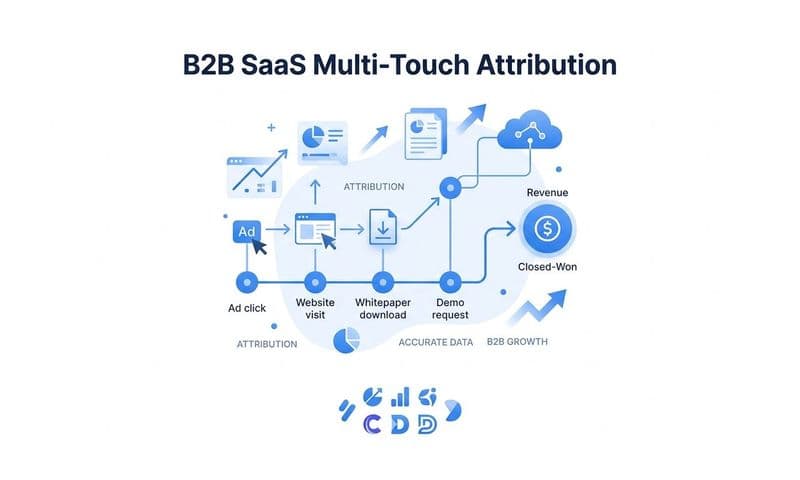
Attribution modeling becomes essential at enterprise scale. For B2B companies with long sales cycles, last-click attribution wildly undervalues the awareness and consideration touchpoints that initiated the journey. Someone might see your LinkedIn ad, later search for your brand on Google, then convert through a direct visit weeks after attending your webinar. Which touchpoint deserves credit? Multi-touch attribution models distribute credit across the entire journey, giving you a more accurate picture of what's actually driving results. Our attribution marketing tracking complete guide explains these models in depth.
Choose attribution models appropriate for your business. Position-based models give extra weight to first and last touchpoints while still crediting everything in between. Time-decay models give more credit to recent touchpoints. Linear models split credit equally. The right choice depends on your sales cycle length and how your customers actually buy. Many enterprises use multiple models to understand their data from different angles.
Unifying data across platforms requires a central system that collects conversion data from everywhere and applies consistent attribution logic. This means pulling data from Google Ads, Meta, LinkedIn, your CRM, your analytics platform, and any other sources that track customer touchpoints. A proper cross platform tracking setup guide helps you architect this unified data layer correctly. The goal is creating a single dashboard where you can compare true performance across channels using the same attribution methodology.
Build dashboards that connect marketing activity to revenue outcomes. Your executive team doesn't care about click-through rates—they care about ROI. Show which channels drive the most revenue at what cost. Break down performance by campaign, audience, and creative. Compare efficiency across platforms using consistent metrics. Make it easy to see where you should increase investment and where you should pull back.
Set up automated alerts for tracking anomalies. If conversion volume suddenly drops by 30%, you need to know immediately—not three weeks later when you're reviewing monthly reports. Configure alerts for unusual patterns in conversion volume, conversion value, or data quality metrics. Monitor for sudden changes in attribution patterns that might indicate tracking issues rather than real performance shifts.
Create reporting that actually drives decisions. Include not just what happened, but why it matters and what to do about it. If one channel is driving high-value customers while another generates high volume but low value, make that insight obvious. If your attribution data shows that certain touchpoint combinations consistently lead to closed deals, highlight those patterns. The goal is making your tracking data actionable, not just informative.
Step 6: Create Governance and Scale Your Tracking System
Your tracking system is only as good as your team's ability to maintain it. Without proper governance, your carefully designed architecture degrades over time. Different teams implement tracking differently. New campaigns launch without proper validation. Someone updates a tag and breaks historical data. Six months later, you're back to the tracking chaos you started with.
Document your tracking standards comprehensively. Create a tracking implementation guide that covers your naming conventions, required data points, technical specifications, and testing procedures. Make this documentation accessible to everyone who launches campaigns or manages digital properties. When new team members join or agencies start working with you, they should be able to implement tracking correctly by following your standards. Following best practices for tracking conversions accurately ensures consistency across your organization.
Establish QA protocols that catch issues before campaigns launch. Create a pre-launch checklist: Are conversion events firing correctly? Are they passing the right values? Do they deduplicate properly? Are they reaching all relevant ad platforms? Does the data flow into your reporting correctly? Require sign-off from your tracking team before any major campaign launches. The cost of proper QA is far less than the cost of running campaigns with broken tracking.
Build a change management process for tracking updates. When you need to modify conversion events, add new platforms, or update your tracking infrastructure, document what's changing and why. Communicate changes to all affected teams. Test thoroughly in staging environments before deploying to production. Maintain backward compatibility when possible so historical data remains comparable to new data. If issues arise, knowing fixing conversion tracking gaps quickly becomes critical.
Train your teams on using attribution data for optimization. Tracking data is worthless if people don't know how to act on it. Teach your campaign managers how to interpret multi-touch attribution. Show them how to use conversion value data to inform bidding strategies. Help them understand which metrics matter for their specific goals. Make data literacy a core competency across your marketing organization.
Plan for ongoing maintenance. Schedule quarterly tracking audits to verify everything still works correctly. Stay current with platform updates—ad platforms regularly change their APIs and tracking requirements. Monitor privacy regulation developments and adjust your data collection practices accordingly. Assign clear ownership for tracking system maintenance so it doesn't fall through the cracks when everyone is focused on campaign execution.
Putting It All Together: Your Enterprise Tracking Checklist
Enterprise conversion tracking is a system, not a project. You've now seen the six steps that transform tracking chaos into data confidence: auditing your current infrastructure to find the gaps, designing a scalable architecture that standardizes data collection, implementing server-side tracking for accuracy that survives browser limitations, connecting your CRM and offline conversions to track the full revenue journey, establishing cross-platform attribution for a single source of truth, and creating governance frameworks that maintain quality as you scale.
Here's your action checklist. First, complete your tracking audit and prioritize gaps by revenue impact. Second, document your conversion taxonomy and tracking architecture. Third, implement server-side tracking for your highest-value conversions. Fourth, integrate your CRM and configure offline conversion tracking. Fifth, set up unified attribution and executive reporting. Sixth, establish QA protocols and ongoing maintenance processes.
Remember that tracking is never truly finished. Browser privacy continues evolving. Ad platforms update their APIs. Your business launches new products and enters new markets. Privacy regulations expand. What works today needs regular review and optimization tomorrow. The enterprises that win are those that treat tracking as an ongoing capability, not a one-time implementation.
The complexity can feel overwhelming, but you don't have to build everything from scratch. Modern attribution platforms handle much of this infrastructure automatically—connecting your ad platforms, implementing server-side tracking, unifying your data, and providing the reporting you need to make confident decisions.
Ready to elevate your marketing game with precision and confidence? Discover how Cometly's AI-driven recommendations can transform your ad strategy—Get your free demo today and start capturing every touchpoint to maximize your conversions. When you can track every interaction from first ad click to closed revenue, you gain the clarity to scale what works and cut what doesn't. That's not just better tracking—it's better marketing.