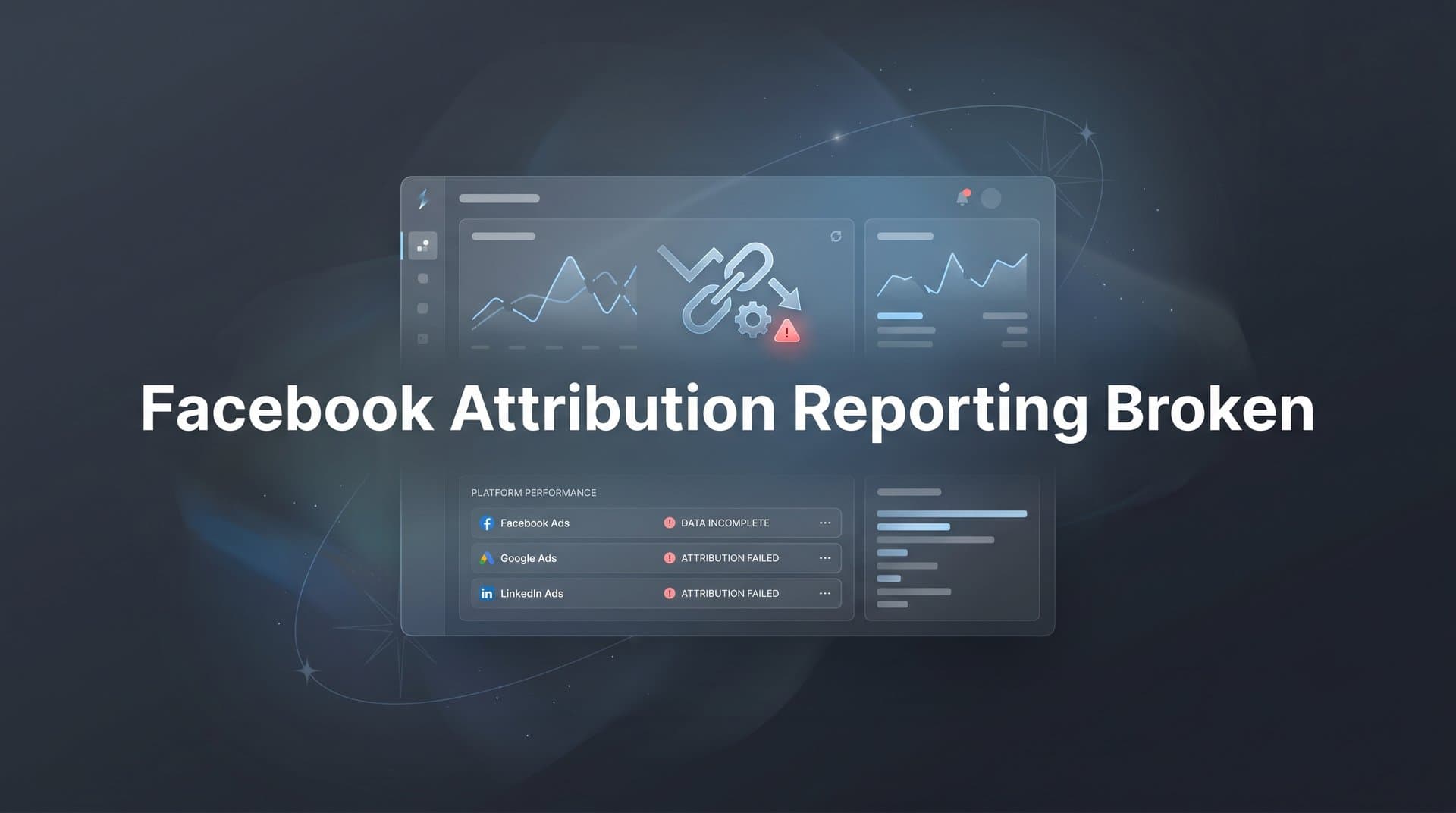
If your Facebook attribution reporting looks broken right now, the numbers you are seeing in Ads Manager are probably not telling the full story. Conversions are missing. ROAS looks either inflated or deflated depending on the day. Your CRM shows one revenue figure and Meta shows something completely different. And somewhere in that gap, you are making budget decisions on data you cannot trust.
You are not imagining it, and you are not alone. Since Apple's iOS 14.5 App Tracking Transparency framework changed the privacy landscape, browser-based tracking has become increasingly unreliable. Add Safari's Intelligent Tracking Prevention, Firefox's Enhanced Tracking Protection, ad blockers, and Chrome's evolving privacy controls, and you have a situation where a meaningful portion of conversion events simply never reach Meta's servers through the pixel alone.
Meta has responded by shifting toward modeled conversions and aggregated event measurement, which helps close some of the gap but introduces its own layer of uncertainty. The result is that many advertisers are flying partially blind, scaling campaigns based on incomplete data or cutting winners because the reporting does not reflect what is actually happening.
The good news is that broken Facebook attribution is fixable. It requires working through a structured diagnostic and implementation process, but each step produces a measurable improvement. This guide walks you through exactly that process: diagnosing where your data is breaking down, auditing and improving your tracking setup, adding server-side tracking to bypass browser limitations, building an independent attribution layer, and feeding corrected data back to Meta's algorithm so it can optimize more effectively.
By the end, you will have a clear picture of what was causing your attribution gaps and a practical system for getting accurate, trustworthy marketing data. Let's get into it.
Step 1: Diagnose Where Your Attribution Data Is Breaking Down
Before you can fix broken Facebook attribution reporting, you need to understand exactly where the breakdown is happening and how large the gap actually is. Jumping straight to solutions without a clear diagnosis often means fixing the wrong thing.
Start by pulling your conversion numbers from three sources side by side: Facebook Ads Manager, your CRM or backend database, and your ecommerce platform if you are running one. Look at the same time period, ideally the last 30 days, and compare the total conversion counts and revenue figures. The discrepancy you find is your baseline. Document it.
Next, check your attribution window settings inside Ads Manager. Meta's default attribution window has changed over time, and it is easy to miss when the platform quietly updates its defaults. Navigate to your campaign reporting view, click the columns dropdown, and check which attribution window is currently selected. Common options include 1-day click, 7-day click, 1-day view, and 7-day click plus 1-day view. A 7-day click window will show significantly more conversions than a 1-day click window, and if your window recently changed, that alone can explain sudden shifts in reported performance. For a deeper dive into how attribution windows affect your numbers, read about attribution window performance.
Look for these specific symptoms as you review your data:
Missing conversions after iOS updates: If you noticed a sudden drop in reported conversions around a major iOS release, browser-level tracking restrictions are likely the primary culprit.
Duplicate events firing: If your conversion numbers look higher than your actual sales or leads, you may have both pixel and server-side events firing without deduplication, counting the same conversion twice.
Delayed reporting discrepancies: Meta's reporting can lag by 24 to 72 hours, especially for modeled conversions. If you are comparing same-day data, you may be looking at incomplete numbers.
Sudden ROAS drops with stable backend revenue: If your actual revenue held steady but Ads Manager ROAS dropped, conversions are going unreported rather than not happening. This is one of the most common Facebook ads reporting discrepancies advertisers encounter.
Write down the specific numbers and symptoms you find. This documentation becomes your benchmark for measuring whether the fixes you implement in the following steps are actually working.
Step 2: Audit Your Facebook Pixel and Conversions API Setup
Once you know the size of your attribution gap, the next step is auditing the technical foundation of your tracking setup. Most attribution problems trace back to issues at this layer.
Open Meta Events Manager and navigate to your data source. Look at the event activity for your key conversion events: Purchase, Lead, AddToCart, and InitiateCheckout are the most important. Check whether these events are firing consistently and whether the volumes look reasonable compared to your backend data.
Use the Test Events tool inside Events Manager to verify your pixel is firing correctly in real time. Open the tool, trigger a conversion on your website, and watch whether the event appears. If it does not show up, you have a pixel implementation problem to solve before anything else. Common causes include pixel code placed incorrectly, firing only on some pages, or being blocked by a consent management platform that is not configured properly. Our guide on Facebook pixel tracking covers how to fix data loss and train Meta's AI correctly.
Now look specifically for these issues:
Missing events on key pages: Your Purchase event should fire on your order confirmation or thank you page every time. Your Lead event should fire on form submission confirmation pages. Walk through your own conversion funnel and verify each event fires exactly once at the right moment.
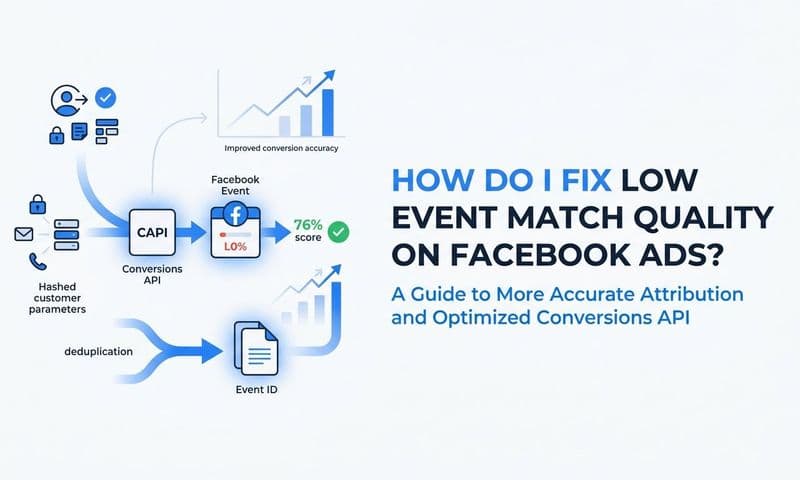
Duplicate events without deduplication: This is one of the most common and damaging issues. If you have both the browser pixel and Conversions API (CAPI) running, which is the recommended setup, both will fire for the same conversion event. Without proper deduplication, Meta counts this as two conversions. The fix is to pass a consistent event_id parameter from both your pixel and your CAPI events. Meta uses this ID to identify and discard duplicate events. Verify this is implemented correctly in your setup.
Conversions API not configured: If you are relying solely on the browser pixel in 2026, you are missing a significant portion of conversions. CAPI sends event data directly from your server to Meta, bypassing browser-level blocks entirely. Check whether CAPI is active by looking at the "Connection Method" column in Events Manager. You should see both Browser and Server listed for your key events. Learn more about how the Facebook attribution API works to strengthen your server-side setup.
If you are using a platform like Shopify, many CAPI integrations are available through the Meta channel app. For custom setups, you will need to implement the CAPI directly through Meta's API or use a tag management solution. The key is that both browser and server events are flowing, and deduplication is working correctly.
After auditing, make a list of every issue you find. Prioritize fixing missing events first, then deduplication, then confirming CAPI is active. Each fix will narrow the gap you documented in Step 1.
Step 3: Improve Event Match Quality to Recover Lost Data
Even with your pixel and CAPI properly configured, you can still lose attribution credit if Meta cannot match your conversion events to specific users in its database. This is where Event Match Quality becomes critical.
In Events Manager, find the Event Match Quality score for each of your key events. Meta displays this as a score roughly on a scale from poor to excellent, and it reflects how often Meta can connect an incoming conversion event to a known user profile. A low score means a large portion of your conversions are coming in as anonymous events that cannot be tied back to a specific ad click, which means those conversions go unreported in your attribution data. Understanding how to fix attribution discrepancies starts with improving this score.
The primary lever for improving match quality is the customer parameters you pass with each event. Meta can match events using email address, phone number, IP address, user agent, first name, last name, city, state, zip code, and country. The more of these parameters you pass, the higher your match quality score will be.
Here is how to improve it in practice:
Pass email and phone whenever available: For post-purchase events, you almost certainly have the customer's email address. For lead events, you have whatever the user submitted in the form. Pass these parameters with every event where they are available. This single change often produces the largest improvement in match quality.
Include IP address and user agent: These are particularly valuable for server-side events sent through CAPI, since the server does not automatically capture them the way a browser does. You need to explicitly capture and forward the user's IP address and browser user agent string from the original request.
Hash your data correctly: Meta requires that personally identifiable information like email and phone be hashed using SHA-256 before it is sent. If your hashing is implemented incorrectly, the parameters will not match Meta's records even if the data is correct. Verify that your hashing implementation follows Meta's specifications exactly, including normalizing data (lowercasing emails, removing formatting from phone numbers) before hashing.
Higher event match quality directly reduces your attribution gap. When Meta can identify more of the users who converted, it can attribute more of those conversions back to the specific ads that drove them. This means your reported ROAS moves closer to reality, and your campaign optimization improves as a result.
Step 4: Set Up Server-Side Tracking to Bypass Browser Limitations
Here is the core reality of browser-based tracking in 2026: it cannot be your only data collection method. Ad blockers prevent pixel events from firing. Safari's Intelligent Tracking Prevention limits cookie lifespans and blocks third-party tracking. Firefox's Enhanced Tracking Protection does the same. iOS App Tracking Transparency means a significant portion of mobile users have opted out of cross-app tracking entirely. And Chrome's Privacy Sandbox continues evolving in ways that further restrict traditional pixel-based measurement.
The combined effect is that a meaningful portion of your conversions are simply invisible to browser-based tracking. The pixel never fires, or it fires but cannot be matched to a user, and those conversions disappear from your attribution data entirely. These are among the most persistent attribution challenges in marketing analytics that advertisers face today.
Server-side tracking solves this by moving the data collection from the user's browser to your server. Instead of relying on a JavaScript pixel running in a potentially restricted browser environment, your server captures the conversion event and sends it directly to Meta's servers. Browser restrictions, ad blockers, and privacy settings cannot interfere with server-to-server communication.
Your practical options for implementing server-side tracking include:
Meta's native Conversions API: This is Meta's own server-side solution and the most direct path. If you have not implemented CAPI yet, this is where to start. Meta provides documentation and integrations for major platforms, and many ecommerce and CRM platforms have built-in CAPI support.
Google Tag Manager server-side containers: GTM's server-side container runs on your own server infrastructure and can forward events to Meta and other ad platforms. This gives you more control over data transformation and can simplify managing multiple platform integrations from one place.
Dedicated attribution platforms: Platforms like Cometly handle server-side tracking automatically as part of their core functionality. Rather than building and maintaining your own CAPI implementation, you connect your ad platforms, website, and CRM to Cometly, and it manages the server-side event flow, deduplication, and data enrichment on your behalf. This is particularly valuable if you are running campaigns across multiple ad platforms and need a unified tracking layer. Explore the top Facebook tracking software options to find the right fit for your setup.
After implementing server-side tracking, return to Events Manager and verify that server events are flowing. You should see your key conversion events showing both browser and server sources. Check that event volumes are increasing relative to your pre-implementation baseline, which confirms you are now capturing conversions that were previously being lost.
Step 5: Cross-Reference with a Multi-Touch Attribution Source of Truth
Here is a problem that no amount of pixel fixing or CAPI configuration can solve: Meta has an inherent incentive to claim credit for as many conversions as possible. When you rely solely on Facebook's self-reported attribution data, you are asking the platform to grade its own homework.
This is not a criticism unique to Meta. Google, TikTok, LinkedIn, and every other ad platform do the same thing. Each platform's in-platform reporting is designed to show that platform in the best possible light. When a customer sees a Facebook ad, then a Google ad, then searches organically and converts, all three channels may claim full credit for that conversion in their respective dashboards. Add them up and you have three times your actual conversion count. Understanding the difference between single source attribution and multi-touch attribution is essential for solving this problem.
The solution is an independent attribution layer that sits outside of any individual ad platform and tracks the complete customer journey across all channels. This gives you a source of truth that is not biased toward any single platform.
Multi-touch attribution models assign credit across all the touchpoints that contributed to a conversion, rather than giving all the credit to one channel. Depending on the model you use (linear, time decay, data-driven), the credit distribution will look different, but the key benefit is that you are working from a complete picture of the customer journey rather than each platform's isolated self-report.
Cometly is built specifically for this use case. It connects your ad platforms, CRM, and website to track every touchpoint in the customer journey and shows you which ads and channels are actually driving revenue. Rather than trusting any single platform's self-reported numbers, you get an independent view that reflects what is actually happening across your entire marketing mix.
Once you have an independent attribution source running, compare its data against what Facebook Ads Manager reports. You will likely see a delta, and understanding that delta is extremely valuable. It tells you how much Meta is over or under-reporting relative to a neutral measurement. Use this independent data as the basis for your budget allocation decisions rather than relying on any single platform's numbers. For a broader look at measuring ROI across platforms, explore cross-channel attribution for marketing ROI.
This step does not replace the technical fixes in the earlier steps. Better pixel, CAPI, and server-side tracking still matter because they improve the quality of data flowing into every system, including your independent attribution tool. But having an independent layer ensures you always have a reliable benchmark to work from.
Step 6: Feed Corrected Conversion Data Back to Meta's Algorithm
Fixing your attribution reporting is not just about getting accurate numbers for your own analysis. It has a direct impact on how Meta's ad delivery algorithm performs for your campaigns.
Meta's algorithm optimizes ad delivery based on conversion signals. When you tell it to optimize for purchases, it looks at which users are converting and finds more people who look like them. But if your conversion data is incomplete because browser tracking is missing events, the algorithm is working from a distorted picture of who your actual buyers are. It cannot find more people like your best customers if it does not know who your best customers are. Mastering Facebook ads optimization depends on feeding the algorithm complete, accurate data.
This creates a compounding problem. Poor tracking leads to poor algorithm optimization, which leads to worse campaign performance, which makes your attribution data look even worse. The good news is that the reverse is also true: better conversion data leads to better algorithm optimization and better campaign performance.
After implementing the fixes in the previous steps, you need to actively ensure that enriched, accurate conversion data is flowing back to Meta. This means:
Sending complete conversion events through CAPI: Not just the event itself, but all the customer parameters, order values, and metadata that help Meta understand who converted and what they bought.
Including offline conversions where relevant: If your sales process includes phone calls, in-person visits, or delayed conversions that happen outside the browser session, upload these through Meta's offline conversions API so the algorithm has a complete picture.
Using Conversion Sync to automate enriched data flow: Cometly's Conversion Sync feature feeds enriched, conversion-ready events back to Meta, Google, and other ad platforms automatically. Rather than manually managing what data gets sent back to each platform, Conversion Sync ensures the algorithm receives accurate, complete signals that reflect your real business outcomes. This directly improves targeting, optimization, and ultimately ad ROI.
After implementing corrected data flow, monitor your delivery metrics and campaign performance over the following two to four weeks. You should see improvements in cost per conversion and overall campaign efficiency as Meta's algorithm begins optimizing based on more accurate signals. The algorithm needs time to learn from the new data, so give it a full learning cycle before drawing conclusions.
Putting It All Together: Your Attribution Fix Checklist
If you have worked through each step, here is a quick-reference summary of everything you should have implemented:
Step 1 complete: You have documented the gap between Ads Manager and your backend data, identified your symptoms, and confirmed your attribution window settings.
Step 2 complete: Your pixel is firing correctly on all key pages, events are not duplicating, and CAPI is active alongside your browser pixel with proper deduplication via event IDs.
Step 3 complete: You are passing enriched customer parameters (email, phone, IP, user agent) with your events, hashing correctly, and your Event Match Quality score has improved.
Step 4 complete: Server-side tracking is implemented and verified, and you are capturing conversions that were previously lost to browser restrictions.
Step 5 complete: You have an independent multi-touch attribution source running, and you are using it as your primary basis for budget decisions rather than relying on Meta's self-reported data.
Step 6 complete: Enriched, accurate conversion data is flowing back to Meta's algorithm, and you are monitoring campaign performance improvements over the learning period.
For ongoing monitoring, set a weekly cadence to compare your independent attribution data against Ads Manager numbers. Over time, the gap should narrow as your tracking setup matures and Meta's algorithm improves its optimization based on better signals. Signs your fix is working include a narrowing discrepancy between Ads Manager and CRM data, more stable and interpretable ROAS figures, and improved campaign delivery efficiency.
The underlying principle across all six steps is the same: accurate data is the foundation of confident marketing decisions. When your attribution is broken, every decision built on top of it is compromised. When it works, you can scale what is actually driving revenue and cut what is not.
If you want a platform that handles server-side tracking, multi-touch attribution, independent conversion measurement, and conversion sync back to ad platforms all in one place, Cometly is built exactly for that. Get your free demo today and start capturing every touchpoint so you can make every budget decision with confidence.