There's a moment most B2B SaaS founders know well. Revenue is growing, the product is solid, and the pipeline is starting to matter more than ever. But marketing? It's a patchwork of tactics, a junior team without direction, and a nagging sense that you're leaving growth on the table. Hiring a full-time CMO feels like a big commitment you're not quite ready for. Running without senior marketing leadership feels like a risk you can't afford.
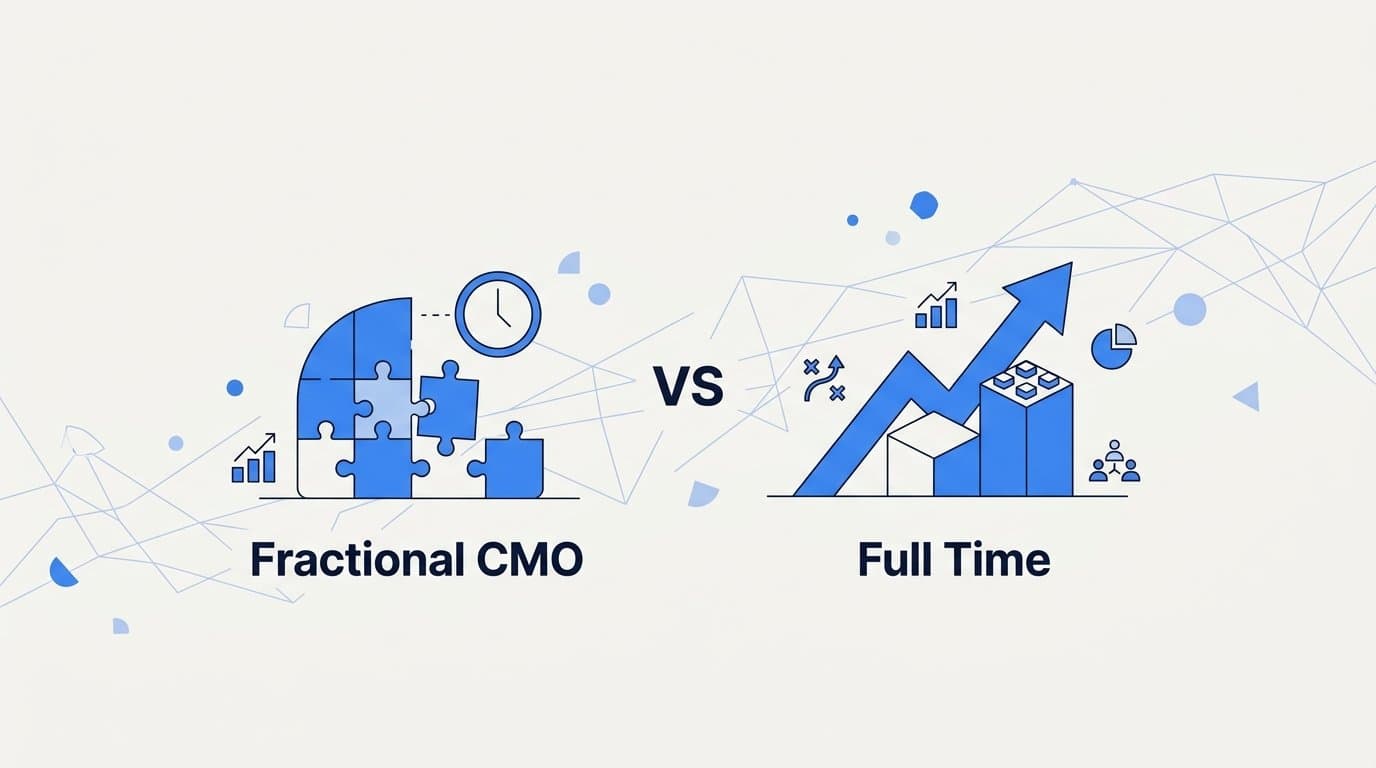
This is the fractional CMO vs full time dilemma, and it's one of the most consequential hiring decisions a growth-stage B2B SaaS company will make. Get it right and you accelerate. Get it wrong and you burn budget, lose time, and stall momentum at exactly the wrong moment.
What makes this decision genuinely hard is that it's not a simple cost comparison. It's a strategic question tied to where your company is right now, where you're trying to go, and whether your marketing function is mature enough to support the leader you're about to bring in. This article breaks down both roles clearly, honestly, and practically so you can make a confident, data-backed decision.
Two Very Different Roles, One Shared Title
The word "CMO" gets used loosely, and that's part of the problem. Before you can decide which type of marketing leader you need, you need to understand what each role actually looks like in practice.
A fractional CMO is a senior marketing executive who works with your company on a part-time or contract basis, typically somewhere between 10 and 20 hours per week. They usually work with multiple clients simultaneously, bringing cross-industry perspective and a broad toolkit developed across different company stages and markets. The engagement is often structured as a monthly retainer, scoped around specific strategic priorities.
Here's the important distinction: a fractional CMO is not a consultant who delivers a report and disappears. They are not an agency pitching a media plan. A true fractional CMO operates as an embedded executive. They sit in strategy meetings. They own goals. They direct your internal team, shape your positioning, and make real decisions about budget and channel allocation. The only difference is the time commitment.
A full-time CMO is a dedicated executive who is fully embedded in your company. They are in the building every day, participating in cross-functional leadership conversations, building relationships with sales, product, and finance, and carrying long-term accountability for the entire marketing function. They typically receive equity, benefits, and a compensation package that reflects the depth of that commitment.
The full-time CMO is not just doing more hours. They are doing fundamentally different work. They are recruiting and developing a team, managing complex internal politics, building culture within the marketing org, and thinking about brand strategy across a multi-year horizon.
Understanding this distinction matters because companies often hire a fractional CMO expecting full-time output, or hire a full-time CMO when what they actually need is strategic direction two days a week. Both mistakes are expensive.
The Cost Reality Behind Each Option
Let's talk about money, but let's talk about it honestly. The surface-level comparison is straightforward: a fractional CMO costs less per month than a full-time CMO. But the real cost picture is more nuanced than that.
A full-time CMO at a growth-stage B2B SaaS company carries a meaningful base salary, typically well into six figures, plus equity, benefits, and the cost of onboarding. Beyond the direct compensation, there's the time cost. It typically takes a new executive six to twelve months before they are producing measurable results. They need time to understand the business, build relationships, audit the existing marketing function, and develop a strategy before execution begins at scale. That's a long runway.
A fractional CMO, by contrast, is structured as a monthly retainer based on hours or scope. The monthly investment is significantly lower, and because fractional leaders typically work with multiple companies, they bring a pattern-recognition advantage that accelerates their ramp time. They've seen similar problems before. They know what questions to ask in week one.
But here's the cost factor most companies overlook: the cost of the wrong hire at the wrong stage.
Hiring a full-time CMO before your company has a repeatable go-to-market motion is a common and costly mistake. A full-time executive at that stage often defaults to what they know: building a team, establishing processes, and creating brand infrastructure. All of that is valuable eventually, but if you don't yet have product-market fit or a clear understanding of which channels drive pipeline, you're funding a marketing operation that's building on an unstable foundation.
Conversely, keeping a fractional CMO too long past the point where your marketing function needs full-time leadership creates a different kind of drag. Strategic momentum stalls when a part-time leader can't give daily attention to a growing team and a complex multi-channel strategy.
The real cost question: It's not which option is cheaper. It's which option is right for your stage, because the wrong choice in either direction costs far more than the difference in monthly spend.
When a Fractional CMO Is the Right Call
The fractional CMO model is genuinely well-suited to a specific company profile, and knowing whether you fit that profile is the most important part of this decision.
The companies that benefit most from a fractional CMO are typically early to mid-stage B2B SaaS businesses. Think annual recurring revenue in the range of $1M to $10M, a small marketing team or no dedicated marketing team at all, and a founder who is currently making most of the marketing decisions themselves. At this stage, what you need is strategic direction, not execution bandwidth. You need someone who can tell you where to focus, what to build, and in what order.
There are specific scenarios where a fractional CMO is particularly valuable. Launching into a new market is one. If you're expanding to a new segment or geography, a fractional leader with relevant experience can compress your learning curve significantly. Building your first marketing playbook is another. If you've been growing primarily through founder-led sales or referrals and you need to create a repeatable, scalable marketing motion, a fractional CMO can build that framework without requiring a full-time salary while you're still validating the approach.
Preparing for a fundraise is a third common use case. Investors want to see a coherent go-to-market narrative, clear metrics, and a marketing function that can scale with new capital. A fractional CMO can help you build and articulate that story. And finally, bridging the gap between a departed CMO and a permanent hire is a practical use case that many companies underestimate. Rather than letting marketing drift for six months during a search, a fractional leader can maintain momentum and even help you define what the full-time role should look like.
One important caveat: fractional CMOs work best when some marketing infrastructure already exists. If you have a CRM, active ad accounts, and basic analytics in place, a fractional leader can hit the ground running. They need data to make decisions quickly, and their limited hours are most valuable when spent on strategy rather than setup. If your marketing infrastructure is essentially nonexistent, you may need to invest in foundational tools before a fractional CMO can operate effectively.
When You Need a Full-Time Marketing Executive
There are clear signals that a fractional engagement is no longer enough, and missing those signals is just as costly as hiring a full-time CMO too early.
The most obvious inflection point is team size. When your marketing team grows beyond two or three people, the coordination and leadership demands increase significantly. A fractional CMO working 15 hours a week cannot effectively manage, mentor, and develop a team of five or more marketers. The team starts to drift without consistent leadership, and the fractional leader becomes a bottleneck rather than an accelerant.
Budget complexity is another signal. When you're running simultaneous campaigns across multiple channels with a meaningful monthly ad spend, daily oversight becomes necessary. Decisions about budget reallocation, creative testing, and channel optimization can't wait for a weekly check-in. A full-time CMO can respond to performance data in real time and make adjustments before budget is wasted.
Companies scaling past $10M to $20M in ARR typically reach a point where marketing is a core competitive differentiator, not just a demand generation function. At that stage, the CMO needs to be fully embedded in company culture, participating in product roadmap conversations, aligning with the sales leadership on pipeline targets, and representing marketing at the board level. That kind of cross-functional accountability requires presence and context that a part-time engagement simply cannot provide.
There's also the organizational depth argument. A full-time CMO can recruit, interview, and onboard marketing talent in a way that builds a cohesive team with a shared culture and direction. They can identify who's growing, who's struggling, and how to develop the team over time. A fractional leader, no matter how skilled, is working with limited visibility into the day-to-day dynamics of your organization. The team-building function alone often justifies the full-time investment once you reach a certain scale.
How Marketing Data Changes This Decision
Here's something that doesn't get discussed enough in the fractional vs full-time conversation: the quality of your marketing data infrastructure directly impacts how effective either type of leader can be, and it may actually influence which option is right for you right now.
Both a fractional and a full-time CMO need accurate, real-time attribution data to do their job well. Without clear visibility into which channels are driving pipeline, what customer acquisition cost looks like by source, and where the conversion funnel is leaking, no marketing leader can make confident budget decisions. They're guessing.
But this problem hits fractional CMOs harder. Because their time is limited, they cannot afford to spend weeks diagnosing data problems before they start making strategic recommendations. A fractional CMO who walks into a company with no clean attribution data, disconnected ad accounts, and a CRM that doesn't talk to the website is going to spend a disproportionate amount of their engagement hours on infrastructure rather than strategy. That's expensive, and it's not what you hired them for.
In B2B SaaS, the customer journey is rarely simple. Prospects interact with ads, organic content, sales outreach, and product trials across weeks or months before converting. Understanding which touchpoints actually influenced the decision requires multi-touch attribution that connects ad spend to pipeline and closed-won revenue. Without that connection, even the most experienced CMO is operating with partial information.
This is where platforms like Cometly become foundational. Cometly connects your ad platforms, CRM, and website to give any marketing leader, fractional or full-time, a real-time view of the entire customer journey. Instead of guessing which campaigns are driving revenue, your CMO can see exactly which channels and ads are contributing to pipeline, compare performance across attribution models, and make budget decisions grounded in actual revenue data rather than surface-level metrics like clicks or impressions.
For a fractional CMO, this kind of attribution clarity is especially valuable. It means they can walk into your company, access a single source of truth for marketing performance, and start making strategic recommendations in their first week rather than their third month. For a full-time CMO, it means the entire marketing team is aligned on what's working and why, with AI-driven recommendations surfacing opportunities that manual analysis would miss.
The practical takeaway is this: before you bring in any senior marketing leader, investing in clean attribution infrastructure is one of the highest-leverage things you can do. It makes every hour of fractional time more productive and every decision a full-time CMO makes more confident.
A Decision Framework for B2B SaaS Leaders
If you're still on the fence, here's a practical framework built around three factors: your current ARR and company stage, the size and maturity of your existing marketing team, and the complexity of the marketing strategy you need to execute.
Company Stage and ARR: If you're pre-Series A or between $1M and $10M ARR, a fractional CMO is almost always the right starting point. You need strategic direction more than you need a fully embedded executive, and the budget flexibility lets you invest the difference in actual marketing programs. If you're Series B or beyond, approaching or past $15M to $20M ARR, the signals typically point toward a full-time hire.
Marketing Team Size and Maturity: A founder with no marketing team and one or two junior marketers needs a fractional CMO to create the playbook. A company with four or more marketers running complex campaigns needs someone in the building every day to lead them. The team's needs should drive this decision as much as the company's budget.
Strategic Complexity: If your marketing strategy is focused on one or two primary channels and a clear ICP, a fractional CMO can manage that effectively. If you're running simultaneous campaigns across paid search, paid social, content, events, and partner channels, and those campaigns require daily attention and cross-functional coordination, you need full-time leadership.
A few practical scenarios to make this concrete. A seed-stage SaaS company with $2M ARR, a founder handling marketing decisions, and one content hire should lean fractional. The fractional CMO builds the strategy, defines the channels, and creates the playbook the internal team can execute. A Series B company with $18M ARR, a five-person marketing team, and a board expecting aggressive pipeline growth almost certainly needs a full-time CMO who can lead the team daily and carry board-level accountability.
The most important thing to remember is that this decision is not permanent. Many of the best-run B2B SaaS companies use a fractional CMO to build the marketing foundation, create a repeatable go-to-market motion, and establish the data infrastructure. Then, when the function is mature enough to justify it, they transition to a full-time hire who can take that foundation and scale it. The two approaches are not mutually exclusive. They're sequential.
Putting It All Together
The fractional CMO vs full time debate is ultimately not about cost savings. It's about matching the right level of marketing leadership to your current stage, your team's needs, and the complexity of the strategy you're trying to execute. Both options can be exactly right or exactly wrong depending on where your company is today.
What's consistent across both paths is this: the marketing leader you bring in will only be as effective as the data they have access to. A fractional CMO without attribution clarity wastes their limited hours on diagnosis. A full-time CMO without real-time pipeline visibility makes budget decisions on incomplete information. Either way, the data infrastructure you build before and alongside your marketing leadership investment determines how quickly that leader can drive results.
Cometly gives any CMO, fractional or full-time, the attribution foundation they need to connect ad spend to pipeline and closed-won revenue across every channel. From capturing every touchpoint to surfacing AI-driven recommendations on which campaigns to scale, Cometly turns your marketing data into a competitive advantage rather than a source of confusion.
If you're ready to give your next marketing leader the real-time visibility they need to make confident, revenue-backed decisions, Get your free demo and see how Cometly connects your entire marketing stack into a single source of truth.