
Account based marketing flips the traditional demand generation funnel on its head. Instead of casting a wide net and hoping the right buyers find you, ABM starts with a precise list of target accounts and builds every campaign, message, and touchpoint around them.
For B2B SaaS companies with longer sales cycles and multiple decision-makers involved in each deal, this focused approach tends to produce stronger pipeline quality and more predictable revenue outcomes. But here is the thing: most marketing teams already understand the concept of ABM. What they struggle with is executing it in a structured, measurable way.
Which accounts should you target? How do you personalize at scale without burning out your team? How do you know if your ABM efforts are actually moving the needle on revenue? These are the questions that separate teams who run ABM as a real growth engine from those who treat it as a buzzword with a loose collection of tactics attached to it.
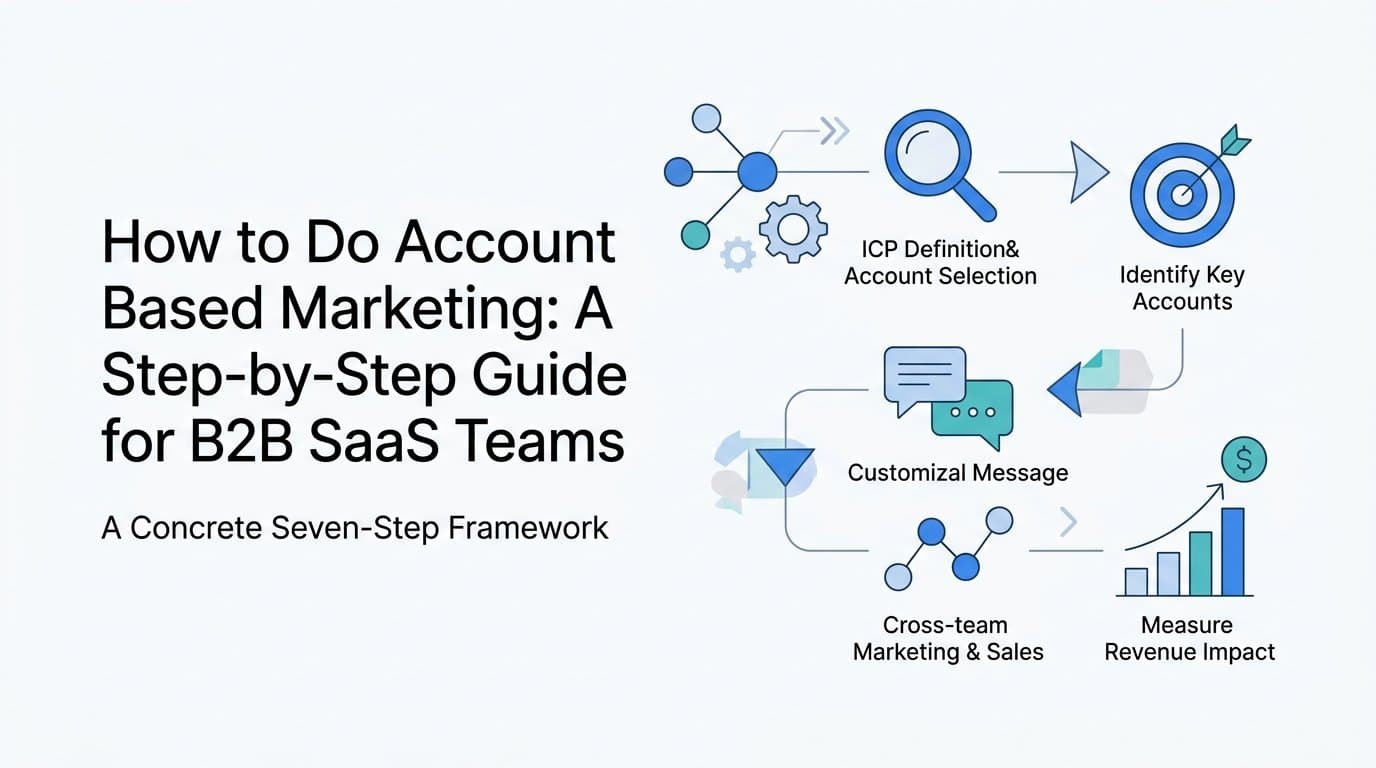
This guide answers all of those questions with a concrete, seven-step framework built specifically for B2B SaaS marketing and sales teams. You will walk through everything from building your ideal customer profile to measuring attribution across every touchpoint in the account journey.
Whether you are launching your first ABM program or looking to sharpen an existing one, these steps will give you a clear path forward. By the end, you will have a repeatable system that aligns your marketing and sales teams, focuses your ad spend on the accounts most likely to convert, and gives you the data you need to optimize and scale with confidence.
Let's get into it.
Step 1: Define Your Ideal Customer Profile and Account Criteria
Every effective ABM program starts with the same foundation: a clearly defined ideal customer profile. Your ICP is not a vague description of who you think your best customers might be. It is a data-backed portrait of the specific types of companies most likely to buy, retain, and expand with your product.
Think of your ICP as the filter that determines which accounts make it onto your target list in the first place. Without it, you are essentially running ABM on guesswork, which defeats the entire purpose.
To build a solid ICP, start with your existing CRM data. Pull your closed-won deals from the past 12 to 24 months and look for patterns. What industries show up most often? What is the typical company size by headcount and revenue? What tech stack do these companies run? How long did their sales cycles take, and what was the average contract value?
The attributes you want to define fall into a few categories:
Firmographic criteria: Company size, industry vertical, revenue range, and geographic location. These are the baseline qualifiers that tell you whether an account is even worth pursuing.
Technographic criteria: The tools and platforms your best customers already use. If your product integrates with a specific CRM or marketing automation platform, companies using those tools are often better fits and faster to close.
Behavioral and growth signals: Are they hiring aggressively? Have they recently raised funding? Are they expanding into new markets? These signals often indicate a company is in a growth phase where your solution becomes more relevant.
It is also worth clarifying the difference between an ICP and a buyer persona. Your ICP describes the company you want to target. Your buyer persona describes the individual decision-makers within that company. ABM requires both. You need to know which accounts to pursue and which people within those accounts to engage.
A common pitfall here is targeting too broadly. If your ICP includes companies ranging from 10 to 10,000 employees across every industry, it is not really a profile at all. The tighter and more specific your criteria, the more focused and effective your ABM program will be.
Success indicator: You have a written ICP document with at least five qualifying criteria that your sales and marketing teams both agree on. This document should be a living reference, not a one-time exercise.
Step 2: Build and Prioritize Your Target Account List
With your ICP defined, the next step is translating it into an actual list of named accounts. This is where ABM moves from strategy to execution.
There are several strong sources for building your account list. Your CRM is the obvious starting point: look at open opportunities, past customers who churned and might be ready to re-engage, and companies in your pipeline that have gone quiet. These accounts already have some relationship with your brand and often respond well to targeted outreach.
Beyond your CRM, LinkedIn Sales Navigator is one of the most practical tools for finding net-new accounts that match your ICP. You can filter by company size, industry, growth rate, and geography, and then export lists directly into your workflow. Intent data platforms add another layer by surfacing companies that are actively researching solutions like yours based on their content consumption behavior. These signals help you identify accounts that are in-market right now, not just accounts that theoretically fit your profile.
Once you have your list, the next critical step is tiering it. Not all target accounts deserve the same level of attention, and trying to treat them all the same will stretch your team too thin.
The standard ABM tiering model works like this:
Tier 1 accounts are your highest-value, highest-fit targets. These get fully personalized, one-to-one campaigns with custom content, direct sales outreach, and dedicated resources. Keep this list small, typically somewhere between 10 and 50 accounts depending on your team size.
Tier 2 accounts are strong fits but not quite at the level of one-to-one attention. These get one-to-few campaigns organized by industry segment or company type, where personalization is real but applied at a segment level rather than an individual account level.
Tier 3 accounts are a broader pool that matches your ICP but where personalization is programmatic. Think persona-based ad campaigns and automated email sequences rather than custom content.
The most common mistake at this stage is inflating your Tier 1 list. It is tempting to add accounts because they seem promising, but if you cannot realistically deliver a personalized experience to each one, they should not be in Tier 1. Quality of engagement beats volume every time in ABM.
Success indicator: You have a tiered account list loaded into your CRM with clear ownership assigned to each account and a documented rationale for why each account belongs in its tier.
Step 3: Map the Buying Committee and Key Stakeholders
Here is a reality that makes ABM fundamentally different from traditional lead generation: in B2B SaaS, you are rarely selling to a single person. Enterprise and mid-market deals typically involve multiple stakeholders, each with different priorities, concerns, and levels of influence over the final decision.
If your ABM program only targets one contact per account, you are leaving significant influence on the table. Buying committee mapping is how you fix that.
The typical B2B SaaS buying committee includes several distinct roles. The economic buyer controls the budget and ultimately approves the purchase. They care about ROI, total cost of ownership, and strategic fit. The technical evaluator assesses whether your product actually integrates with existing systems and meets technical requirements. The end user champion is the person who will use your product day-to-day and often drives internal advocacy. And depending on deal size, you may also have legal or procurement stakeholders who focus on contract terms and vendor risk.
To identify the right contacts within each target account, start with LinkedIn. Search by company name and filter by job title or function to find the roles that match each buying committee seat. Cross-reference with your CRM to see if any contacts already exist for that account. Company websites, especially leadership pages and team directories, can fill in additional gaps.
Once you have identified the contacts, the next step is tailoring your messaging for each role. The economic buyer wants to understand how your product affects revenue and efficiency. The technical evaluator wants to know about integrations, security, and implementation. The end user champion wants to see that your product will actually make their job easier.
Do not make the mistake of focusing all your energy on the most senior title in the room. The end user champion often carries more internal influence than their title suggests, especially in SaaS where adoption and usage data directly affect renewal decisions. Winning them over early can accelerate the entire deal.
Success indicator: For each Tier 1 account, you have identified at least three key contacts with different roles and crafted distinct messaging angles for each one based on their specific priorities.
Step 4: Create Personalized Content and Multi-Channel Campaigns
This is where your ABM strategy becomes visible to the accounts you are targeting. Content and campaigns are how you demonstrate relevance, build credibility, and move stakeholders from awareness to consideration.
The core principle of ABM content is specificity. Generic content that could apply to any company in any industry will not cut through in a targeted program. Your content needs to speak directly to the pain points, goals, and context of the accounts you are pursuing.
The channels that tend to work best for ABM include:
LinkedIn ads: LinkedIn's targeting capabilities make it the go-to platform for ABM paid media. You can target by company name, job title, seniority level, and function, which means your ads can reach the exact stakeholders in your exact target accounts. Sponsored content, message ads, and conversation ads all work well depending on where an account sits in the funnel.
Display retargeting to account lists: Serve display ads specifically to visitors from your target accounts who have already been to your website. This keeps your brand visible during the research phase without requiring them to click on a LinkedIn ad first.
Personalized email sequences: Coordinated email outreach from both marketing and sales, aligned around the same themes and offers, creates a cohesive experience for the account rather than disconnected touches from different people.
Custom landing pages: For Tier 1 accounts especially, a landing page that references the account's industry, specific use case, or even the company name by name signals a level of attention that generic pages simply cannot match.
The level of personalization should match the tier. Tier 1 accounts deserve custom one-pagers, personalized video messages, and tailored case study selections. Tier 2 accounts get industry-specific content that feels relevant without requiring individual customization. Tier 3 accounts get persona-based content that speaks to their role and challenges at a broader level.
One practical tip: personalization does not have to mean starting from scratch for every account. Build modular content templates where you can swap in industry-specific language, relevant use cases, and account-specific details without rebuilding the entire asset. This approach scales without sacrificing the sense of relevance that makes ABM content effective.
Success indicator: Each Tier 1 account has at least one piece of content or campaign asset personalized specifically for them, and your campaigns across all tiers are running on at least two channels simultaneously.
Step 5: Align Sales and Marketing Around Account Engagement
ABM is one of the few marketing strategies that is genuinely impossible to execute well without tight sales and marketing alignment. If your two teams are operating from different data, following different definitions of what constitutes a ready account, or running outreach that conflicts with each other, your ABM program will underperform regardless of how good your content is.
Alignment starts with a shared view of the account. Both sales and marketing need to see the same engagement data in your CRM: which contacts have visited your website, which ones have clicked on ads, which ones have opened emails, and which accounts have had recent conversations with sales. When both teams operate from the same picture, coordination becomes natural rather than forced.
One of the most important structural changes you can make in an ABM program is replacing the traditional MQL handoff with an account-level engagement threshold. Instead of marketing handing off an individual lead when they hit a certain score, the trigger becomes the account reaching a defined level of engagement across multiple contacts and channels. This shift ensures that sales is engaging accounts that have demonstrated real buying intent rather than individual contacts who happened to download one piece of content.
Regular account review meetings are another essential component. These are not pipeline reviews in the traditional sense. They are focused conversations where marketing shares engagement signals and sales shares feedback from conversations, and both teams align on the next best action for each priority account. Cadence matters here: weekly for Tier 1 accounts, bi-weekly or monthly for Tier 2.
Document everything in a formal SLA between sales and marketing. This agreement should define what engagement thresholds trigger a sales follow-up, how quickly sales is expected to act once an account is handed over, and how marketing will continue to support accounts that are in active sales conversations.
Success indicator: Your sales and marketing teams have a documented SLA that defines engagement thresholds for account handoffs, follow-up timelines, and shared accountability for account-level pipeline metrics.
Step 6: Launch Targeted Paid Ads to Reach Your Account List
Paid advertising is one of the most powerful levers in an ABM program because it lets you reach specific stakeholders at specific companies with specific messages, at scale and with measurable results. But ABM paid media requires a different setup than standard demand generation campaigns.
Start with Google Ads and LinkedIn Campaign Manager as your two primary platforms. LinkedIn is particularly well-suited for ABM because it allows you to upload a list of company names and layer on job title or function filters, which means your ads can be shown specifically to the decision-makers at your target accounts. Upload your Tier 1 and Tier 2 account lists as matched audiences, then build ad sets targeting the specific job functions that correspond to your buying committee roles.
On Google, customer match and display audience targeting let you reach contacts from your account list across search and the display network. This is especially effective for retargeting accounts that have already shown intent by visiting your website or engaging with your content.
Structure your campaigns to match the buying stage of each account rather than running the same ad to everyone. Cold accounts that have never heard of you need top-of-funnel content: thought leadership, industry insights, and problem-framing content that builds awareness and credibility. Accounts that are already engaged and in active conversations with sales need bottom-of-funnel proof: customer stories, comparison content, ROI frameworks, and demo offers.
Running the wrong message to the wrong stage is one of the most common ways ABM ad budgets get wasted. A company that has never heard of you does not need to see a demo request ad. An account that is already in late-stage evaluation does not need to see a brand awareness video.
Keep your creative specific to the account tier and industry. If you are targeting SaaS companies in a specific vertical, use language and examples that reflect their world. Generic ad creative wastes budget on audiences that will not convert, even when the targeting is precise.
Success indicator: Your paid campaigns are segmented by account tier and buying stage, and you are tracking impression share among your target account list to confirm your ads are reaching the right audiences.
Step 7: Measure ABM Performance with Full-Funnel Attribution
Here is where many ABM programs hit a wall. Teams do all the right work: they build the account list, create personalized content, align sales and marketing, and run targeted campaigns. Then they try to measure results using the same lead-based metrics they have always used, and the data tells them almost nothing useful.
Standard metrics like cost per lead, MQL volume, and form submission rates are not designed to capture the true impact of ABM. They measure individual contacts in isolation, which misses the account-level dynamics that ABM is specifically designed to influence.
The metrics that actually matter in an ABM program are:
Account coverage: What percentage of your target account list has at least one identified contact, and how many of those contacts are actively engaged? Low coverage means your campaigns are not reaching enough of the buying committee.
Account engagement rate: How many of your target accounts are actively interacting with your content, ads, emails, or sales outreach? This is your primary leading indicator of pipeline health.
Pipeline influenced by target accounts: Of the opportunities currently in your pipeline, how many originated from or are associated with your target account list? This connects your ABM activity to actual revenue potential.
Revenue from target accounts: The ultimate measure. What percentage of closed-won revenue came from accounts on your ABM list? This is the metric that justifies the investment and informs how to scale the program.
To measure these metrics accurately, you need to connect your ad platforms, CRM, and revenue data in a single attribution system. This is where most teams struggle, because the data lives in separate tools with no easy way to connect ad impressions on LinkedIn to a closed deal in your CRM six months later.
This is exactly the problem Cometly is built to solve. Cometly connects your ad spend across platforms like LinkedIn and Google with your CRM and revenue data, giving you a complete view of the account journey from the first ad impression to the closed deal. With multi-touch attribution at the account level, you can see which campaigns and channels are actually moving target accounts through the funnel, not just which ones are generating clicks.
Instead of guessing which ABM activities are worth continuing, you get clear data showing which touchpoints influenced pipeline and which channels are driving the most engagement among your highest-value accounts. That visibility is what allows you to optimize your program, reallocate budget toward what is working, and scale with confidence.
Success indicator: You can report on pipeline and revenue influenced by your ABM program and tie specific campaigns and channels back to closed-won deals, giving your leadership team a clear picture of ABM ROI.
Putting It All Together: Running ABM That Drives Real Pipeline
Account based marketing works when every step is connected. Your ICP informs your account list. Your account list shapes your content and campaigns. Your sales and marketing alignment ensures no account falls through the cracks. And your attribution data tells you what is working so you can double down and scale.
The teams that get the most out of ABM treat it as an ongoing system rather than a one-time campaign. Review your target account list regularly and update it as your market evolves. Refresh your content as new use cases emerge and competitive dynamics shift. Use engagement data to adjust which accounts deserve more attention and which should be deprioritized in favor of better-fit targets.
Most importantly, make sure you have the measurement infrastructure in place to connect your ABM activity to actual revenue. Without full-funnel attribution, you are making decisions based on incomplete information. You might be investing heavily in a channel that feels productive but is not actually influencing deals. Or you might be underinvesting in a touchpoint that is quietly driving a significant portion of your closed-won revenue.
Cometly gives B2B SaaS marketing teams the visibility to track every touchpoint from first ad click to closed deal. With real-time attribution across your ad platforms, CRM, and revenue data, you always know which ABM efforts are worth scaling and which ones need to be rethought.
Start your ABM program with a clear ICP, stay disciplined about your account list, align your teams around shared account data, and let the attribution data guide every decision from there. That is how you build an ABM program that consistently delivers pipeline and revenue, not just activity.
Ready to connect your ABM campaigns to real revenue data? Get your free demo and see how Cometly helps B2B SaaS teams track every touchpoint and scale the campaigns that actually drive growth.