If you ran paid ads before and after April 2021, you probably remember the moment things stopped making sense. Campaigns that once delivered clear, reliable ROAS numbers suddenly looked like they were barely working. Conversions dropped. Attribution gaps appeared. And no matter how much you optimized, the data just didn't add up.
It wasn't a glitch in your tracking setup. It wasn't a platform bug. It was something far more fundamental: Apple restructured the entire privacy architecture of its operating system, and in doing so, pulled the rug out from under pixel-based conversion tracking across the entire digital advertising industry.
The introduction of App Tracking Transparency (ATT) with iOS 14.5 marked a before-and-after moment for digital marketers. Suddenly, the tools that advertisers had relied on for years to measure campaign performance were either firing with incomplete data or not firing at all for a significant portion of mobile users. The downstream effects rippled through Meta campaigns, Google Ads, TikTok, and beyond, leaving marketers with underreported conversions, confused algorithms, and budget decisions based on data they could no longer fully trust.
This article breaks down exactly what happened, why it broke the measurement systems so many teams depended on, and what modern marketers can do right now to recover accurate conversion data and make confident decisions again. The good news: the solutions exist, they work, and the marketers who implement them are operating with a real competitive advantage.
The Privacy Update That Changed Paid Advertising Forever
To understand the scale of what changed, you need to understand what Apple actually did. With iOS 14.5, released in April 2021, Apple introduced the App Tracking Transparency framework. The premise was simple: before any app could track a user's activity across other companies' apps and websites, it had to explicitly ask for permission. A prompt would appear, the user would tap "Allow Tracking" or "Ask App Not to Track," and that choice would determine whether the app could access the IDFA, the Identifier for Advertisers.
The IDFA had been the backbone of mobile advertising measurement for years. It was the persistent identifier that allowed ad platforms to connect an ad impression on one app to a conversion that happened somewhere else. When users began opting out of tracking at scale, that identifier became unavailable, and the data pipeline that Meta Pixel, Google tags, and other client-side trackers depended on was effectively severed for a large portion of iOS users.
Industry observers widely noted that opt-out rates were high among iOS users, though exact figures varied by app category and time period. The directional reality was clear: a substantial majority of users, when given the choice, chose not to be tracked. For advertisers, this meant a significant portion of their iOS audience became invisible to their measurement tools overnight.
The problem didn't stop with iOS 14.5. Each subsequent iOS version added new layers of privacy protection that compounded the original impact. iOS 15 introduced Mail Privacy Protection, which masked IP addresses and pre-loaded email content, breaking open-rate tracking and email-based attribution. Safari's Intelligent Tracking Prevention (ITP), which Apple had been building out for years through WebKit, continued to evolve, progressively shortening the lifespan of third-party cookies and blocking cross-site tracking at the browser level.
This matters because ITP operates independently of ATT. Even users who might have allowed app tracking were still subject to Safari's restrictions when browsing the web. The result was a layered, compounding set of restrictions that made browser-based conversion tracking increasingly unreliable across the entire Apple ecosystem, affecting not just app-based advertising but web-based campaigns targeting iOS users as well.
iOS 16 and 17 continued this trajectory, reinforcing Apple's commitment to privacy as a platform differentiator. For marketers, the message became clear: the old model of browser-level tracking was not coming back. This was a structural shift, not a temporary inconvenience. Understanding how iOS 17 link tracking protection compounds these earlier restrictions helps clarify why adapting your measurement infrastructure is no longer optional.
Why Pixel-Based Tracking Was the First Casualty
To appreciate why iOS changes hit pixel tracking so hard, it helps to understand how pixel tracking actually works at a technical level. When you install a Meta Pixel or a Google tag on your website, you're placing a small snippet of JavaScript that executes in the user's browser. When a user takes an action, such as completing a purchase or submitting a lead form, that JavaScript fires and sends event data back to the ad platform. The platform then matches that event to an ad click or impression using browser-level identifiers, including cookies and, in the case of mobile, the IDFA.
This entire process depends on two things: the browser executing the JavaScript without interference, and the availability of identifiers that can tie the conversion back to a specific user who saw a specific ad. iOS changes attacked both of these dependencies simultaneously.
When a user opts out of tracking via ATT, the IDFA becomes unavailable. When Safari's ITP restricts or deletes third-party cookies, the browser-level identifiers that pixels rely on for matching are either degraded or absent. The pixel may still fire, but it fires with incomplete data, making it impossible for the ad platform to attribute the conversion to the correct campaign, ad set, or creative. In many cases, for opted-out users, the conversion simply goes unrecorded from the ad platform's perspective. A deeper look at pixel tracking problems on iOS reveals just how many conversion events are silently disappearing from your reported data.
The downstream consequences of this data loss are significant. Ad platform algorithms, particularly Meta's and Google's, are designed to optimize toward conversion signals. They use reported conversion data to determine which users are most likely to convert, adjust bids accordingly, and allocate budget toward the highest-performing audiences and creatives. When the conversion signal weakens, these algorithms effectively go partially blind.
Meta's Advantage+ campaigns, Google's Smart Bidding, and TikTok's optimization systems all depend on a healthy volume of conversion events to function well. When pixel data drops off, the algorithm has less to work with, bidding strategies become less efficient, and campaigns that were previously performing well can appear to deteriorate. The ROAS looks lower than it actually is, not because the campaigns stopped working, but because the measurement system stopped seeing the full picture.
This created a particularly frustrating situation for marketers: the campaigns were still driving conversions, but the tools they used to measure and optimize those campaigns were reporting a distorted version of reality. Decisions made on that distorted data, such as cutting budgets on campaigns that appeared underperforming, often made the problem worse by starving the algorithm of the very spend it needed to optimize effectively.
The Specific Data Gaps Still Affecting Campaigns Today
Even years after the initial iOS changes, the data gaps they created are still present and still affecting campaign performance for teams that haven't fully adapted their tracking infrastructure. Understanding the specific nature of these gaps is essential for diagnosing what's broken and prioritizing fixes.
Underreported conversions: This is the most direct and visible impact. Purchases, lead form submissions, sign-ups, and other conversion events that happen on iOS devices but can't be attributed back to the ad that drove them simply disappear from your reported data. Your ad platform shows fewer conversions than actually occurred, making campaigns look less effective than they are and leading to misguided optimization decisions.
Attribution window compression: Meta's response to ATT was to introduce Aggregated Event Measurement (AEM), a framework designed to work within Apple's privacy constraints. AEM limits each domain to eight conversion events, requires advertisers to prioritize those events by business value, and uses statistical modeling to fill in gaps where individual-level tracking isn't possible. The practical effect is that lower-priority events, such as add-to-cart or initiate-checkout, may simply get dropped in favor of higher-priority events like purchases. This compresses the visibility you have into your funnel and makes it harder to optimize for mid-funnel behavior. Understanding how conversion window attribution works is critical for interpreting what your reported data is actually telling you.
Cross-device and cross-channel blind spots: Consider a common customer journey: a user sees a Facebook ad on their iPhone during their commute, doesn't convert, then later searches on their desktop, clicks a Google ad, and makes a purchase. Stitching that journey together requires connecting data across devices and channels, which is exactly what iOS restrictions make difficult. Without server-side data and first-party identifiers, multi-touch attribution models are left with incomplete information, often crediting the final touchpoint while ignoring the earlier interactions that actually drove awareness and intent.
These gaps don't just affect reporting accuracy. They affect every downstream decision that reporting informs, including which campaigns get more budget, which creatives get scaled, and which audiences get targeted. Learning how to fix attribution discrepancies in your data is one of the most valuable steps a performance marketer can take right now. Operating on incomplete data is not a neutral act; it actively steers decisions in the wrong direction.
Server-Side Tracking: The Technical Fix That Restores Signal
The most impactful solution to the iOS tracking problem is also the most technically substantive: server-side tracking. Understanding why it works requires understanding what makes it fundamentally different from pixel-based tracking at an architectural level.
With pixel tracking, the browser is the messenger. It observes what the user does, collects identifiers from the browser environment, and sends that data to the ad platform. iOS changes degraded the browser's ability to perform this function by restricting the identifiers it could access and the cookies it could set. Server-side tracking removes the browser from the equation entirely.
Instead of relying on a JavaScript snippet in the browser, server-side tracking sends conversion data directly from your server to the ad platform's API. Meta calls this the Conversions API (CAPI). Google calls it Enhanced Conversions. TikTok has its Events API. The mechanics differ slightly, but the principle is the same: the conversion event originates from your server, not the user's browser, so it is not subject to ATT opt-outs, ITP cookie restrictions, or ad blockers. Following a thorough Conversion API implementation tutorial is the most direct path to recovering the attribution data your campaigns have been missing.
The data that travels through this server-to-server connection is first-party customer data: hashed email addresses, phone numbers, IP addresses, and other identifiers that the user provided directly to your business. Because this data comes from your own systems rather than from browser-level tracking, it is not blocked by iOS restrictions. The ad platform can use this hashed data to match the conversion event to a user in its own system, restoring attribution that would otherwise be lost.
One important technical consideration when implementing server-side tracking alongside an existing pixel is event deduplication. If both your pixel and your server are sending the same conversion event to the ad platform, you risk double-counting conversions in your reported data. Proper deduplication requires assigning a unique event ID to each conversion and passing that ID through both the pixel and the server-side event. The ad platform uses this ID to recognize that both events represent the same conversion and counts it only once. Getting deduplication right is not optional; it is essential for keeping your data clean and your reporting accurate.
Platforms like Cometly are built to handle this complexity. Cometly's server-side tracking and Conversion Sync features send enriched, first-party conversion data directly to Meta, Google, and other ad platforms, bypassing the browser restrictions that iOS introduced and restoring the conversion signal that algorithms need to optimize effectively. The result is more complete data flowing into your ad platform, better algorithm performance, and attribution that actually reflects what's happening in your business.
Multi-Touch Attribution: Rebuilding the Full Customer Journey
Recovering the conversion signal through server-side tracking is a critical first step. But it doesn't fully solve the measurement problem on its own. The other major casualty of iOS changes was the integrity of attribution models, particularly for advertisers running campaigns across multiple channels and touchpoints.
Last-click attribution was already a flawed model before iOS changes. It assigns all credit for a conversion to the final touchpoint a user interacted with before converting, ignoring every earlier interaction that contributed to building awareness, consideration, and intent. After iOS changes, last-click attribution became even more unreliable. With gaps in the tracking chain, the "last click" is often the last measurable click, not necessarily the last actual interaction. A Facebook ad that introduced a user to your brand might never get credit because the subsequent cross-device journey can't be stitched together.
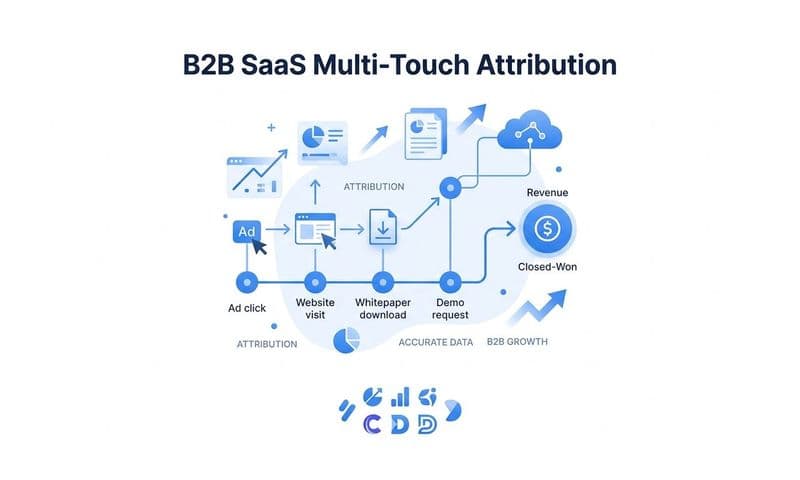
Multi-touch attribution addresses this by distributing credit across all measurable touchpoints in the customer journey. Rather than giving 100% of the credit to the final interaction, multi-touch attribution models assign credit to each touchpoint based on its role in moving the user toward conversion. This gives marketers a far more accurate picture of what is actually driving results across their channel mix.
Implementing multi-touch attribution in a post-iOS world requires a specific approach. Native ad platform reporting is inherently siloed: Meta's attribution model only sees Meta touchpoints, Google's only sees Google touchpoints. Neither has visibility into what happened on the other platform, in your CRM, or on your website between ad interactions. To build a true multi-touch model, you need to aggregate data from all of these sources into a single, unified view.
This is where first-party data and CRM integration become essential. When you connect your ad platform data with CRM events and website behavior, you can reconstruct the customer journey even when browser-level tracking is incomplete. A lead that came in through a Facebook ad, engaged with an email sequence, and then converted after a Google search can be attributed across all three touchpoints when the data from each system is connected and analyzed together. Building a robust first-party data strategy is what makes this kind of cross-channel reconstruction possible.
Cometly's multi-touch attribution capabilities are designed specifically for this challenge. By connecting ad platforms, CRMs, and website data in one place, Cometly gives marketers a complete view of the customer journey, applying consistent attribution models across all channels and surfacing the insights needed to allocate budget toward what's actually working, not just what's easiest to measure.
Future-Proofing Your Conversion Tracking Strategy
The marketers who are thriving in the post-iOS environment share a common characteristic: they stopped relying on third-party tracking infrastructure they don't control, and started building measurement systems anchored in first-party data and server-side architecture. Here's what that looks like in practice.
Prioritize first-party data collection at every touchpoint: Email addresses, phone numbers, and behavioral data collected directly from your own properties are not subject to third-party restrictions. Every form submission, account creation, and checkout is an opportunity to capture identifiers that can be used for server-side event matching. The richer your first-party data, the more accurately your server-side tracking can match conversions back to the users who saw your ads, even when browser-level tracking is unavailable.
Feed enriched conversion data back to ad platform algorithms: Server-side tracking isn't just about recovering lost attribution for your own reporting. It's about improving the quality of the conversion signals you send back to Meta, Google, and other platforms. When Meta's Advantage+ or Google's Smart Bidding algorithms receive enriched, accurate conversion data, they can identify higher-quality audiences, refine their targeting, and optimize bids more effectively. Better data in means better performance out. Reviewing best practices for tracking conversions accurately ensures your server-side setup is delivering the cleanest possible signal to the platforms that depend on it. This is one of the most direct ways that fixing your tracking infrastructure translates into lower CPAs and more efficient ad spend.
Move to a unified analytics approach: Relying on native platform reporting means accepting siloed, self-serving data from each ad platform. Meta's attribution model will naturally favor Meta touchpoints. Google's will favor Google. Neither gives you the objective, cross-channel view you need to make sound budget decisions. A centralized attribution platform that aggregates data from all your channels, applies consistent attribution models, and surfaces AI-driven insights gives you something none of the native tools can: the truth about what's actually driving your results. The right conversion tracking platform makes this unified view achievable without requiring a custom data engineering team to build it.
Cometly is built for exactly this purpose. It connects your ad platforms, CRM, and website to capture every touchpoint across the customer journey. Its AI Ads Manager identifies high-performing campaigns and surfaces actionable recommendations across every channel. Its AI Chat lets you interrogate your data conversationally, getting answers to complex attribution questions without needing to build custom reports. And its Conversion Sync feeds enriched, conversion-ready events back to Meta, Google, and other platforms, improving the quality of the signals that power their optimization algorithms.
The future of conversion tracking is not about finding ways to circumvent privacy changes. It's about building measurement infrastructure that is accurate, durable, and grounded in data you actually own. That means server-side tracking, first-party data strategies, and unified attribution, all working together.
The Bottom Line on iOS Changes and What Comes Next
Lost conversion data after iOS changes was not a temporary glitch that platforms eventually patched. It was a structural shift that permanently altered the rules of digital advertising measurement. The browser-based, third-party-identifier-dependent tracking model that powered a decade of performance marketing is no longer reliable for a significant portion of the audience you're trying to reach.
The marketers who recognized this early and adapted their infrastructure accordingly now operate with a meaningful competitive advantage. They have more complete conversion data, better-performing algorithms, more accurate attribution, and greater confidence in the decisions they make with their ad budgets. The gap between them and teams still relying on pixel-only tracking continues to widen.
Cometly is the platform built for this new reality. It connects your ad platforms, CRMs, and websites to capture every touchpoint, sends enriched first-party conversion data back to ad platform algorithms via server-side tracking, and surfaces AI-powered recommendations that help you scale with confidence. Whether you're trying to recover attribution you've been losing since iOS 14.5 or build a measurement foundation that's ready for whatever privacy changes come next, Cometly gives you the tools to do it.
Ready to stop flying blind and start making decisions based on complete, accurate data? Get your free demo today and see exactly how Cometly's server-side tracking and multi-touch attribution can restore the conversion visibility your campaigns depend on.