Most B2B SaaS marketing teams believe they are making smart budget decisions. They look at their ad dashboards, see which campaigns are driving conversions, and shift spend accordingly. The problem is that a significant portion of the data feeding those decisions has been missing for years, and most teams have no idea how much revenue they are leaving on the table as a result.
When Apple introduced App Tracking Transparency with iOS 14.5, it fundamentally changed what ad platforms can see. Users who decline tracking on their iPhones essentially disappear from ad attribution systems. Their clicks, sessions, and conversions go unrecorded in Meta Ads Manager and Google Ads. The platforms fill those gaps with statistical models, which sounds reassuring until you realize you are making real budget decisions based on estimated data rather than actual results.
For B2B SaaS companies, the stakes are especially high. Long buying cycles, multi-device research behavior, and high customer acquisition costs mean that even small attribution errors compound into major misallocations. Lost revenue from iOS tracking is not a reporting inconvenience. It is a structural blind spot that causes teams to cut budgets on campaigns that are actually working and double down on channels that only appear to be performing.
This article breaks down exactly how iOS tracking loss creates revenue blind spots, why standard pixel-based solutions cannot fix it, and what modern attribution infrastructure actually looks like when it is built to close the gap.
How Apple's ATT Framework Rewrote the Rules of Ad Tracking
Apple's App Tracking Transparency framework, introduced with iOS 14.5 in April 2021, requires every app distributed through the App Store to ask users for explicit permission before tracking their activity across apps and websites owned by other companies. When a user taps "Ask App Not to Track," Apple withholds the IDFA, the Identifier for Advertisers that ad platforms rely on to connect ad exposures to downstream behavior.
Think of the IDFA as the thread that ties a story together. Ad platform A shows a user an ad. The user taps through, visits a website, signs up for a trial three days later. Without the IDFA, the ad platform cannot connect those events. The thread is cut. The story becomes three disconnected fragments that look like three separate anonymous users.
What gets lost when a user opts out goes beyond a single conversion event. Cross-app behavioral signals vanish. Retargeting audiences shrink because platforms can no longer identify who visited your site from an iOS device. Lookalike audiences become less accurate because the training data is incomplete. And most critically, conversion events tied to ad clicks on iOS simply do not fire or do not match back to the right user in the platform's system.
Ad platforms have not stood still in response. Meta introduced Aggregated Event Measurement as its primary workaround. AEM uses statistical modeling to estimate conversions for iOS users who opted out. It also limits advertisers to eight conversion events per domain and introduces reporting delays of up to three days. Google implemented similar modeling approaches in its attribution systems.
Here is the part that matters most: modeled data is not real data. When Meta tells you that a campaign drove 200 conversions, a portion of that number is a statistical estimate derived from patterns observed in users who did consent to tracking, projected onto those who did not. That estimation error is not random noise. It compounds across campaigns, across time, and across budget cycles. The longer you run campaigns without addressing the underlying tracking gap, the more your optimization decisions drift away from reality.
The distinction between what ad platforms report and what actually happened is not a minor technical nuance. It is the difference between knowing your marketing is working and believing it is working. For growth-stage B2B SaaS companies where every dollar of ad spend needs to justify itself against pipeline and revenue targets, that distinction is everything. Understanding how iOS 14 changed digital advertising permanently is the first step toward building a measurement system that accounts for these gaps.
Where Revenue Goes Missing: The Attribution Gap Explained
Understanding that iOS tracking creates data gaps is one thing. Understanding exactly where revenue attribution breaks down, and why it costs you money, is another.
The most common failure point is last-click attribution. In a last-click model, the channel that receives credit for a conversion is whichever one the user interacted with immediately before converting. This model was already a blunt instrument before iOS tracking loss. Now it actively misleads.
Here is a scenario that plays out constantly in B2B SaaS. A prospect sees a Meta ad on their iPhone during their morning commute. They tap through, read a blog post, and close the tab. They opt out of tracking, so Meta never records this touchpoint. Over the next two weeks, they search for your category on Google, visit your pricing page, read a comparison article, and eventually convert through a Google Search ad. Last-click attribution gives Google 100 percent of the credit. Meta receives nothing. Your dashboard tells you Google is performing brilliantly and Meta is underperforming.
You respond rationally to the data you have: you increase Google spend and cut Meta spend. Except you just reduced spend on the channel that was initiating the journeys that Google was closing. Over time, your Google campaigns start converting less efficiently because the top-of-funnel awareness that was feeding them has been cut off. Revenue slows. The data still blames Meta for underperforming.
This compounding effect is one of the most damaging consequences of lost revenue from iOS tracking. It is not just that individual conversions are missed. It is that the misattribution actively shapes budget decisions that accelerate the damage. Teams cut the channels that iOS tracking has made invisible, which are often the awareness and consideration touchpoints that start the journey, and over-invest in the closing channels that appear to be doing all the work.
B2B SaaS funnels are particularly vulnerable to this dynamic. Buying cycles regularly span weeks or months. Prospects research across multiple devices, switch from mobile to desktop, involve multiple stakeholders, and interact with content across a wide range of channels before a purchase decision is made. Every iOS opt-out along that journey removes a data point from the attribution record. The longer the cycle, the more data points are at risk of disappearing entirely. Teams that rely on B2B revenue attribution software purpose-built for complex funnels are far better positioned to surface these hidden touchpoints.
The result is a version of your marketing performance that looks coherent but is systematically distorted. The channels that appear strongest may simply be the ones that happen to operate in environments where tracking still works. The channels that appear weakest may be the ones doing the most valuable work in the parts of the journey that have gone dark.
Why Browser Pixels Cannot Solve This Problem
The instinctive response to tracking loss is to optimize your pixel implementation. Make sure the Meta pixel is firing correctly. Verify your Google tag. Check event configurations. These are reasonable hygiene steps, but they do not address the fundamental issue.
Browser-side pixels work by executing JavaScript in a user's browser when a specific event occurs, a page view, a form submission, a purchase. That script reads device identifiers and cookies, then sends the event data to the ad platform. The entire mechanism depends on the browser having access to the identifiers that iOS now restricts or blocks entirely.
When an iOS user opts out of tracking, the pixel can still fire, but the data it sends cannot be matched back to the user's ad exposure. The event arrives at the platform as an anonymous signal with no connection to the ad click that preceded it. The conversion disappears from attribution. The pixel did its job technically, but the information it sent was unusable for attribution purposes. The full scope of pixel tracking problems on iOS goes well beyond simple misconfiguration and requires a fundamentally different approach to solve.
Meta's Aggregated Event Measurement provides some signal to fill this gap, but it is important to understand what that signal actually is. AEM does not recover the lost conversion data. It estimates what that data might have looked like based on patterns from consented users. The eight-event limit per domain forces advertisers to prioritize which conversion events they track, which means many meaningful mid-funnel events, demo requests, trial activations, pricing page visits, get dropped from the model entirely.
The gap between ad platform reporting and CRM reality is where this becomes a real business problem. Your Meta Ads Manager might show a certain number of conversions for a given period. Your CRM shows a different, often larger, number of qualified leads from the same period. Without a reliable way to reconcile these two datasets using pixel-only tracking, you are left guessing which campaigns actually drove the leads your sales team is working.
That gap is not just a measurement inconvenience. It means your optimization decisions, your budget allocations, your creative tests, and your audience targeting are all being guided by a partial view of reality. Pixel-only tracking was imperfect before iOS 14.5. In the current environment, it is structurally insufficient for any B2B SaaS team that needs to connect ad spend to actual revenue outcomes.
Server-Side Tracking and Conversion APIs: How Modern Attribution Works
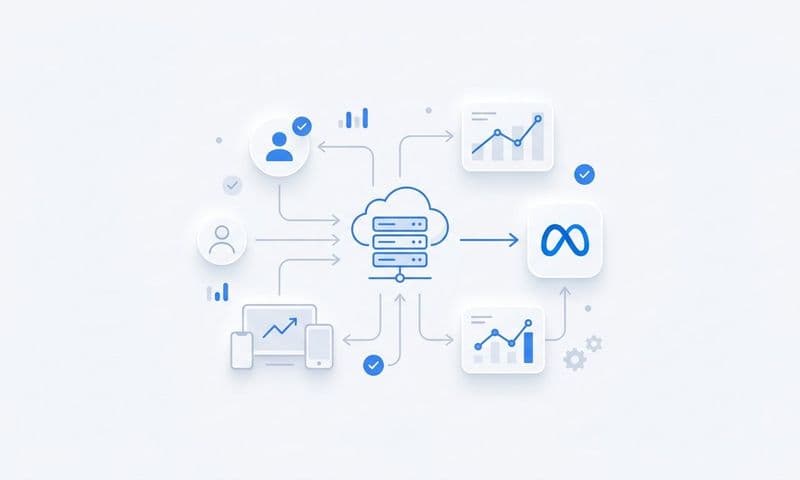
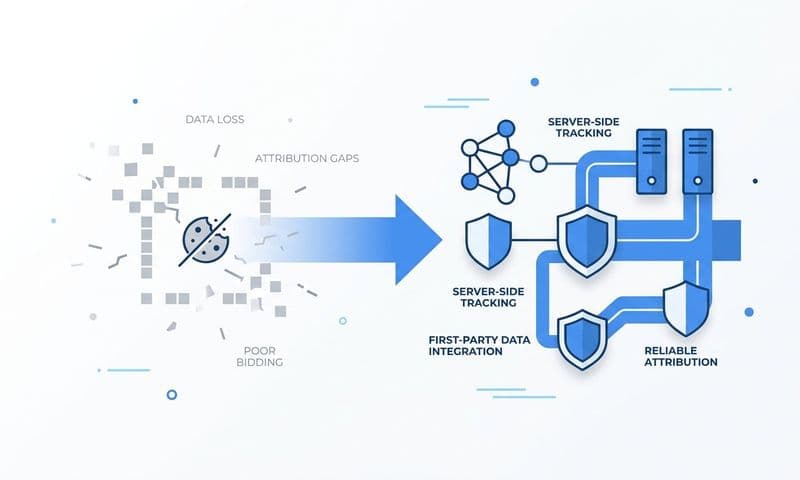
Server-side tracking addresses the iOS problem at its root by removing the browser from the equation entirely. Instead of relying on JavaScript executing in a user's browser to fire a conversion event, server-side tracking sends that event directly from your web server or data infrastructure to the ad platform's API.
Meta's Conversion API and Google's Enhanced Conversions are the primary implementations of this approach. When a conversion event occurs, your server sends the event data directly to Meta or Google via their APIs. Because this transmission happens server-to-server, it bypasses iOS browser restrictions, ad blockers, and cookie limitations. The event reaches the platform regardless of what the user's device settings are. A detailed server-side tracking implementation guide can help teams understand exactly what is required to deploy this infrastructure correctly.
The real power of server-side tracking comes from first-party data enrichment. When a user converts on your platform, you typically have information about them that goes well beyond what a browser pixel can capture. Their email address, phone number, company name, and CRM identifiers are all first-party data points you own. By passing hashed versions of this data through the Conversion API, you give the ad platform a much stronger signal for matching the conversion event back to the user who clicked the ad, even on iOS.
This matching process, called event matching or customer matching, works because Meta and Google maintain their own first-party data sets from users who are logged into their platforms. When you send a hashed email address alongside a conversion event, the platform can check whether that email matches a user in their system and connect the conversion to the appropriate ad exposure. This approach is far more resilient to iOS restrictions than device-level tracking because it relies on identity signals that exist outside the iOS tracking permission framework.
The connection to revenue visibility is where this becomes transformative for B2B SaaS teams. When your server-side events include CRM data such as deal stage, pipeline value, and closed-won status, you can attribute real revenue back to specific campaigns rather than relying on proxy metrics like clicks or form fills. A lead that becomes a qualified opportunity that closes at a specific contract value can be traced back to the campaign, ad set, and creative that initiated the journey. That is the level of attribution that actually informs budget decisions. Understanding why server-side tracking is more accurate than browser-based alternatives makes clear why this infrastructure shift is non-negotiable for teams serious about revenue visibility.
Implementing server-side tracking alongside your existing pixel creates what is often called a redundant tracking setup. Events are captured both client-side and server-side, with deduplication logic preventing double-counting. The result is significantly higher event match quality and a much more complete picture of campaign-driven conversions, including the iOS traffic that was previously invisible.
Multi-Touch Attribution: Building Resilience Into Your Measurement Model
Server-side tracking recovers data that iOS restrictions were blocking. Multi-touch attribution determines what to do with that data once you have it. These two capabilities work together, and in a post-ATT environment, neither is sufficient without the other.
Multi-touch attribution models distribute conversion credit across all tracked touchpoints in the customer journey rather than assigning it entirely to one event. Linear attribution gives equal credit to every touchpoint. Time-decay models weight recent touchpoints more heavily. Data-driven models use machine learning to assign credit based on the actual contribution of each touchpoint to conversion outcomes. All of these approaches are more resilient to tracking gaps than single-touch models because they do not depend on any single touchpoint being perfectly recorded.
When some iOS touchpoints are obscured despite server-side tracking, multi-touch models can still surface meaningful patterns from the touchpoints that are captured. A prospect's CRM journey, from lead creation to demo request to opportunity creation to closed-won, contains first-party events that are not subject to iOS restrictions at all. These events can be tied back to campaign sources through UTM parameters and first-party identifiers, creating an attribution chain that runs through your own data infrastructure rather than depending entirely on ad platform signals. Proper UTM tracking implementation is foundational to making this cross-channel attribution work reliably.
This is where the concept of pipeline and revenue attribution becomes the practical standard for B2B SaaS teams. Instead of measuring campaign performance by leads generated or clicks driven, you measure it by pipeline created, pipeline influenced, and closed-won revenue. Each of these metrics is grounded in CRM data that you own and control, not in ad platform models that estimate what they cannot directly observe.
The practical implication is significant. A campaign that looks weak in Meta Ads Manager because its iOS conversions are underreported might look very different when you analyze the pipeline it contributed to through your CRM. Prospects who clicked that campaign's ads, converted through a different channel, and eventually became customers show up in your CRM data with UTM attribution intact. Multi-touch models can credit that campaign for its role in the journey even when the ad platform's own reporting cannot see it.
Building this kind of attribution requires connecting your ad platform data, your CRM, and your revenue data in a single system. It requires consistent UTM tagging across all campaigns. It requires first-party identifiers that persist across sessions and devices. And it requires attribution models sophisticated enough to interpret the resulting dataset accurately. This is the infrastructure that separates marketing teams who know what is driving revenue from those who are guessing based on incomplete platform reporting. Reviewing the best marketing attribution platforms for revenue tracking can help teams identify which solutions are built to handle this level of complexity.
Recovering Lost Revenue Visibility: A Practical Path Forward
The path from iOS-impaired attribution to reliable revenue visibility is not a single fix. It is a layered infrastructure build that addresses each point of failure systematically.
The foundation is server-side tracking with Conversion API integrations for every major ad platform you run. This means implementing Meta CAPI and Google Enhanced Conversions with first-party data enrichment, passing hashed customer identifiers alongside conversion events to maximize event match quality. This step alone recovers a meaningful portion of the iOS conversions that pixel-only setups were missing. Teams looking for a complete iOS tracking solution should prioritize platforms that handle CAPI integration natively rather than requiring custom engineering work.
The second layer is moving away from last-click attribution toward multi-touch models that distribute credit across the full customer journey. This requires consistent UTM parameter implementation across all campaigns and ad platforms, so that CRM-level events can be tied back to their campaign sources even when ad platform signals are incomplete. It also requires choosing attribution models that reflect the reality of your buying cycle rather than defaulting to whatever the ad platform reports natively.
The third layer is connecting your ad platform data to your CRM and revenue data in a single attribution platform. This is where AI-driven attribution becomes genuinely valuable. Modern attribution platforms use AI to identify patterns in available data and surface insights about which campaigns are likely driving revenue even when direct tracking signals are incomplete. A campaign that appears to underperform in pixel-only data might be identified by AI analysis as a consistent initiator of journeys that close, a signal that would be invisible without the cross-platform data integration. Tracking closed-won revenue back to its originating campaigns is the ultimate measure of whether this infrastructure is working as intended.
This is precisely what Cometly is built to do. Cometly captures every touchpoint from ad click to closed-won revenue, connecting your ad platforms with your CRM and Stripe data to create a single source of truth for marketing attribution. Server-side tracking and Conversion API integrations are built into the platform, meaning enriched conversion events are fed back to Meta and Google to improve their targeting and optimization algorithms. AI-driven recommendations surface the campaigns and channels that are actually driving pipeline and revenue, not just the ones that appear to be performing based on incomplete platform data.
For B2B SaaS marketing teams dealing with long buying cycles and high customer acquisition costs, this kind of revenue-level attribution is not a nice-to-have. It is the difference between scaling the campaigns that are genuinely driving growth and cutting them because iOS tracking made them look like they were not working.
The Bottom Line on iOS Tracking and Revenue Intelligence
Lost revenue from iOS tracking is not a problem that ad platforms will eventually solve on your behalf. Apple's ATT framework reflects a deliberate privacy direction that is not reversing. Meta's modeled data and Google's estimation approaches provide some signal, but they are not substitutes for first-party tracking infrastructure that you own and control.
The marketing teams that are winning in this environment are not waiting for better platform reporting. They are building attribution systems that start with server-side tracking, layer in multi-touch models that distribute credit across the full customer journey, and connect ad spend to pipeline and closed-won revenue through CRM integration. They are using AI to identify high-performing campaigns that pixel-only data would have flagged as underperformers. And they are making budget decisions based on what is actually driving revenue rather than what the ad platform dashboard happens to be able to see.
The gap between what your ad platforms report and what is actually happening in your pipeline is real, and it is costing you money. The good news is that closing that gap is achievable with the right infrastructure in place.
Ready to stop making budget decisions on incomplete data? Get your free demo and see how Cometly restores full visibility into your customer journey, from the first ad click to closed-won revenue, so every dollar you spend is backed by data you can actually trust.