Your campaigns look profitable on paper. ROAS is positive, cost-per-lead seems reasonable, and the ad dashboards are full of green numbers. But pipeline is thin, revenue targets keep slipping, and the sales team is asking why lead quality has declined. Sound familiar?
This is one of the most frustrating positions a B2B SaaS marketer can be in: the data says one thing, but the business results say another. And when you dig into the disconnect, the culprit is rarely the creative, the offer, or even the targeting. It is the tracking infrastructure underneath it all.
Broken, incomplete, or misattributed tracking data quietly misdirects budget away from what is actually working and hides the real drivers of revenue. Campaigns that are genuinely building pipeline get paused because they look underperforming. Channels that generate noise but not revenue get scaled because they report conversions that never actually closed. The result is a slow, invisible leak in your growth engine.
This article breaks down exactly how lost sales from tracking issues happen, why the problem is getting worse, and what B2B SaaS teams can do to fix it at the infrastructure level rather than just patching symptoms.
How Tracking Gaps Quietly Drain Your Revenue Pipeline
Most tracking problems do not announce themselves. There is no error message, no alert, no obvious signal that something is wrong. Instead, the damage accumulates quietly over weeks and months, and by the time you notice the revenue impact, the root cause is buried under layers of compounded misattribution.
Here is the core mechanism: ad platforms like Meta and Google rely on conversion events to optimize their bidding and targeting algorithms. When those events go unrecorded, the platform's machine learning model is essentially flying blind. It cannot identify which users, audiences, or placements are generating real outcomes, so it defaults to optimizing for whatever signals it can find. That often means serving ads to lower-intent audiences and pulling budget away from the placements that are actually converting.
The downstream effect is subtle at first. Your cost-per-click stays stable. Impressions look fine. But the quality of traffic gradually degrades because the platform's targeting model is working from incomplete information. Fewer of the right people see your ads, and fewer of those who do click end up becoming qualified leads.
Missing touchpoints in the customer journey create a second, equally damaging problem. B2B buyers rarely convert after a single interaction. A typical journey might include a LinkedIn ad that introduces the brand, a Google Search click during active research, a retargeting ad that brings them back, and finally a direct visit to book a demo. If any of those middle touchpoints go unrecorded, the marketer sees an incomplete picture of what influenced the decision.
This is where budget decisions go wrong. If the LinkedIn campaign that started the journey is invisible in your attribution data, it looks like a cost center with no return. You pause it. Suddenly the top of the funnel dries up, pipeline shrinks three months later, and no one connects the two events because the data never showed the relationship.
The compounding effect is what makes this particularly dangerous. A small tracking error in an early funnel stage, say a missed form fill or an unrecorded page visit, does not just affect that one event. It affects every downstream calculation tied to it: cost per lead, cost per pipeline opportunity, and ultimately cost per closed-won deal. By the time a deal closes six months later, the original misattribution has multiplied into a completely distorted view of campaign ROI.
Lost sales from tracking issues are not a single event. They are the accumulated result of many small data failures that compound into a significant revenue problem over time. Understanding how to fix conversion tracking gaps is the first step toward stopping that compounding damage.
The Most Common Tracking Issues B2B SaaS Teams Face
Understanding where tracking breaks down is the first step toward fixing it. For B2B SaaS teams, there are three categories of tracking failure that show up most consistently.
Browser-Side Pixel Limitations: The traditional method of tracking conversions relies on JavaScript pixels that fire in the user's browser. This approach has become increasingly unreliable. Apple's App Tracking Transparency framework and Safari's Intelligent Tracking Prevention have significantly restricted cross-site data collection. Ad blockers, which are widely used by the tech-savvy B2B audiences that SaaS companies typically target, prevent pixels from firing entirely. The result is a meaningful share of conversion events that simply never get reported back to Meta, Google, or any other ad platform. Understanding what a tracking pixel is and how it works helps clarify why browser-side methods fall short for modern B2B campaigns.
CRM and Ad Platform Disconnection: This is arguably the most costly tracking gap for B2B SaaS companies. A lead fills out a form, enters your CRM, goes through a sales cycle, and eventually closes as a customer. Your sales team knows where the deal came from because they talked to the prospect. But your ad platform has no idea, because the link between the original ad click and the CRM record was never established. When ad data and CRM data live in separate systems with no bridge between them, you cannot answer the most important question in B2B marketing: which campaigns are generating closed-won revenue, not just leads?
Multi-Session and Multi-Device Journeys: B2B buyers do their research across multiple sessions and multiple devices. Someone might first see your ad on a mobile phone during their commute, then research your product on a work laptop, and finally book a demo from a home computer. Without cross-channel tracking implementation, each of those interactions looks like a separate, unconnected event. The first and middle touchpoints that built awareness and intent become invisible, and only the last click gets credit. This systematically undervalues upper-funnel and mid-funnel campaigns, leading teams to cut the very activities that are warming up their best prospects.
Each of these issues individually creates measurement blind spots. Together, they make it nearly impossible to build an accurate picture of what is actually driving pipeline and revenue. The B2B SaaS buying cycle is already complex and long. Layering broken tracking on top of that complexity turns marketing measurement into guesswork.
What Happens to Ad Spend When Your Data Is Broken
The financial consequences of broken tracking extend well beyond inaccurate reports. They directly affect how your ad budget is allocated, how your campaigns are optimized, and ultimately how many qualified leads reach your sales team.
Ad platform algorithms are built around a feedback loop. You run ads, users convert, the platform records those conversions, and the algorithm uses that data to find more people like the ones who converted. When conversion data is incomplete, that feedback loop breaks. The algorithm receives a degraded signal, and instead of finding high-intent buyers, it starts targeting audiences that look similar to whoever happened to trigger the partial data it did receive. Budget gets misallocated toward lower-quality audiences, and the efficiency of your spend quietly declines. Learning how to improve ad tracking accuracy is essential to restoring that feedback loop.
The problem compounds at the campaign management level. Without accurate attribution, marketing teams are forced to make budget decisions based on last-click metrics or surface-level engagement data. A campaign that gets credit for the final click before a form fill looks like a strong performer. A brand awareness campaign that introduced your product to a decision-maker three months ago looks like it produced nothing. So you scale the last-click campaign and cut the awareness campaign, degrading the top of your funnel in the process.
This pattern plays out across channels. Google Search gets over-credited because it captures high-intent clicks at the bottom of the funnel. LinkedIn gets under-credited because its influence happens earlier in the journey. Retargeting looks like a conversion machine because it catches people who were already going to convert anyway. The budget follows the data, and when the data is wrong, the budget distribution is wrong.
The downstream effect on sales is where lost sales from tracking issues become most tangible. When ad targeting degrades, the leads that reach your sales team are less qualified. Sales cycles lengthen because reps are spending time on prospects who were never a strong fit. Conversion rates from lead to close decline. The sales team reports that marketing lead quality is down, marketing points to their dashboard metrics as evidence that campaigns are performing, and the disconnect between the two teams widens because neither side has accurate data to work from.
This is not a hypothetical scenario. It is a structural consequence of running ad campaigns on broken tracking infrastructure. The fix requires addressing the data problem at its source, not just adjusting bids or refreshing creative. Using the right ad tracking tools to scale with accurate data is what separates teams that grow predictably from those stuck in this cycle.
Server-Side Tracking and First-Party Data as the Fix
The most effective solution to browser-side tracking limitations is moving conversion data collection to the server. Server-side tracking is more accurate than browser-based methods because it sends conversion events directly from your server to the ad platform rather than relying on a browser pixel to fire correctly.
Because this data travels server-to-server, it is not affected by ad blockers, browser privacy restrictions, or iOS tracking limitations. A form submission, a demo booking, or a trial signup gets recorded accurately regardless of what the user's browser settings are. The ad platform receives a complete, reliable signal instead of a partial one, and its optimization algorithms can function the way they were designed to.
This matters enormously for B2B SaaS teams targeting technical audiences. The people most likely to use ad blockers are often the same people you most want to reach: engineers, product managers, and technical decision-makers who are evaluating SaaS tools. Browser-side pixels frequently miss these users entirely. Server-side tracking captures them.
First-Party Data Enrichment: Server-side tracking also creates an opportunity to send richer, more valuable data to ad platforms. When you capture UTM parameters, user identifiers, and CRM event data server-side, you can pass that enriched information back to Meta and Google as part of the conversion event. This gives the platform's AI a more complete picture of who is converting and what their journey looked like, which improves targeting precision and bidding efficiency over time.
Event Deduplication: When you implement both browser-side pixels and server-side tracking simultaneously, which is the recommended approach, there is a risk of counting the same conversion event twice. Proper deduplication ensures that each event is recorded once and only once, giving ad platforms a clean, accurate signal. Without deduplication, inflated conversion counts lead to over-optimistic ROAS figures and misguided budget decisions. With it, the data is trustworthy enough to actually act on. Exploring the full range of server-side tracking benefits makes clear why this approach has become the standard for serious growth teams.
Server-side tracking is not a complex technical project reserved for enterprise engineering teams. Modern attribution platforms make it accessible to marketing and growth teams who want to fix their data infrastructure without writing custom code. The investment in getting this right pays dividends across every campaign you run, because every future optimization decision will be based on accurate data rather than a partial view.
Connecting Ad Data to Revenue to See the Full Picture
Even with server-side tracking in place, there is another layer of the problem that many B2B SaaS teams have not solved: connecting ad spend data all the way through to closed-won revenue. Tracking conversions accurately is necessary, but it is not sufficient. You need to know which conversions actually turned into customers.
This is where multi-touch attribution becomes essential. A B2B buyer might interact with a LinkedIn Sponsored Content ad during initial research, click a Google Search ad when they are actively evaluating options, and then respond to a retargeting ad before finally booking a demo. Each of those touchpoints played a role in the decision. A last-click model gives all the credit to the retargeting ad and zero credit to the LinkedIn and Google touchpoints that built the intent in the first place.
Multi-touch attribution models, whether linear, time-decay, or data-driven, distribute credit across the touchpoints that influenced the journey. This gives marketing teams a more accurate picture of which channels and campaigns are contributing to pipeline, not just which ones happen to be present at the moment of conversion. For B2B SaaS teams managing campaigns across multiple channels with long sales cycles, this distinction is the difference between scaling what works and scaling what looks like it works. Reviewing the B2B revenue attribution models for SaaS helps teams choose the right framework for their specific go-to-market motion.
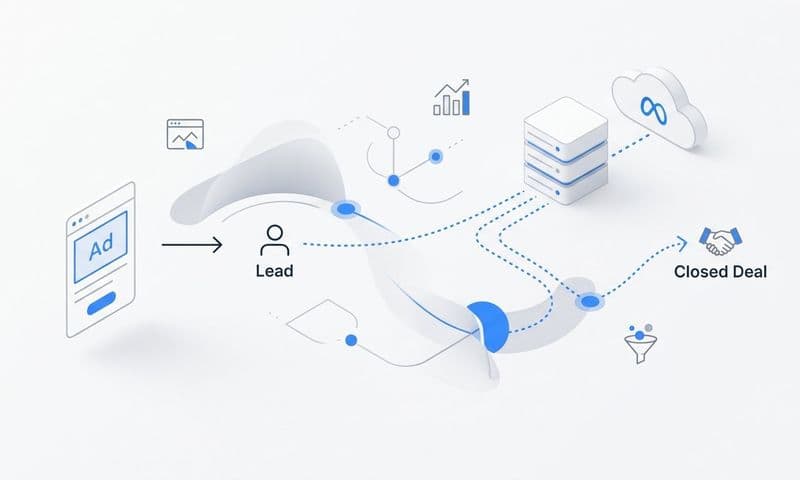
CRM Pipeline Integration: The next step is connecting ad attribution data to CRM pipeline stages and closed-won revenue. When you can see that a specific LinkedIn campaign generated ten leads, five of which progressed to pipeline opportunities, and two of which closed as customers, you have a completely different level of insight than cost-per-lead alone provides. You can calculate true cost-per-revenue, identify which campaigns generate the highest-quality leads, and make budget decisions based on actual business outcomes rather than proxy metrics.
Single Source of Truth: The goal is a unified view where ad spend, conversion events, pipeline data, and revenue metrics all live in one place and reference each other accurately. When those data sources are siloed, every budget decision requires manual reconciliation across multiple tools, and the conclusions are only as good as the person doing the reconciliation. A single source of truth eliminates that friction and gives every stakeholder, marketing, sales, and finance, the same accurate picture of what is driving growth. The best marketing attribution software makes this unified view achievable without months of custom development.
Platforms like Cometly are built specifically to create this connection for B2B SaaS teams. By linking ad platform data to CRM events and revenue outcomes, Cometly gives marketing teams the ability to see which campaigns generated not just clicks or leads, but actual pipeline and closed-won revenue. That is the data foundation you need to stop losing sales to invisible tracking gaps.
Turning Accurate Tracking into a Competitive Growth Advantage
Fixing your tracking infrastructure is not just about stopping the bleeding. It is about building a compounding advantage that improves every aspect of your marketing performance over time.
When ad platforms receive complete, accurate conversion signals, their machine learning models work significantly better. Meta's CAPI documentation and Google's Enhanced Conversions guidance both emphasize that signal quality directly affects algorithm performance. Better signals mean better audience targeting, more efficient bidding, and lower cost-per-acquisition over time. The improvement is not immediate, but it builds as the algorithm accumulates higher-quality data to learn from.
Accurate attribution also changes how growth teams operate. Instead of debating which channel deserves credit or manually reconciling reports from five different tools, teams can focus on identifying the highest-performing campaigns and scaling them with confidence. When you know that a specific Google Search campaign is generating pipeline opportunities that close at a high rate, you can increase that budget with conviction. When you know that a particular LinkedIn audience segment consistently produces low-quality leads despite decent CPL numbers, you can reallocate that spend without second-guessing the decision.
This is the strategic value of solving the lost sales from tracking issues problem: it transforms marketing from a cost center with uncertain ROI into a predictable growth engine with clear, defensible numbers. Marketing leaders can walk into board meetings with revenue attribution data that connects ad spend directly to closed-won deals. Sales leaders can trust that the leads coming from marketing have been qualified by accurate targeting rather than degraded algorithms. Finance teams can evaluate marketing investment with the same rigor they apply to any other part of the business.
Cometly is built to make this possible for B2B SaaS teams. It captures every touchpoint from first ad click to closed-won revenue, connects ad platform data to CRM pipeline stages, feeds enriched conversion signals back to Meta and Google for smarter optimization, and surfaces AI-driven recommendations that help teams identify what to scale and what to cut. It is the data infrastructure layer that turns accurate tracking into a genuine competitive advantage.
The companies that invest in getting their tracking right now will have a meaningful edge over competitors still operating on broken data. Every campaign they run will optimize faster, every budget decision will be more accurate, and every growth lever they pull will move in the right direction because it is based on a complete, trustworthy picture of what is actually happening in their funnel.
The Bottom Line on Tracking and Revenue
Lost sales from tracking issues are not a marketing performance problem. They are a data infrastructure problem. When you cannot see the full customer journey, you cannot optimize it. Campaigns get cut that should be scaled. Budget flows to channels that look productive but are not contributing to pipeline. Ad platforms optimize toward the wrong audiences because they are working from incomplete signals. And by the time the revenue impact becomes visible, the compounded misattribution makes it nearly impossible to trace back to the root cause.
Fixing tracking is not just a technical task for an engineering sprint. It is a revenue strategy. Server-side tracking, first-party data enrichment, multi-touch attribution, and CRM-to-ad-platform integration are not nice-to-have features. They are the foundation that every other marketing optimization effort depends on. Without accurate data, every other decision is built on sand.
The good news is that the tools to fix this exist, and they are accessible to marketing and growth teams without requiring months of engineering work. The question is whether your team is ready to treat data infrastructure as the strategic priority it actually is.
Ready to stop losing revenue to invisible tracking gaps? Get your free demo and see how Cometly helps B2B SaaS teams capture every touchpoint, connect ad spend to closed-won revenue, and feed better conversion signals back to ad platforms for smarter, more efficient growth.