
If your Facebook ads are spending but not returning the revenue you expected, you are not alone. Low ROAS on Facebook ads is one of the most frustrating challenges for B2B SaaS marketers and growth teams. You are watching budget disappear while your dashboard shows weak returns, and it is often unclear whether the problem is your creative, your audience, your tracking, or something deeper in your funnel.
The reality is that low ROAS is rarely caused by a single issue. It is usually the result of compounding problems: inaccurate conversion data feeding Facebook's algorithm the wrong signals, audiences that are too broad or too narrow, offers that do not match where buyers are in their journey, or landing pages that fail to convert qualified clicks into pipeline.
Before you pause campaigns or slash budgets, you need a systematic approach to diagnosing what is actually broken. Reactive changes based on surface-level metrics almost always make things worse. You might pause a campaign that was quietly assisting conversions, or scale an audience that generates clicks but never closes into revenue.
This guide walks you through a clear, step-by-step process to identify the root cause of your low ROAS, fix the underlying issues, and build a foundation for sustained ad performance. Each step builds on the last, moving from data integrity and tracking accuracy through audience strategy, creative performance, funnel alignment, and ongoing optimization.
Whether you are running lead generation campaigns for a SaaS product or trying to attribute pipeline back to specific ad sets, this process will help you stop guessing and start making decisions backed by clean, reliable data. Let's work through it systematically.
Step 1: Verify Your Conversion Tracking Before Touching Anything Else
Here is the uncomfortable truth: most campaigns diagnosed as "low ROAS" are actually suffering from broken or incomplete tracking. Before you touch your audiences, creative, or budget allocation, you need to confirm that Facebook is receiving accurate conversion data. Everything else depends on this.
When your tracking is off, Facebook's algorithm optimizes toward the wrong outcomes. It thinks it knows what a conversion looks like, but it is working from incomplete or inaccurate signals. The result is campaigns that appear to underperform when the real problem is that the algorithm has been trained on bad data.
Audit your pixel events first. Open Meta Events Manager and review which conversion events are firing and whether they align with your actual conversion actions: form submissions, trial signups, demo requests, and purchase events. Check that each event is triggering on the correct page or action, not misfiring on page loads or duplicate triggers.
Understand the iOS privacy problem. Browser-based pixel tracking has become significantly less reliable since Apple's privacy changes took effect. Ad blockers and browser-level restrictions mean that a meaningful portion of your conversions may never reach Meta through the pixel alone. This creates a systematic undercount that makes your ROAS look worse than it actually is.
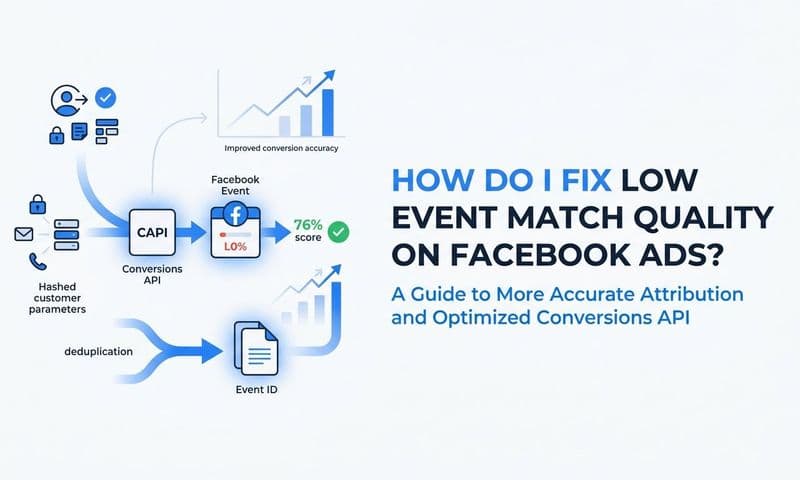
Implement server-side tracking via the Meta Conversion API. The Conversion API sends conversion data directly from your server to Meta, bypassing browser limitations entirely. This is no longer optional for B2B SaaS teams who need accurate data. When you sync conversion data to Facebook using both the pixel and CAPI simultaneously, you get broader coverage without the gaps that browser-only tracking creates.
Check for deduplication issues. Running both the pixel and CAPI together introduces a new risk: the same conversion being counted twice. Meta uses event deduplication parameters to prevent this, but you need to confirm they are implemented correctly. Duplicate events inflate your reported conversions and make your ROAS look artificially better than it is, which can lead to misguided scaling decisions.
Review your event match quality scores. In Events Manager, Meta scores how effectively your conversion events are being matched to Facebook user profiles. Higher match quality improves algorithmic optimization. If your scores are low, enriching your events with additional first-party identifiers such as email and phone can improve them significantly. Understanding Facebook event match quality is essential for getting the most out of your conversion data.
Success indicator: Your Events Manager shows high event match quality scores and your conversion volume aligns with what your CRM or backend is recording. If these numbers are significantly out of sync, tracking is your problem, not your campaigns.
Common pitfall: Skipping this step entirely and spending hours optimizing audiences and creative while the algorithm is still working from flawed data. You cannot fix ROAS on a broken foundation.
Step 2: Align Your Attribution Model With Your Actual Sales Cycle
Even with perfect tracking in place, you can still draw the wrong conclusions about ROAS if your attribution model does not reflect how your buyers actually make decisions. This is especially true for B2B SaaS companies where the path from first ad click to closed deal often spans weeks or months.
Facebook's default attribution window is typically set to seven-day click and one-day view. For a consumer purchase, that window might be perfectly adequate. For a B2B SaaS product with a multi-stakeholder buying process, it captures only a fraction of the conversions that Facebook actually influenced. The result is a systematically understated ROAS that makes your campaigns look less valuable than they are.
Review your attribution settings in Ads Manager. Go to your campaign reporting view and check which attribution window is currently applied. Understand what each window means: a seven-day click window counts conversions that happened within seven days of someone clicking your ad, regardless of what else they did in between. Extending this window to 28 days or 30 days can surface conversions that would otherwise go uncredited.
Understand the limits of last-click attribution. Facebook's native reporting tends to favor last-click or last-touch logic, which gives full credit to whichever touchpoint immediately preceded the conversion. For B2B buyers who interact with your brand across multiple channels and sessions before converting, this model systematically undervalues the campaigns that warmed them up earlier in the journey. A deeper understanding of Facebook ads attribution is critical for making accurate budget decisions.
Move toward multi-touch attribution. Multi-touch models distribute credit across all the touchpoints that contributed to a conversion, giving you a more accurate picture of which campaigns are actually influencing pipeline. This matters enormously when you are trying to decide whether to scale or cut a Facebook campaign that is generating top-of-funnel awareness but not getting last-click credit.
Connect your ad data to your CRM pipeline. The most meaningful ROAS metric for a B2B SaaS company is not cost per lead. It is cost per qualified opportunity and cost per closed deal. To calculate those, you need to connect your Facebook campaign data to your CRM so you can see which campaigns are generating leads that actually progress through the pipeline and close as revenue.
Success indicator: You can see which campaigns are driving pipeline and closed revenue, not just form fills. You have a view that goes beyond what Facebook Ads Manager reports natively.
Common pitfall: Judging ROAS solely by Facebook-reported conversions without validating against actual revenue in your CRM. This often leads to cutting campaigns that are contributing to pipeline in ways the platform cannot see.
Step 3: Diagnose Audience Quality and Targeting Gaps
Once your tracking and attribution are solid, the next question is whether you are reaching the right people. For B2B SaaS, audience quality is often the difference between campaigns that generate pipeline and campaigns that generate noise.
Analyze your demographic breakdowns. In Ads Manager, break down your campaign performance by age, gender, placement, and device. Look for segments with high spend, high click volume, and poor conversion rates. These are often signals that your targeting is pulling in people who look engaged but are not your actual buyers.
Evaluate your lookalike audience seed data. Lookalike audiences are only as good as the data you build them from. A lookalike based on your closed-won customer list will almost always outperform one built from all leads or website visitors, because the seed data represents people who actually bought. If your lookalikes are underperforming, the seed quality is the first place to investigate.
Check for audience overlap and saturation. If you are running multiple ad sets targeting similar audiences, they may be competing against each other in the auction. Use Meta's Audience Overlap tool to identify where this is happening. Saturation is a separate issue: when an audience has seen your ads too many times, performance degrades even if the targeting was correct to begin with. Reviewing your Facebook ads performance by segment helps you catch saturation before it erodes ROAS.
Use exclusion audiences aggressively. Exclude existing customers, churned users, and people who have already converted. For B2B SaaS, also consider excluding job titles and company sizes that fall outside your ICP. Spending budget on people who will never buy is a direct drag on ROAS, and exclusions are one of the fastest ways to tighten efficiency.
Structure your retargeting audiences by funnel stage. Website visitors who spent 30 seconds on your homepage are not the same audience as people who started a trial and did not complete onboarding. Treat them differently. Retargeting works best when your offer matches the intent level of the audience, which means you need distinct segments for each stage of the funnel.
Success indicator: Each audience segment has a clear intent level, and your spend is concentrated on segments that have historically generated qualified pipeline, not just volume.
Common pitfall: Running broad interest-based targeting for a B2B SaaS product where job title, company size, and industry are the real qualifying filters. Interest targeting can work for consumer products but tends to pull in too much noise for B2B audiences with specific professional profiles.
Step 4: Evaluate Creative Performance With Structured Data
Bad creative is often blamed first when ROAS drops, but the reality is more nuanced. Creative problems are usually a symptom of not measuring the right things. If you are evaluating ads by likes and reach, you will make the wrong calls. The goal is to connect creative performance to downstream conversion outcomes.
Implement a naming convention framework. Before you can analyze creative performance at scale, you need a consistent naming structure that tells you what each ad contains. Include variables like format (video, static, carousel), message angle (pain point, feature, social proof), and offer type (trial, demo, content). This makes it possible to aggregate performance data across campaigns and identify which variables are driving results.
Focus on the metrics that predict qualified pipeline. Hook rate and thumbstop ratio tell you whether people are stopping to engage. Click-through rate tells you whether the message is compelling enough to act on. But for B2B SaaS, the metric that matters most is cost per qualified lead, which requires connecting your ad data to downstream qualification signals in your CRM. Tracking the right Facebook marketing metrics is what separates creative decisions backed by data from those based on gut feel.
Identify creative fatigue early. Watch for the combination of rising frequency and declining CTR alongside increasing CPM. This pattern typically means your audience has seen the ad enough times that it is no longer generating new responses. Rotating creative before fatigue sets in is far more efficient than waiting until performance has already degraded significantly.
Test with structure, not randomness. Effective creative testing means isolating one variable at a time so you can attribute performance differences to a specific change. Running five completely different ads simultaneously tells you which ad won but not why. Structured tests that change one element, such as the headline, the visual format, or the call to action, generate learnings you can apply systematically across your creative library.
Success indicator: You have a clear view of which creative formats and message angles drive the lowest cost per qualified lead for each audience segment, and you can explain why based on structured test data.
Common pitfall: Pausing ads too early before they exit the learning phase, or running too many variations simultaneously, which splits data across too many ad sets and slows the algorithm's ability to optimize effectively. Give each test enough budget and time to generate statistically meaningful results before drawing conclusions.
Step 5: Fix the Post-Click Experience to Stop Losing Qualified Traffic
You can have perfect tracking, precise audiences, and compelling creative, and still produce low ROAS if your landing page fails to convert qualified clicks into pipeline. The post-click experience is where many B2B SaaS campaigns quietly bleed performance.
Audit for message match. When someone clicks your ad, the headline and value proposition on your landing page should directly reflect what the ad promised. Any disconnect creates cognitive friction and increases bounce rates. If your ad promotes a free trial for a specific use case and the landing page leads with a generic product overview, you are losing people who were genuinely interested.
Address technical barriers. Page speed matters more than most marketers realize, particularly for mobile traffic. A page that loads slowly on a mobile device will lose a significant portion of your audience before they ever see your offer. Form length is another common barrier for B2B audiences: every additional field you require reduces completion rates. Ask only for what you genuinely need to qualify and follow up with a lead.
Use conversion data to isolate the problem. Break down your landing page conversion rate by traffic source. If your Facebook traffic converts at a significantly lower rate than your Google Ads traffic for the same offer, the issue is likely a mismatch between what Facebook audiences expect and what your page delivers, rather than a problem with the page itself. This distinction matters because the fix is different in each case. Accurate Facebook conversion tracking at the landing page level is what makes this diagnosis possible.
Align your offer with funnel stage. Cold audiences who have never heard of your product are unlikely to book a demo on their first interaction. Low-friction offers like free trials, product tours, or content downloads typically outperform high-commitment asks for top-of-funnel Facebook traffic. Save the demo request for warm retargeting audiences who have already shown meaningful intent.
Success indicator: Your landing page conversion rate for Facebook traffic is consistent with or better than other paid channels for the same offer. If it is significantly lower, you have a post-click problem worth solving before scaling spend.
Common pitfall: Sending all Facebook traffic to a generic homepage or product page instead of a dedicated landing page built for the specific campaign offer. Generic destinations force visitors to do the work of finding relevance, and most will not bother.
Step 6: Build a Reporting Framework That Connects Ad Spend to Revenue
At this point, you have addressed tracking, attribution, audiences, creative, and landing pages. The next step is making sure your reporting infrastructure can actually tell you whether all of this is working. Facebook Ads Manager alone cannot answer the question that matters most: which campaigns are generating closed revenue?
We cover this in more depth in our guide to AI creative for Facebook ads.
For B2B SaaS companies with sales cycles longer than a few days, the gap between ad click and closed deal can span multiple weeks and involve multiple stakeholders. During that time, leads move through pipeline stages, get qualified or disqualified, and eventually convert or churn. None of that nuance is visible in Ads Manager.
Build a reporting view that spans the full funnel. Connect your ad platform data to your CRM pipeline stages and revenue data. The metrics you need at each stage are distinct: cost per click and cost per lead at the top of the funnel, cost per qualified opportunity in the middle, and cost per closed deal and blended ROAS at the bottom. Each metric tells a different story about where performance is breaking down. A structured Facebook ads reporting dashboard makes it far easier to monitor these metrics in one place.
Use this data to make budget allocation decisions. When you can see which campaigns are generating the most closed revenue, not just the most leads, you can shift budget toward what is actually working. This often produces a significant efficiency improvement without changing a single targeting parameter or creative asset, because the spend was simply going to the wrong places.
Set ROAS benchmarks that reflect your business model. A realistic ROAS target depends on your average contract value, your funnel conversion rates, and the length of your sales cycle. A campaign generating leads that close at a high ACV can sustain a much higher cost per lead than one feeding a low-ACV product. Set your benchmarks based on your actual unit economics, not industry averages that may not apply to your context.
This is exactly where Cometly is built to help. Cometly connects your ad platform data with your CRM and revenue data to give B2B SaaS teams a single source of truth for ad performance. Instead of manually stitching together spreadsheets from three different systems, you get a unified view of every touchpoint from first ad click to closed deal, with real-time data on which campaigns are driving pipeline and which are not.
Success indicator: You can answer the question of which specific campaigns generated closed revenue this month without a manual data reconciliation process. The answer is in your dashboard, not in a spreadsheet.
Common pitfall: Optimizing for cost per lead without knowing which lead sources actually convert to revenue. This frequently leads to scaling campaigns that generate cheap but unqualified leads, which inflates pipeline volume while depressing close rates and actual ROAS.
Step 7: Implement a Continuous Optimization Cycle to Sustain ROAS Gains
Fixing low ROAS is not a one-time project. The improvements you make today will erode over time if you do not have a structured process for maintaining and building on them. Audiences saturate, creative fatigues, and market conditions shift. The teams that sustain strong ROAS are the ones with a consistent review cadence built into their workflow.
Follow a weekly optimization checklist. Each week, review budget pacing to confirm spend is flowing to your highest-performing campaigns. Check frequency scores across your active audiences and rotate creative before fatigue sets in. Monitor your conversion event quality in Events Manager to catch any tracking issues before they compound. These are tactical checks that prevent small problems from becoming expensive ones.
Run a monthly strategic review. Once a month, step back and look at the bigger picture. Which campaigns are contributing to pipeline? Which audience segments have stopped performing? Are your lookalike seeds still current, or do they need to be refreshed with recent closed-won customer data? Monthly reviews are where you make structural decisions about campaign architecture, audience strategy, and offer testing. Applying a disciplined approach to Facebook ads optimization during these reviews is what separates teams that sustain ROAS from those that plateau.
Use AI-driven recommendations to surface what you might miss. At the scale that most B2B SaaS teams operate, there is more data than any individual can review manually. AI-driven tools can identify underperforming ad sets, flag anomalies in conversion data, and surface opportunities to scale what is working before the window closes. Cometly's AI recommendations are built specifically for this: helping growth teams identify high-performing campaigns across every ad channel and act on that intelligence quickly. AI ads optimization tools are increasingly essential for teams managing complex multi-campaign structures.
Feed better first-party data back to Meta continuously. The Conversion API is not a set-it-and-forget-it implementation. As you collect richer first-party data from your CRM and product, sending that data back to Meta improves the quality of signals the algorithm uses for optimization. Better signals produce better targeting, which compounds ROAS improvements over time.
Success indicator: Your ROAS trend line is improving month over month and your team has a documented process for reviewing and acting on performance data, rather than reacting to daily fluctuations.
Common pitfall: Making reactive changes based on daily performance swings instead of following a structured review process. Ad performance has natural variability, and teams that optimize too frequently based on short windows often disrupt campaigns that were performing well over a longer horizon.
Putting It All Together: Your ROAS Recovery Checklist
Fixing low ROAS on Facebook ads requires working through the problem systematically rather than making reactive changes based on surface-level metrics. Start with your tracking foundation, confirm your attribution model reflects your actual sales cycle, tighten your audience strategy, and then focus on creative and post-click experience. Finally, build a reporting framework that connects ad spend to real revenue so every optimization decision is grounded in data that matters.
Before you scale, run through this checklist:
Conversion API is active: Server-side tracking is implemented and event match quality scores are high in Events Manager.
Attribution window is aligned: Your attribution settings reflect your average sales cycle length, not just Facebook's default window.
Audiences are segmented by intent: Each audience segment is built on quality seed data and structured by funnel stage, with exclusions in place.
Creative is evaluated by downstream results: You are measuring cost per qualified lead and pipeline contribution, not just CTR and engagement.
Landing pages are offer-specific: Every campaign sends traffic to a dedicated page with clear message match and an offer aligned to the audience's funnel stage.
Reporting spans the full funnel: A unified dashboard connects ad spend to pipeline stages and closed revenue without manual reconciliation.
A review cadence is in place: Weekly tactical checks and monthly strategic reviews are documented and consistently executed.
Cometly helps B2B SaaS teams move through this entire process by connecting your ad platforms, CRM, and website into a single attribution view. Instead of guessing which campaigns are driving revenue, you get clear, real-time data on every touchpoint from first ad click to closed deal, so you can scale what works and stop funding what does not.
Ready to stop guessing and start scaling with confidence? Get your free demo today and see exactly which campaigns are driving revenue for your business.