

You pull the data. Google Ads says one number. Meta says another. Your CRM says something completely different. And somewhere in the middle, you're supposed to make a budget decision that affects next quarter's pipeline.
If this scenario sounds familiar, you're not alone. Marketing data discrepancies are one of the most frustrating realities of running multi-channel campaigns in 2026. But here's the important thing to understand: those mismatched numbers are not a sign that your tools are broken. They are a predictable, structural outcome of how modern ad tracking is built.
Every platform you use was designed independently, with its own logic, its own rules, and its own definition of what counts as a conversion. When you layer three or four of those systems on top of each other, the numbers will never perfectly align. The question is not how to make them match. The question is how to understand why they differ and how to build a framework that lets you make confident decisions anyway.
This article breaks down the root causes of marketing data discrepancies, explains what each type of mismatch actually means, and walks through the practical steps to reconcile your data into a reliable single source of truth. By the end, you'll understand the system well enough to stop arguing about the numbers and start using them.
The Hidden Architecture Behind Every Data Gap
To understand why your numbers never match, you first need to understand that each ad platform operates in complete isolation from the others. Google Ads has its own pixel, its own attribution engine, and its own definition of what constitutes a conversion. Meta does the same. So does TikTok and LinkedIn. None of these systems communicate with each other in real time.
This creates a fundamental problem: a single customer conversion can be claimed by multiple platforms at once. Think about what happens when a user sees a Meta ad on Monday, clicks a Google search ad on Wednesday, and converts on Thursday. Both Meta and Google will report that conversion as theirs. Your CRM records one new customer. Your ad platforms report two conversions. The sum of platform-reported conversions will always exceed your actual conversion count. This is not a bug or an error. It is arithmetic.
Browser-based tracking adds another layer of fragility to this picture. Every major ad platform relies on JavaScript pixels to fire conversion events in the user's browser. But that browser environment is increasingly hostile to tracking. Ad blockers prevent pixels from loading entirely. Safari's Intelligent Tracking Prevention limits how long cookies persist. Firefox blocks third-party cookies by default. Each of these restrictions degrades the signal that platforms receive, causing them to undercount events relative to what your server or CRM actually recorded.
The result is a strange paradox: ad platforms can simultaneously overcount conversions through double-claiming and undercount them through signal loss. Depending on your traffic mix and audience demographics, you might see inflated totals in one report and deflated totals in another, both for the same campaign. Understanding attribution challenges in marketing analytics is the first step toward interpreting these gaps correctly.
Time zone differences and reporting latency make this even messier. If your Google Ads account is set to Pacific Time and your CRM is set to Eastern Time, a conversion that happens at 11 PM Eastern on Tuesday shows up in different reporting days across systems. Add in the fact that platforms process and finalize conversion data at different speeds, and you end up with reports that look like they are measuring different campaigns when they are actually measuring the same one, just at different points in the data pipeline.
Understanding this architecture matters because it reframes how you interpret discrepancies. When your numbers do not match, the first question should not be "which platform is wrong?" It should be "what is each platform actually measuring, and at what point in the data pipeline is it measuring it?"
Attribution Models: The Silent Source of Conflicting Numbers
Even if every platform had perfect tracking, your numbers would still not match. The reason is attribution models, and this is where most marketing data discrepancies explained in technical terms actually start to make intuitive sense.
An attribution model is simply a set of rules for deciding which touchpoint gets credit for a conversion. Last-click attribution gives 100 percent of the credit to the final touchpoint before conversion. First-click gives it all to the first. Linear spreads it evenly across every touchpoint. Time-decay weights recent touchpoints more heavily. Data-driven attribution uses machine learning to distribute credit based on observed patterns.
Here is the problem: different platforms default to different models, and most CRMs do not use any attribution model at all. They simply record the most recent UTM source or the original lead source, depending on how they are configured. When you compare Google Ads revenue (which might use data-driven attribution) to Meta revenue (which uses a 7-day click and 1-day view window) to CRM revenue (which records last known source), you are not comparing apples to oranges. You are comparing apples, to a recipe, to a grocery receipt.
Meta's default attribution window deserves specific attention. By default, Meta counts a conversion if a user clicked an ad within the past 7 days or viewed an ad within the past 1 day. That 1-day view window is particularly aggressive. It means that if someone saw your ad in their feed but never clicked, and then converted through a completely different channel the next day, Meta claims that conversion. This is documented behavior in Meta's attribution settings, and it is a significant driver of inflated Meta-reported numbers.
Google's approach varies by campaign type. Performance Max campaigns default to data-driven attribution, while some manual campaign types may still use last-click. This inconsistency within a single platform makes cross-campaign comparison difficult, let alone cross-platform comparison. Reviewing how to fix attribution discrepancies in data can help you establish a consistent baseline across all your platforms.
For B2B SaaS companies, this is especially consequential. B2B buyers rarely convert after a single touchpoint. A typical journey might include a LinkedIn ad that introduces the brand, a Google search ad that drives a demo page visit, a retargeting ad that brings them back, and a direct visit to complete the sign-up. Last-click attribution credits only that final direct visit. The LinkedIn campaign that initiated the relationship gets nothing. Over time, this systematically underfunds the channels that generate awareness and initiate demand, while over-rewarding the channels that capture intent that was already there.
Multi-touch attribution is the model that most accurately reflects how B2B buyers actually behave. It distributes credit across the full journey, giving visibility into which channels start conversations and which ones close them. Without it, you are optimizing for the last mile of a marathon and wondering why your pipeline keeps running dry.
How iOS Privacy Changes and Cookie Deprecation Made Things Worse
The structural issues described above have always existed. But starting in 2021, they became significantly more pronounced due to a series of privacy changes that fundamentally altered how much data advertisers can collect from browsers and mobile devices.
Apple's App Tracking Transparency framework, introduced with iOS 14.5, required apps to ask users for permission before tracking them across other apps and websites. The opt-in rate for this permission turned out to be low across most app categories, which meant that Meta, Snap, and other platforms that relied heavily on mobile app data suddenly lost visibility into a substantial portion of their audience's behavior. Conversions were still happening. Platforms just could not see them.
This created a structural gap between what platforms report and what actually occurred. If a user saw a Meta ad on their iPhone, opted out of tracking, and then converted on your website, Meta has no way to connect those two events. Your CRM records the conversion. Meta does not. This is one of the primary reasons your CRM often shows more conversions than your ad platforms report, even while your ad platforms are simultaneously overcounting through double-claiming.
Browser-level privacy changes compound this further. Safari's Intelligent Tracking Prevention has been restricting cross-site tracking for several years, and Firefox blocks third-party cookies by default. These restrictions mean that pixel-based tracking loses visibility on a meaningful portion of web traffic depending on your audience's browser preferences. Conversions happen. The pixel simply cannot see them. Understanding mobile marketing attribution is increasingly important as more of your audience browses and converts on iOS devices.
Server-side tracking and Conversion APIs were developed specifically to address this problem. Meta's Conversion API (CAPI) and Google's Enhanced Conversions allow you to send conversion data directly from your server to the ad platform, completely bypassing the browser. Because the data travels server-to-server rather than through the user's browser, it is not affected by ad blockers, cookie restrictions, or iOS privacy settings.
Implementing CAPI does not eliminate all discrepancies, but it meaningfully improves match rates and restores signal accuracy. It also gives the ad platform's optimization algorithm better data to work with, which tends to improve campaign performance alongside reporting accuracy. This is one of the few places where fixing your data problem directly improves your ad results.
UTM Parameters, CRM Mismatches, and the Last-Touch Trap
Even if you solve the platform-level tracking problems, there is still a layer of discrepancy that lives entirely within your own systems. UTM parameters are the connective tissue between your ad platforms and your CRM, and they are only as reliable as the discipline applied to using them.
UTM parameters are query string values appended to URLs that tell your analytics tool and CRM where a visitor came from. When they work correctly, they give you clean source attribution at the lead level. When they break down, they silently corrupt your data in ways that are difficult to detect.
Common failure points include: campaigns launched without UTM parameters, organic social posts that share the same landing page URL as paid campaigns, redirect chains that strip UTM values before the user reaches the destination page, and direct traffic that overwrites previously set UTM values in session-based analytics tools. Each of these scenarios causes traffic to be misattributed or attributed to no source at all, inflating direct traffic numbers and making paid campaigns look less effective than they are. A structured approach to tracking marketing campaigns with consistent UTM conventions is one of the most impactful fixes available to any marketing team.
Most CRMs record attribution at the lead level using either the first UTM source captured or the most recent one. This choice has enormous implications. If your CRM records first-touch, then the channel that brought someone to your site initially gets all the credit, regardless of what happened afterward. If it records last-touch, the channel that drove the final session before form submission gets all the credit. Neither approach reflects the multi-touchpoint reality of a B2B sales cycle.
This creates what is often called the last-touch trap. Your CRM shows that organic search and direct traffic are your top revenue-driving channels. Your paid campaigns look expensive and underperforming. But what is actually happening is that organic and direct traffic are capturing demand that was initiated by paid campaigns earlier in the journey. The paid campaigns did the work. The organic visit got the credit.
When you compare CRM data to ad platform data without accounting for these structural differences, you are not looking at a data problem. You are looking at a framing problem. The two systems are measuring fundamentally different things and using the same vocabulary to describe them. Resolving this requires not better data, but a clearer understanding of what each system is designed to measure. Exploring marketing data management best practices can help you establish the governance layer that prevents these silent corruptions from accumulating.
Building a Framework to Reconcile Your Marketing Data
Understanding why discrepancies exist is the foundation. But the practical goal is building a framework that lets you make confident decisions despite those discrepancies. Here is how to approach that.
Assign each metric type a primary source of authority. Ad platforms should be your authority on impressions, clicks, reach, and cost. They have direct access to this data and no other system can replicate it. Your attribution platform should own conversion and revenue attribution, because it is the only system designed to connect touchpoints across the full journey. Your CRM should own pipeline and deal-level data, including deal stage, contract value, and close date. When you mix these without a reconciliation layer, you create the exact confusion that leads to unproductive arguments about which number is right.
Standardize your attribution model and lookback window for internal reporting. Choose one model and one window, document your reasoning, and apply it consistently across all reporting. This does not make your numbers match the platform-native reports. It does eliminate internal disagreements about what the numbers mean. A common starting point for B2B SaaS teams is a 30-day click window with linear or position-based multi-touch attribution, which balances recency with full-funnel visibility. Building a coherent marketing analytics strategy around a single agreed-upon model is what separates teams that argue about data from teams that act on it.
Implement server-side tracking and Conversion API integrations. This is the technical step that restores signal quality at the source. By sending first-party conversion data directly from your server to Meta, Google, and other platforms, you improve match rates and reduce the underreporting caused by browser-based tracking limitations. This also gives platform algorithms better data to optimize toward, creating a compounding benefit where better data leads to better targeting leads to better results.
Audit your UTM implementation on a regular cadence. Build a naming convention, document it, and enforce it across every campaign, every channel, and every team member who launches campaigns. Use UTM builders to reduce human error. Check your CRM periodically for leads with missing or malformed UTM values. The cleaner your UTM data, the more reliable your CRM attribution becomes as a cross-reference for your attribution platform.
Build a reconciliation view that shows all three data layers side by side. Rather than trying to force one number, create a reporting structure that shows platform-reported conversions, attribution-platform conversions, and CRM-recorded conversions in the same view. When you understand why these numbers differ, seeing them together becomes informative rather than confusing. The gaps themselves tell you something about your tracking health and attribution coverage. A marketing analytics solution that unifies these layers into a single interface eliminates the manual reconciliation work that consumes hours of analyst time every reporting cycle.
Turning Data Clarity Into Smarter Ad Spend Decisions
All of this work is in service of one goal: making better decisions about where to put your budget. Data clarity is not an end in itself. It is the prerequisite for confident, defensible marketing investment decisions.
Once you have a reconciliation framework in place, the most valuable shift is moving from last-touch optimization to full-funnel investment. Clean multi-touch attribution data reveals which channels initiate demand and which ones capture it. In most B2B SaaS companies, paid social and display advertising play a significant role in generating initial awareness and driving people into the funnel, even though they rarely get credit in last-touch CRM reports. Understanding this distinction allows you to fund the full funnel rather than systematically starving the top of it.
A unified attribution view that connects ad spend directly to pipeline and closed revenue also changes how marketing communicates with finance and leadership. Instead of presenting platform-reported ROAS numbers that are inflated by double-counting, you can present a revenue attribution model that accounts for the full customer journey and ties directly to actual closed-won deals. This is the language that CFOs and executive teams respond to, and it is only possible when your attribution data is grounded in reality rather than platform self-reporting. Adopting best practices for using data in marketing decisions ensures that the insights you surface are defensible at every level of the organization.
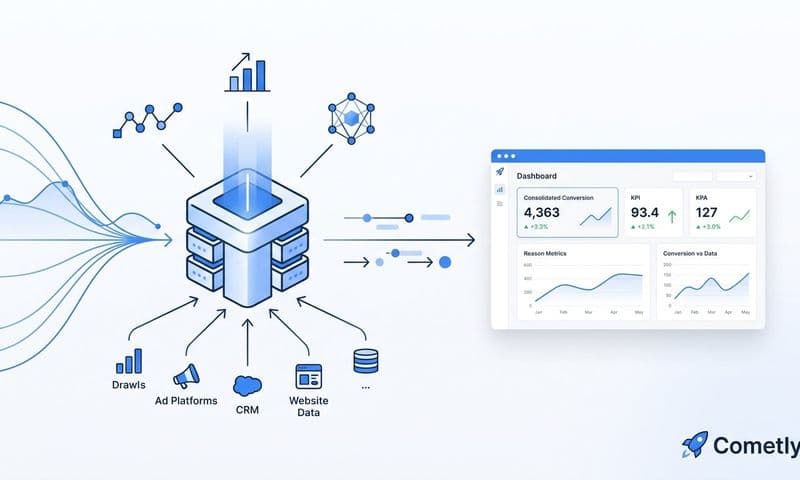
This is precisely the problem that Cometly was built to solve for B2B SaaS teams. Cometly connects your ad platforms, CRM, and server-side events into a single attribution layer, giving you a complete view of every customer journey from first ad click to closed-won revenue. Rather than toggling between Google Ads, Meta, and your CRM and trying to reconcile three different numbers manually, Cometly provides a single source of truth that accounts for multi-touch attribution, server-side conversion data, and pipeline-level revenue attribution in one place.
With Cometly's AI-driven recommendations, you can identify which campaigns and channels are actually driving revenue, not just which ones are claiming to. You can feed enriched, conversion-ready events back to Meta and Google to improve their optimization algorithms. And you can present clean, credible attribution data to stakeholders without having to caveat every number with "but this doesn't match our CRM."
The Bottom Line on Marketing Data Discrepancies
Marketing data discrepancies are not random errors. They are predictable outcomes of how tracking systems are architected. Every platform measures independently. Attribution models assign credit differently. Privacy changes have degraded browser-based signal quality. UTM parameters break in ways that silently corrupt CRM data. When you understand these root causes, the numbers stop feeling chaotic and start making structural sense.
The path forward has three layers. First, understand the root causes so you can interpret discrepancies correctly rather than reacting to them as if they are malfunctions. Second, establish a reconciliation framework that assigns authority to the right system for each metric type, standardizes your attribution model, and audits your UTM implementation. Third, implement server-side tracking and Conversion API integrations to restore signal accuracy at the source and give platform algorithms the data they need to perform.
When all three layers are in place, the goal shifts from reconciling numbers to using them. Clean attribution data is what allows you to fund the full funnel, communicate ROI in language that finance understands, and scale the campaigns that actually drive revenue rather than the ones that simply claim to.
If you're ready to stop arguing about which number is right and start building a marketing data foundation you can trust, Get your free demo of Cometly today and see how it connects every touchpoint from first ad click to closed-won revenue in a single attribution view.