Here is a reality most B2B SaaS marketing teams know but rarely say out loud: your prospects almost never convert on the first touchpoint. They see a LinkedIn ad, scroll past it, find you again through a Google search three weeks later, open a nurture email, and then finally book a demo after a colleague mentions your product in a Slack thread. By the time they become a customer, they have touched your brand across five, six, or seven different interactions spanning multiple channels and weeks.
Yet most teams are making budget decisions based on the last thing that happened before the conversion. That is the attribution trap, and it quietly distorts spend allocation for even the most sophisticated marketing organizations.
The marketing journey is the full sequence of touchpoints a prospect moves through from first awareness all the way to closed revenue. Understanding that sequence completely is not just a reporting exercise. It is the foundation of every smart attribution decision, every budget call, and every optimization move your team makes. When you can see the whole journey, you stop guessing and start growing with confidence.
This article breaks down how B2B marketing journeys actually work, where most teams lose visibility, how attribution models help you interpret what you see, and how modern platforms make it possible to track every touchpoint from the first ad click to closed-won revenue.
The Anatomy of a B2B Marketing Journey
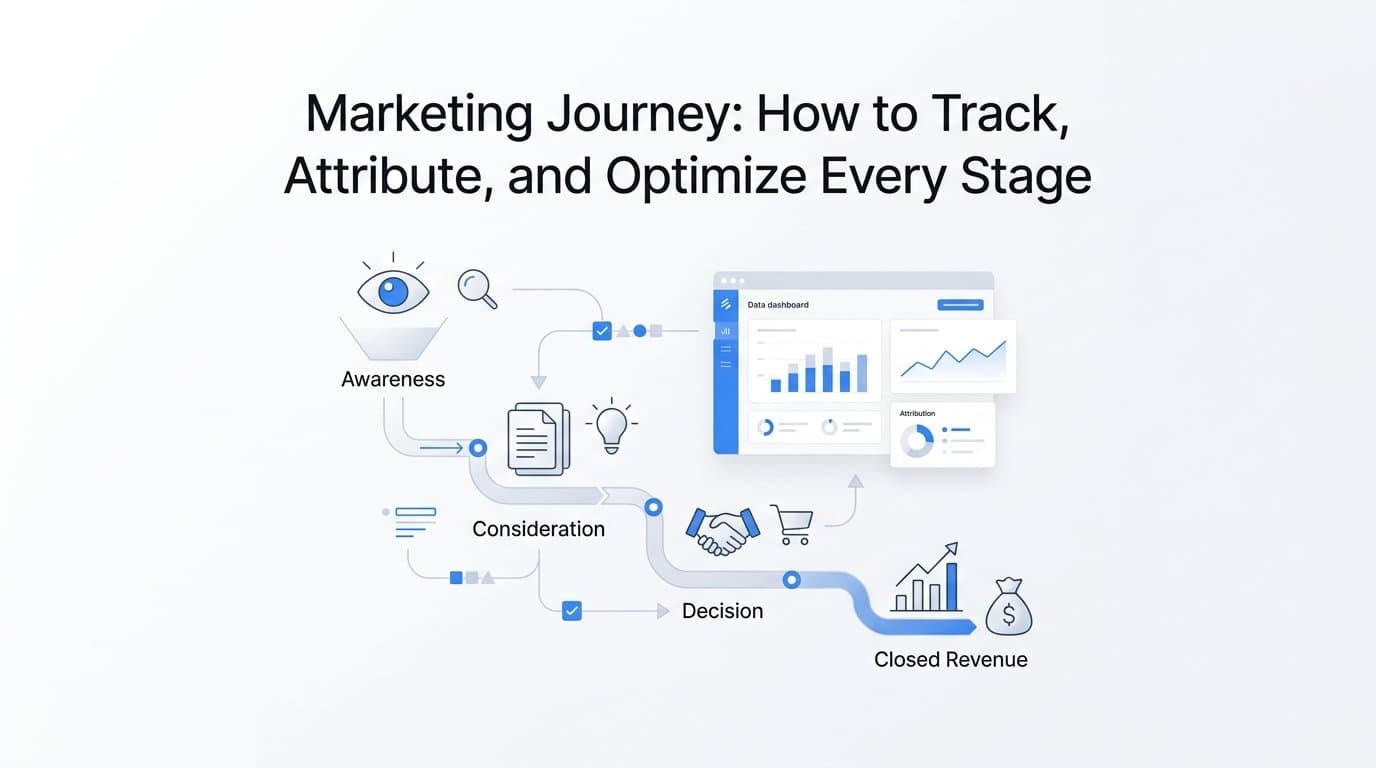
Think of the marketing journey as three distinct phases, each with its own intent signals, conversion events, and strategic implications. Understanding what happens in each phase is what separates teams that optimize intelligently from teams that optimize reactively.
Awareness: This is where the journey begins. A prospect encounters your brand for the first time through a paid social ad, an organic search result, a piece of content, or a mention in an industry newsletter. They are not ready to buy. They are becoming problem-aware and starting to understand that a solution like yours exists. The conversion event at this stage is not a purchase. It is attention: a click, a page view, a video watch, a content download.
Consideration: Now the prospect is actively evaluating options. They are requesting demos, engaging with email nurture sequences, returning to your site through retargeting ads, reading comparison pages, and consuming case studies. This stage is where intent sharpens and where your content and sales motion start to work together. The signals here are richer: demo requests, trial sign-ups, email opens, and multiple return visits within a short window.
Decision: This is the bottom of the funnel, where sales conversations happen, proposals get reviewed, and deals close. The conversion event that matters most to revenue is closed-won. But this stage rarely happens without everything that came before it.
B2B journeys differ from B2C in ways that make tracking significantly harder. Sales cycles stretch across weeks or months rather than hours. Multiple stakeholders are involved, often researching independently before aligning internally. And the journey mixes digital touchpoints like ads and emails with offline interactions like sales calls, conference conversations, and referrals that never get captured in a pixel.
Each individual interaction within this journey is a touchpoint. Touchpoints are the atomic units of the marketing journey, and missing even one of them distorts your understanding of what is actually driving revenue. If your attribution model cannot see the awareness-stage LinkedIn ad that started a journey, it will never give that channel credit for the deal that closed six weeks later. Over time, that blind spot leads to cutting the very channels that are filling your pipeline.
Where the Journey Goes Dark
Most marketing teams are not seeing the full journey. They are seeing fragments of it, and they are making decisions as if those fragments represent the whole picture. There are three places where visibility breaks down, and each one has real consequences for how you allocate budget.
The first gap is browser-based tracking. Standard pixel tracking depends on a user's browser to fire events and store cookies. But ad blockers, iOS privacy changes, and the ongoing deprecation of third-party cookies have made browser-level tracking increasingly unreliable. A meaningful portion of your web traffic is not being captured by pixel-only setups. Touchpoints that happen in those sessions simply vanish from your data, leaving gaps in the journey that make it look shorter and simpler than it actually is.
The second gap is channel fragmentation. A typical B2B prospect might click a LinkedIn ad on a Tuesday, return to your site via a branded Google search on Thursday, open a nurture email the following Monday, and then book a demo through a retargeting ad the week after. Each of those platforms has its own native reporting. Each one sees only the touchpoint it was responsible for. And because each platform uses last-click or view-through attribution by default, each one claims full credit for the eventual conversion.
The result is inflated ROAS across every channel simultaneously. Your LinkedIn dashboard shows strong returns. Your Google dashboard shows strong returns. Your email platform shows strong returns. But when you add up what each platform claims it drove, the number is two or three times your actual revenue. This is not a reporting glitch. It is the inevitable outcome of siloed attribution, and it leads directly to misallocated budgets.
The third gap is the offline disconnect that is specific to B2B. Sales conversations, CRM stage progressions, and closed-won events happen in your CRM, not in your ad platforms. Without a deliberate integration between your CRM and your ad platforms, those revenue signals never make it back upstream. Your optimization algorithms are running on lead volume data at best, and they have no idea which leads actually became customers. That means they are optimizing for the wrong outcome, which compounds over time as ad platform AI learns from incomplete signals.
Closing these gaps requires more than adding another tracking pixel. It requires rethinking how you collect, connect, and send data across your entire marketing and sales stack.
Attribution Models and What They Reveal
Attribution models are frameworks for assigning credit to the touchpoints in a journey. Different models answer different questions, and choosing the wrong one for your business situation leads to cutting channels that are quietly driving pipeline.
First-touch attribution assigns all credit to the first interaction a prospect had with your brand. It is useful for understanding which channels are generating awareness and bringing new prospects into your funnel. If you want to know what is filling the top of your pipeline, first-touch gives you that answer. But it completely ignores everything that happened after that first interaction, which means it tells you nothing about what actually closes deals.
Last-touch attribution assigns all credit to the final interaction before conversion. It is the default for most ad platforms and analytics tools. It is also the most misleading model for B2B SaaS, because it consistently over-credits bottom-funnel channels like branded search while ignoring the awareness and consideration touchpoints that created the intent in the first place. Teams running on last-touch data often dramatically underfund their top-of-funnel channels because those channels never appear to drive conversions.
Linear attribution distributes credit equally across every touchpoint in the journey. It is more representative than single-touch models and gives you a clearer view of how channels work together. Time-decay attribution is a variation that weights touchpoints closer to the conversion more heavily, which can make sense for shorter sales cycles where recency is a meaningful signal.
Multi-touch attribution is the approach that most closely reflects how B2B buying decisions actually happen. Rather than forcing all credit onto a single interaction, multi-touch models distribute credit proportionally across the full journey based on each touchpoint's role. Data-driven multi-touch attribution goes further by using algorithmic weighting based on actual conversion patterns in your data, rather than applying a fixed formula.
The key insight here is that no single model is universally correct. The right model depends on your sales cycle length, your channel mix, and the specific business question you are trying to answer. A team with a 90-day average sales cycle needs a different model than a team closing deals in two weeks. What matters is that you choose intentionally, understand what your chosen model reveals and what it hides, and use multiple model views to get a complete picture of how your marketing journey is performing.
Building the Technical Foundation for Full-Journey Tracking
Understanding the marketing journey conceptually is one thing. Capturing it reliably in your data is another. The technical foundation required to track the full journey from ad click to closed revenue involves three interconnected components.
The first is server-side event tracking combined with Conversion API integrations. Meta's Conversion API and Google's Enhanced Conversions allow you to send conversion event data directly from your server to the ad platform, bypassing browser-level signal loss entirely. When a prospect fills out a demo request form, that event gets captured server-side and sent to your ad platforms with full accuracy, regardless of whether the user has an ad blocker installed or is browsing on a privacy-restricted iOS device. This is now standard practice for teams running paid social at scale, and it directly improves match rates, attribution accuracy, and the quality of signals your ad platforms use for optimization.
The second component is connecting your ad platforms to your CRM. This is what creates the closed loop between marketing spend and actual revenue outcomes. When ad click data flows into your CRM alongside lead records, and when CRM stage progressions and closed-won events flow back to your ad platforms, you can trace a customer's full journey from the first impression all the way to the subscription or contract that generated revenue. Without this connection, marketing can only report on lead volume. With it, marketing can report on pipeline generated, revenue influenced, and customer acquisition cost at the channel and campaign level.
The third component is consistent UTM parameters and event naming conventions across every channel and tool in your stack. This sounds like a housekeeping detail, but it is actually foundational. If your LinkedIn campaigns use one UTM structure and your email campaigns use another, and your website events use a third naming convention, stitching those touchpoints into a coherent journey becomes nearly impossible. Consistent naming conventions are what allow your attribution platform to connect the dots across channels and present a unified view of each prospect's path to revenue.
Together, these three components create a data infrastructure that captures the full journey rather than fragments of it. That infrastructure is what makes every downstream analysis and optimization decision trustworthy.
Turning Journey Data into Smarter Ad Decisions
Once you have reliable journey-level data, the way you make budget decisions changes fundamentally. You stop asking "which channel drove the most conversions last month?" and start asking "which channels initiate the journeys that eventually close at the highest rates?"
That shift matters because the answers are often very different. A paid social channel might rarely appear as the last touch before a conversion, but it might consistently appear as the first touchpoint in journeys that go on to close. Under a last-touch model, that channel looks like a poor performer. Under a multi-touch model with full journey visibility, it looks like the engine that starts your pipeline. Teams that cannot see the full journey systematically underfund their best awareness channels while over-investing in bottom-funnel channels that are capturing intent rather than creating it.
Journey data also improves the performance of your ad platforms themselves. When you send enriched, accurate conversion events back to Meta and Google, their machine learning algorithms have better signals to work with. Instead of optimizing toward leads that may or may not convert to revenue, they can optimize toward the conversion events that actually matter to your business. Ad platform AI performs significantly better when it receives complete, accurate conversion signals rather than the partial data that pixel-only setups provide.
AI-driven insights take this a step further by identifying patterns across thousands of journeys that no human analyst could spot manually. Which ad creative consistently appears in journeys that convert at the highest rates? Which channel combinations produce the shortest sales cycles? Which awareness touchpoints correlate with the highest average contract values? These are the questions that journey-level AI analysis can answer, and the answers directly inform where you invest next.
Putting It All Together with a Single Source of Truth
The shift from siloed channel reports to a unified marketing journey view is not just an analytics upgrade. It is an operational change that affects how your entire growth team makes decisions.
When your ad spend data, touchpoint data, CRM events, and revenue outcomes all live in one place and speak the same language, you stop having conversations about whose numbers are right. You stop reconciling conflicting reports from LinkedIn, Google, and your CRM. You start having conversations about what the data is telling you and what to do about it.
Accurate journey tracking is a competitive advantage in a market where most teams are still making decisions based on last-click data or single-channel reports. Teams that understand their full marketing journey can confidently scale what is working, cut what is not, and justify every budget decision with real data rather than platform-reported ROAS that inflates every channel simultaneously.
This is exactly what Cometly is built to deliver for B2B SaaS teams. Cometly connects your ad platforms, CRM, and website data into a real-time view of the complete marketing journey, from the first ad impression to closed-won revenue. With multi-touch attribution, server-side conversion tracking, Conversion API integration, and AI-driven insights across 70-plus native integrations, Cometly gives you a single source of truth for your marketing data. You can see which channels initiate journeys, which ones close them, and which combinations drive the highest-value customers, all in one place without stitching together reports from five different tools.
The marketing journey is not a metaphor. It is a measurable sequence of events that determines your revenue outcomes. The teams that track it completely make better decisions, allocate budgets more accurately, and grow with a level of confidence that last-click data simply cannot support.
Your Next Move
If your team is still relying on platform-reported attribution or last-touch data to make budget decisions, you are working with an incomplete picture of your marketing journey. You are likely underfunding the channels that start your pipeline and over-crediting the ones that simply capture intent at the bottom of the funnel.
The good news is that full-journey visibility is achievable. It requires the right technical foundation, the right attribution approach, and a platform that connects all of your data into a coherent, real-time view. When you have that, every budget conversation gets easier, every optimization decision gets sharper, and every growth initiative gets grounded in what is actually driving revenue.
Ready to see your complete marketing journey in one place? Get your free demo and discover how Cometly connects every touchpoint from first ad click to closed revenue so you can make smarter decisions and scale with confidence.