Every SaaS marketing leader knows the feeling. Pipeline targets are climbing, the board wants to see growth, and somewhere in the middle of it all, someone asks the question that nobody has a clean answer to: "Which channels are actually driving revenue?" It's not a simple question. And in SaaS, getting it wrong is expensive in ways that compound over months, not just one bad quarter.
SaaS marketing is fundamentally different from e-commerce or traditional B2B. You're not optimizing for a single transaction. You're building a pipeline of recurring revenue where customer acquisition cost, lifetime value, and monthly recurring revenue are the metrics that actually matter. Buyers take weeks or months to evaluate your product. Multiple stakeholders are involved. And the journey from first ad impression to closed-won deal passes through a dozen touchpoints across paid, organic, and direct channels.
That complexity makes measurement non-negotiable. A marketing strategy built on gut instinct and last-click attribution will consistently misdirect budget, undervalue the channels that build pipeline, and overweight the ones that just happen to show up at the end. This article is a practical framework for building a SaaS marketing strategy that is channel-smart and measurement-first from day one. Let's get into it.
Why SaaS Marketing Demands a Different Playbook
If you've ever tried to apply e-commerce marketing logic to a SaaS business, you've probably run into the same wall. The metrics don't translate. A cost-per-click that looks expensive in a retail context might be perfectly reasonable when the customer you're acquiring will pay you for three years. That's the fundamental shift in thinking that SaaS marketing requires.
Subscription revenue changes the entire equation. Instead of optimizing for a one-time purchase conversion, you're managing a relationship between customer acquisition cost and lifetime value. A campaign that looks unprofitable at month one might be highly profitable at month twelve. This means you need attribution and reporting infrastructure that connects ad spend to long-term revenue outcomes, not just immediate conversions.
The buying journey adds another layer of complexity. B2B SaaS purchases rarely happen because one person saw one ad and clicked "start free trial." They happen because a team of stakeholders spent weeks researching options, comparing alternatives, reading reviews, attending demos, and internally advocating for a solution. A VP of Marketing might see your LinkedIn ad first. A developer might find your documentation through organic search. A finance lead might read a comparison article before signing off. Every one of those touchpoints contributed to the deal.
This is where single-touch attribution breaks down completely. If you're crediting the last click, you're essentially ignoring everything that built the case for your product before that final touchpoint. And in SaaS, where the sales cycle stretches across weeks or months, the last click is often the least informative signal you have.
The cost of misattribution compounds over time. If your data tells you that LinkedIn Ads aren't contributing to pipeline, you cut the budget. But if LinkedIn was actually influencing early-stage awareness that eventually converted through branded search, you've just removed a critical piece of your funnel without realizing it. Months later, pipeline starts to thin and you can't immediately identify why. That's the danger of building a SaaS marketing strategy without proper measurement infrastructure underneath it.
The Core Pillars of a SaaS Marketing Strategy
Before you can build a strategy, you need to understand the two fundamentally different jobs that marketing is doing at any given time: creating demand and capturing it. Conflating the two leads to budget misallocation and strategic confusion.
Demand generation versus demand capture: Demand generation is the work of making people aware that a problem exists and that your product solves it. This is content, thought leadership, social media, podcasts, events, and top-of-funnel paid campaigns. Demand capture is the work of converting people who already know they have a problem and are actively looking for a solution. This is branded search, competitor comparison pages, retargeting, and bottom-of-funnel paid campaigns. Both are essential. The right balance depends on your market maturity, growth stage, and attribution data.
Content and SEO as compounding assets: For SaaS companies, organic content is one of the most powerful long-term investments you can make. A well-optimized blog post, comparison page, or educational resource continues to attract buyers months and years after it's published. Over time, a strong content and SEO program reduces your reliance on paid acquisition and lowers your blended CAC. It also attracts buyers who are actively researching solutions, which means they tend to be higher intent and more likely to convert. The compounding nature of content makes it a strategic asset, not just a traffic tactic.
Paid acquisition channels and B2B buying cycles: Each paid channel plays a different role in a SaaS funnel, and understanding those roles is critical to structuring your campaigns effectively.
Google Ads is primarily a demand capture channel. When someone searches for a solution to a specific problem, Google puts your product in front of them at the exact moment of intent. This makes it highly efficient for converting existing demand, but it won't create awareness among buyers who don't yet know they need what you offer.
LinkedIn Ads offer something different: the ability to reach professional audiences by job title, seniority, company size, and industry. For B2B SaaS targeting specific personas, this precision is valuable. LinkedIn tends to operate higher in the funnel, building awareness and generating interest among the right decision-makers before they've started actively searching.
Facebook and Instagram Ads can serve both awareness and retargeting purposes. They're particularly effective for reaching warm audiences who have already engaged with your brand and for building retargeting campaigns that keep your product visible throughout a long consideration period.
The key insight is that none of these channels operates in isolation. A buyer might first encounter your brand through a LinkedIn campaign, research your product through organic content, and then convert via a branded Google search. Understanding how these channels work together requires multi-touch attribution, which we'll address directly in a later section.
Mapping the SaaS Customer Journey Before You Spend a Dollar
Here's a principle that separates high-performing SaaS marketing teams from the ones that are always scrambling: they map the customer journey before they allocate budget. Not after. Before.
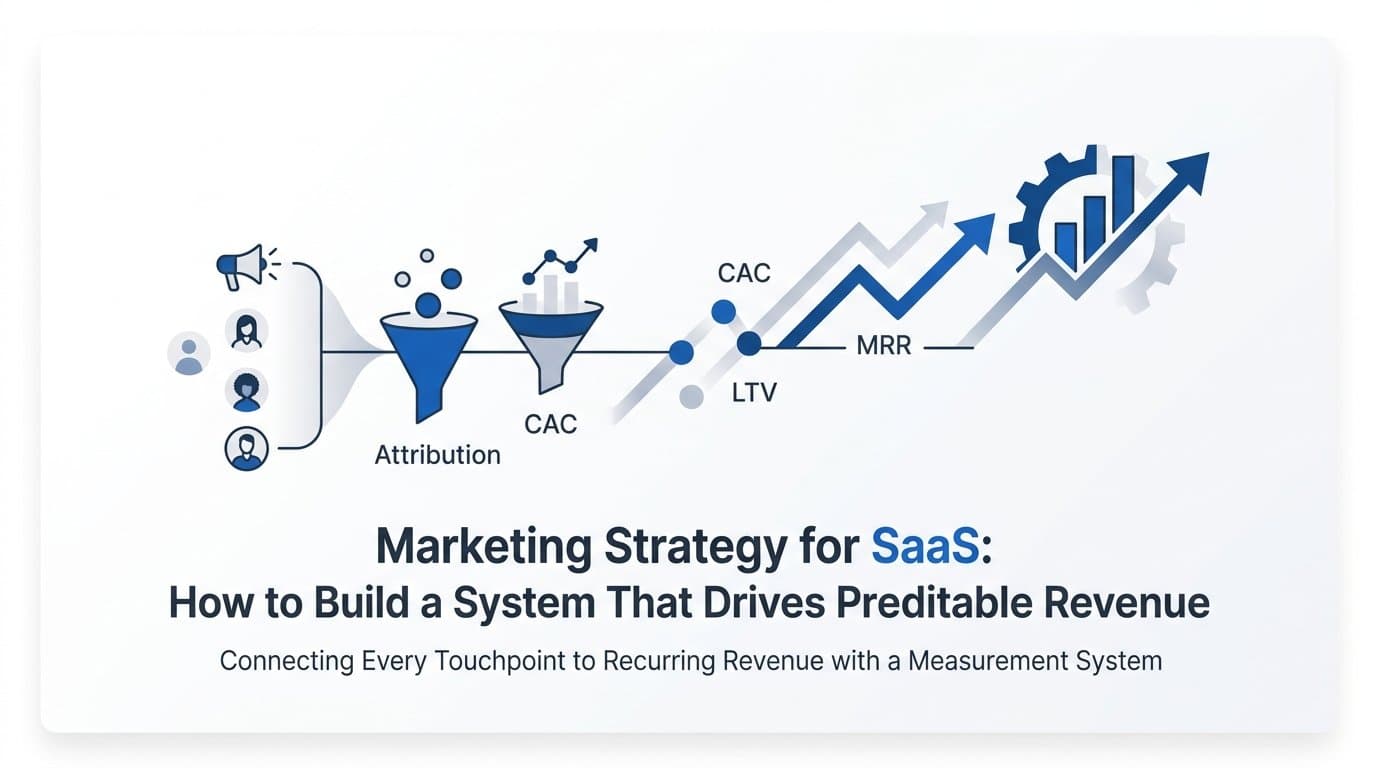
The full funnel in SaaS runs from first ad click to closed-won revenue. Every stage along that path has its own dynamics, its own success metrics, and its own contribution to the final outcome. If you only measure what happens at the bottom of the funnel, you're flying blind for most of the journey.
Think about what that journey actually looks like. A potential buyer might see a LinkedIn ad introducing your product category. They visit your website, read a few blog posts, and leave. Two weeks later, they search for a comparison between your product and a competitor. They read your comparison page, sign up for a free trial, and spend a week evaluating the product. They attend a demo, loop in two colleagues, and then convert to a paid plan. That entire sequence might span four to six weeks and involve six or seven distinct touchpoints across three or four channels.
Each stage of that journey needs its own success metric. At the awareness stage, you might track impressions, reach, and engagement rates. At the consideration stage, you're watching trial sign-ups, demo requests, and content engagement. At the decision stage, you're tracking pipeline created, demo-to-trial conversion, and sales cycle length. And ultimately, you're connecting all of it to closed-won revenue and LTV.
Identifying the key touchpoints across paid, organic, and direct channels is the foundation of this exercise. Look at your CRM data and work backwards from your best customers. Which channels appeared in their journey? How many touchpoints did they have before converting? How long did their evaluation period last? This data tells you where to invest and which stages of the funnel need more support.
Customer journey data also helps you prioritize budget allocation intelligently. If you find that most of your best customers engaged with three or more organic content pieces before requesting a demo, that's a signal to invest more in content. If you see that LinkedIn consistently appears early in the journey of your highest-LTV customers, cutting that budget because it doesn't show conversions in last-click reporting would be a costly mistake.
Attribution: The Missing Layer Most SaaS Teams Ignore
Last-click attribution is the default setting for most marketing analytics tools. It's also one of the most misleading frameworks you can use in a SaaS context. Here's why.
Last-click attribution gives 100% of the credit for a conversion to the final touchpoint before the conversion event. In practice, this means that branded search, direct traffic, and bottom-of-funnel retargeting campaigns get all the credit while the awareness and consideration channels that built the pipeline get none. Over time, this creates a predictable pattern: teams cut the channels that look expensive and unproductive (LinkedIn, content-driven campaigns, top-of-funnel paid) and double down on the channels that look efficient (branded search, retargeting). Pipeline shrinks. Growth stalls. And nobody immediately understands why, because the attribution data looked fine.
Multi-touch attribution models solve this by distributing credit across all the touchpoints that influenced a conversion. Different models distribute that credit differently. Linear attribution gives equal weight to every touchpoint. Time-decay models give more credit to touchpoints closer to the conversion. Position-based models give more weight to the first and last touchpoints while crediting the middle interactions proportionally. Data-driven attribution uses actual conversion patterns to assign credit based on which touchpoints most frequently appear in converting journeys.
For B2B SaaS with complex, multi-stakeholder buying journeys, multi-touch attribution reveals the true influence of each channel. It shows you that the LinkedIn campaign you were about to cut actually appears in the early journey of most of your best customers. It shows you that the blog content you almost deprioritized is a consistent touchpoint before demo requests. This is the intelligence that makes confident budget decisions possible.
But attribution is only as good as the data feeding it. And this is where many SaaS marketing teams hit a technical wall. Browser-side pixel tracking has become increasingly unreliable. iOS privacy changes, ad blockers, and cross-device journeys all create gaps in the data. Third-party cookies are no longer a foundation you can build on.
Server-side tracking and Conversion API integrations have become essential for maintaining attribution accuracy. Instead of relying on a browser pixel to fire correctly, server-side tracking sends conversion data directly from your server to ad platforms like Meta and Google. This closes the data gaps that browser-side tracking leaves open and ensures that your attribution model is working with complete, accurate information. First-party data, collected directly from your own systems and passed through server-side connections, is now a genuine competitive advantage in SaaS marketing.
Platforms like Cometly are built specifically to solve this problem, connecting your ad platforms, CRM, and website data through server-side tracking and Conversion API integrations to give you an accurate, complete picture of every touchpoint across the customer journey.
Metrics That Actually Reflect SaaS Marketing Performance
Let's talk about vanity metrics. Impressions, clicks, click-through rates, and even website sessions can all look great in a dashboard while your pipeline sits flat. These metrics measure activity. They don't measure impact. And in SaaS, the difference between activity metrics and impact metrics is the difference between a marketing team that feels busy and one that drives growth.
The shift that high-performing SaaS marketing teams make is moving their primary KPIs from activity metrics to pipeline and revenue attribution. Pipeline influenced measures how much qualified pipeline marketing has contributed to across all channels and touchpoints. Revenue attribution connects specific campaigns and channels to closed-won deals. These are the metrics that tell you whether your marketing strategy is working, not whether your ads are getting clicks.
Building a reporting framework that connects ad spend data to CRM pipeline and closed revenue is both a technical and organizational challenge. On the technical side, it requires integrating your ad platforms, your CRM, and your attribution layer so that data flows cleanly between them. On the organizational side, it requires alignment between marketing and sales on what counts as a qualified lead, how pipeline stages are defined, and how attribution credit is assigned when multiple channels contributed to a deal.
The metrics that matter most in a SaaS marketing context include customer acquisition cost by channel, which tells you the true cost of acquiring a customer through each specific source. Pipeline attribution by channel shows you which channels are contributing to qualified opportunities, not just leads. Revenue attribution by campaign connects your marketing investment directly to closed revenue. And LTV to CAC ratio gives you the long-term view of whether your acquisition economics are sustainable.
When these metrics are tracked accurately and consistently, they give you something more valuable than a dashboard full of numbers. They give you the confidence to make budget decisions based on what's actually working rather than what looks good in a platform's native reporting. And in a market where every dollar of marketing spend needs to be justified, that confidence is a strategic advantage.
Scaling What Works: Using Data to Make Confident Budget Decisions
Once you have accurate attribution data and a clear view of which channels and campaigns are driving pipeline and revenue, the next challenge is scaling intelligently. This is where AI-driven analysis starts to create a real performance edge.
Human analysts reviewing campaign data can identify obvious patterns. But the volume of data generated across multiple ad platforms, multiple campaigns, and multiple audience segments quickly exceeds what any team can manually process. AI-driven tools can surface high-performing ads and campaigns that human review often misses, identifying patterns in creative performance, audience response, and conversion sequences that would take weeks to find manually.
The feedback loop between enriched conversion data and ad platform performance is one of the most powerful dynamics in modern SaaS marketing. When you send accurate, enriched conversion events back to Meta, Google, and LinkedIn through server-side connections, you're giving those platforms' algorithms better data to optimize against. Instead of optimizing for a proxy metric like a form fill, the algorithm can optimize for the conversion events that actually predict revenue. Over time, this creates a compounding performance advantage: better data leads to better targeting, which leads to higher quality conversions, which generates even better data.
Building a single source of truth for marketing data is the organizational foundation that makes all of this possible. When your team is looking at different numbers from different platforms, decision-making slows down and confidence erodes. Each ad platform reports its own attribution based on its own models and attribution windows, which means the numbers in Google Ads, Meta Ads Manager, and LinkedIn Campaign Manager will never agree with each other. A centralized attribution platform resolves this by applying a consistent attribution model across all channels and giving every team member the same view of performance.
Cometly is built to serve as that single source of truth. It connects your ad platforms, CRM data, and revenue data into one unified view, applies consistent attribution across all channels, and surfaces AI-driven recommendations for where to scale and where to pull back. When every team member is working from the same numbers, budget conversations become faster, more confident, and more aligned with actual business outcomes.
Putting It All Together: From Strategy to Measurable Growth
Let's bring the framework together. A SaaS marketing strategy that drives predictable revenue starts with the customer journey. Before you allocate budget, before you launch campaigns, you need to understand how your best customers find you, evaluate you, and decide to buy. That journey is the map. Everything else is built around it.
From there, you build your channel strategy to match the journey. Use demand generation channels to create awareness and build pipeline at the top of the funnel. Use demand capture channels to convert the intent that your demand generation efforts have created. Use content and SEO to build compounding organic assets that reduce your long-term CAC. And structure your paid campaigns around the different stages of a B2B buying cycle rather than optimizing everything for immediate conversion.
Then you layer in attribution and measurement. Not as an afterthought, but as a parallel infrastructure that you build at the same time as your channel strategy. Strategy without measurement is guesswork. You might get lucky for a quarter, but you won't build the kind of systematic, compounding growth that SaaS businesses need to scale. Multi-touch attribution, server-side tracking, and pipeline-to-revenue reporting are not optional extras. They are the foundation of a strategy that can learn, adapt, and improve over time.
This is exactly what Cometly is built to support. As a marketing attribution and analytics platform designed specifically for B2B SaaS companies, Cometly connects every touchpoint from first ad click to closed-won revenue, applies consistent multi-touch attribution across all your channels, and feeds enriched conversion data back to your ad platforms to improve algorithmic targeting. It gives your team a single source of truth, AI-driven recommendations for scaling what's working, and the clear view of pipeline and revenue attribution that modern SaaS marketing demands.
The best SaaS marketing strategy is not the one with the most channels or the biggest budget. It's the one built on accurate data, clear attribution, and a measurement infrastructure that connects every marketing dollar to real business outcomes. Before you scale your next campaign, audit your current measurement setup. If you can't trace a closed deal back to the first touchpoint that started the journey, you're making budget decisions with incomplete information.
Ready to build a marketing strategy on a foundation of accurate attribution and real revenue data? Get your free demo and see how Cometly connects your ad platforms, CRM data, and revenue attribution into one clear, confident view of what's actually driving your growth.