
Leads and revenue rarely arrive from a single direction. In most B2B SaaS companies, prospects are discovering your brand through a Google ad or a blog post at the same time your SDR team is sending cold email sequences to a target account list. Both motions are running in parallel, both are influencing pipeline, and both deserve credit in your attribution data.
The problem is that most teams measure them separately, or worse, only measure one side entirely. When attribution only captures inbound digital touchpoints, your outbound team becomes invisible in the data. When it only tracks CRM activity, your paid campaigns look like they contribute nothing. Either way, budget decisions get made on incomplete information, and high-performing channels get cut while underperforming ones get scaled.
This guide breaks down what outbound and inbound attribution actually mean, why they require different measurement approaches, and how combining both into a unified system gives you the complete picture your revenue data has been missing.
Two Paths to the Same Pipeline
Before you can measure both motions accurately, you need to understand how fundamentally different they are at the data level.
Inbound attribution covers leads and conversions that originate from channels where the prospect finds you first. This includes paid search and social ads, organic content, SEO-driven blog traffic, email newsletters, and social media. The data trail here is digital: a prospect clicks an ad with UTM parameters attached, lands on your site, fires a pixel event when they fill out a demo request form, and gets created as a contact in your CRM with source data attached to the record.
The entire inbound attribution chain depends on capturing those digital signals accurately at every step. UTM parameters tell you which campaign and channel drove the visit. Pixel events or server-side tracking confirm which actions the visitor took. CRM field mapping connects the lead back to the originating touchpoint so that when a deal closes months later, you can trace it back to the specific ad or content piece that started the journey.
Outbound attribution works differently because the company initiates contact rather than the prospect. Cold email sequences, LinkedIn outreach, SDR phone calls, and direct mail campaigns all fall into this category. There is no ad click to track, no UTM parameter to capture, and no pixel event to fire. The prospect did not visit your site before the first touch. The entire interaction begins inside your CRM or sales engagement platform.
This creates a fundamentally different data challenge. Outbound attribution relies on CRM activity logs, call recordings, email sequence data from tools like Outreach or Salesloft, and LinkedIn engagement records. These touchpoints are not browser-based events. They live in your sales stack, not your marketing stack, and most attribution platforms are not built to read them by default.
The result is a structural gap between the two motions. Inbound attribution is built on digital tracking signals. Outbound attribution is built on CRM activity data. When these two data sources are not connected, you end up with two separate, incomplete pictures of what is actually driving your pipeline.
Why Standard Attribution Models Fall Short for Outbound
Most attribution platforms are designed around a browser-centric view of the customer journey. They assign credit using models like first-touch, last-touch, or linear distribution across ad clicks, page visits, and form submissions. These models work reasonably well for inbound-only environments where every meaningful touchpoint happens in a browser session that can be tracked.
Outbound touches do not appear in these models because they happen entirely outside the browser. A cold email reply, an SDR phone call, or a LinkedIn message exchange leaves no footprint in your ad platform or website analytics. From the perspective of a standard attribution tool, those interactions never happened.
Here is where this creates real damage to your data. Imagine a deal where an SDR sent a cold email sequence to a target account, booked a meeting after the third follow-up, and the deal closed after a 90-day sales cycle. If your attribution platform only reads browser-based events, that entire deal may show zero attributed revenue from the outbound motion. The SDR's work is invisible. Meanwhile, if the prospect happened to visit your website at some point during the sales cycle after clicking a retargeting ad, that ad gets full credit for a deal it did not source.
This misattribution has real consequences. Marketing teams appear to drive more pipeline than they actually source. Sales development teams cannot demonstrate their revenue influence. Budget allocation decisions favor paid channels over SDR headcount because the data makes paid look more productive. None of this reflects reality. It reflects a measurement gap.
The framework that can bridge both motions is multi-touch attribution. Instead of assigning all credit to a single event, multi-touch models distribute credit across every meaningful touchpoint in the customer journey. A paid ad click, a content download, an SDR email reply, and a demo call can all receive partial credit for influencing the deal. This approach reflects how B2B buying decisions actually happen: through a series of interactions across marketing and sales channels over weeks or months.
But multi-touch attribution only works when the underlying data is unified. If your ad platform data and your CRM activity data live in separate systems that never talk to each other, even the most sophisticated attribution model cannot connect the dots. The model is only as complete as the data feeding it.
How Inbound Attribution Actually Works in Practice
Understanding the inbound attribution data chain helps clarify where signal gets lost and where it needs to be protected.
It starts with the ad click. A prospect sees a LinkedIn ad or a Google search result, clicks through, and lands on your site. The URL they arrive on contains UTM parameters that identify the campaign, channel, source, and ad creative. Your analytics platform captures this session data and associates it with a visitor profile.
From there, if the prospect takes a meaningful action, such as filling out a demo request form or starting a trial, a conversion event fires. Traditionally this was a browser-based pixel event. The pixel would read the visitor's cookie, fire the event back to the ad platform, and the conversion would be attributed to the campaign that drove the click. Clean, simple, and increasingly unreliable.
Browser-based pixel tracking has become significantly less accurate due to three compounding factors. Ad blockers prevent pixels from loading on a growing share of browsers. Apple's Intelligent Tracking Prevention and iOS privacy updates limit the lifespan and scope of cookies used to identify users across sessions. And as third-party cookies continue to be phased out across the industry, the ability to track a user from an ad click to a conversion that happens days or weeks later is eroding.
For B2B SaaS companies with sales cycles that can span 60 to 180 days, this signal loss is especially damaging. The gap between the first ad click and the eventual demo request or trial signup can be substantial. If cookie-based tracking loses the thread partway through that journey, the conversion never gets attributed to the campaign that earned it.
Server-side tracking and Conversion APIs solve this problem by moving event data off the browser and onto your server. Instead of relying on a browser pixel to fire a conversion event, your server sends the event data directly to the ad platform, bypassing ad blockers and cookie restrictions entirely. Meta's Conversion API and Google's Enhanced Conversions both operate on this principle. The data arrives cleaner, more complete, and more accurately matched to the ad interaction that started the journey.
First-party data enrichment adds another layer of protection. When you capture and store visitor-level data at the server layer, including email addresses, form submission data, and session identifiers, you create a durable record of the inbound touchpoint that persists even when browser signals degrade. This enriched data can be matched against CRM records later in the sales cycle, keeping the attribution link intact from the first ad click all the way to a closed-won deal.
Connecting Outbound Touches to Revenue in Your Attribution Data
Getting outbound touches into your attribution data requires a different approach than inbound tracking. There is no pixel to fire, no UTM to capture. The data already exists. It just lives in your CRM and sales engagement tools, and it needs to be surfaced into your attribution layer.
The practical mechanism is CRM integration. When your attribution platform can read activity data from Salesforce or HubSpot, including email sequence logs, call notes, LinkedIn touchpoints, and meeting records, it can incorporate those interactions into the customer journey timeline alongside inbound ad data. An SDR's cold email that got a reply becomes a tracked touchpoint. A discovery call becomes part of the attribution record. The deal's full history is visible in one place.
This matters especially when you need to understand the relationship between inbound and outbound touches on the same deal. Many B2B opportunities involve both motions. A prospect might click a paid ad and visit your site without converting, then get picked up by an SDR doing account-based outreach two weeks later. The question your attribution data should answer is: did the inbound touch create awareness that made the outbound touch more effective? Or did the outbound touch initiate an opportunity that was later accelerated by retargeting campaigns?
Pipeline attribution and revenue attribution give outbound teams a way to demonstrate their influence even when they did not originate the lead. By mapping which outbound sequences touched deals that also had inbound interactions, you can see whether SDR activity is accelerating inbound-sourced opportunities or independently sourcing net-new pipeline. Both are valuable. Both deserve to be visible in your data.
Consistent CRM field mapping is the operational foundation that makes this work. Lead source fields need to be structured so that outbound-sourced contacts are categorized distinctly from inbound-sourced ones. Sequence enrollment data needs to be logged in a format that attribution software can read. UTM parameters captured from any inbound touchpoints need to be stored on the contact record and carried through to the opportunity.
Without this hygiene, outbound and inbound data collide in the CRM as unstructured noise. Attribution software cannot distinguish an SDR-initiated contact from a form-fill lead if the source fields are inconsistently populated or left blank. Clean data structure is not a nice-to-have. It is what makes outbound attribution possible at all.
Building a Unified View Across Both Motions
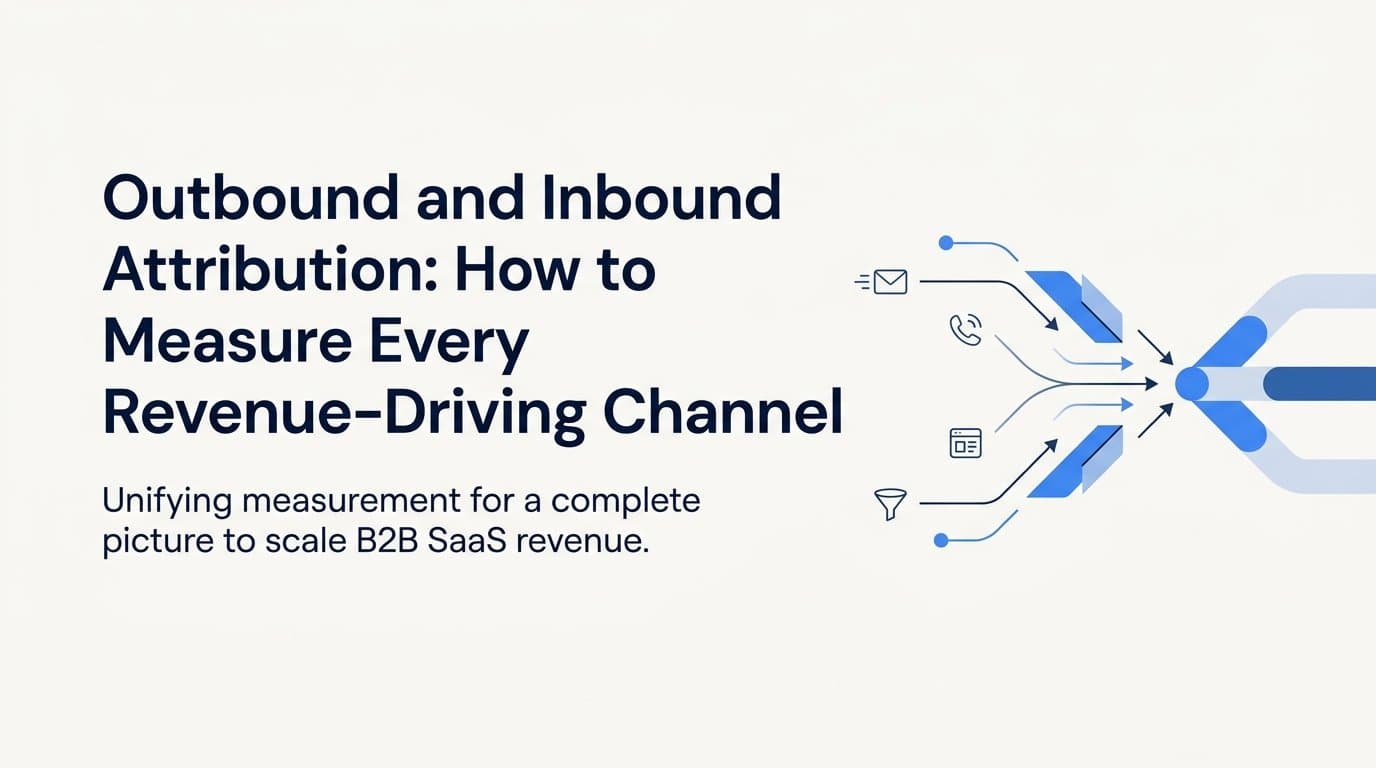
A unified inbound and outbound attribution model looks like a single customer journey timeline that shows every meaningful interaction a prospect had with your company before becoming a customer. Not just the marketing touches. Not just the sales touches. All of them, in sequence, connected to the deal they influenced.
In practice, that timeline might look like this: a prospect clicks a LinkedIn ad and visits your pricing page, reads a blog post through organic search two weeks later, receives a cold email sequence from an SDR and replies to the third message, attends a demo, and signs a contract 60 days after the first ad click. A unified attribution system captures all of those touchpoints and connects them to the closed-won revenue. Every team involved in that journey gets visibility into their contribution.
Comparing attribution models across this unified dataset reveals something that siloed reporting cannot: which motion sources opportunities versus which motion closes them. A first-touch attribution model might give full credit to the LinkedIn ad because it was the first interaction. A last-touch model might give full credit to the demo call. A linear model distributes credit evenly across all touchpoints. A data-driven model uses historical patterns to assign credit based on which touchpoints actually correlate with conversions.
Running multiple models against the same dataset lets you answer different strategic questions. If you want to understand which channels are building awareness and generating net-new pipeline, first-touch attribution tells that story. If you want to understand which activities are closing deals, last-touch or opportunity-stage attribution is more relevant. If you want to understand overall channel influence across the full funnel, linear or data-driven models give you that view.
This is where AI-driven attribution analysis creates a meaningful advantage. Human analysts can compare attribution models and draw conclusions from summary reports. AI can process thousands of individual customer journeys simultaneously and surface patterns that would take weeks to identify manually. Which combinations of inbound and outbound touchpoints most reliably predict high-value conversions? Which channel sequences have the highest pipeline influence per dollar spent? Which outbound sequences tend to accelerate inbound-sourced deals most effectively? These are questions that AI attribution analysis can answer at scale, turning your unified attribution data into a continuous source of strategic insight.
Smarter Attribution Starts With Complete Data
The core distinction between inbound and outbound attribution comes down to where the data lives and how it needs to be captured. Inbound attribution requires robust digital tracking infrastructure: server-side events, Conversion APIs, and consistent UTM tagging across every campaign. Outbound attribution requires CRM integration and activity data syncing so that sales touches appear in the same attribution layer as marketing touches. Neither is complete without the other.
The goal of combining both is not just cleaner reporting. It is better decision-making. When you can see the actual revenue influence of every channel, whether that is a paid search campaign, an organic content strategy, or an SDR cold email sequence, you can allocate budget and headcount based on what is actually working rather than what is easiest to measure.
Teams that rely on siloed channel metrics end up optimizing for the metrics they can see rather than the outcomes that matter. Paid teams optimize for cost-per-click. SDR teams optimize for meetings booked. Neither metric tells you which combination of activities is driving the highest-value revenue at the lowest total cost. Only unified attribution data can answer that question.
Cometly is built to connect these two worlds. By integrating ad platform data, CRM activity, and website behavior into a single attribution view, Cometly gives B2B SaaS teams the complete customer journey visibility they need to track every touchpoint across both inbound and outbound motions. With real-time insights, AI-powered pattern recognition, and native integrations across major ad platforms and CRMs, Cometly makes it possible to see not just where leads come from, but which combinations of marketing and sales activity actually drive closed revenue.
Measuring only inbound or only outbound attribution leaves significant blind spots in your revenue data. The most effective B2B SaaS teams treat attribution as a unified system, not two separate reports. When you bring both sides together, you stop guessing about what is working and start making decisions with confidence.
Ready to elevate your marketing game with precision and confidence? Discover how Cometly's AI-driven recommendations can transform your ad strategy. Get your free demo today and start capturing every touchpoint to maximize your conversions.