Most B2B SaaS marketing teams are making budget decisions based on data that is already old by the time it arrives. A prospect clicks a LinkedIn ad on Monday, reads a blog post on Wednesday, opens a nurture email on Friday, and books a demo the following week. By the time that conversion shows up in a weekly report, the team has already shifted budget away from the campaign that started the whole journey.
This is the core problem with how most teams approach the real time customer journey. The journey itself is live and continuous. The data, however, arrives in batches, gets filtered through disconnected tools, and lands in dashboards that reflect what happened, not what is happening. That gap between reality and reporting is where budget gets wasted and growth opportunities get missed.
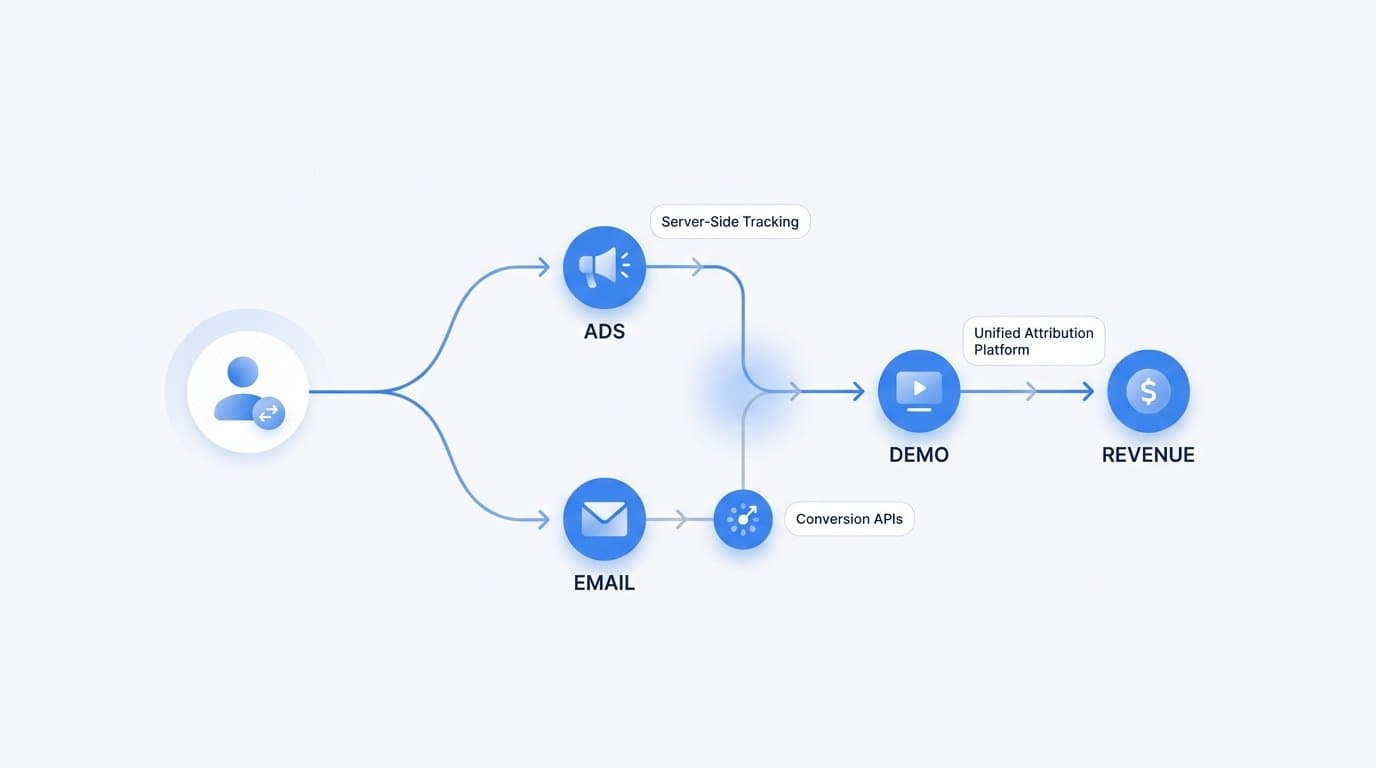
The good news is that the technology to close that gap exists today. Server-side tracking, Conversion APIs, and unified attribution platforms have made it possible to capture every touchpoint as it happens and connect it directly to pipeline and revenue. What follows is a practical breakdown of what real time customer journey tracking actually means, how to build a system that does it well, and how to turn that data into decisions that drive growth.
Why the Customer Journey Is No Longer a Straight Line
The mental model of a funnel, where a prospect moves neatly from awareness to consideration to decision, was always a simplification. In B2B SaaS, it has become dangerously misleading. Modern buyers interact with your brand across many channels before they ever raise their hand. A typical journey might include a paid search click, an organic blog visit, a retargeting ad on Meta, a direct visit after a colleague mention, and a branded search before the final demo request.
Each of those touchpoints played a role. None of them alone explains the conversion. Yet most attribution setups credit only one, usually the last click, and declare it the winner. This creates a systematic distortion where bottom-of-funnel channels like branded search look like they are doing all the heavy lifting, while the awareness and consideration campaigns that started the journey get starved of budget.
The problem compounds when reporting is delayed. Static or batch-processed reports show you what happened last week or last month. By the time you see that a campaign is underperforming, you have already spent more on it. By the time you see that a new creative is outperforming expectations, the budget cycle has moved on. Decisions made on delayed snapshots are always decisions made about the past.
There is also a compounding effect to consider. Each additional channel a prospect interacts with adds complexity to the attribution question. When you have two or three touchpoints, last-click attribution is a rough approximation. When you have six or seven, it becomes actively misleading. The more sophisticated your marketing mix, the more you need a tracking system that can hold the full picture together in real time, not reconstruct it after the fact.
This is why customer journey tracking has shifted from a reporting exercise to a strategic capability. The teams that can see the full journey as it unfolds are the ones who can respond to it, not just analyze it retroactively.
Defining Real Time Customer Journey Tracking
Real time customer journey tracking is the continuous, live capture of every interaction a prospect has with your brand, from the first ad impression to a closed-won deal, with no meaningful delay between the event and its appearance in your data. The emphasis on "no meaningful delay" matters because most tools that claim to offer journey tracking are actually offering delayed aggregation. They collect events, batch them, process them overnight, and surface them the next morning. That is not real time. That is historical reporting with a shorter lag.
True real time tracking means that when a prospect clicks an ad, that event is captured and attributed immediately. When they fill out a form, that lead is tied to the originating campaign instantly. When they move from MQL to SQL in the CRM, that pipeline event is connected to the touchpoint data that preceded it. When they close as a customer, the revenue is attributed back through the full journey, not just the last interaction.
It is important to distinguish between two different layers of data here. Session-level data tells you what happened on your website during a given visit: which pages were viewed, how long the session lasted, which form was submitted. Full journey data tells you which ad drove that session, what happened in the CRM after the lead was created, which nurture emails were opened, and whether the prospect eventually converted to revenue. Session data is a slice. Journey data is the whole story.
The reliability of real time journey data depends heavily on how it is collected. Browser-based tracking using third-party cookies has become increasingly unreliable. Safari's Intelligent Tracking Prevention, Firefox's enhanced privacy protections, and the broader trend toward cookie deprecation have created significant signal loss for marketers relying on pixel-based tracking alone. Events that should be captured are dropped, attributed incorrectly, or lost entirely.
Server-side tracking addresses this directly. Instead of relying on a browser pixel that can be blocked or restricted, server-side tracking sends event data directly from your server to the attribution platform and to ad platforms via Conversion APIs. Meta's Conversion API and Google's Enhanced Conversions are both built on this principle, and both are publicly documented as the recommended approach for reliable signal capture. First-party data collected through server-side methods is more durable, more accurate, and more complete than anything a browser pixel can provide in today's privacy environment.
The Core Components of a Real Time Journey Tracking System
Building a real time customer journey tracking system requires connecting several data sources that typically live in separate tools. Each component plays a specific role, and gaps between them are where attribution breaks down.
Ad Platform Integration: The journey starts at the ad click, which means your attribution system needs a live connection to every paid channel you run. When a prospect clicks a Meta ad or a Google search ad, that click data, including the campaign, ad set, creative, and audience, should flow directly into your attribution layer without manual exports or batch uploads. Any delay or manual step in this connection creates a window where data can be lost, mismatched, or simply missing.
CRM and Pipeline Event Syncing: This is where most attribution systems fall short. Connecting ad clicks to website sessions is relatively straightforward. Connecting those sessions to what happens downstream in the CRM is where the real value lies. When a lead progresses from MQL to SQL, when an opportunity is created, when a deal closes, those events need to be synced back to the original touchpoint data. Without this connection, marketing can see which campaigns drove form fills but cannot see which campaigns drove pipeline or revenue. In B2B SaaS, where the gap between a form fill and a closed deal can span weeks or months, this connection is everything.
Server-Side Events and Conversion APIs: As covered in the previous section, browser-based pixels miss a meaningful portion of events due to privacy restrictions and ad blockers. Server-side event tracking and Conversion API integrations capture what pixels miss. This matters not just for attribution accuracy but for the quality of the signal you send back to ad platforms. Meta's CAPI and Google's Enhanced Conversions use these server-side events to improve their targeting algorithms. If your event stream is incomplete, the platform's AI is optimizing toward an incomplete picture of your best customers.
The connecting thread across all three components is that they need to work together in a single, unified system. When ad click data, website behavior, CRM events, and revenue data all flow into one attribution platform, the real time customer journey becomes visible as a coherent whole. When they live in separate tools and get reconciled manually, the picture is always incomplete and always delayed.
How Attribution Models Shape What You See in the Journey
Real time data is only as useful as the model you use to interpret it. Attribution models are the rules that determine how credit for a conversion is distributed across the touchpoints in a journey. Different models produce entirely different pictures of the same journey, and choosing the wrong one leads to misallocated budget.
Last-click attribution gives all the credit to the final touchpoint before conversion. It is simple and easy to implement, which is why it remains common. But it systematically over-credits channels like branded search that capture intent created by earlier touchpoints, while under-crediting the awareness and consideration campaigns that built that intent in the first place. In a multi-touch B2B journey, last-click attribution is almost always misleading.
First-touch attribution has the opposite problem. It credits the first interaction and ignores everything that followed. This can make top-of-funnel campaigns look more impactful than they are, while the nurture campaigns that kept prospects engaged through a long sales cycle receive no credit at all.
Linear attribution distributes credit equally across all touchpoints. It is more accurate than single-touch models for long journeys, but it treats a brief retargeting impression the same as a 20-minute product demo visit, which is rarely the right assumption.
Data-driven attribution, available in platforms that have sufficient conversion volume, uses statistical modeling to assign credit based on which touchpoints actually correlate with conversion. It is the most accurate model for mature programs with enough data to train the model, but it requires volume and a reliable event stream to work properly.
For B2B SaaS companies with longer sales cycles, multi-touch models are almost always more appropriate than single-touch models. A prospect who interacts with your brand seven times over six weeks before booking a demo is not adequately represented by a model that credits only the first or last touch. The real value of real time customer journey data comes when you can compare attribution models side by side, see how the picture changes, and make decisions based on a complete view rather than a single lens.
Turning Journey Data Into Actionable Marketing Decisions
Data that does not change behavior is just overhead. The point of building a real time customer journey tracking system is to make faster, better marketing decisions. Here is what that looks like in practice.
Faster Budget Reallocation: When you can see which campaigns are generating pipeline right now, not two weeks from now, you can reallocate budget before wasted spend compounds. If a campaign is driving high click volume but zero pipeline movement, that signal is visible immediately in a real time system. You do not need to wait for the monthly review to act on it. Conversely, when a new campaign starts generating qualified pipeline, you can scale it while the momentum is there rather than waiting for delayed data to confirm what is already happening.
AI-Driven Pattern Recognition: Human review of journey data can surface obvious patterns, but AI-driven analysis can go deeper. Which ad creative consistently appears in the journeys of prospects who close fastest? Which channel combination correlates with the highest deal values? Which nurture sequence is most common among prospects who convert from trial to paid? These patterns exist in the data, but they are difficult to find manually when you are looking at thousands of journeys. AI analysis of enriched journey data can surface these insights systematically, turning raw touchpoint data into prioritized recommendations for where to focus.
Improving Ad Platform Optimization: One of the most underappreciated benefits of real time journey tracking is what it does for ad platform performance. Meta and Google's algorithms optimize toward the conversion signals they receive. When those signals are limited to form fills or page views, the algorithm learns to find more people who fill out forms, which is not the same as finding people who become customers. When you feed enriched, server-side conversion events back to ad platforms, including pipeline creation and closed-won revenue, the algorithm learns to find audiences that actually generate revenue. This is documented in both Meta's CAPI product documentation and Google's Enhanced Conversions guidance, and it represents a meaningful improvement in targeting quality over time.
Aligning Marketing and Sales: When marketing can show which campaigns produced specific pipeline opportunities, the conversation with sales changes. Instead of debating whether marketing is generating enough leads, the discussion becomes about which campaigns are producing the highest-quality pipeline and how to generate more of it. Real time journey data makes that conversation possible because it connects the marketing touchpoints to the CRM outcomes that sales cares about.
Building Your Real Time Journey Tracking Strategy
Knowing what a real time customer journey tracking system looks like is different from knowing how to build one. Here is a practical framework for getting started.
Start With a Data Audit: Before adding more tracking or more channels, identify where the gaps currently exist. Map the journey from ad click to closed-won revenue and find every point where data is missing, delayed, or disconnected. Common gaps include ad click data that does not connect to CRM leads, CRM events that do not flow back to attribution, and revenue data that lives only in a billing system with no connection to marketing. Prioritizing these gaps before adding new channels ensures you are building on a solid foundation rather than adding complexity on top of broken data.
Establish a Single Source of Truth: One of the most common mistakes in marketing analytics is trying to reconcile data from multiple disconnected tools. When ad platform dashboards, Google Analytics, a CRM, and a separate attribution tool all tell different stories, the team spends time debating which number is right instead of acting on the data. Centralizing all touchpoint data in one attribution platform eliminates this problem. A single source of truth means every team is working from the same data, and decisions can be made with confidence rather than caveats.
Define Your Key Conversion Events: Not all events are equally valuable. For most B2B SaaS companies, the conversion events that matter most include demo requests, trial signups, MQL-to-SQL transitions, and closed-won deals. Define these events clearly, ensure each is tracked as a server-side event to maximize signal accuracy, and make sure each event is connected to the campaign and touchpoint data that preceded it. These are the events you want to feed back to ad platforms via Conversion API integrations, because they are the signals that will improve algorithmic targeting over time.
Build for Iteration: A real time journey tracking system is not a one-time setup. As your marketing mix evolves, new channels and touchpoints will need to be added. As your attribution understanding deepens, you will want to test different models and compare their outputs. Build your system with the expectation that it will grow, and choose a platform that makes iteration straightforward rather than requiring a new implementation every time something changes.
Connecting the Dots Across the Full Funnel
Real time customer journey tracking is not about collecting more data. It is about connecting the right data so that every marketing decision is grounded in what is actually happening across the full funnel, not what happened last week or what a single attribution model suggests.
The progression from fragmented snapshots to a live, unified view changes how marketing teams operate. Budget decisions happen faster and with more confidence. Campaign optimizations are based on pipeline and revenue signals, not just clicks and impressions. Ad platform algorithms receive better conversion data and improve their targeting in return. And the conversation between marketing and sales shifts from volume to quality.
This is the standard that modern B2B SaaS marketing requires. The teams that build it gain a compounding advantage: better data leads to better decisions, better decisions lead to better results, and better results generate more data to learn from.
Cometly is built specifically to deliver this for B2B SaaS teams. It connects your ad platforms, CRM, and website to track the entire customer journey in real time, with multi-touch attribution, server-side conversion tracking, and Conversion API integrations built in. Its AI surfaces which campaigns are driving pipeline and revenue right now, and feeds enriched conversion events back to Meta and Google to improve algorithmic targeting. If you are ready to move from delayed snapshots to a live view of what is actually driving your revenue, Get your free demo and see how Cometly connects every touchpoint to the outcomes that matter.