
You can see the leads coming in. You can see which ads are driving clicks, which campaigns are generating form fills, and which channels are producing the most MQLs. What you cannot see is which of those leads actually turned into paying customers. That gap, between lead volume and closed revenue, is where marketing budgets quietly go to waste.
For B2B SaaS marketing teams, this is one of the most persistent and costly blind spots in the entire growth operation. You optimize what you can measure, and if what you measure stops at the lead stage, you end up scaling campaigns that look great in the dashboard but underperform in the pipeline. The deals that actually close, the ones that represent real revenue, stay invisible to your attribution model.
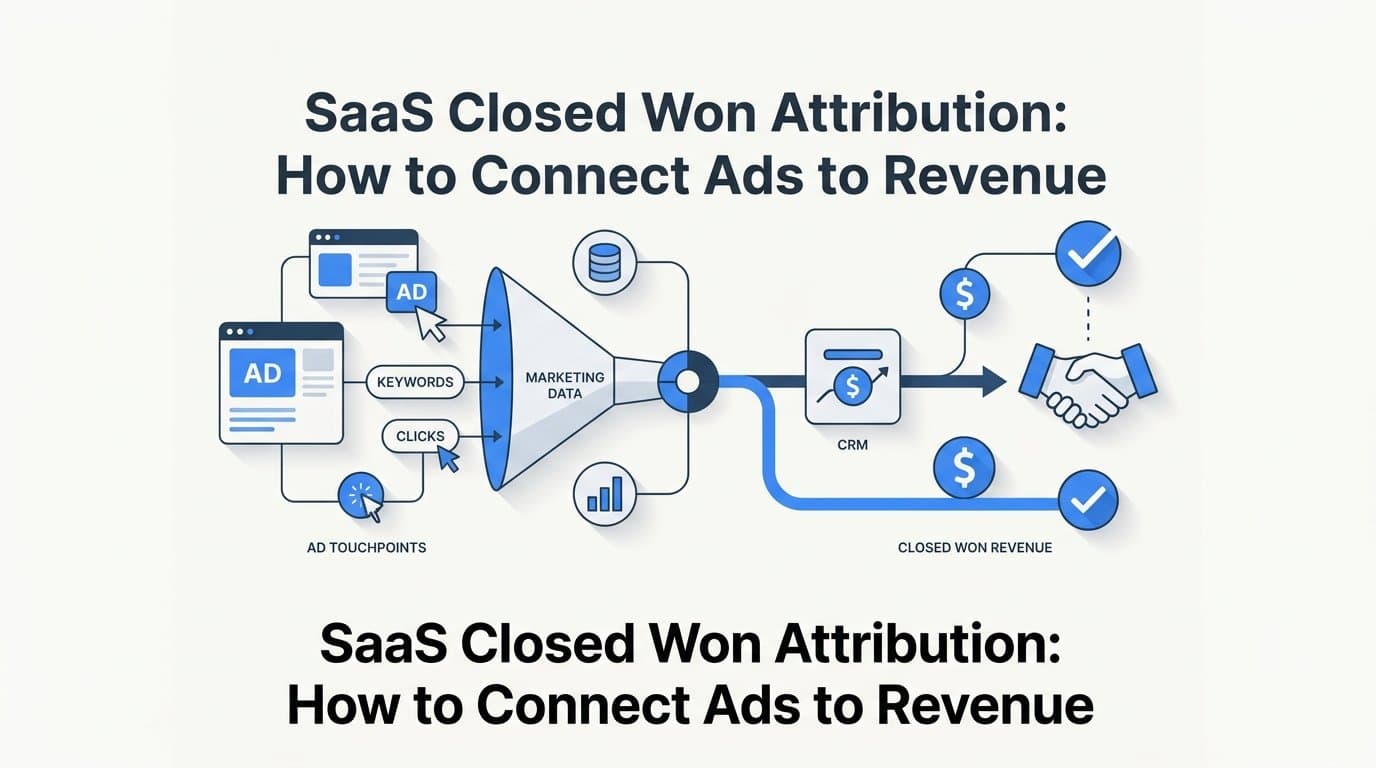
Closed won attribution changes that. It is the practice of connecting your marketing touchpoints, your ads, your campaigns, your channels, all the way through to the moment a deal is marked closed won in your CRM. It is the bridge between marketing activity and actual business outcomes, and for any growth team serious about ROI, it is not optional.
This article covers everything you need to understand about SaaS closed won attribution: why standard lead-level tracking fails, how attribution models apply to the full funnel, what technical infrastructure you need, and how to turn attribution data into smarter budget decisions. Let's start with the problem itself.
The Gap Between Leads and Revenue That Kills Marketing ROI
Most B2B SaaS marketing teams are measured on MQLs. It is a reasonable proxy metric, it is trackable, it is reportable, and it gives leadership something concrete to point to in a quarterly review. The problem is that MQLs are not revenue. They are a guess at revenue, and a surprisingly unreliable one.
Different channels and campaigns often produce leads with dramatically different close rates. A paid social campaign might generate three times the lead volume of a branded search campaign, but if those leads close at a fraction of the rate, the actual revenue contribution is inverted. Without visibility into what closes, you would scale the social campaign because the numbers look better, and you would quietly starve the channel that is actually driving revenue.
This is not a hypothetical. It is the default state for any marketing team that tracks attribution at the lead level and stops there. The optimization signal you are feeding your campaigns is disconnected from the outcome that actually matters to the business.
In most B2B SaaS CRM setups, whether that is HubSpot, Salesforce, or Pipedrive, the closed won stage is the deal stage that marks the moment a prospect converts to a paying customer. It is the most commercially significant event in the entire sales pipeline. It represents actual revenue, not potential revenue. It is the north star conversion event that marketing attribution should be built around.
When marketing teams optimize for MQLs or cost-per-lead without connecting those metrics to closed won outcomes, they are essentially flying blind. They may be generating a high volume of leads that sales cannot close, investing in channels with poor pipeline quality, or undervaluing campaigns that produce fewer but far more valuable opportunities.
The cost of this blind spot compounds over time. Budget gets funneled into channels that perform well on paper but drain resources without producing revenue. Campaigns that genuinely drive closed deals get underfunded because their lead volume looks modest. And the entire marketing operation optimizes for the wrong outcome, quarter after quarter.
Closing this gap requires connecting your ad data to your CRM's closed won stage. That is the foundation of effective SaaS closed won attribution, and it starts with understanding what that attribution process actually involves.
Tracing Deals Back to Their Marketing Origins
Closed won attribution is the process of tracing a closed deal back to the specific marketing touchpoints that influenced it across the entire customer journey. That sounds straightforward, but in B2B SaaS, it is anything but simple.
Unlike e-commerce attribution, where a customer might see an ad, click through, and purchase in a single session, B2B SaaS deals typically unfold over weeks or months. A prospect might encounter a LinkedIn ad, read a blog post, attend a webinar, receive a nurture email, search your brand name, and then book a demo before ever talking to sales. Each of those interactions played a role in moving the deal forward. A single-touch attribution model will credit exactly one of them and ignore the rest.
This is why closed won attribution in B2B SaaS is inherently multi-touch. The buying journey involves multiple interactions across multiple channels, often across multiple devices, and sometimes involving multiple stakeholders from the same organization. Any attribution approach that ignores this complexity will produce a distorted picture of what is actually driving revenue.
The data required to do this correctly spans multiple systems. Your ad platforms hold impression and click data. Your website analytics capture session behavior and conversion events. Your CRM stores lead records, contact activity, opportunity stages, and deal outcomes. And your revenue data, whether from Stripe, your billing system, or your CRM, tells you what a closed deal is actually worth.
Connecting these systems is the core technical challenge of closed won attribution. Each platform uses its own identifiers, its own session logic, and its own conversion definitions. A lead in HubSpot is not automatically linked to the Google Ads click that brought them to your site. A closed won deal in Salesforce does not automatically know which LinkedIn campaign touched that contact six weeks before they booked a demo.
Building that connection requires deliberate infrastructure: UTM parameters that persist through form submissions, CRM integrations that pull deal stage data into your attribution layer, and identity resolution logic that matches ad click data to CRM records using consistent identifiers. Without these pieces in place, closed won attribution remains aspirational rather than operational.
The good news is that once these systems are connected, the clarity you gain is significant. You move from reporting on lead volume to reporting on revenue influence. You can see not just which campaigns generated leads, but which campaigns generated deals that actually closed.
Why Standard Attribution Models Fall Short for Long Sales Cycles
Understanding closed won attribution also means understanding the limitations of the attribution models that most teams default to. The two most common, last-click and first-touch, were designed for simpler buying journeys. Applied to B2B SaaS sales cycles, they produce systematically misleading results.
Last-click attribution assigns 100% of the credit for a conversion to the final touchpoint before the deal closed. In practice, that is often a branded search, a direct visit, or a demo booking page. This model systematically undervalues every earlier touchpoint that built awareness, established credibility, and moved the prospect through the funnel. If your LinkedIn ads are introducing your product to prospects who later convert through branded search, last-click attribution will credit Google and ignore LinkedIn entirely. You might cut your LinkedIn budget based on data that is simply wrong.
First-touch attribution has the opposite problem. It gives all the credit to the initial interaction and ignores everything that happened afterward. For a deal that took four months to close and involved a webinar, three nurture emails, a sales call, and a free trial, first-touch attribution credits whatever ad or channel brought the prospect to your site on day one. The nurturing work that actually moved the deal forward gets no recognition.
Multi-touch attribution models are far better suited to the realities of B2B SaaS sales cycles. They distribute credit across multiple touchpoints rather than concentrating it in one place.
Linear attribution gives equal credit to every touchpoint in the journey. It is simple and inclusive, though it does not differentiate between a touchpoint that was pivotal and one that was incidental.
Time decay attribution gives more credit to touchpoints that occurred closer to the closed won event. This reflects the intuition that interactions near the decision point matter more, though it can undervalue early awareness efforts that initiated the buying journey.
Data-driven attribution uses algorithmic modeling to distribute credit based on actual conversion patterns in your data. It is the most sophisticated approach and, when you have sufficient data volume, the most accurate. Rather than applying a fixed rule, it learns which touchpoints and sequences are most predictive of closed won outcomes.
For most B2B SaaS teams, the right starting point is a multi-touch model, either linear or time decay, that captures the full journey. As data volume grows, moving toward data-driven attribution provides a more precise picture of what is actually influencing closed deals.
Building the Technical Foundation for Closed Won Tracking
Knowing which attribution model to use is only half the equation. The other half is making sure your data infrastructure can actually support it. Closed won attribution requires a reliable data pipeline that connects your ad platforms, your website, and your CRM in a way that preserves identity across every step of the journey.
The starting point is UTM parameter tracking. Every ad click should carry UTM parameters that identify the source, medium, campaign, and ad. Those parameters need to persist through your entire funnel, from the landing page through the form submission, and into the CRM record that gets created for that lead. If UTMs are dropped at any point in that chain, you lose the ability to connect a closed deal back to the ad that started the journey.
This sounds basic, but it is one of the most common failure points in B2B SaaS attribution setups. Forms that do not capture hidden UTM fields, CRM integrations that do not map those fields to contact records, or deal records that do not inherit attribution data from the associated contact, any of these gaps will silently corrupt your closed won attribution data.
Server-side tracking and Conversion API integrations are the next critical layer. Browser-based pixels miss a significant portion of user activity due to ad blockers, iOS privacy restrictions, and cross-device behavior. A prospect who clicks your LinkedIn ad on their phone and later fills out a form on their laptop may look like two separate users to a client-side tracking setup. Server-side tracking, combined with first-party identifiers, allows you to connect those sessions and build a more complete picture of the customer journey.
First-party data enrichment is what ties everything together. When a deal closes in your CRM, your attribution system needs to be able to match that deal record back to the ad click data that started the journey. This requires consistent identifiers, typically email addresses or CRM contact IDs, that can be used to link records across your ad platforms, your website analytics, and your CRM.
Identity resolution is not a one-time setup. It requires ongoing maintenance as your tech stack evolves, as privacy regulations shift, and as your sales process changes. But the investment is worth it. When your data pipeline is solid, closed won attribution becomes a reliable source of truth rather than an approximation.
From Attribution Data to Smarter Budget Decisions
Once closed won attribution is in place, the way you think about marketing performance changes fundamentally. You stop asking which campaigns generated the most leads and start asking which campaigns generated the most revenue. Those are very different questions, and they often have very different answers.
The most immediate benefit is the ability to calculate true cost-per-acquisition based on closed won deals rather than leads. Cost-per-lead is a proxy metric. It tells you how efficiently you are generating pipeline volume, but it says nothing about pipeline quality. Cost per closed won deal tells you how much you are actually paying for revenue, and it is the metric that should inform budget allocation decisions.
Pipeline attribution reporting takes this further. Rather than just counting leads by source, you can see the revenue value associated with deals at each stage of the pipeline, broken down by the campaigns and channels that influenced them. This allows you to identify which sources are generating deals that actually close, and which are producing high-volume but low-quality pipeline that consumes sales resources without converting to revenue.
The metrics that matter most in this view include revenue influenced per channel, close rate by lead source, pipeline velocity by channel, and return on ad spend calculated against closed revenue rather than lead volume. These numbers tell a story that cost-per-lead simply cannot.
AI-driven attribution platforms add another layer of value by surfacing patterns in closed won data that would be difficult to identify manually. Which campaign sequences correlate with faster deal velocity? Which ad creatives appear most frequently in the journeys of high-value accounts? Which channels contribute most to deals above a certain contract value? These are the kinds of insights that turn attribution from a backward-looking reporting function into a forward-looking growth lever.
With this data in hand, budget decisions become defensible and precise. You can shift spend toward channels with strong closed won performance, pause campaigns that generate leads but not revenue, and test new channels with a clear framework for evaluating their contribution to actual pipeline.
Putting Closed Won Attribution to Work With Cometly
The technical requirements for closed won attribution are real, and assembling the data pipeline manually, stitching together ad platforms, CRM data, and website behavior, is a significant undertaking. This is exactly the problem Cometly is built to solve.
Cometly connects your ad platforms, CRM, and website into a single attribution view, making it possible to see which specific ads and channels contributed to closed won deals without manual data stitching or custom integrations. From first ad click through trial, opportunity, and closed won, the entire customer journey is tracked and attributed in one place.
With Cometly's pipeline and revenue attribution, B2B SaaS marketing teams can move beyond lead-level reporting and start reporting on what actually matters: influenced pipeline, close rates by source, and revenue tied directly to ad spend. Marketing gets a seat at the revenue table because the data finally supports that conversation.
Cometly also addresses the signal loss problem that affects browser-based tracking. Through server-side conversion tracking and Conversion API integrations with Meta, Google, and other ad platforms, Cometly captures touchpoints that client-side pixels miss, giving your attribution model a more complete and accurate dataset to work with.
And because Cometly sends enriched, conversion-ready events back to ad platforms, your closed won attribution data does not just inform your internal reporting. It feeds directly into the machine learning algorithms that power ad platform targeting and optimization. When Meta and Google receive closed won conversion signals rather than just form fills, they can optimize toward higher-quality leads, creating a feedback loop that improves targeting over time and reduces your cost per closed deal.
Cometly's AI layer surfaces patterns across your closed won data, identifying which campaigns to scale, which to pause, and where to test new spend. Attribution becomes not just a measurement tool but an active input into campaign strategy.
The Bottom Line on SaaS Closed Won Attribution
Closed won attribution is not a nice-to-have for B2B SaaS marketing teams. It is the foundation of any marketing operation that takes revenue seriously. Optimizing for leads without tracking what closes is optimizing for the wrong outcome, and the cost of that misalignment compounds with every dollar you spend scaling the wrong campaigns.
The core insight is simple: the conversion event that matters most to your business is not the form fill or the MQL. It is the moment a deal closes and revenue is recognized. Your attribution model should be built around that event, and every budget decision should be informed by data that connects ad spend to that outcome.
Start by auditing your current attribution setup. Ask whether your UTM parameters persist through to your CRM. Ask whether your deal records carry the attribution data needed to trace them back to the ads that started the journey. Ask whether your reporting shows you close rates and revenue by channel, or just lead volume. The answers will tell you how far your current setup is from true closed won attribution.
If the gaps are significant, the path forward starts with the right infrastructure. Get your free demo and see exactly which ads are driving your closed won deals, so every budget decision you make is grounded in real revenue data.