If you've ever sat in a pipeline review where marketing points to lead volume and sales points to close rates and neither team can agree on what's actually working, you already know the problem. Most SaaS companies don't have a marketing problem or a sales problem. They have an alignment problem, and it's costing them pipeline, revenue, and growth velocity.
The tension is structural. Marketing optimizes for MQLs. Sales optimizes for closed deals. Leadership tries to reconcile two different scorecards and ends up making budget decisions based on incomplete data. Meanwhile, the customer journey, which spans weeks or months and touches a dozen different channels, gets no single owner.
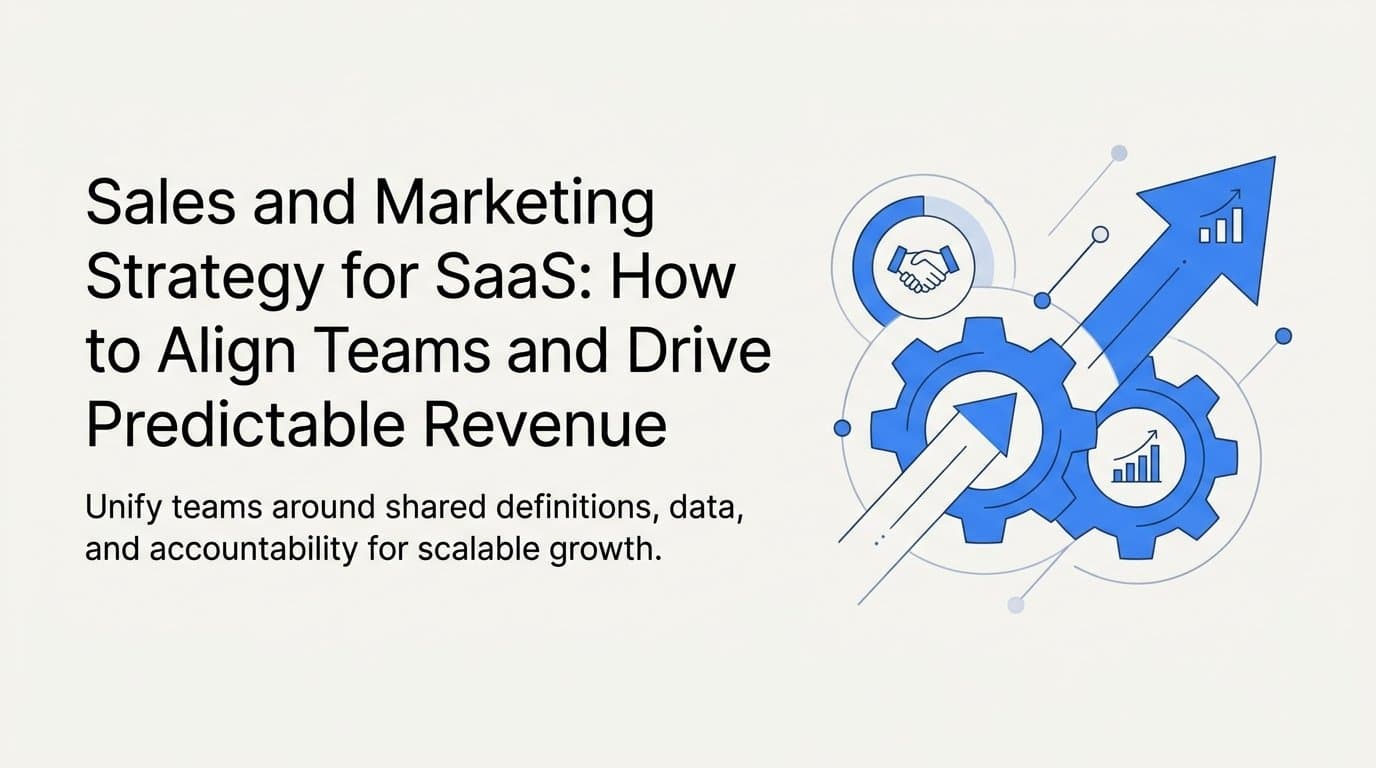
A winning sales and marketing strategy for SaaS isn't about finding the right campaign tactic or the hottest new channel. It's about building a connected system where both teams share definitions, share data, and share accountability for revenue outcomes. That shift, from parallel tracks to a unified go-to-market motion, is what separates SaaS companies that scale predictably from those that plateau.
This article breaks down the core pillars of that system: ICP alignment, funnel structure, channel strategy, attribution, and the metrics that actually matter. If you're a growth leader or marketing director who's tired of guesswork, this is the framework to build from.
Why SaaS Demands a Different Go-to-Market Approach
SaaS revenue doesn't work like a transactional business. When a customer signs, that's not the finish line. It's the starting line. ARR compounds when customers expand. NRR tells you whether your product and your go-to-market motion are delivering enough value to justify renewal and upsell. That retention-first reality changes everything about how you should approach sales and marketing from day one.
Subscription models also mean that the cost of acquiring the wrong customer is amplified. A poor-fit customer who churns at month six doesn't just cost you the CAC you spent acquiring them. They cost you the revenue you expected to retain, the support resources they consumed, and the opportunity cost of a sales rep who closed them instead of a better-fit account.
This is why the misalignment between sales and marketing in SaaS is so damaging. It's not a personality conflict or a communication failure. It's a structural incentive problem. Marketing is typically measured on lead volume and MQL counts. Sales is measured on closed revenue. These two scorecards don't naturally converge, so each team optimizes for its own number while the handoff between them becomes a friction point.
Marketing generates leads that sales ignores. Sales complains about lead quality. Marketing argues the leads are fine and sales isn't following up. Neither team has the data to prove their case because they're each looking at different systems with different definitions.
The fix isn't a better SLA or a monthly sync meeting. The fix is treating the entire funnel as a shared system with shared definitions, shared data, and shared accountability for pipeline and revenue. That requires both teams to agree on what a qualified opportunity actually looks like, what signals indicate buying intent, and how success gets measured at every stage of the funnel.
When that foundation is in place, sales and marketing stop being two separate departments handing off a baton. They become one revenue team working from the same playbook.
Building an ICP That Both Teams Actually Use
Most SaaS companies have an ICP document somewhere. Few have one that sales reps reference before outreach or that marketing teams use to make targeting decisions. The gap between having an ICP and operationalizing it is where a lot of pipeline gets wasted.
For B2B SaaS, a useful ICP goes well beyond demographics. Firmographic data matters: company size, industry, growth stage, funding status, and tech stack all signal whether a prospect is likely to need your product and have the budget and infrastructure to use it. But firmographics alone don't tell you whether someone is ready to buy.
Behavioral signals are where intent lives. How does your best-fit customer evaluate tools? Who owns the budget decision? Who are the internal champions and blockers? What does their evaluation process look like, and how long does it typically take? These questions, answered by your own closed-won data, shape an ICP that reflects reality rather than aspiration.
Outcome-based criteria are the third layer. What does success look like for your ideal customer in the first 90 days? If you can define that clearly, marketing can build messaging around that outcome and sales can qualify faster by asking whether a prospect's goals match what your product actually delivers.
Positioning is where ICP clarity pays off in both directions. When marketing and sales share the same positioning framework, ads attract the right buyers and sales conversations move faster because prospects arrive pre-educated on the value proposition. The rep isn't starting from zero. They're continuing a conversation that marketing already started.
Segmenting your ICP by funnel stage adds another layer of utility. A prospect who just discovered your category needs different content than one who is actively evaluating vendors. Marketing can map content to each stage of the decision journey, and sales can prioritize outreach based on engagement signals that indicate genuine buying intent rather than casual curiosity.
The ICP should also be a living document. Refine it regularly based on which customers close fastest, expand most, and churn least. That feedback loop between sales outcomes and marketing targeting is one of the highest-leverage activities a SaaS revenue team can run.
Structuring the Funnel from Awareness to Closed-Won
A clear funnel structure isn't just an organizational chart for leads. It's a shared operating model that tells both teams what needs to happen at each stage, who owns it, and what the handoff criteria look like. Without explicit entry and exit criteria at each stage, leads fall through gaps and nobody knows where they went.
The four core stages for most SaaS funnels are Awareness, Consideration, Evaluation, and Decision. Each stage requires different content, different channels, and different triggers for moving a prospect forward or handing them to sales.
Awareness: The prospect has a problem but may not know your product exists. This is where paid social, content marketing, and SEO do their heaviest lifting. Success here is measured by reach, engagement, and whether you're attracting the right firmographic profile.
Consideration: The prospect is actively researching solutions. This is where comparison content, case studies, and webinars perform well. Marketing's job is to build enough credibility and education that the prospect moves toward an evaluation conversation.
Evaluation: The prospect is comparing vendors. Demo requests, free trial sign-ups, and direct sales conversations happen here. This is the critical handoff zone where marketing context, which pages they visited, which ads they clicked, which content they consumed, needs to flow to sales so reps can have informed conversations.
Decision: The prospect is negotiating terms or finalizing a choice. Sales owns this stage, but marketing can support with ROI calculators, implementation guides, and customer success stories that reduce friction.
Lead scoring only works when it's built on real behavioral data. A lead who downloaded a whitepaper and visited your pricing page three times is meaningfully different from one who downloaded the same whitepaper and never returned. The behavioral context is what separates a marketing-qualified lead from a sales-ready one.
For companies running a product-led growth motion alongside a sales-led approach, the funnel needs an additional layer. Free trial and freemium users are a distinct segment. They've already experienced the product, which changes the conversion conversation entirely. Nurture sequences for PLG users should focus on activation and expansion, not awareness and education. Sales outreach to high-usage trial accounts is a fundamentally different motion than cold outbound, and the funnel structure should reflect that distinction.
Channel Strategy and Paid Acquisition That Drives Pipeline
Channel strategy in SaaS isn't about being everywhere. It's about being visible to the right buyers at the right stage of their decision journey, with enough frequency to stay relevant across a long buying cycle.
For most B2B SaaS companies, the strongest paid acquisition mix combines Google Search for high-intent, bottom-funnel capture, LinkedIn Ads for audience-based targeting and awareness, and Meta Ads for retargeting and mid-funnel nurture. The specific weighting depends on your deal size, sales cycle length, and where your ICP spends time.
Google Search captures buyers who are actively searching for a solution. These prospects are already in evaluation mode, which makes search a strong driver of demo requests and trial sign-ups. The challenge is that search volume for specific SaaS categories can be limited, which means search alone rarely scales to fill a full pipeline.
LinkedIn Ads allow you to target by job title, company size, industry, and seniority, which makes them particularly effective for reaching buying committees in B2B. The CPCs tend to be higher than other channels, but the audience precision often justifies the cost for enterprise-focused SaaS companies.
Meta Ads are often underestimated in B2B. For retargeting audiences who have already visited your site or engaged with your content, Meta can be a cost-effective way to stay visible during a long consideration phase. The key is using it for what it does well: reinforcing awareness and driving return visits, not as a primary acquisition channel.
Budget allocation decisions should be driven by pipeline contribution, not surface-level metrics like impressions or click-through rate. A campaign that generates strong CTR but produces leads that never advance past the first sales call is not performing, regardless of what the ad platform dashboard shows. This is where the connection between ad data and CRM outcomes becomes critical.
Retargeting and nurture sequences are especially important in SaaS because buying cycles stretch across months. A prospect who clicks an ad in month one may not be ready to request a demo until month three. Staying visible across channels during that window, with content that matches where they are in their decision process, is what keeps your product in the consideration set when they're finally ready to act.
Attribution: The Infrastructure Behind Smarter Decisions
Attribution is where most SaaS marketing operations break down, and the consequences are significant. Without accurate attribution, budget decisions are based on incomplete data, high-performing channels get underfunded, and low-performing ones continue to consume spend because nobody can prove they're not working.
Single-touch attribution models are especially misleading in SaaS. First-click attribution gives all the credit to the channel that generated initial awareness, ignoring every touchpoint that educated and nurtured the prospect over the following weeks. Last-click attribution does the opposite, crediting the final touchpoint while ignoring everything that built the relationship before it. In a buying journey that spans multiple channels and multiple months, both models systematically misrepresent how pipeline actually gets created.
Think about a typical SaaS buying journey. A prospect first encounters your brand through a LinkedIn ad. They visit your site, read two blog posts, and leave. Two weeks later, they see a retargeting ad on Meta and watch a product demo video. A month after that, they search for your brand name on Google, click a paid search ad, and request a demo. Last-click attribution gives all the credit to Google. First-click gives it all to LinkedIn. Neither tells the real story.
Multi-touch attribution distributes credit across all the touchpoints that contributed to a conversion. Models like linear attribution, time-decay, and data-driven attribution each weight touchpoints differently, but all of them provide a more accurate picture of channel contribution than single-touch models. This shared view is what allows sales and marketing to have productive conversations about which channels are working and where budget should go.
The step most SaaS companies skip is connecting attribution data to CRM outcomes. Knowing which channels drive leads is useful. Knowing which channels drive leads that actually close into revenue is transformative. Without that connection, marketing optimizes for lead volume while sales optimizes for deal quality, and the gap between the two creates the exact misalignment that kills pipeline.
Platforms like Cometly are built specifically to close this gap. By connecting ad platform data to CRM events and closed-won revenue, Cometly gives SaaS marketing and sales teams a single, accurate view of which campaigns and channels are actually contributing to pipeline and revenue, not just clicks and form fills. That connection is what makes attribution actionable rather than academic.
Metrics That Force Sales and Marketing to Work Together
The metrics you choose to measure determine the behaviors you incentivize. If marketing is measured on MQL volume, they'll optimize for MQL volume. If that optimization produces leads that sales doesn't convert, the metric is creating the wrong behavior. Replacing MQL-centric measurement with pipeline-contribution metrics is one of the highest-leverage changes a SaaS revenue team can make.
Marketing Sourced Pipeline (MSP) measures the total pipeline value originated by marketing campaigns. It forces marketing to think downstream and gives sales leaders visibility into marketing's actual revenue impact, not just its lead generation output.
Marketing Influenced Pipeline (MIP) captures pipeline where marketing had at least one touchpoint, even if sales sourced the initial conversation. This metric is important for understanding the supporting role that content, retargeting, and nurture play in deals that might otherwise appear to be purely sales-sourced.
Cost Per Opportunity (CPO) is a more meaningful efficiency metric than cost per lead for SaaS teams. A lead that never becomes a sales opportunity has no pipeline value. CPO forces marketing to account for lead quality, not just lead volume.
Sales Velocity measures how quickly deals move through the pipeline. It's a metric that both teams can influence together. Marketing improves it by delivering better-educated prospects who arrive at sales conversations with context and intent. Sales improves it by tightening qualification and reducing time spent on poor-fit accounts. Tracking it jointly creates shared accountability for deal progression, not just deal creation.
Reporting cadence matters as much as the metrics themselves. Weekly pipeline reviews that bring together marketing and sales data, reviewed by both teams in the same room, create the feedback loops needed to catch underperforming campaigns or misaligned messaging before they become expensive problems. When both teams see the same data at the same time, attribution debates get replaced by optimization conversations.
The LTV:CAC ratio and Time to Close round out the core measurement framework. LTV:CAC tells you whether your go-to-market motion is efficient at a unit economics level. Time to Close tells you whether your funnel is accelerating or stalling. Both metrics improve when sales and marketing are aligned on ICP, messaging, and channel strategy.
Scaling Without Guessing: How Data Makes Growth Sustainable
Scaling ad spend without accurate attribution is one of the most common and costly mistakes in SaaS growth. The logic seems straightforward: if a channel is generating leads, spend more. But if those leads aren't converting to pipeline and closed revenue, scaling that channel just accelerates the waste. Before increasing budget on any channel, the first question should always be whether that channel is generating pipeline and revenue, not just leads.
This is where AI-driven insights create a genuine advantage. At scale, human analysts can review campaign performance and identify obvious patterns. But the patterns that drive the most leverage, which ad creatives attract buyers who convert fastest, which audience segments have the highest LTV, which channels produce the lowest cost per closed deal, often only emerge from data sets that are too large and too interconnected to analyze manually.
Cometly's AI-driven recommendations surface these patterns automatically, giving marketing teams the signal they need to scale with confidence rather than intuition. Instead of asking "which campaign looks best in the dashboard," you can ask "which campaign produces the most revenue per dollar spent" and get a data-backed answer.
A single source of truth for marketing and sales data is the infrastructure that makes scaling sustainable. When both teams are working from the same data set, with the same definitions and the same view of the customer journey, decisions are faster, internal debates are shorter, and the feedback loop between campaign performance and revenue outcomes runs continuously rather than quarterly.
Server-side tracking and Conversion API integrations also matter here. As browser-based tracking becomes less reliable due to privacy changes and ad blockers, server-side data collection ensures that conversion events are captured accurately. Feeding enriched, accurate conversion data back to ad platforms like Meta and Google improves their targeting algorithms, which compounds over time into better audience matching and lower acquisition costs.
The companies that scale predictably in SaaS aren't the ones with the biggest budgets. They're the ones with the clearest data, the tightest alignment between sales and marketing, and the systems to turn that data into decisions quickly.
Putting It All Together
A strong sales and marketing strategy for SaaS isn't a collection of tactics. It's a connected system built on ICP clarity, a structured funnel with shared ownership, a channel strategy driven by pipeline contribution, accurate multi-touch attribution, and metrics that align both teams around revenue rather than activity.
Each pillar reinforces the others. A sharp ICP improves channel targeting. Better channel targeting produces higher-quality leads. Accurate attribution tells you which channels to scale. Shared metrics create accountability that sustains alignment over time. When these elements work together, growth stops feeling like guesswork and starts feeling like a repeatable process.
The gap most SaaS teams need to close isn't strategic. They understand the framework. The gap is operational: connecting ad spend data to CRM outcomes, building attribution models that reflect the real buying journey, and giving both teams a single source of truth to work from.
That's exactly what Cometly is built to do. From multi-touch attribution across every channel to real-time pipeline analytics and AI-driven recommendations for scaling, Cometly gives B2B SaaS teams the data infrastructure to execute this strategy with confidence. If you're ready to stop optimizing for leads and start optimizing for revenue, Get your free demo and see how Cometly connects every touchpoint to closed-won revenue.