Selling software as a service is fundamentally different from selling almost anything else. When someone buys a piece of hardware or a one-time license, the transaction is complete. With SaaS, the sale is just the beginning. Your customer decides, month after month, whether your product is still worth paying for. That ongoing relationship changes everything about how marketing has to work.
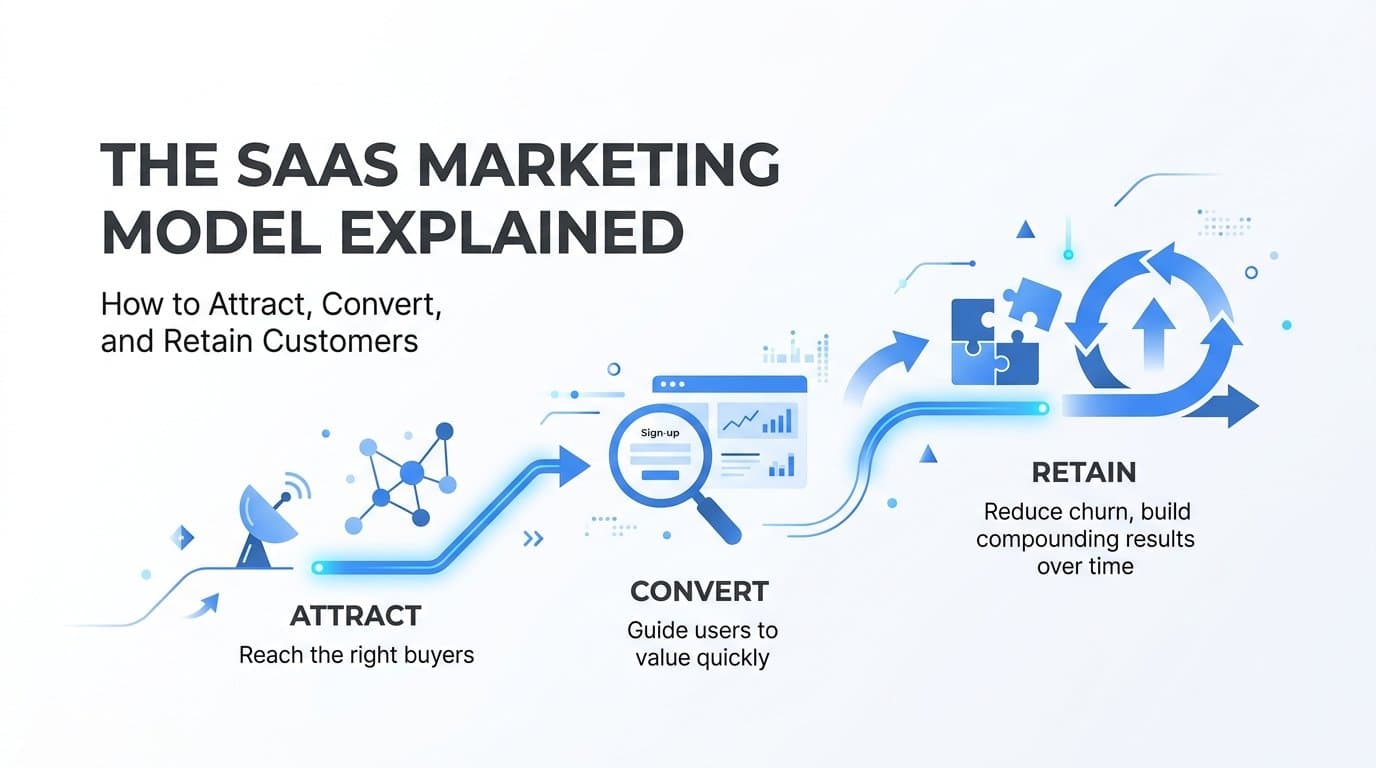
Traditional product marketing is built around a moment: create desire, drive purchase, celebrate the conversion. SaaS marketing is built around a system: attract the right buyers, guide them to value quickly, and give them enough reasons to stay and grow with you. The metrics are different, the channels overlap in unexpected ways, and the consequences of getting acquisition wrong show up months later as churn.
For growth-focused marketing teams, understanding the SaaS marketing model is not optional background knowledge. It is the foundation for every campaign decision, budget allocation, and performance conversation you will have. Get it right, and your marketing compounds over time. Get it wrong, and you end up with impressive top-of-funnel numbers that quietly hollow out your recurring revenue.
This guide walks through the key pillars of the SaaS marketing model: how it differs from traditional marketing, how the funnel actually works, which channels drive sustainable growth, which metrics tell the real story, why attribution is the piece most teams get wrong, and how to build a model that scales. Let's get into it.
Why SaaS Marketing Operates Differently From Traditional Marketing
The most important shift in SaaS marketing is what you are actually optimizing for. In traditional product marketing, success is measured at the point of purchase. A customer buys, revenue is recognized, and the marketing team moves on to the next prospect. In SaaS, that purchase moment is just the start of a long revenue relationship that can grow, shrink, or disappear entirely depending on what happens next.
This is why customer lifetime value sits at the center of every healthy SaaS marketing model. The question is never just "how much did it cost to acquire this customer?" It is "how much did it cost relative to how long they stay and how much they spend?" A high acquisition cost can be completely justified if customers expand over time. A low acquisition cost becomes a problem if those customers churn after ninety days.
SaaS buyers also behave differently from impulse or transactional purchasers. In B2B SaaS especially, the buying journey is long and research-intensive. Buyers read comparison articles, watch product demos, talk to peers, and evaluate multiple options before they ever fill out a form. In many cases, multiple stakeholders are involved, each with different priorities and objections. Marketing teams need to account for this extended evaluation period in how they build content, structure campaigns, and measure influence across the journey.
Here is something many marketing teams underestimate: churn is a marketing problem. It is easy to treat churn as a product issue or a customer success failure. But when churn is high, the root cause often traces back to acquiring the wrong customers in the first place. Broad targeting, misleading messaging, or campaigns optimized for volume rather than fit all bring in users who were never going to find lasting value in the product.
This makes ideal customer profile alignment a core marketing responsibility. If your campaigns are attracting buyers who do not match the profile of customers who actually succeed with your product, you are not just wasting acquisition spend. You are actively damaging your unit economics by inflating churn, increasing support load, and reducing the net revenue retention that makes SaaS businesses compound over time.
The practical implication is that SaaS marketing teams need to work closely with customer success and product teams to understand who the best customers actually are, and then build campaigns that attract more of them. That feedback loop between retention data and acquisition strategy is one of the defining characteristics of a mature SaaS marketing operation.
The Core Funnel: From Awareness to Activation
The SaaS funnel is often described in simple terms: awareness, consideration, conversion. But that framing misses the stage that determines whether your marketing actually works. The real SaaS funnel runs from awareness through consideration, into trial or demo, then activation, and finally expansion. Each stage requires completely different messaging, different channels, and different conversion goals.
At the top of the funnel, your job is to reach buyers who are experiencing the pain your product solves, whether or not they are actively searching for a solution yet. This is where content marketing, paid search, and social advertising do their heaviest lifting. A buyer who just realized they have a problem needs educational content that validates their experience and starts building your brand's authority. A buyer actively comparing solutions needs content that positions your product against alternatives and speaks directly to their evaluation criteria.
The consideration stage is where most SaaS buyers spend the majority of their time. They are reading documentation, watching demo videos, exploring pricing pages, and talking to peers. Your marketing at this stage needs to reduce friction, answer objections before they become blockers, and give buyers enough confidence to take the next step, whether that is starting a trial or requesting a demo.
Trial and demo stages are where marketing hands off to product experience and sales. But marketing still plays a role here. The messaging that sets expectations before a trial starts directly shapes what users look for inside the product. If your ads promise one thing and the onboarding delivers something different, you lose users before they ever reach value.
Activation is the most underrated stage in the entire SaaS funnel. This is the moment when a user first experiences the core value of your product, the moment where something clicks and they understand why they need it. Getting users to that moment quickly is where marketing and product teams must work together. Onboarding email sequences, in-app guidance, and targeted content all play a role in reducing the time between signup and first meaningful outcome.
Why does activation matter so much for marketing? Because trial-to-paid conversion is directly tied to how many users actually reach that first value moment. If your top-of-funnel is generating thousands of trial signups but activation rates are low, you are not facing a traffic problem. You are facing an activation problem, and the messaging, targeting, and expectations set by marketing campaigns are often contributing factors.
Key Channels That Drive SaaS Growth
There is no universal channel mix for SaaS marketing. The right combination depends on your company's stage, average contract value, target buyer, and how much of your growth relies on self-serve versus sales-assisted motions. That said, there are a handful of channels that consistently appear in effective SaaS marketing models.
Paid Search: Google Ads is a primary demand capture channel for SaaS companies because it reaches buyers who are actively searching for solutions. When someone types in a query that matches your product's core use case, paid search puts you in front of them at exactly the right moment. The challenge is that this channel only captures existing demand. If buyers are not yet searching for what you sell, paid search will not find them.
Paid Social: Meta Ads and LinkedIn Ads operate differently from paid search. Rather than capturing demand that already exists, they generate it by reaching buyers before they are actively searching. This makes paid social particularly valuable for SaaS companies launching new categories, targeting niche audiences, or trying to reach buyers based on company size, job title, or industry rather than keyword intent. The tradeoff is that the conversion path is longer, which makes attribution more complex.
Organic Search and Content Marketing: Content and SEO build compounding traffic over time. By targeting keywords that align with buyer pain points at different funnel stages, from broad educational topics to specific comparison queries, SaaS companies can attract qualified visitors without paying for each click. This channel takes longer to show results but creates an asset that keeps delivering. A well-ranked piece of content can drive trial signups for years with minimal ongoing investment.
Product-Led Growth and Referral: Many modern SaaS companies use free trials or freemium models to let the product sell itself. When the product delivers clear value quickly, users become advocates who refer colleagues and share their experience. This creates a lower-cost acquisition loop that compounds as the customer base grows. Referral programs, integration marketplaces, and community-driven growth are all variations of this approach. They require a strong product and customer success foundation to work, but when they do, they significantly reduce dependence on paid spend.
The key insight across all of these channels is that they do not operate in isolation. A buyer might discover your product through a blog post, see a retargeting ad on social, attend a webinar, and then finally request a demo after reading a comparison page. Each touchpoint contributes to the conversion, even if only one gets credit in your reporting.
The Metrics That Actually Define SaaS Marketing Performance
SaaS marketing teams are often measured on metrics that do not connect to business outcomes. Impressions, clicks, and even leads can all look healthy while the underlying revenue picture tells a completely different story. The metrics that actually matter in a SaaS marketing model are the ones that connect marketing activity to recurring revenue.
Customer Acquisition Cost (CAC): This is the total marketing and sales spend divided by the number of new customers acquired in a given period. CAC is only meaningful when you track it at the channel and campaign level, not just in aggregate. Knowing your blended CAC tells you very little. Knowing that your paid search CAC is half your paid social CAC, or that one content vertical drives significantly lower CAC than another, is what drives smart budget decisions.
Customer Lifetime Value (LTV): LTV represents the total revenue you can expect from a customer over the course of their relationship with your company. The ratio of LTV to CAC is one of the most important indicators of whether a SaaS marketing model is sustainable. If you are spending more to acquire customers than they will ever generate in revenue, no amount of optimization will fix the underlying economics.
Pipeline Contribution and Lead-to-Close Rate by Source: Marketing teams should be able to show how much pipeline they generated and what percentage of that pipeline closed, broken down by channel and campaign. This moves the conversation beyond cost-per-lead and into actual revenue impact. A channel that generates expensive leads might still be your best performer if those leads close at a higher rate and expand over time.
Monthly Recurring Revenue Influence: How much new MRR can be directly connected to marketing activity? This requires connecting your ad platforms and CRM to revenue data, which most teams have not done. But it is the metric that makes marketing a revenue function rather than a cost center.
Trial-to-Paid Conversion Rate and Time-to-Activate: These product-adjacent metrics reveal whether the customers marketing is acquiring are actually the right fit. Low trial-to-paid conversion often signals a targeting or messaging problem upstream. High time-to-activate suggests that onboarding communications, which are partly a marketing responsibility, are not working hard enough to get users to first value.
Attribution: The Missing Link in Most SaaS Marketing Models
Here is the attribution problem in plain terms: a SaaS buyer touches your brand multiple times before converting. They read a blog post, click a Google Ad, watch a demo video, get retargeted on LinkedIn, and finally request a demo after seeing a testimonial. When that deal closes, which channel gets credit?
In most marketing setups, the answer is the last click. The channel that happened to be the final touchpoint before the conversion gets 100% of the credit, and every other interaction that shaped the buyer's decision gets nothing. This is not just imprecise. It actively misleads budget decisions. Channels that do important upper-funnel work, building awareness, educating buyers, keeping your brand top of mind during a long evaluation period, consistently appear to underperform because they rarely get the last click.
Multi-touch attribution solves this by distributing credit across the full customer journey. Different models weight touchpoints differently. Linear attribution gives equal credit to every touchpoint. Time-decay models give more credit to interactions closer to the conversion. Position-based models weight the first and last touches most heavily. The right model depends on your sales cycle and how you think about channel contribution, but any multi-touch model gives a more accurate picture than last-click alone.
For B2B SaaS companies with longer sales cycles, accurate attribution is especially critical. When a deal takes three to six months to close and involves multiple stakeholders, the gap between what last-click attribution shows and what actually drove the revenue can be enormous. Teams making budget decisions based on last-click data routinely over-invest in bottom-of-funnel channels while starving the upper-funnel activities that created the opportunity in the first place.
There is also a growing technical challenge. Browser-based tracking is becoming less reliable as privacy changes and ad blockers reduce the accuracy of pixel-based measurement. SaaS marketing teams increasingly need server-side tracking and Conversion APIs to send accurate conversion data back to ad platforms. This matters not just for reporting, but for campaign optimization. When Meta or Google receives incomplete conversion data, their algorithms optimize toward the wrong signals, reducing the efficiency of every campaign you run.
This is exactly where Cometly's multi-touch attribution becomes a competitive advantage for SaaS marketing teams. Rather than relying on fragmented data from individual ad platforms, Cometly connects your ad spend, CRM data, and revenue in one place, giving you a complete view of which channels and campaigns are actually driving pipeline and closed revenue across the full customer journey.
Building a SaaS Marketing Model That Scales
Scaling SaaS marketing is not about spending more. It is about having the data clarity to know where more spending will actually pay off. Most marketing teams hit a growth ceiling not because they lack ideas or budget, but because they lack a reliable system for understanding what is working and why.
The foundation of a scalable SaaS marketing model is a single source of truth for performance data. This means connecting your ad platforms, CRM, and revenue data into one place where you can see the full picture from first ad click to closed-won deal. When this connection exists, marketing teams can answer the questions that actually drive growth: Which campaigns are generating the highest-quality pipeline? Which channels produce customers with the best retention? Where is the LTV:CAC ratio strongest?
Without that unified view, teams end up making decisions based on platform-reported metrics that do not reflect business reality. A campaign might show a low cost-per-click in Google Ads while generating customers who churn after two months. A paid social campaign might look expensive on the surface while quietly driving some of your highest-value enterprise deals. You will not know the difference unless your data connects ad spend to actual revenue outcomes.
Iterating on messaging and channel mix based on real attribution data is what separates teams that compound their wins from teams that spin their wheels. When you know which messages resonate with your best customers, you can scale those messages with confidence. When you know which channels drive the highest-quality pipeline, you can shift budget toward them without second-guessing.
Cometly is built for exactly this kind of decision-making. It connects your ad platforms, CRM, and Stripe revenue data into one clear picture, surfaces the metrics that matter for SaaS growth, and uses AI to identify high-performing campaigns across every channel. It also sends enriched conversion data back to Meta and Google, improving ad platform optimization by training algorithms on real revenue signals rather than incomplete pixel data.
The organizational piece matters too. Scaling SaaS marketing requires alignment between marketing, sales, and customer success around shared pipeline and revenue metrics. When marketing is measured on leads and sales is measured on close rate and customer success is measured on retention, each team optimizes for their own number and the customer journey suffers. When all three functions share accountability for revenue and retention, the entire model becomes more efficient.
Putting It All Together
The SaaS marketing model is not a single tactic or a clever campaign. It is a connected system that spans acquisition, activation, and retention, and every part of that system affects the others. Attract the wrong buyers and churn rises. Fail to activate trial users and conversion rates suffer. Measure the wrong metrics and you scale the wrong things.
The teams that win in SaaS marketing are the ones who measure the full customer journey accurately and make decisions based on real revenue data. They know which channels drive pipeline, which campaigns attract customers who stay, and where the highest-leverage opportunities for growth actually are. That clarity comes from having the right attribution and analytics infrastructure in place.
Cometly gives SaaS marketing teams exactly that visibility. It connects your ad platforms, CRM, and revenue data into one place so you can see what is actually driving growth, not just what looks good in a dashboard. From multi-touch attribution to AI-driven campaign recommendations, it is built for the way SaaS marketing actually works.
Ready to see which campaigns are really driving your revenue? Get your free demo and start building a marketing model based on the data that actually matters.