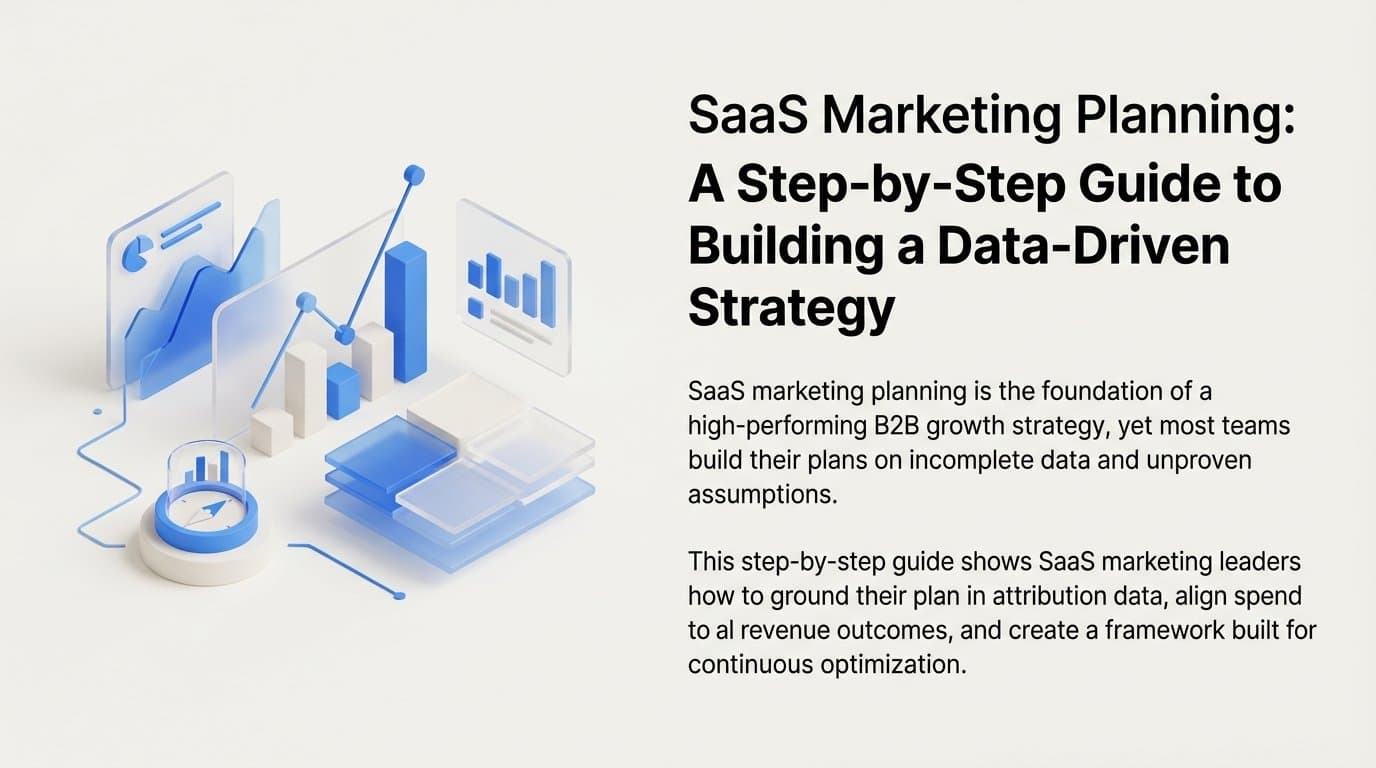
SaaS marketing planning is one of the most consequential decisions a growth team makes each year. Unlike traditional product marketing, SaaS requires a continuous, measurable approach where every channel, campaign, and dollar must connect back to pipeline and revenue.
The challenge is that most marketing teams build their plans on incomplete data, gut instinct, or last year's assumptions. They allocate budget to channels that look good on a dashboard but cannot prove they actually drove closed-won deals. The result is wasted spend, missed targets, and a marketing team that struggles to earn credibility with the CFO and CEO.
Sound familiar? You are not alone. This is the default state for most B2B SaaS marketing teams before they build a proper attribution foundation.
This guide is built for B2B SaaS marketing leaders, growth teams, and demand generation managers who want to build a marketing plan that is grounded in attribution data, aligned to revenue goals, and structured for continuous optimization. Each step is designed to be actionable and sequential, so you can move through the process in order and build on what you learn at each stage.
By the end, you will have a clear framework for SaaS marketing planning that connects ad spend to pipeline, tracks every touchpoint from first click to closed revenue, and gives your team a single source of truth for decision-making. Let's get into it.
Step 1: Audit Your Current Marketing Performance
Before you plan anything new, you need an honest accounting of what is already happening. Most SaaS marketing teams are surprised by what they find when they actually dig into the data rather than relying on dashboard summaries.
Start by pulling performance data from every active channel: paid search, paid social, organic, email, referral, and direct. The goal is not just to see which channels are generating traffic or leads. The goal is to understand which channels are contributing to pipeline and closed-won revenue.
Here is where most audits fall short. Teams look at lead volume and cost per lead, then stop. But lead volume without pipeline context is just noise. A channel that generates many leads at a low cost per lead may actually have a poor pipeline conversion rate, meaning it looks efficient on the surface but is draining budget that could go toward higher-quality sources.
As you review each channel, categorize performance across three dimensions:
Lead volume: How many leads is this channel generating, and at what cost?
Pipeline contribution: How many of those leads become qualified opportunities and enter the sales pipeline?
Closed-won revenue: How many of those opportunities convert to paying customers, and what is the average contract value?
Next, check your tracking setup. Are conversion events firing correctly on every channel? Are those events tied to actual revenue outcomes in your CRM, or are they only capturing form fills and demo requests without any downstream connection to what happens in sales?
Flag any attribution blind spots where you cannot trace a lead back to its original source or first touchpoint. These gaps are common, especially in companies that have grown quickly and layered on tools without a unified tracking strategy. Every blind spot is a place where budget decisions are being made on incomplete information.
Success indicator: You have a clear picture of which channels are generating pipeline and which are generating noise. You also have a documented list of tracking gaps that need to be resolved before your next planning cycle begins.
Step 2: Define Revenue-Aligned Marketing Goals
Once you understand your current performance baseline, you can set goals that actually mean something to the business. The key shift here is starting with the company revenue target and working backward, rather than starting with marketing activity metrics and projecting forward.
Let's say your company has a revenue target for the year. Break that down into the pipeline required to hit it, based on your historical win rate. Then calculate how many qualified opportunities marketing needs to generate, based on your sales-qualified lead to opportunity conversion rate. Finally, determine how many marketing-qualified leads are needed to produce that opportunity volume.
This backward calculation gives you a goal that is directly tied to business outcomes rather than marketing vanity metrics. It also makes conversations with your CFO and CEO much more straightforward, because every marketing goal has a clear line to a revenue number.
One distinction worth getting right early: the difference between marketing-sourced revenue and marketing-influenced revenue. Marketing-sourced means marketing was the original source of the lead. Marketing-influenced means marketing touched the account at some point, even if sales or another channel sourced it. Both matter, but conflating them inflates your apparent contribution and creates credibility problems when revenue targets are missed.
Beyond your primary revenue goal, set leading indicator metrics that give you early signals of whether you are on track:
Cost per qualified lead: This tells you whether your acquisition efficiency is improving or degrading over time.
Pipeline generated per channel: This shows which channels are actually contributing to the revenue engine, not just the top of the funnel.
Marketing-sourced revenue percentage: This tracks your overall contribution to company revenue over time.
Also factor in your sales cycle length when setting planning timelines. If your average sales cycle is four to six months, a quarterly marketing plan may not give you enough time to see the downstream impact of campaigns you launch in month one. Align your measurement windows to your actual buying cycle so you are not making premature optimization decisions based on incomplete data.
Common pitfall: Setting goals based on MQL volume without connecting them to downstream revenue creates plans that look successful on paper but miss business targets. Avoid this by requiring every goal to have both a metric and a defined measurement method tied to pipeline or revenue.
Success indicator: Every marketing goal has a direct line to a revenue number and a clear method for measuring progress against it.
Step 3: Map Your Full Customer Journey
B2B SaaS buying decisions are rarely linear. A prospect might discover your product through a Google search, read a few blog posts, see a retargeting ad on LinkedIn, visit a review site, attend a webinar, and then finally request a demo weeks later. If you only credit the demo request form, you are missing the entire story of how that customer found you.
Mapping your full customer journey is the foundation for understanding multi-touch attribution, which we will configure in the next step. But first, you need to document what that journey actually looks like for your customers.
Start with your CRM data. Look at the contact records for customers who converted to paid in the last six to twelve months. What touchpoints are recorded? Where did they first engage? What channels appear most frequently in the paths of customers who actually closed?
Document every touchpoint a prospect encounters from the first ad impression through free trial, demo request, sales handoff, and closed-won deal. Label each touchpoint by channel and funnel stage:
Awareness stage: Paid search, organic content, social ads, podcast mentions, review site listings.
Consideration stage: Retargeting ads, email nurture, webinars, case study downloads, comparison pages.
Decision stage: Demo requests, free trials, sales conversations, pricing page visits, direct outreach.
Look for patterns in your CRM data. Where do prospects tend to drop off? Where do they accelerate? Which content assets appear most frequently in the journeys of customers who converted at the highest contract values?
One important insight for B2B SaaS specifically: last-click attribution will systematically undervalue top-of-funnel channels. If you only credit the channel that drove the final conversion action, organic content and awareness-stage paid ads will always appear to underperform, even when they are the reason a prospect entered your funnel in the first place. Your journey map will make this visible and give you the evidence you need to defend investment in channels that do not always get the final click.
Success indicator: You have a documented map of the typical customer journey with touchpoints labeled by channel and funnel stage. You can identify which channels create awareness and which channels drive final conversion decisions.
Step 4: Choose and Configure Your Attribution Model
This is the step where SaaS marketing planning gets technical, but it is also where the biggest performance gains are unlocked. Your attribution model determines how credit is assigned to the touchpoints in your customer journey, and different models tell very different stories about your marketing performance.
Here is a quick overview of the core models:
First-touch attribution: Gives 100% of credit to the first touchpoint. Useful for understanding what drives initial awareness, but ignores everything that happened afterward.
Last-click attribution: Gives 100% of credit to the final touchpoint before conversion. Easy to implement, but systematically undervalues upper-funnel channels.
Linear attribution: Distributes credit equally across all touchpoints. More balanced, but treats every touchpoint as equally important regardless of its actual influence.
Time-decay attribution: Gives more credit to touchpoints that occurred closer to the conversion event. Works well for shorter sales cycles but may undervalue early-stage content in longer B2B cycles.
Data-driven attribution: Uses machine learning to assign credit based on actual conversion patterns in your data. The most accurate model, but requires sufficient data volume to produce reliable results.
For most B2B SaaS companies with longer sales cycles, a multi-touch attribution model provides a more accurate picture than first or last-click alone. The specific model you choose matters less than having a consistent model that is properly configured and connected to your actual revenue data.
Configuration is where many teams fall short. A few critical requirements:
Server-side event tracking: Browser-based tracking has become less reliable due to privacy changes across major browsers. Configure server-side tracking through tools like Meta Conversion API and Google Enhanced Conversions so that data flows directly from your server to the ad platform, bypassing browser limitations and ad blockers. This is not optional. It is the foundation of data completeness.
CRM integration: Your attribution system must connect to your CRM so that lead source data flows through to closed-won revenue without manual reconciliation. If your attribution platform cannot see what happened after the form fill, it cannot tell you which campaigns drove actual revenue.
Unified ad platform connections: Connect Google Ads, Meta Ads, LinkedIn Ads, and any other paid channels into a single attribution system. Platform-native attribution from Google Ads or Meta Ads Manager in isolation creates overlapping credit and inflated ROAS numbers because each platform takes full credit for conversions it touched.
Platforms like Cometly are built specifically for this use case. Cometly connects ad spend data from Google, Meta, and other channels directly to pipeline and revenue through 70+ native integrations, giving B2B SaaS marketing teams a single source of truth for attribution data rather than stitching together reports from multiple disconnected tools.
Success indicator: You can pull a report that shows which campaigns and ad sets contributed to closed-won deals, not just clicks or form fills. The data flows from ad platform to website to CRM without manual intervention.
Step 5: Allocate Budget Based on Pipeline Data
With your attribution model configured and producing reliable data, you can now make budget decisions based on actual pipeline contribution rather than estimated reach or impression volume. This is one of the most impactful shifts a SaaS marketing team can make.
The key metric to use for budget allocation is cost per pipeline opportunity, not cost per click or cost per lead. Cost per lead is easy to optimize for but often misleading, because lead quality varies significantly across channels. A channel that generates leads at a low cost per lead may have a poor pipeline conversion rate, meaning you are paying for volume that does not move the revenue needle.
Rank your channels by two primary metrics from your attribution data:
Cost per pipeline opportunity: How much does it cost to generate a qualified opportunity in the sales pipeline from each channel?
Cost per closed-won deal: How much does it cost to acquire a paying customer from each channel, accounting for win rates?
Shift budget toward channels with the strongest pipeline-to-revenue conversion rates, even if their top-of-funnel volume metrics appear lower than other channels. A channel that generates fewer leads but converts them at a higher rate to closed-won revenue is almost always worth more budget than a high-volume, low-quality source.
Build your budget model with three distinct allocations:
Base allocation: Budget for proven channels with documented pipeline contribution. This is your foundation and should be protected from short-term fluctuations.
Test allocation: A smaller portion of budget reserved for new channels or tactics you have not yet proven. Keep this contained so that experiments do not cannibalize proven performance.
Scale reserve: Budget set aside to accelerate campaigns that show strong early pipeline signals. Having this reserve allows you to move quickly when something is working rather than waiting for the next budget cycle.
Factor in your sales cycle length when evaluating new channel investments. A channel you start investing in today may not show pipeline impact for several months. Build this lag into your evaluation timeline so you do not pull budget from a channel before it has had time to demonstrate its contribution.
Success indicator: Your budget allocation is directly tied to historical pipeline contribution data. You can explain every budget decision by pointing to a specific cost per opportunity or cost per closed-won deal metric from your attribution reports.
Step 6: Build Your Campaign Execution Calendar
A well-structured campaign calendar is what turns a marketing strategy into a repeatable execution system. The goal is not just to schedule campaigns. It is to organize them by funnel stage, align them with sales capacity, and ensure every campaign has conversion tracking in place before it goes live.
Organize campaigns across three funnel stages:
Awareness campaigns: Target in-market audiences who fit your ideal customer profile but have not yet engaged with your brand. Paid search for high-intent keywords, social ads targeting relevant job titles and company sizes, and content distribution campaigns all belong here.
Consideration campaigns: Retargeting and nurture campaigns for prospects who have already engaged with your brand. These campaigns should reinforce your value proposition, address common objections, and move prospects toward a trial or demo request.
Conversion campaigns: Direct-response campaigns focused on trial signups, demo requests, and other high-intent conversion actions. These campaigns should be tightly targeted and closely monitored for cost per conversion.
Align campaign timing with your sales team's capacity. A demand generation spike that overwhelms your SDR team creates lead response delays that hurt conversion rates. Coordinate with sales leadership before launching large awareness campaigns so that follow-up capacity is in place.
Plan all content assets, ad creative, and landing pages before the campaign launch date. Execution delays that push a campaign live two weeks late compress your measurement window and make it harder to draw reliable conclusions from the data. Build creative production timelines into your calendar, not just launch dates.
Include structured test periods for creative and messaging experiments. Your campaign calendar should include a learning agenda alongside a delivery schedule. Allocate time and budget for A/B tests on headlines, offers, and audience segments so that your plan generates insights, not just impressions.
Most importantly: set up conversion tracking for every campaign before it goes live. Day-one data should be clean and attributable. If tracking is added after launch, you lose the early performance data that often contains the most valuable signals.
Success indicator: Every campaign on your calendar has a defined goal, a tracking setup confirmed before launch, and a scheduled measurement checkpoint with a named owner.
Step 7: Create a Continuous Optimization Loop
A SaaS marketing plan is not a document you write in January and revisit in December. It is a living system that improves over time as you accumulate data, run experiments, and feed better signals back into your channels. The final step is building the cadence and infrastructure that makes continuous optimization possible.
Start with a weekly performance review. Each week, examine pipeline generated, cost per opportunity, and channel-level ROAS using your attribution dashboard. The goal is not to make reactive changes based on a single week of data, but to identify emerging trends early enough to act on them before they compound into larger problems.
Use AI-driven insights from your attribution platform to surface performance signals faster than manual analysis allows. Modern attribution platforms like Cometly use AI to identify which ads and campaigns are outperforming or underperforming, so your team can prioritize optimization actions rather than spending hours sorting through raw data to find the signal in the noise.
Send enriched conversion data back to your ad platforms through server-side integrations. When you send high-quality conversion signals back to Meta through the Conversion API or to Google through Enhanced Conversions, you improve the machine learning models those platforms use for targeting and bidding. Over time, this creates a compounding improvement effect: better data produces better targeting, which produces better results, which produces better data. This feedback loop is one of the most powerful advantages available to SaaS marketing teams who invest in proper attribution infrastructure.
Hold a monthly attribution review to assess whether your model is accurately reflecting the customer journey. Buying behavior shifts over time. New channels emerge. Content that used to drive awareness may now be driving conversion. Revisit your attribution model weighting regularly and adjust it when you see evidence that the customer journey has changed.
Document every optimization decision and its outcome. When you pause a campaign, shift budget, or test a new creative approach, record what you did, why you did it, and what happened as a result. This institutional knowledge prevents your team from repeating the same experiments quarter after quarter and builds a compounding base of strategic insight that makes each planning cycle smarter than the last.
Success indicator: Your team can point to specific optimization decisions that improved pipeline efficiency, with before-and-after data from your attribution dashboard to support each change.
Putting It All Together
Building a SaaS marketing plan that actually works requires more than a channel mix and a budget spreadsheet. It requires a data foundation that connects every touchpoint to revenue, a goal-setting process tied to business outcomes, and a feedback loop that gets smarter over time.
Use this checklist to confirm your plan is ready to execute:
Audit complete: Current channel performance is reviewed and tracking gaps are documented.
Goals aligned: Every marketing goal is tied to pipeline and revenue, not just lead volume.
Journey mapped: The full customer journey is documented with multi-touch visibility across channels and stages.
Attribution configured: A multi-touch attribution model is connected to your CRM and ad platforms with server-side tracking in place.
Budget grounded in data: Budget allocation is based on pipeline contribution metrics, not estimated reach.
Calendar ready: Campaigns are scheduled with conversion tracking confirmed before launch.
Optimization cadence set: Weekly and monthly review schedules are in place with clear owners for each.
If you are missing any of these elements, start with the audit in Step 1 and build forward. Each step reinforces the next, and the entire system becomes more valuable as your data accumulates.
Cometly is built to support every stage of this process, from capturing first-touch data across 70+ integrations to connecting ad spend to closed-won revenue in real time. When your marketing plan is backed by accurate attribution, every decision becomes faster, more confident, and more defensible to the stakeholders who matter most.
Ready to build a marketing plan backed by real attribution data? Get your free demo today and see how Cometly connects every touchpoint to revenue so your team always knows what is working.