You're spending real budget on paid campaigns. Your team is generating leads. The dashboard shows clicks, impressions, and cost-per-lead trending in the right direction. And yet, when your CFO asks which channels are actually driving revenue, you hesitate. Because the honest answer is: you're not entirely sure.
This is the defining frustration for B2B SaaS marketing leaders right now. The data exists, but it's fragmented. Your ad platforms tell one story. Your CRM tells another. And somewhere in the gap between a prospect clicking a LinkedIn ad and a deal closing six weeks later, the attribution thread gets lost entirely.
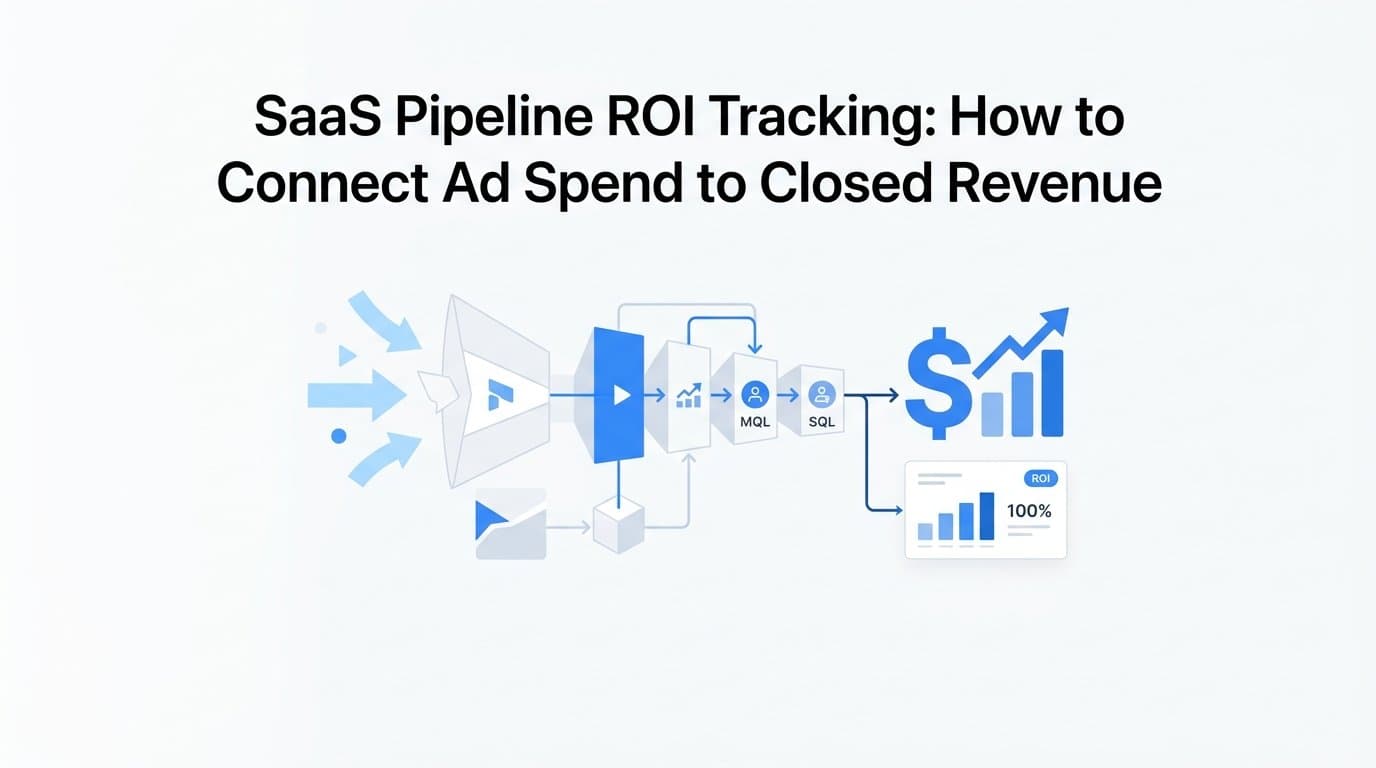
Vanity metrics like clicks and impressions are easy to report but nearly impossible to connect to closed revenue. That disconnect doesn't just create reporting headaches. It leads to misallocated budgets, scaled-up campaigns that don't actually drive pipeline, and a marketing function that struggles to justify its investment in the language of finance and leadership. SaaS pipeline ROI tracking is the discipline that closes this gap. This guide breaks down what it means, how it works, and how to build a system that connects every ad dollar to real revenue outcomes.
Why Standard Marketing Metrics Fall Short for SaaS Revenue Goals
There's a fundamental mismatch in how most marketing teams measure success versus how the rest of the business evaluates it. Marketing reports on MQLs, click-through rates, cost-per-lead, and form fill volume. Sales cares about qualified opportunities and pipeline coverage. Finance wants to know CAC payback period, revenue influenced, and whether marketing investment is generating a return.
These aren't just different ways of looking at the same data. They're measuring entirely different things. A campaign that generates hundreds of MQLs at a low cost-per-lead might look like a win on a marketing dashboard while contributing almost nothing to closed-won revenue. Without the infrastructure to connect those leads to pipeline outcomes, you have no way to know the difference.
B2B SaaS makes this problem significantly harder than most industries. Sales cycles are long, often spanning weeks or months. Multiple decision-makers are involved. A single prospect might engage with a LinkedIn thought leadership post, then a Google search ad, then a retargeting campaign, then a direct visit to your pricing page before ever talking to sales. Standard last-click attribution would credit only that final touchpoint, making your retargeting campaign look like a hero while completely ignoring the awareness channels that started the journey.
The practical consequence of this blind spot is budget misallocation at scale. When you can't trace pipeline and revenue back to specific campaigns, you end up optimizing for the metrics you can see rather than the outcomes that actually matter. Channels that generate high-quality pipeline but operate earlier in the funnel get defunded. Channels that produce easy-to-track form fills but attract poor-fit leads get scaled up. Over time, this compounds into a real competitive disadvantage.
Companies that have solved this problem can make confident, data-backed decisions about where to invest next quarter. They know which channels produce the highest-quality pipeline, which campaigns shorten sales cycles, and which audiences convert at the best rates. That kind of clarity is not a luxury for high-growth SaaS teams. It's a prerequisite for sustainable, efficient growth.
Defining Pipeline ROI Tracking in a SaaS Context
Pipeline ROI tracking is the practice of connecting marketing touchpoints across the full customer journey to pipeline stages and closed-won revenue, rather than stopping at lead volume or cost-per-acquisition. It answers a fundamentally different question than standard marketing analytics: not "how many leads did we generate?" but "which campaigns and channels actually drove revenue?"
To do this well, it helps to understand the distinction between two related but separate concepts: pipeline attribution and revenue attribution.
Pipeline Attribution: This looks at which campaigns and channels influenced deals that are currently open in your pipeline. It helps you understand which marketing efforts are creating opportunities, even if those deals haven't closed yet. This is a leading indicator of future revenue.
Revenue Attribution: This connects marketing touchpoints to deals that have already closed. It's a lagging indicator that tells you, with certainty, which campaigns drove actual closed-won outcomes. This is the data that finance and leadership ultimately care about.
B2B SaaS teams need both views running simultaneously. Pipeline attribution helps you make real-time budget decisions before the revenue data is in. Revenue attribution validates those decisions over time and helps you refine your model. Together, they give you a complete picture of marketing's contribution to the business.
Within a pipeline ROI framework, the metrics that matter shift significantly from standard marketing KPIs. The ones worth tracking closely include:
Pipeline Influenced: The total value of pipeline that had at least one marketing touchpoint, giving you a sense of marketing's reach across active deals.
Marketing-Sourced Pipeline: Pipeline where marketing was the originating source, distinguishing between deals marketing created versus deals it supported.
Cost Per Opportunity (CPO): Ad spend divided by the number of qualified opportunities generated, a far more meaningful efficiency metric than cost-per-lead.
Revenue Attributed Per Channel: Closed-won revenue tied back to specific channels or campaigns, the clearest signal of what's actually working.
Marketing-Sourced ARR: Annual recurring revenue that originated from marketing campaigns, which directly connects marketing activity to business growth.
CAC by Channel: Customer acquisition cost broken down by the channel that sourced or influenced the deal, enabling apples-to-apples efficiency comparisons across your media mix.
Pipeline Velocity: How quickly deals move through pipeline stages. Campaign quality often influences this. High-intent, well-targeted campaigns tend to attract prospects who move faster through the funnel.
The Building Blocks of a Reliable Pipeline ROI Tracking System
Understanding the metrics is one thing. Building the infrastructure to capture them accurately is another. A reliable pipeline ROI tracking system rests on three foundational components, and skipping any one of them creates gaps that undermine the entire model.
First-Party Data Capture and Server-Side Tracking
Browser-based tracking has become significantly less reliable over the past few years. iOS privacy changes, third-party cookie deprecation, and the widespread use of ad blockers mean that a meaningful portion of conversion events simply never make it back to your ad platforms when you rely solely on pixel-based tracking.
Server-side tracking solves this by sending conversion data directly from your server to ad platforms, bypassing browser limitations entirely. Conversion API integrations, including Meta's Conversion API (CAPI) and Google's Enhanced Conversions, allow you to pass accurate, enriched conversion events that your pixel would have missed. For pipeline ROI tracking, this is foundational. If your conversion data is incomplete at the top of the funnel, every downstream attribution calculation inherits that inaccuracy.
CRM and Ad Platform Integration
Your CRM is where deal stages, opportunity values, and closed-won events live. Your ad platforms hold the click data and campaign information. Pipeline ROI tracking requires bridging these two systems so that a closed deal in your CRM can be traced back to the specific ad touchpoints that initiated and influenced the customer journey.
Without this integration, you're left manually reconciling data across disconnected systems, which is both time-consuming and error-prone. The goal is a direct, automated connection between your CRM pipeline events and your ad attribution data so that when a deal closes, the revenue automatically flows back to the campaigns that deserve credit.
Choosing the Right Attribution Model
Attribution models determine how credit for a conversion is distributed across touchpoints, and each model tells a different story about pipeline ROI. The right choice depends on your sales cycle, data volume, and what decision you're trying to inform.
First-Touch Attribution: Credits the channel that first brought the prospect in. Useful for understanding which channels are best at generating awareness and initiating journeys.
Last-Touch Attribution: Credits the final touchpoint before conversion. Tends to over-credit bottom-funnel channels like branded search and direct, while undervaluing the campaigns that created the opportunity in the first place.
Linear Attribution: Distributes credit equally across all touchpoints. More balanced, but doesn't account for the fact that some touchpoints have more influence than others.
Time-Decay Attribution: Gives more credit to touchpoints closer to conversion. Can be useful for shorter sales cycles but may undervalue early-stage awareness campaigns in longer B2B cycles.
Data-Driven Attribution: Uses machine learning to assign credit based on actual conversion patterns in your data. The most accurate approach, but it requires sufficient data volume to produce reliable results.
For most B2B SaaS teams, running multiple attribution models in parallel provides the richest picture. First-touch tells you what's driving awareness. Multi-touch models show you the full journey. Data-driven attribution, when you have the data to support it, gives you the most precise view of what's actually moving deals.
Mapping the Customer Journey from First Ad Click to Closed Deal
Tracking the customer journey in B2B SaaS is more complex than in most other contexts because the journey itself is longer, less linear, and often involves multiple people within the same account. Building a system that captures this accurately requires deliberate structure across your paid channels and a clear framework for how touchpoints get tied to contact and account records.
Across channels like Google Ads, Meta, and LinkedIn, the goal is to ensure that every ad interaction, whether it results in a click, a form fill, or just an impression that preceded a later direct visit, is captured and associated with a single contact or account record. This requires consistent UTM parameter structures, first-party tracking pixels, and ideally, server-side event logging that persists even when browser tracking fails.
The reality of B2B SaaS buying journeys is that multi-touch influence is the norm, not the exception. A prospect might engage with a LinkedIn thought leadership ad, return a week later via a branded Google search, then convert on a retargeting ad after visiting your pricing page. In a last-click model, the retargeting campaign gets all the credit. In a multi-touch model, each of those interactions gets recognized for its role in moving the deal forward.
This matters for budget decisions. If you only see last-touch data, you'll over-invest in retargeting and under-invest in the awareness campaigns that put prospects into your funnel in the first place. Multi-touch visibility lets you see the full sequence and make smarter allocation decisions across the entire funnel.
Customer journey analytics takes this a step further by helping you identify which channel sequences and campaign combinations most reliably produce pipeline and closed revenue. You might discover that prospects who engage with a LinkedIn video ad before a Google search ad convert to opportunities at a much higher rate than those who come through search alone. Or that a specific retargeting sequence dramatically shortens time-to-close for mid-funnel prospects. These are the kinds of insights that only emerge when you have complete journey data connected to revenue outcomes.
Building this level of visibility requires connecting your ad platform data, your website analytics, and your CRM into a unified view where each touchpoint is part of a continuous record rather than a siloed data point in a disconnected system.
Turning Pipeline ROI Data into Smarter Budget Decisions
Tracking pipeline ROI is only valuable if it changes how you make decisions. The real payoff comes when attribution data shapes budget allocation, informs campaign strategy, and gives your marketing team the ability to have confident, credible conversations with finance and leadership.
The most immediate application is shifting budget toward channels and campaigns that generate the highest-quality pipeline, not just the most volume. When you can see revenue attributed per channel and cost per opportunity broken down by campaign, the picture often looks very different from what your cost-per-lead data suggests. A channel that looks expensive on a CPL basis might deliver the lowest cost per closed deal. A channel generating high lead volume might produce opportunities that rarely close or close at low ARR values. Pipeline ROI data surfaces these differences and gives you a principled basis for reallocation.
Beyond internal budget decisions, pipeline ROI data also improves the performance of your ad platforms themselves. When you feed enriched conversion events back to Meta, Google, and LinkedIn via their Conversion APIs, their AI optimization algorithms learn from higher-quality signals. Instead of optimizing toward form fills, which any bot or low-intent visitor can complete, the platform's AI learns to find users who resemble your actual closed-won customers. This feedback loop consistently improves targeting quality over time, which compounds the impact of your pipeline ROI tracking investment.
The third dimension is reporting. Most marketing teams default to reporting in marketing language because that's what their tools surface: impressions, CTR, MQLs, cost-per-lead. Finance and leadership speak a different language. They want to know pipeline sourced, revenue influenced, and marketing's contribution to ARR. When your reporting cadence is built around pipeline ROI metrics rather than top-of-funnel vanity metrics, you shift the entire conversation about marketing's value within the organization.
This shift matters beyond optics. When marketing can credibly demonstrate its contribution to pipeline and revenue, it builds the cross-functional trust needed to secure budget, gain alignment on go-to-market strategy, and operate as a genuine growth driver rather than a cost center.
Building Your Attribution Stack on the Right Foundation
The concepts covered in this article only deliver value when they're implemented in a system that can actually capture, connect, and surface the data you need. Choosing the right attribution platform is the difference between a pipeline ROI tracking system that works and one that creates more questions than it answers.
When evaluating solutions, the key capabilities to look for include native integrations with your CRM and ad platforms, support for multiple attribution models so you can view your data through different lenses, real-time revenue data rather than delayed batch reporting, and the ability to connect ad spend directly to pipeline stages and closed-won events without requiring significant manual data work.
Cometly is built specifically for this use case. It connects your ad platform data, CRM pipeline events, and Stripe revenue into a single source of truth, so your marketing team can see exactly which campaigns are driving closed-won revenue rather than inferring it from disconnected data sources. With support for multi-touch attribution, server-side conversion tracking, and Conversion API integrations across major ad platforms, Cometly captures the full customer journey from first ad click to closed deal.
The AI-driven recommendations within Cometly go beyond reporting. They identify which ads and campaigns are performing across every channel, surface the patterns that drive high-quality pipeline, and help you make confident scaling decisions backed by real revenue data. And because Cometly sends enriched conversion events back to Meta, Google, and other platforms, your ad platform AI gets better signals to optimize toward, creating a compounding improvement in campaign performance over time.
Getting started doesn't require rebuilding your entire marketing stack. The practical first steps are straightforward: audit your current tracking setup to identify where data is being lost between your ad platforms and CRM, map the gaps between your click data and your pipeline events, and implement a unified attribution system that connects these sources automatically. Most teams find that even closing a portion of this visibility gap immediately changes how they allocate budget and report to leadership.
The Bottom Line on Pipeline ROI Tracking
Pipeline ROI tracking is not an advanced analytics project for teams with unlimited resources. For B2B SaaS companies, it's the foundational infrastructure that makes confident marketing investment decisions possible. Without it, you're optimizing for the metrics you can see rather than the outcomes that actually drive the business forward.
The progression is clear: identify the gap between your marketing metrics and revenue outcomes, build the infrastructure to capture first-party data accurately, connect your CRM and ad platforms into a unified view, apply attribution models that reflect the complexity of your sales cycle, and use that data to make smarter budget decisions and better-informed reports to leadership.
Every step in this system compounds. Better data leads to better attribution. Better attribution leads to smarter budget decisions. Smarter budget decisions lead to higher-quality pipeline. And enriched conversion signals fed back to ad platforms improve targeting over time, making each subsequent campaign more efficient than the last.
If you're ready to stop guessing and start connecting your ad spend to real revenue outcomes, Get your free demo of Cometly today and see how a single source of truth for pipeline and revenue attribution can change the way your team makes marketing decisions.