You ask a new customer how they found you. They say "Google." But your attribution software tells a different story: three LinkedIn ad clicks, a retargeting impression, and a branded search right before they booked a demo. So which version is true?
This is one of the most common and frustrating tensions in B2B SaaS marketing. The customer genuinely believes Google brought them to you. And in a sense, they're right — that final search was the moment they decided to act. But the LinkedIn ads that built awareness over the previous two weeks? Those barely register in memory.
The gap between what customers say and what data shows is not a minor inconvenience. For marketing teams making decisions about where to allocate budget, which channels to scale, and which campaigns to cut, this gap can lead to real misallocation. Defund the LinkedIn campaigns because "nobody mentions them," and you may quietly kill the engine that was warming up your best leads all along.
This is the core tension between self-reported attribution and software attribution. Both methods try to answer the same question: what drove this conversion? But they approach that question from completely different angles, and they often produce conflicting answers. Understanding what each method captures, where each one falls short, and how to use them together is one of the most valuable skills a B2B SaaS marketing team can develop.
This article breaks down both approaches clearly, so you can make smarter decisions about which one to trust, when to use each, and how to build an attribution stack that actually reflects reality.
How Each Method Captures Credit for a Conversion
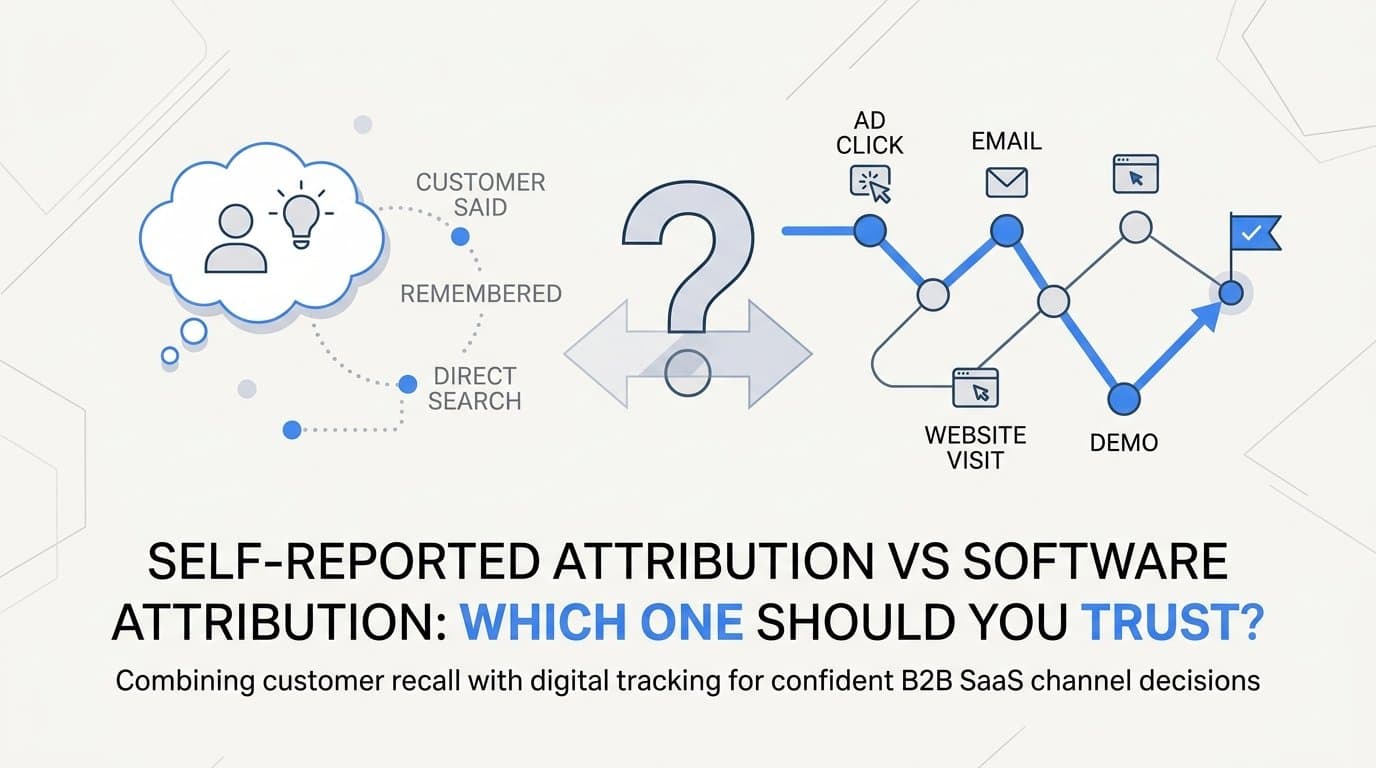
At the most basic level, the difference between self-reported attribution and software attribution comes down to this: one captures what customers remember, the other captures what they actually did.
Self-Reported Attribution: This method relies on asking customers directly where they heard about you. It might show up as a dropdown field on a demo request form ("How did you hear about us?"), a question during a sales discovery call, or a post-purchase survey. The answers are qualitative and based on the customer's own perception of their journey. When someone says "a colleague recommended you" or "I saw you on LinkedIn," they're describing their remembered experience, not necessarily their full behavioral path.
Self-reported data can capture things that software cannot easily measure: word-of-mouth referrals, podcast mentions, conference conversations, or the influence of a thought leadership article they read months ago. These are real awareness drivers with no trackable click path, and self-reported surveys are often the only way to surface them.
Software Attribution: This method uses technical infrastructure to automatically record every interaction a prospect has with your brand before converting. Tracking pixels, UTM parameters, first-party cookies, server-side events, and CRM integrations work together to build a behavioral data trail. Every ad click, page visit, form fill, and email open gets logged, timestamped, and associated with a contact record.
Software attribution can support multiple models for assigning credit across that journey. First-touch attribution gives full credit to the channel that initiated awareness. Last-touch credits the final interaction before conversion. Linear models distribute credit evenly across all touchpoints. Time-decay models weight recent interactions more heavily. Data-driven attribution uses algorithmic weighting based on actual conversion patterns, though it requires substantial data volume to be reliable.
The fundamental difference is this: self-reported attribution captures perception, while software attribution captures behavior. A customer who clicked a LinkedIn ad three times but remembers typing your name into Google will report Google as their source. Software attribution will show LinkedIn as a significant influence. Both answers contain truth. Neither is the complete picture on its own.
This is why the debate between the two methods is rarely resolved by picking a winner. The more useful question is understanding where each method breaks down, and how to combine them intelligently.
Where Self-Reported Attribution Gets It Wrong
Self-reported attribution has genuine value, but it has structural limitations that make it unreliable as a primary source for performance decisions. The problems are not random — they follow predictable patterns that systematically distort your data in specific directions.
The most significant issue is how human memory works. People tend to recall the most recent or most emotionally salient touchpoint, not the first or most influential one. This creates a consistent bias toward branded search, direct traffic, and word-of-mouth. When someone types your brand name into Google right before booking a demo, that branded search feels like the moment of discovery — even if three paid ads created the awareness that led them there. Self-reported data will credit Google. Your paid campaigns get no recognition.
This is not a flaw in the customer's honesty. It reflects how memory and decision-making actually work. People construct narratives about their choices after the fact, and those narratives tend to center on the most obvious or final action they took. The longer and more complex the buying journey, the more compressed and simplified the recalled version becomes.
Survey Fatigue and Incomplete Data: Even when you ask the right question, response rates for "how did you hear about us?" fields are often low or inconsistent. Some customers skip the field entirely. Others select the first option in a dropdown without thinking carefully. The result is a dataset with significant gaps and noise, making it risky to draw firm conclusions about channel performance from self-reported data alone.
B2B Buying Committees Add Complexity: In B2B SaaS, the person filling out a demo form is rarely the only person involved in the purchase decision. A buying committee might include a VP of Marketing, a Head of Operations, a CFO, and an IT lead. Each of these stakeholders may have encountered your brand through entirely different channels. Asking one person "how did you hear about us?" ignores the reality that five other people were also influenced by your marketing in ways that never get captured.
The champion who submitted the form might have found you through a LinkedIn post. The CFO who approved the budget might have heard your CEO on a podcast. The IT lead might have seen a retargeting ad. Self-reported attribution, by its nature, captures only one perspective from what is often a multi-person, multi-channel journey.
None of this means you should abandon self-reported data. But it does mean you should treat it as qualitative context rather than quantitative evidence. It tells you what customers believe influenced them, which has value — just not the kind of value that should drive your paid media budget decisions.
The Real Limitations of Software Attribution
Software attribution is more reliable than memory, but it is not infallible. The technical infrastructure that powers it has real vulnerabilities, and the models used to assign credit introduce their own layer of interpretation.
The most significant challenge in recent years has been the erosion of client-side tracking accuracy. Browser privacy changes, particularly those introduced with iOS 14 and subsequent updates, have limited the ability of tracking pixels to identify and follow users across sessions. Ad blockers remove pixels entirely for a meaningful portion of your audience. Third-party cookie deprecation has further reduced the reliability of cross-site tracking.
The practical result is that pixel-based attribution misses touchpoints. A user who clicks a Meta ad on their iPhone with privacy settings enabled may not be recorded as a conversion in your ad platform, even if they later become a paying customer. This creates underreporting in your software attribution data, which can make paid channels look less effective than they actually are.
The industry response to this has been server-side tracking through Conversion APIs. Meta's Conversion API (CAPI) and Google's Enhanced Conversions send event data directly from your server to the ad platform, bypassing browser-level restrictions. This restores a significant portion of the signal that client-side pixels lose. But implementation requires technical investment, and many B2B SaaS teams are still relying primarily on pixel-based tracking, which means their software attribution data has gaps they may not fully recognize.
Attribution Models Are Interpretations, Not Facts: Even with perfect tracking, software attribution requires you to choose a model for assigning credit. And every model is a simplification. Last-touch attribution systematically over-credits branded search and direct traffic, because those tend to be the final step before conversion regardless of what drove awareness. First-touch attribution ignores everything that happened between initial discovery and the decision to buy. Linear models treat every touchpoint as equally important, which is rarely accurate.
Choosing the wrong model does not just affect reporting. It affects budget decisions. A team running last-touch attribution may cut their top-of-funnel LinkedIn campaigns because they appear to generate no conversions, not realizing those campaigns are the reason prospects are searching for them in the first place.
Software Cannot Track Intent or Influence: Software attribution captures clicks and sessions. It does not capture the influence of a podcast episode someone listened to during their commute, a conference presentation that changed how they think about a problem, or a colleague's recommendation over lunch. These are real awareness drivers with no trackable click path, and software attribution will simply not see them.
This is precisely where self-reported data has an edge. The two methods are not competing for the same job. They are capturing different dimensions of the same journey.
Why B2B SaaS Teams Benefit From Using Both Together
The most sophisticated B2B marketing teams do not choose between self-reported attribution and software attribution. They use both, and they build a practice of comparing the two to surface insights that neither method could produce alone.
Think of software attribution as your behavioral map and self-reported data as your qualitative compass. The behavioral map shows you exactly which paths customers took through your marketing funnel. The qualitative compass tells you which directions customers felt they were moving in, including directions your map does not yet cover.
When you triangulate both data sources, you get a more complete picture of how your marketing is actually working. Software attribution shows the measurable journey. Self-reported data reveals perceived influence and brand awareness channels that are difficult or impossible to track with pixels and UTM parameters.
Using Self-Reported Data to Expose Blind Spots: One of the most practical ways to use self-reported attribution is to validate or challenge what your software data is telling you. If a significant portion of your customers mention a specific podcast or community in their intake forms, but you see no corresponding traffic from those sources in your software attribution, that is a signal worth investigating. Either the channel genuinely drives awareness in a way that does not leave a trackable click trail, or you have a tracking gap that needs to be fixed.
Either outcome is valuable. In the first case, you now have evidence to invest more in that channel and potentially build better tracking infrastructure around it. In the second case, you have identified a gap in your data that was distorting your performance picture.
Handling Long B2B Sales Cycles: B2B SaaS buying journeys often stretch across weeks or months, involving multiple touchpoints across different channels and multiple stakeholders across the buying committee. Software attribution with a time-decay or data-driven model can show you which channels are most active across that extended journey. Self-reported data can reveal which touchpoints stakeholders found most memorable or influential, even if those touchpoints were not the ones that generated the most clicks.
For example, your software attribution might show that most pipeline originates from paid search. But your self-reported data might consistently show that customers first heard about you through a thought leadership newsletter or a LinkedIn post from your CEO. That top-of-funnel awareness driver may never appear in your software attribution because it does not generate direct clicks to a tracked landing page. Without self-reported data, you might underinvest in exactly the content that is seeding your pipeline.
The goal is not to reconcile the two datasets into a single number. It is to let them inform each other and build a richer understanding of your marketing's actual impact.
Building a Reliable Attribution Stack for B2B SaaS
If software attribution is going to serve as your operational system of record for performance decisions, it needs to be built on accurate data. That means addressing the technical vulnerabilities that degrade tracking quality before you start drawing conclusions from your reports.
The most important upgrade most B2B SaaS teams can make is moving from client-side pixel tracking to server-side event tracking via Conversion APIs. Meta's Conversion API and Google's Enhanced Conversions allow you to send conversion events directly from your server, bypassing the browser-level restrictions that have made pixel-based tracking increasingly unreliable. This restores signal accuracy and gives your ad platforms better data to optimize against, which improves both your attribution reporting and your campaign performance.
Connect Ad Data to Pipeline and Revenue, Not Just Leads: One of the most common attribution mistakes in B2B SaaS is measuring success at the lead level. A channel that generates a high volume of form fills looks great in a lead-based attribution report. But if those leads never close, or if they close at a fraction of the deal size of leads from another channel, the lead-level data is actively misleading you.
Connecting your ad platform data to your CRM pipeline and revenue data changes the conversation entirely. Instead of asking "which channel generates the most leads?", you can ask "which channel generates the most closed-won revenue?" That is the question that actually matters for budget allocation. It requires integrating your ad platforms with your CRM and, ideally, with your revenue data from tools like Stripe, so you can trace a deal from first ad click all the way through to closed-won.
Unifying Your Attribution Data in One Place: Managing attribution across multiple ad platforms, a CRM, a website analytics tool, and self-reported survey data creates fragmented data that is hard to act on. Marketing teams end up with different numbers in different systems and no clear way to reconcile them.
This is exactly the problem that platforms like Cometly are built to solve. Cometly connects your ad platforms, CRM events, and customer journey tracking into a single source of truth, so you can see the full picture of how your marketing is performing without toggling between disconnected dashboards. Its server-side tracking capabilities restore the signal accuracy that browser-based tracking loses, and its AI layer surfaces recommendations on which campaigns and channels are actually driving revenue, not just clicks or leads.
With 70+ native integrations and the ability to compare attribution models side by side, Cometly gives B2B SaaS teams the infrastructure to make confident, data-driven decisions about where to scale and where to cut. That kind of clarity is what separates teams that grow efficiently from teams that spend reactively.
Making the Call: When to Lean on Each Method
Knowing the strengths and limitations of each method makes it much easier to decide which one should inform a given decision. The key is matching the right tool to the right question.
When to Use Self-Reported Attribution: Self-reported data is most valuable when you are trying to understand brand awareness, qualitative influence, and channels that do not leave a trackable click path. If you want to know whether your podcast appearances are building recognition, whether your thought leadership content is resonating, or whether word-of-mouth is playing a meaningful role in your pipeline, self-reported surveys are often your best tool. They capture the perceived influence of channels that software attribution simply cannot see.
Self-reported data is also useful during early-stage research, when you are trying to understand how your target audience discovers solutions like yours. Qualitative context about awareness channels can inform your content strategy and brand investment in ways that click-based data cannot.
When to Use Software Attribution: For performance decisions, software attribution needs to be your primary source of truth. Budget allocation, ad scaling, channel ROI analysis, and conversion rate optimization all require behavioral data at scale. When you are deciding whether to increase spend on Google Ads or LinkedIn, whether to cut a campaign that has been running for 90 days, or which landing page variant is driving more pipeline, you need software attribution data. Individual recollections cannot support those decisions reliably.
The most effective B2B marketing teams treat self-reported data as a qualitative signal that informs strategy and surfaces blind spots, while treating software attribution as the operational system of record that drives day-to-day performance decisions. They invest in making the software layer as accurate as possible through server-side tracking, CRM integration, and revenue attribution, because they understand that the quality of their decisions is only as good as the quality of their data.
The goal is not to make one method win. It is to use each one for what it does best, and to build the infrastructure that makes your software attribution trustworthy enough to act on with confidence.
Putting It All Together
The tension between self-reported attribution and software attribution comes down to a simple but important distinction: self-reported data reflects perception, software attribution reflects behavior. Customers tell you what they remember. Software tells you what they did. Both are real, and both are incomplete.
For B2B SaaS teams making real budget decisions, software attribution needs to be the foundation. It is the only method that scales, that captures the full behavioral journey, and that connects marketing activity to pipeline and revenue in a measurable way. But that foundation needs to be built on accurate, server-side data. Pixel-based tracking alone is no longer sufficient in a privacy-first environment, and attribution models need to be chosen deliberately based on your sales cycle and business model.
Self-reported data plays a supporting role. It surfaces awareness channels that software cannot track, adds qualitative context to your behavioral data, and helps you identify blind spots in your attribution infrastructure. Used together, the two methods give you a more honest picture of how your marketing is actually working.
The teams that get this right do not just have better reporting. They make better decisions, allocate budget more effectively, and scale the campaigns that are genuinely driving revenue rather than the ones that just look good in a last-touch report.
If you are ready to build an attribution stack that connects every touchpoint from first ad click to closed-won revenue, Cometly gives you the server-side tracking, CRM integration, and AI-powered insights to make that a reality. Get your free demo today and start capturing every touchpoint to maximize your conversions.