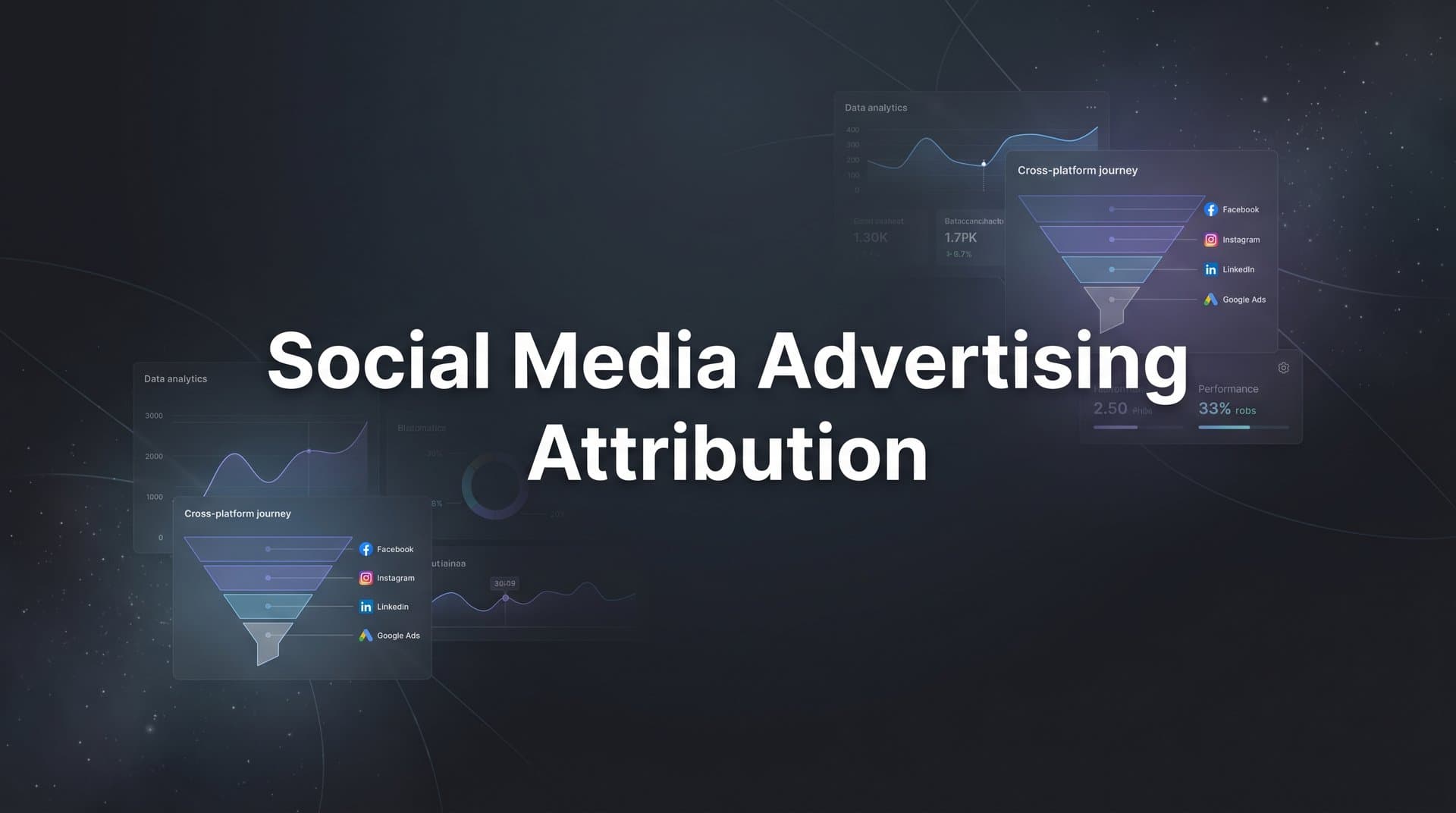
Social media advertising budgets keep growing, but most marketers still struggle to answer a fundamental question: which social ads actually drive revenue?
The challenge is real. Customers bounce between Instagram, Facebook, TikTok, LinkedIn, and your website before ever converting. Native platform analytics often inflate results because each platform claims credit for the sale. And privacy changes have made pixel-based tracking less reliable than ever.
Without accurate social media advertising attribution, you are essentially flying blind, pouring budget into campaigns based on incomplete or misleading data. You might be scaling a campaign that looks great inside Meta's dashboard but contributes almost nothing to actual closed revenue. Meanwhile, a LinkedIn campaign that quietly influences high-value buyers goes undervalued and underfunded.
The good news is that modern attribution strategies can cut through the noise and give you a clear picture of what is working. The seven strategies below are built for digital marketers and agencies who want to connect social ad spend to real revenue, optimize budgets with confidence, and scale the campaigns that truly perform.
1. Move Beyond Platform-Reported Metrics with Independent Tracking
The Challenge It Solves
Every major ad platform uses self-attribution. Meta claims credit for conversions it touched. Google claims credit. TikTok claims credit. When you add up the reported conversions across all your platforms, the total often exceeds your actual sales by a wide margin. This overlap is not a bug in the system; it is a structural feature of how native dashboards work. Relying solely on platform-reported data leads to inflated confidence in campaigns that may not be performing as well as they appear.
The Strategy Explained
Independent tracking means capturing conversion data through a system that sits outside any single ad platform's reporting. Server-side tracking is the most effective approach here. Instead of relying on browser-based pixels that can be blocked by privacy settings, ad blockers, or iOS restrictions, server-side tracking sends conversion events directly from your server to your attribution platform.
This approach captures conversions that pixel-based tracking misses entirely, giving you a more accurate count of what actually happened. When you compare this independent data against what each platform reports, you quickly see where the gaps and overlaps exist. Understanding why attribution data doesn't match across platforms is the first step toward building a reliable measurement system.
Implementation Steps
1. Implement server-side tracking on your website and key conversion events so data flows directly to your attribution platform rather than relying on browser pixels.
2. Connect all your ad platforms to a single independent attribution tool that reports conversions based on your first-party data, not each platform's self-reported numbers.
3. Run a parallel comparison for two to four weeks, reviewing what each platform claims versus what your independent system records, and use the independent data as your decision-making baseline.
Pro Tips
Do not wait for platform metrics and independent data to align perfectly. They rarely will, and that is expected. The goal is to use independent tracking as your source of truth while treating platform dashboards as directional signals. Tools like Cometly's server-side tracking are specifically designed to fill the gaps that iOS restrictions and cookie limitations create, giving you a reliable foundation for every attribution decision.
2. Adopt Multi-Touch Attribution Instead of Last-Click Defaults
The Challenge It Solves
Last-click attribution gives 100% of the credit for a conversion to the final touchpoint before purchase. For social media advertising, this is a serious problem. A customer might see your brand on Instagram three times, click a LinkedIn ad, read a blog post, and then convert through a Google search. Last-click gives all the credit to Google and zero credit to the social ads that built awareness and drove consideration. Over time, this causes marketers to systematically underfund social campaigns that are genuinely contributing to revenue.
The Strategy Explained
Multi-touch attribution distributes credit across all the touchpoints in a customer's journey. Different models distribute that credit in different ways. Linear attribution splits credit equally across all touchpoints. Time-decay models give more credit to touchpoints closer to conversion. Position-based models weight the first and last touch more heavily while still crediting the middle. Each approach gives you a more complete view of how social ads contribute across the funnel.
For most social media advertisers, adopting any multi-touch model is a significant upgrade over last-click defaults. Social platforms often play an awareness or consideration role that last-click attribution completely ignores.
Implementation Steps
1. Audit your current attribution setup and identify which default model your analytics tools are using. Most default to last-click.
2. Choose a multi-touch model that aligns with your typical customer journey length. Longer consideration cycles often benefit from linear or time-decay models.
3. Apply your chosen model within your attribution platform and compare the credit distribution against your last-click data to understand how your social campaigns are being revalued.
Pro Tips
Start with a linear model if you are new to multi-touch attribution. It is easy to explain to stakeholders and immediately surfaces the contribution of upper-funnel social ads. Once you have buy-in, you can experiment with more nuanced models. Cometly's multi-touch attribution capabilities let you switch between models without rebuilding your entire tracking setup.
3. Unify Your Ad Platforms and CRM Data in One Attribution Source
The Challenge It Solves
Most marketing teams operate with a fragmented data stack. Ad performance lives in Meta Ads Manager. Lead data lives in the CRM. Website behavior lives in Google Analytics. Revenue data lives in the sales platform. No single team member has a complete view of which social ad campaigns are generating not just clicks or leads, but actual closed revenue. This fragmentation leads to budget decisions based on incomplete data, often optimizing for cost-per-lead rather than cost-per-customer.
The Strategy Explained
Connecting your ad platforms directly to your CRM creates a unified dashboard for marketing and sales attribution that spans the entire customer journey from first ad impression to closed deal. This integration allows you to trace a specific lead back to the exact social campaign, ad set, and creative that first engaged them. When that lead converts into a paying customer, the revenue is attributed back through the chain to the original ad.
This is particularly powerful for B2B advertisers and any business with a longer sales cycle, where the gap between a social ad click and a closed sale can be weeks or months.
Implementation Steps
1. Map your existing data sources: which ad platforms are active, which CRM you use, and where revenue data is recorded. Identify the gaps between these systems.
2. Use an attribution platform that natively integrates with both your ad platforms and your CRM, so data flows automatically rather than requiring manual exports and spreadsheet merging.
3. Define your key revenue milestones within the CRM (such as qualified lead, opportunity, and closed-won) and configure your attribution platform to track how social campaigns contribute at each stage.
Pro Tips
When you connect CRM data to ad attribution, you often discover that the campaigns generating the most leads are not the campaigns generating the most revenue. This insight alone can justify a significant budget reallocation. Cometly is built to connect ad platforms and CRM data into a single attribution source, giving you the full picture from click to closed revenue.
4. Feed Enriched Conversion Data Back to Ad Platform Algorithms
The Challenge It Solves
Ad platform algorithms are only as smart as the data you feed them. When iOS restrictions and cookie limitations prevent accurate conversion tracking, Meta and Google's algorithms receive incomplete signals about which users are actually converting. This causes their targeting and bidding systems to optimize toward the wrong audiences, reducing the efficiency of your social ad spend over time. The platforms know this is a problem, which is why they have developed server-side APIs specifically to address it.
The Strategy Explained
Conversion syncing means sending verified, first-party conversion events back to ad platforms through their server-side APIs, such as Meta's Conversions API or Google's Enhanced Conversions. Instead of relying on a browser pixel to fire when a purchase happens, your server sends the conversion event directly. This restores the signal quality that privacy changes eroded and gives the ad platform's algorithm accurate data to optimize against.
When algorithms receive better conversion signals, they can identify users who share characteristics with your actual buyers, not just your website visitors. Accurate tracking of paid social conversions improves targeting efficiency and can meaningfully reduce your cost per acquisition over time.
Implementation Steps
1. Set up Meta's Conversions API and Google's Enhanced Conversions for your key conversion events, ensuring that server-side events are matched to browser events to avoid duplication.
2. Enrich the conversion data you send back with first-party signals such as purchase value, customer lifetime value indicators, or lead quality scores from your CRM.
3. Monitor your event match quality scores within each platform's dashboard and refine the data you are sending to improve match rates over time.
Pro Tips
Sending revenue value alongside conversion events, rather than just a binary conversion signal, gives ad algorithms the context to optimize for higher-value customers. Cometly's Conversion Sync feature automates this process, sending enriched conversion data back to Meta, Google, and other platforms so their algorithms can work harder on your behalf without manual configuration.
5. Map the Full Customer Journey Across Social Touchpoints
The Challenge It Solves
Knowing that a campaign contributed to conversions is useful. Knowing exactly how customers move through your social touchpoints before converting is transformative. Without journey mapping, you can see that an Instagram campaign drove revenue, but you cannot see whether customers who saw Instagram ads first converted at a higher rate, or whether a specific sequence of touchpoints consistently produces your highest-value buyers. This gap prevents you from engineering your campaigns around the paths that actually work.
The Strategy Explained
Customer journey mapping in attribution means capturing every social ad interaction, website visit, and CRM event in sequence for each individual user. Instead of looking at aggregate conversion numbers, you examine the actual paths customers took from first touch to conversion. This reveals patterns: which ad types tend to initiate journeys, which touchpoints appear most often in high-value conversion paths, and where customers tend to drop off.
With this visibility, you can make intentional decisions about which campaign types to invest in at each stage of the funnel. Mastering tracking paid social campaigns accurately is essential to building these journey-level insights rather than treating all social ad spend as interchangeable.
Implementation Steps
1. Ensure your attribution platform captures individual-level journey data, not just aggregate channel data. Each conversion should have a traceable sequence of touchpoints attached to it.
2. Segment your completed journeys by conversion value or customer type to identify which paths lead to your highest-value outcomes.
3. Use journey patterns to inform campaign structure. If high-value customers consistently start with a video ad on Instagram before converting through a retargeting campaign, invest accordingly in that sequence.
Pro Tips
Look for touchpoint sequences that appear repeatedly among your best customers. These patterns are your most valuable strategic insight. They tell you not just what works but what works in combination, which is something aggregate channel data can never reveal. Cometly's analytics dashboard is designed to surface these journey-level insights across all your connected ad platforms and CRM events.
6. Use AI-Powered Analysis to Surface Hidden Performance Patterns
The Challenge It Solves
Modern social media advertising generates enormous volumes of data across campaigns, ad sets, audiences, creatives, and placements. Manual analysis can identify obvious winners and losers, but it struggles to surface the subtle patterns buried in the data: the audience segment that consistently converts at a higher value, the creative format that outperforms in specific journey positions, or the campaign that looks average on its own but dramatically improves conversion rates for every subsequent touchpoint. These patterns exist in your data but require significant analytical capacity to find.
The Strategy Explained
AI-powered attribution analysis processes your performance data across all dimensions simultaneously, identifying correlations and patterns that would take a human analyst days or weeks to uncover manually. Rather than reviewing performance one campaign at a time, AI tools surface which combinations of audience, creative, placement, and timing are driving the strongest attribution results.
More practically, AI analysis translates those patterns into actionable recommendations: which campaigns to scale, which to pause, and where to reallocate budget for the greatest impact on attributed revenue. Comprehensive social media advertising analytics form the foundation that makes these AI-driven insights possible.
Implementation Steps
1. Consolidate all your attribution data into a single platform so the AI has a complete, unified dataset to analyze rather than siloed platform-by-platform numbers.
2. Define your optimization goal clearly, whether that is cost per attributed conversion, revenue per dollar spent, or return on ad spend across specific channels, so AI recommendations align with your actual business objective.
3. Review AI-generated recommendations regularly and implement budget adjustments based on the patterns identified, then track whether the changes produce the expected improvements in attributed performance.
Pro Tips
Treat AI recommendations as a starting point for analysis, not an automatic override. The most effective marketers use AI to surface what to investigate, then apply their own context and judgment before acting. Cometly's AI Ads Manager and AI Chat features are built specifically for this workflow, allowing you to ask attribution questions in plain language and receive data-backed answers and budget recommendations in real time.
7. Compare Attribution Models Side by Side to Validate Your Decisions
The Challenge It Solves
Every attribution model tells a different story about which social ads deserve credit. If you commit to a single model without comparing alternatives, you risk making budget decisions based on a perspective that may not reflect your actual customer behavior. A time-decay model might undervalue your top-of-funnel social campaigns. A first-touch model might overvalue awareness campaigns that rarely close deals on their own. Without comparing models, you have no way to know whether your attribution perspective is aligned with reality.
The Strategy Explained
Running multiple attribution models simultaneously and comparing how credit shifts between channels gives you a more complete and validated picture of performance. When two or three different models all agree that a specific campaign is a strong performer, you can act on that insight with high confidence. Exploring the various types of attribution models in digital marketing helps you understand which perspectives are most relevant to your business.
Model comparison also helps you build internal alignment. When stakeholders see that a campaign performs well across multiple attribution frameworks, the case for investment becomes much stronger than when it is based on a single model's output.
Implementation Steps
1. Select two or three attribution models that represent different perspectives on your funnel: for example, last-click, linear, and time-decay. Apply all three to the same conversion dataset.
2. Identify the campaigns where model outputs agree and those where they diverge significantly. Agreement signals confidence; divergence signals a need for deeper investigation.
3. Use model comparison as a regular review practice rather than a one-time exercise. As your campaign mix evolves, the model that best reflects your customer journey may shift over time.
Pro Tips
Pay particular attention to social campaigns that look weak under last-click but perform well under multi-touch models. These are often your most undervalued campaigns, the ones building awareness and consideration that other channels then close. Cometly's attribution platform lets you compare models side by side within the same interface, making it straightforward to validate decisions before committing budget.
Tying It All Together: Your Attribution Action Plan
Accurate social media advertising attribution is not a single fix. It is a layered practice that builds in value over time as each component reinforces the others.
Start with the foundation. Implement server-side tracking and connect your ad platforms to your CRM. These two steps alone will give you a more accurate and complete picture of performance than most marketing teams have. Without this foundation, every other strategy is built on shaky data.
Next, layer on multi-touch attribution and customer journey mapping. These shift your perspective from channel-level metrics to journey-level insight, revealing how social ads contribute across the funnel rather than just at the final click.
Once your data is clean and your attribution models are in place, activate conversion syncing to feed enriched signals back to your ad platforms. This step closes the loop, making your ad algorithms smarter and improving the efficiency of future spend automatically.
Finally, use AI-powered analysis and model comparison as your ongoing optimization practice. These strategies transform attribution from a reporting exercise into a continuous improvement engine, surfacing new patterns and validating decisions as your campaigns evolve.
The marketers who win on social media are not necessarily the ones with the biggest budgets. They are the ones who know exactly what is working and why, and who can act on that knowledge faster than their competitors.
Ready to elevate your marketing game with precision and confidence? Discover how Cometly's AI-driven recommendations can transform your ad strategy. Get your free demo today and start capturing every touchpoint to maximize your conversions.