Most B2B SaaS marketing teams are running ads, publishing content, and generating leads without a clear picture of how prospects actually move from that first touchpoint to a closed deal. Budget decisions get made based on incomplete data. Campaigns get paused or scaled for the wrong reasons. And the real drivers of revenue stay hidden behind surface-level metrics.
Understanding the stages of the customer journey is not an academic exercise. It is a practical framework that determines where you allocate budget, how you craft messaging at each phase, and how you measure what is genuinely working. When you can see the full path a prospect takes from first ad impression to signed contract, everything about how you market becomes sharper and more defensible.
This guide breaks down each stage of the B2B SaaS customer journey with a focus on what marketers need to track, which touchpoints are most commonly missed, and how to build the data infrastructure that connects ad spend to actual revenue. If you have ever looked at your analytics and felt like something was missing, it probably was.
Why the Customer Journey Looks Different in B2B SaaS
The customer journey framework is well established in marketing, but its application in B2B SaaS is fundamentally different from what most generic models describe. Consumer purchases often happen in minutes. B2B SaaS deals can take weeks or months, involve multiple stakeholders, and require a prospect to move through several distinct phases before a contract is ever signed.
Think about what that actually means for your marketing data. A prospect might click a LinkedIn ad in January, read a comparison blog post in February, attend a webinar in March, and finally book a demo after receiving a targeted retargeting ad in April. If your analytics tool only captures the last click before conversion, you are crediting the retargeting ad for a deal that took four months and five touchpoints to close.
The multi-stakeholder dynamic adds another layer of complexity. In many B2B SaaS buying decisions, the person who first discovers your product is not the person who approves the purchase. A junior marketer might find you through organic search, bring the product to their director, who then loops in finance and IT. Each of those stakeholders may interact with your content and ads through different channels and at different times. A single-source view of your marketing data simply cannot capture that reality.
This is why stage-by-stage visibility matters so much in B2B SaaS. You are not trying to understand one person's decision. You are trying to understand a buying group's journey across a long and often non-linear path. Last-click attribution does not just miss some touchpoints in this context. It misrepresents the entire story.
Modern SaaS marketing teams need a connected view of data across every channel, every stage, and every conversion event. Without it, you are making budget decisions based on the last chapter of a story you have not actually read.
Breaking Down Each Stage of the Customer Journey
While the B2B SaaS journey is rarely perfectly linear, it generally moves through three core stages: awareness, consideration, and decision. Understanding what is happening at each stage helps you align your messaging, channels, and measurement accordingly.
The Awareness Stage
At this stage, a prospect is just discovering that a problem exists or that a solution like yours is available. They may encounter your brand through a paid search ad, a social post, an organic blog article, or a mention from a peer. The goal here is not to sell. It is to capture attention and generate qualified traffic from the right audience.
Awareness-stage content tends to be educational and broad. You are answering questions, surfacing pain points, and establishing credibility. Paid channels like Google Ads and LinkedIn are common entry points, but organic search and word of mouth also play a significant role in B2B SaaS discovery.
The challenge at this stage is that results are hard to measure directly. Someone who reads your blog post today may not convert for another three months. That does not mean the touchpoint did not matter. It means your measurement system needs to be able to connect that early interaction to a downstream conversion event.
The Consideration Stage
Once a prospect is aware of your product, they move into evaluation mode. They are comparing you to alternatives, reading reviews, watching demo videos, downloading comparison guides, and trying to understand whether your solution fits their specific needs. This is where deeper content like product walkthroughs, feature breakdowns, and customer stories become critical.
The consideration stage is also where your retargeting strategy comes into play. Prospects who have visited your site or engaged with your content are signaling interest. Reaching them again with relevant, specific messaging keeps your product in the conversation while they evaluate their options.
For B2B SaaS teams, this stage often involves multiple stakeholders consuming different types of content simultaneously. One person is evaluating technical capabilities while another is assessing pricing and ROI. Your marketing needs to speak to each of those perspectives.
The Decision Stage
At the decision stage, the prospect is ready to act. They have narrowed their options and are looking for the final signals that confirm their choice. This is where trial experiences, personalized demos, pricing transparency, and sales conversations carry the most weight.
Marketing's role does not end at the handoff to sales. The ads a prospect sees during this phase, the emails they receive, and the content they consume all influence the final outcome. Decision-stage marketing is about removing friction, reinforcing confidence, and making the path to purchase as clear as possible.
Understanding which touchpoints appear in the final days before a deal closes helps you invest in the right assets and channels at this critical moment.
The Touchpoints Marketers Most Commonly Miss
Here is where the gap between theory and reality becomes most visible. Most marketing teams can describe the awareness, consideration, and decision stages. Far fewer can actually see what is happening between those stages in their data.
Mid-funnel touchpoints are the most commonly invisible layer in standard analytics setups. Retargeting ads that bring a prospect back to your pricing page, email sequences that nurture a lead after a webinar, content downloads that signal deepening interest: these interactions happen constantly, but basic analytics tools often fail to capture them in a way that connects back to the original ad source or the eventual revenue outcome.
CRM events are another major blind spot. When a prospect books a demo, joins a sales call, or receives a proposal, those are critical stage transitions. They represent real signals about where a buyer is in their journey. But if your CRM data is not connected to your ad platform data, you have no way of knowing which campaign or channel drove that demo booking. You are flying blind on the very conversions that matter most.
The technical root of this problem is the reliance on client-side tracking. Browser-based cookies and pixel-based attribution miss a growing share of user activity due to ad blockers, browser privacy restrictions, and cross-device behavior. When a prospect clicks an ad on their phone and later books a demo from their laptop, standard client-side tracking often fails to connect those two events.
Server-side tracking and first-party data capture solve this problem. By sending conversion data directly from your server rather than relying on a browser pixel, you capture touchpoints that would otherwise fall out of your attribution picture entirely. This is not a nice-to-have for B2B SaaS teams with long sales cycles. It is the foundation of accurate attribution.
Without visibility into these mid-funnel interactions, you end up with attribution gaps that distort your understanding of which channels and campaigns are actually moving prospects through the journey. You might undervalue a channel that is doing critical consideration-stage work simply because it does not show up cleanly in your last-click report.
How Attribution Models Change What You See at Each Stage
The attribution model you choose does not just affect how credit is distributed. It shapes your entire understanding of the customer journey and the decisions you make as a result.
First-touch attribution gives all credit to the channel or campaign that first brought a prospect to your brand. This model is useful for understanding how prospects enter your funnel, but it completely ignores everything that happened between that first touchpoint and the eventual conversion. If you optimize purely for first-touch, you risk underinvesting in the channels that drive consideration and close deals.
Last-click attribution is the default in many analytics platforms and the most commonly misused model in B2B SaaS. It credits the final touchpoint before a conversion, which sounds logical until you realize that the final click is rarely the reason someone decided to buy. It is often just the most convenient moment to act. Last-click attribution systematically strips credit from awareness and consideration channels, leading teams to over-invest in bottom-of-funnel tactics while starving the top of the funnel that feeds them.
Multi-touch attribution distributes credit across all the touchpoints a prospect encountered throughout their journey. This approach gives marketers a far more accurate view of which channels contribute at each stage and which combinations of touchpoints tend to produce the best outcomes.
There are several multi-touch models to choose from. Linear attribution spreads credit equally across all touchpoints. Time-decay attribution gives more credit to touchpoints closer to the conversion. Position-based models weight the first and last touches more heavily while still crediting the middle. Each has its use case, but all of them are more reflective of the B2B SaaS reality than single-touch models.
The practical implication is significant. When you switch from last-click to a multi-touch model, you often discover that channels you were undervaluing, such as a content marketing program or a top-of-funnel LinkedIn campaign, were actually contributing meaningfully to pipeline. Conversely, you may find that some bottom-of-funnel spend was capturing credit for deals that were already essentially closed.
Choosing the right attribution model is not just a reporting preference. It is a strategic decision that directly influences how you allocate budget across the stages of the customer journey.
Metrics That Actually Matter at Each Journey Stage
One of the most common mistakes in B2B SaaS marketing is applying the same metrics across every stage of the funnel. Impressions are a reasonable signal at the awareness stage. They are meaningless as a success metric at the decision stage. Getting clear on which metrics belong at which stage is essential for making good optimization decisions.
Awareness stage metrics tell you whether you are reaching the right people and entering the right conversations. Impressions and reach show the scale of your exposure. Cost per click tells you how efficiently you are driving traffic. New visitor volume indicates whether you are expanding your audience or just recycling existing contacts. These metrics do not tell you whether those visitors will convert, but they tell you whether you are building the top of your funnel with the right inputs.
Consideration stage metrics reveal whether prospects are engaging meaningfully with your brand after that first touch. Time on site and pages per session indicate whether your content is holding attention. Demo request volume and content download rates show whether prospects are taking the next step. Lead quality scores, often generated from CRM data, tell you whether the people entering your funnel match your ideal customer profile. If these metrics are weak, your consideration-stage content and targeting need attention.
Decision stage metrics are where marketing gets directly accountable to revenue. Pipeline value attributed by channel shows which sources are generating deals, not just leads. Cost per acquisition reveals the true efficiency of your marketing investment. Closed-won rate by lead source tells you which channels bring in prospects who actually buy. Revenue attribution by campaign is the clearest signal of marketing ROI available to a SaaS team.
The goal is not to track every metric at every stage. It is to build a reporting structure that surfaces the right signals at the right time so you can make confident decisions about where to invest and where to pull back.
Tracking the Full Journey From Ad Click to Closed Revenue
Understanding the stages of the customer journey is only as valuable as your ability to actually see what is happening at each one. The real competitive advantage comes from connecting your ad platform data to your CRM and revenue data in a way that closes the loop between top-of-funnel spend and bottom-of-funnel outcomes.
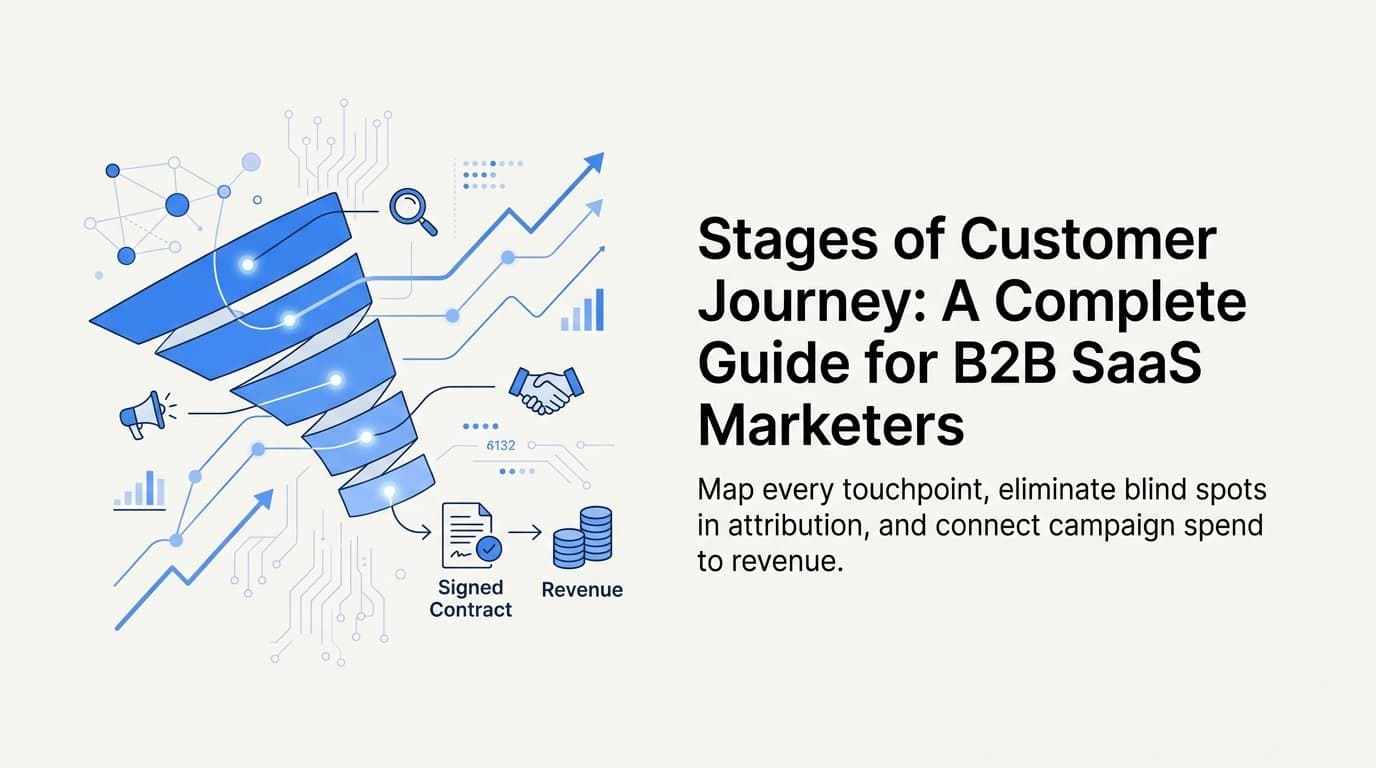
This connection starts with capturing every touchpoint. When a prospect clicks a Google ad, visits your pricing page, downloads a guide, books a demo, and eventually converts to a paying customer, each of those events needs to be tracked and linked to a single customer journey. Without that thread, you are looking at fragments of data rather than a complete picture.
Server-side tracking plays a critical role here. By capturing conversion events at the server level rather than relying solely on browser pixels, you retain data that would otherwise be lost to ad blockers, privacy settings, and cross-device gaps. This is particularly important in B2B SaaS, where the buying journey often spans multiple devices and sessions over an extended period.
Cometly is built specifically to solve this problem for B2B SaaS teams. It captures every touchpoint across the customer journey, from the first ad click to CRM events like demo bookings and sales calls, and ties all of that activity directly to pipeline and closed revenue. Rather than stitching together data from multiple disconnected tools, you get a single source of truth that reflects the full journey.
One of the most powerful aspects of this approach is what happens when enriched conversion data flows back to ad platforms. When you send accurate, first-party conversion signals back to Meta or Google, their algorithms get a clearer picture of which users are actually converting. This improves targeting, optimizes bidding, and compounds performance over time across every stage of the journey. You are not just measuring better. You are feeding the machine better data so it can find more of the right prospects.
Cometly's AI-driven recommendations layer on top of this data to surface insights about which ads and campaigns are performing across each stage of the funnel. Instead of manually digging through reports, you get clear signals about where to scale and where to cut, grounded in revenue data rather than proxy metrics.
This is the difference between knowing your stages of the customer journey conceptually and actually being able to act on them with precision.
Putting It All Together
The stages of the customer journey give you a framework for thinking about how prospects move from discovery to revenue. But a framework without data infrastructure behind it is just a diagram on a whiteboard.
The shift that matters most for B2B SaaS marketing teams is moving from siloed, single-touch metrics to a connected, full-funnel view that captures every touchpoint, applies the right attribution model, and ties marketing activity directly to pipeline and closed revenue. When you can see the complete journey, you make better decisions at every stage: smarter budget allocation, more relevant messaging, and clearer accountability for what marketing is actually contributing to growth.
That shift requires the right tools, the right tracking infrastructure, and a commitment to measuring what actually matters rather than what is easiest to see.
Ready to elevate your marketing game with precision and confidence? Discover how Cometly's AI-driven recommendations can transform your ad strategy. Get your free demo today and start capturing every touchpoint to maximize your conversions.