
Paid social is one of the highest-investment channels for B2B SaaS companies, yet most teams are making budget decisions based on incomplete data. Clicks are easy to count. Revenue is not. The gap between ad spend and closed-won deals is exactly where attribution breaks down and where budget quietly disappears.
Think about how this typically plays out. Your LinkedIn campaign drives a wave of form fills. Your ad platform reports a healthy cost per lead. Everyone feels good. Then, three months later, you check your CRM and realize almost none of those leads ever became opportunities. You have been optimizing for volume, not value.
This guide walks you through exactly how to track paid social conversions from first click to pipeline, so your team can make confident, data-backed decisions about where to scale and where to cut. Whether you are running campaigns on Meta, LinkedIn, TikTok, or Google, the same core framework applies across all of them.
The framework has six steps: define what a conversion actually means for your business, set up the right tracking infrastructure, connect your ad data to your CRM, choose an attribution model that reflects your sales cycle, build a dashboard that shows revenue impact, and use that data to optimize campaigns and feed better signals back to ad platform algorithms.
By the end of this guide, you will have a clear, repeatable system for tracking paid social conversions that goes beyond vanity metrics and ties directly to business outcomes. This is not a one-time setup. It is an ongoing system that compounds in value the longer you run it.
Let's get into it.
Step 1: Define Your Conversion Events Before You Touch a Pixel
Before you configure a single tracking tag or connect any platform, you need to get clear on what you are actually trying to measure. This sounds obvious, but it is where most B2B SaaS teams skip ahead and pay for it later.
Not all conversions are equal. A page visit is not the same as a demo request. A content download is not the same as a free trial signup that converts to a paying customer. If you treat all of these as equivalent signals, your ad platforms will optimize toward the easiest-to-generate action, which is rarely the one that drives revenue.
Start by mapping your conversion events to your funnel stages. A practical way to organize this is to separate micro-conversions from macro-conversions.
Micro-conversions are early engagement signals: blog visits, resource downloads, webinar registrations, and time-on-site thresholds. These are useful for understanding audience behavior and warming up retargeting pools, but they should not be your primary optimization target for paid social campaigns.
Macro-conversions are pipeline-generating actions: demo requests, free trial signups, MQL handoffs to sales, opportunities created in your CRM, and closed-won deals. These are the events that connect ad spend to revenue, and they should drive your campaign optimization decisions.
For each macro-conversion, document the following: what the event is, where it occurs in the funnel, what qualifies it as a meaningful signal, and what monetary value you can assign to it. Assigning a value is especially important for B2B SaaS teams because it allows ad platforms to optimize toward higher-value conversions when you send that data back as a signal.
A common pitfall here is tracking "leads" without defining what a qualified lead looks like. If your ad platform is optimizing for any form submission, it will find the audiences most likely to fill out forms, which is not necessarily the audiences most likely to become customers. Define lead quality criteria upfront and bake them into your conversion event definitions. Understanding best practices for tracking conversions accurately at this stage will save you significant rework later.
Success indicator: You have a documented list of conversion events with clear definitions, funnel stage mapping, and assigned monetary values where possible. Every paid social campaign has a primary conversion event tied to a specific funnel outcome.
Step 2: Set Up First-Party Tracking with Server-Side Events
Once you know what you are measuring, you need to make sure you can actually measure it accurately. This is where many teams run into a wall they did not see coming: browser-based pixel tracking alone is no longer reliable enough for B2B SaaS attribution.
Here is the problem. Browser pixels depend on JavaScript executing in the user's browser and cookies persisting across sessions. iOS privacy updates have restricted cross-app tracking. Ad blockers prevent pixels from firing entirely. Third-party cookie deprecation across major browsers has eroded the data foundation that pixel-based tracking was built on. The result is that browser pixels routinely underreport conversions, sometimes significantly. Understanding what a tracking pixel is and how it works helps clarify exactly why these limitations exist.
Server-side tracking solves this by sending conversion events directly from your server to the ad platform, bypassing the browser entirely. The two most important implementations for paid social are the Meta Conversion API (CAPI) and Google Enhanced Conversions.
At a conceptual level, the setup process works like this. You connect your server or your attribution platform to the ad platform's API. You define which events to send, such as lead form submissions, trial signups, and demo requests. When a user completes one of those actions, your server fires the event directly to Meta or Google, along with hashed user data like email and phone number that helps the platform match the event to a real user profile.
That matching process matters a lot. Match rate quality, the percentage of server-side events that can be successfully matched to a user profile in the ad platform, directly affects how well the platform's algorithm can optimize. Enriching your events with additional data points like email, phone number, and user agent improves match rates and gives the platform's AI better signal to work with.
One critical detail: if you are running both a browser pixel and server-side events simultaneously, which is actually the recommended setup for redundancy, you must implement event deduplication. Without it, the same conversion will be counted twice, inflating your reported conversion numbers and causing your campaigns to optimize on bad data. Both Meta CAPI and Google Enhanced Conversions have deduplication mechanisms built in, but they need to be configured correctly. Reviewing the top server-side tracking tools available can help you choose the right implementation approach for your stack.
Platforms like Cometly handle this server-side integration natively, connecting your conversion events to Meta, Google, LinkedIn, and TikTok while managing deduplication automatically. This removes a significant amount of technical complexity from the setup process.
Success indicator: Server-side events are firing for your key conversion actions, match rates are high, and duplicate events are being filtered correctly. Your ad platform event manager shows consistent, clean conversion data that aligns with what you are seeing in your CRM.
Step 3: Connect Your CRM Data to Your Ad Platforms
Server-side tracking gets you accurate top-of-funnel conversion data. But for B2B SaaS teams with longer sales cycles, that is only part of the picture. You also need to close the loop between ad clicks and downstream CRM outcomes: opportunities created, pipeline value, and closed-won revenue.
Here is why this matters. Your ad platform knows that someone clicked an ad and filled out a form. It does not know whether that person became a qualified opportunity, stalled in the sales process, or closed as a customer six weeks later. Without that downstream data, the platform optimizes toward lead volume rather than lead quality, and you end up paying for leads that never convert.
The solution is syncing CRM events back to your ad platforms as offline conversions. When a lead progresses to an opportunity in your CRM, or when a deal closes, that event gets sent back to Meta, LinkedIn, or Google as a conversion signal. Now the platform knows not just who clicked, but who actually became a customer. Over time, this trains the algorithm to find more users who look like your actual customers, not just users who look like form fillers. A deeper look at how to track offline conversions explains exactly how this CRM-to-platform sync closes the attribution gap.
To make this work, you need consistent UTM parameter tagging across all your paid social traffic. Every ad on every platform should include UTM parameters for source, medium, campaign, ad set, and ad. When a lead fills out a form, those UTM parameters get captured in your CRM record. When that lead later converts to an opportunity or a closed deal, the CRM record retains the attribution data, and you can send that enriched event back to the ad platform.
UTM consistency is non-negotiable. If your UTM naming conventions are inconsistent across Meta, LinkedIn, and TikTok, your CRM data will be fragmented and your attribution will be unreliable. Establish a naming convention and enforce it across every campaign before you launch. If you are new to parameter tagging, learning what UTM tracking is and how it helps your marketing will give you a solid foundation.
This CRM-to-ad-platform sync is one of the most powerful levers in paid social optimization, but it is also one of the most commonly skipped steps because it requires coordination between marketing, sales ops, and sometimes engineering. A marketing attribution platform like Cometly automates this data sync, pulling CRM pipeline and revenue data into the attribution layer and sending enriched conversion signals back to ad platforms without manual exports or error-prone spreadsheet workflows.
Success indicator: CRM records for leads from paid social campaigns include source, campaign, and ad-level attribution data. Your ad platforms are receiving offline conversion signals that reflect CRM outcomes, not just form fills.
Step 4: Choose the Right Attribution Model for Paid Social
You have your conversion events defined, your tracking infrastructure in place, and your CRM connected. Now you need to decide how to assign credit for conversions across the multiple touchpoints in your customer journey. This is the attribution model question, and it has a bigger impact on budget decisions than most teams realize.
The model you choose determines which channels and campaigns appear to be performing well. Change the model and the story changes. That is not a flaw in the system. It reflects the reality that attribution is always a lens, not a perfect measurement. The goal is to choose the lens that most accurately reflects how your buyers actually behave.
For B2B SaaS companies, here is how the main models play out in practice.
First-touch attribution gives all credit to the first interaction a user had with your brand. It is useful for understanding which channels are generating initial awareness, but it tends to overvalue top-of-funnel paid social campaigns and tells you nothing about what drove the final conversion decision.
Last-touch attribution gives all credit to the final touchpoint before conversion. It is simple and easy to explain, but it tends to overvalue bottom-funnel retargeting campaigns and undervalue the awareness and consideration campaigns that brought the user into your funnel in the first place.
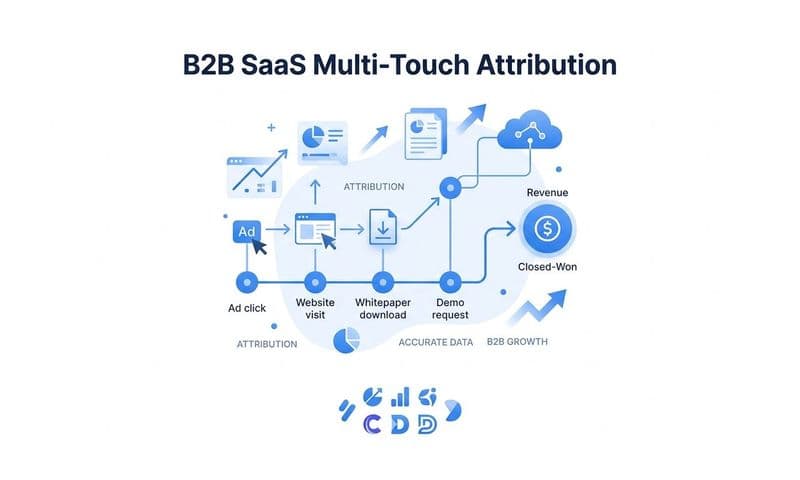
Multi-touch attribution models, including linear, time-decay, and position-based, distribute credit across multiple touchpoints. Linear gives equal credit to every touchpoint. Time-decay gives more credit to touchpoints closer to the conversion. These models are better suited to B2B SaaS buyers who interact with your brand across multiple channels over weeks or months before making a decision. Tracking the full customer journey is what makes multi-touch models genuinely actionable.
Data-driven attribution uses algorithmic modeling to assign credit based on actual conversion path data. It is increasingly the preferred approach for teams with sufficient conversion volume because it reflects the real contribution of each touchpoint rather than applying a fixed rule. Google Ads offers a version of this natively, and platforms like Cometly apply data-driven modeling across all your paid social channels in a unified view.
The practical recommendation for most B2B SaaS teams: use multi-touch attribution as your primary model for evaluating paid social performance. Last-click will consistently undervalue your top-of-funnel campaigns and lead you to cut spend that is actually generating pipeline.
Success indicator: Your team has agreed on a primary attribution model and applies it consistently when reporting on paid social conversion performance. Budget decisions are not being made based on last-click data alone.
Step 5: Build a Paid Social Conversion Dashboard That Shows Revenue Impact
At this point, you have the tracking infrastructure in place and an attribution model selected. Now you need a way to see all of that data in a format that actually drives decisions. That means moving beyond ad platform native reporting.
Ad platform dashboards are optimized to show you what the platform wants you to see: impressions, clicks, cost per click, and platform-reported conversions. These metrics are useful for creative testing and day-to-day campaign management. They are not sufficient for answering the question that matters most: is paid social generating pipeline and revenue? A comprehensive approach to paid media analytics fills exactly this gap between platform reporting and true revenue visibility.
A revenue-focused paid social dashboard for B2B SaaS should include the following metrics.
Cost per qualified lead: Not all leads are equal. This metric filters for leads that meet your defined quality criteria, giving you a more accurate picture of acquisition efficiency.
Cost per opportunity created: This connects ad spend to the CRM stage where sales actually engages. If cost per lead looks great but cost per opportunity is high, you have a lead quality problem.
Pipeline generated per campaign: The total value of opportunities attributed to each campaign. This is the metric that tells you whether paid social is actually building your sales pipeline.
Revenue attributed per channel: Closed-won revenue connected back to the paid social channels and campaigns that influenced the deal. This is the ultimate measure of paid social ROI.
Blended ROAS at the revenue level: Return on ad spend calculated using actual closed revenue, not platform-reported conversions. This is the number that should drive budget allocation decisions.
Building this dashboard requires connecting your ad platform data, your CRM pipeline data, and your revenue data in a single view. That is exactly what Cometly is built to do. It centralizes paid social conversion data across Meta, LinkedIn, TikTok, and Google into one attribution dashboard with real-time visibility into pipeline and revenue. Instead of toggling between ad platforms and your CRM and trying to reconcile the numbers manually, you get a single source of truth. Evaluating the best software for tracking marketing attribution can help you understand what to look for when selecting the right platform for your team.
Success indicator: Your dashboard shows pipeline and revenue attributed to each paid social campaign, ad set, and individual ad. You can answer the question "which campaign is generating the most qualified pipeline?" in under a minute.
Step 6: Use Conversion Data to Optimize Campaigns and Feed Ad Platform AI
Accurate conversion tracking is not just a reporting tool. It is a performance lever. The data you collect feeds directly back into ad platform algorithms, and the quality of that data determines how well those algorithms can optimize on your behalf.
Here is the feedback loop in practice. When you send enriched, high-quality conversion events back to Meta or Google via server-side APIs, you are giving the platform's machine learning model better signal to work with. Instead of optimizing toward users who click ads, the algorithm learns to find users who actually become customers. Over time, this improves targeting quality, reduces wasted spend, and lowers your cost per qualified lead.
This is why the quality of your conversion signals matters as much as the quantity. Sending a high volume of low-quality leads back to Meta as conversion events trains the algorithm to find more users who look like those low-quality leads. Sending a smaller volume of enriched, revenue-linked conversion events trains it to find users who look like your actual customers. The difference in campaign performance over time is significant. Understanding how ad tracking tools help you scale ads using accurate data makes this feedback loop much easier to act on.
On the optimization side, accurate revenue attribution data enables decisions that would be impossible with surface-level metrics alone. Consider a few practical examples.
Pausing underperforming campaigns: A campaign might show a strong cost per lead in the ad platform while generating zero qualified opportunities in the CRM. Without revenue-level attribution, you would not see this. With it, you can pause the campaign and reallocate budget to campaigns that are actually generating pipeline.
Scaling high-performers: When you can see which specific ad sets and creatives are generating the most pipeline and revenue, you can scale those with confidence rather than guessing based on click-through rates.
Adjusting bidding strategies: Most ad platforms allow you to set conversion values for your optimization events. When you feed in actual revenue data rather than estimated lead values, the platform's bidding algorithm can optimize toward maximizing real revenue, not just conversion volume.
Cometly's AI-driven recommendations surface which ads and campaigns are driving the most qualified pipeline across all your paid social channels, so your team can act on insights without spending hours in manual analysis. The platform connects the enriched conversion signals to your ad platforms while giving your team a clear view of where to scale and where to cut.
Success indicator: Your ad platforms are receiving enriched conversion signals linked to CRM outcomes. Optimization decisions are based on pipeline and revenue data, and your campaign performance is improving over time as the algorithms learn from higher-quality signals.
Your Paid Social Conversion Tracking Checklist
Before you move on, use this checklist to confirm your tracking system is fully operational.
1. Conversion events are documented with clear definitions, funnel stage mapping, and assigned monetary values.
2. Server-side tracking is implemented via Meta CAPI and Google Enhanced Conversions for all key conversion actions.
3. Event deduplication is configured to prevent double-counting when both pixel and server-side events fire.
4. UTM parameters are applied consistently across all paid social campaigns on every platform.
5. CRM records capture UTM attribution data at the lead level and retain it through the full sales cycle.
6. Offline conversion syncs are sending CRM pipeline and closed-won events back to ad platforms.
7. Your team has agreed on a primary attribution model and applies it consistently in reporting.
8. Your paid social dashboard shows cost per qualified lead, cost per opportunity, pipeline generated, and revenue attributed per campaign.
9. Ad platforms are receiving enriched conversion signals and optimization decisions are based on revenue data.
Tracking paid social conversions accurately requires both the right infrastructure and the right analytical framework. The infrastructure includes server-side tracking and CRM sync. The framework includes attribution modeling and revenue-focused reporting. Together, they give you a complete picture of what paid social is actually contributing to your business.
Cometly brings all of this together in one platform, connecting your ad platforms, CRM, and revenue data into a single source of truth for B2B SaaS marketing teams. If you want to see how your paid social campaigns are actually performing at the pipeline and revenue level, Get your free demo and start building the attribution system your team needs to scale with confidence.