
Repeat customers are the backbone of sustainable revenue growth for B2B SaaS companies. Yet most marketing teams focus their tracking efforts almost entirely on acquisition, leaving a major blind spot in their data.
When you cannot see which campaigns, channels, or touchpoints are driving customers back to purchase again, you are making budget decisions with incomplete information. You might be scaling a campaign that generates cheap first conversions but rarely produces second or third purchases. Meanwhile, a higher-cost channel that consistently brings in loyal, high-LTV customers goes underfunded because the data does not tell that story.
This guide walks you through exactly how to track repeat customer purchases, from setting up your foundational data infrastructure to analyzing multi-touch journeys and feeding that intelligence back into your ad platforms. By the end, you will have a clear, repeatable process for capturing every purchase event, attributing it to the right source, and using that data to scale what is working.
Whether you are running paid ads on Meta and Google, nurturing leads through email, or relying on organic search, this framework applies to your entire marketing stack. The steps build on each other progressively, so follow them in order for the best results.
Step 1: Define What a Repeat Purchase Means for Your Business
Before you configure a single tracking pixel or write a single UTM parameter, you need clarity on what you are actually measuring. This sounds obvious, but it is where most teams skip ahead and create problems they spend months untangling later.
Start by building out your purchase event taxonomy. In B2B SaaS, "a purchase" is rarely a single event type. You likely have first purchases, second purchases, upsells to higher-tier plans, renewals, and expansion revenue from adding seats or products. Each of these is a distinct event with different marketing implications. Collapsing them all into one "purchase" conversion event destroys the granularity you need to understand what is driving repeat revenue.
First purchase: The initial conversion from prospect to paying customer. This is your acquisition event and should be tracked separately from everything that follows.
Second purchase or renewal: The first signal that a customer is retained. This event tells you which acquisition campaigns actually generate loyal customers, not just one-time buyers.
Upsell or expansion: A customer increasing their contract value. This is often influenced by different campaigns and content than the original acquisition, so it needs its own event label.
Next, identify the unique customer identifier you will use to stitch purchases together across sessions and time periods. Hashed email addresses and persistent user IDs are the most reliable options. CRM contact IDs work well if your CRM is the system of record. The key is choosing one primary identifier and using it consistently across every system, from your website to your ad platforms to your attribution layer.
You also need a time window definition. What qualifies as a repeat purchase versus a new purchase cycle? For a monthly SaaS subscription, a renewal after 30 days is expected behavior. For an annual contract, a renewal after 12 months is the baseline. Define these windows explicitly so your analytics do not flag normal renewals as surprising repeat behavior or miss genuine expansion signals.
Document all of this in a shared data dictionary. Your marketing, sales, and analytics teams need to be working from the same definitions. When a marketing manager asks "what is our repeat purchase rate?" and a data analyst asks the same question, they should get the same answer. Without a shared dictionary, they often do not.
The most common pitfall here is treating all purchase events as identical conversions. When you do that, attribution becomes impossible because you cannot distinguish the campaign that drove a renewal from the campaign that drove a brand-new first purchase.
Step 2: Set Up Server-Side Event Tracking for Purchase Events
Once your event taxonomy is defined, you need a tracking infrastructure that can actually capture those events reliably. Browser-based pixel tracking alone is no longer sufficient for repeat purchase tracking, and here is why.
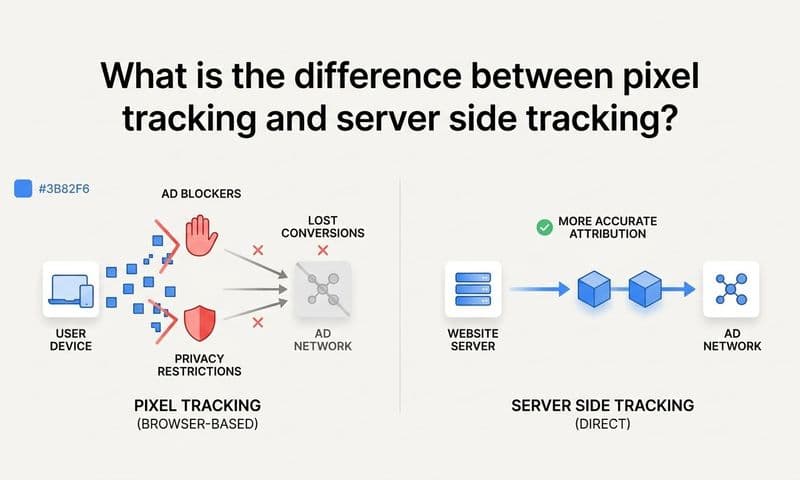
Cookie degradation is a real and growing problem. Privacy changes from Apple's iOS updates significantly reduced the reliability of browser-side tracking. Ad blockers prevent pixels from firing. Safari limits cookie lifespans. The result is that browser-only tracking misses a meaningful portion of purchase events, and the ones it does capture often lack the identity data needed to connect them to the right customer record.
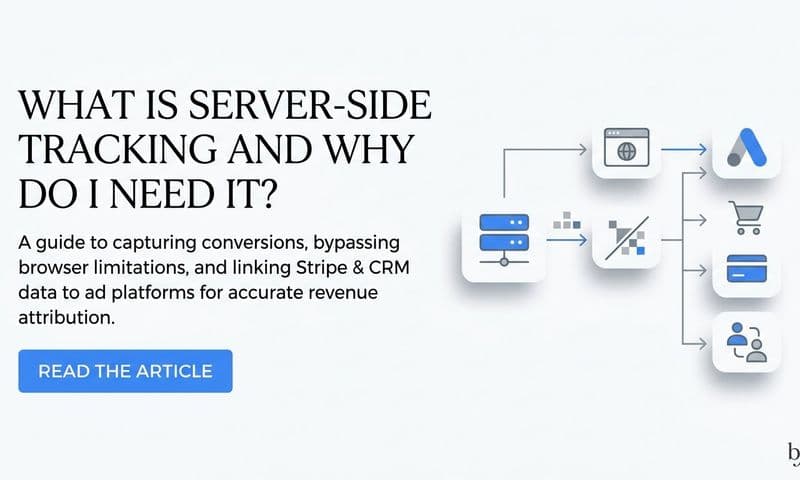
Server-side tracking solves this by sending conversion events directly from your server to the ad platform, bypassing the browser entirely. Meta's Conversion API (CAPI) and Google Enhanced Conversions are the two primary implementations you need to configure.
Here is how to set this up effectively:
1. Implement server-side event sending: When a purchase event fires in your application or CRM, your server sends that event data directly to Meta CAPI and Google Enhanced Conversions via API. This happens regardless of what the user's browser is doing.
2. Pass customer identifiers with every event: Include hashed email, user ID, and any other identifiers you defined in Step 1. This is what enables cross-session identity resolution. Without these identifiers, you are sending a purchase signal without context about who made the purchase.
3. Configure event deduplication: If you are sending both browser-side and server-side events (which is recommended for maximum coverage), you need deduplication keys to prevent the same purchase from being counted twice. Use a consistent event ID that matches between your browser pixel and your server event.
4. Verify events in your ad platform event manager: Before moving forward, confirm that your purchase events are appearing correctly in Meta Events Manager and Google's conversion tracking dashboard. Check that event counts look reasonable and that customer match rates are healthy.
A complete event tracking foundation also means thinking about how purchase events connect to your lead tracking process. The same server-side infrastructure that captures lead events should extend naturally to capture purchase events, renewal events, and expansion events using the same identity resolution logic.
Getting this layer right is non-negotiable. Everything in the steps that follow depends on clean, complete event data flowing from your server to your attribution and ad platforms.
Step 3: Connect Your CRM and Ad Platforms to a Single Attribution Layer
Here is the core problem that most B2B SaaS marketing teams run into: your CRM knows who bought again, but your ad platform has no idea which campaign influenced that decision. These two systems are speaking different languages, and without a translation layer between them, you are left guessing.
Your CRM holds the ground truth about customer behavior: deal stages, purchase dates, contract values, and customer IDs. Your ad platforms hold the campaign data: which ads were shown, which were clicked, and which drove sessions. Connecting these two sources is what makes repeat purchase attribution possible.
Start with UTM parameter discipline. Every campaign, email, and organic link in your marketing stack needs consistent UTM tagging. This is the simplest mechanism for ensuring that source data travels with each customer session. When a customer clicks a retargeting ad, opens a renewal email, or finds you through organic search, the UTM parameters attached to that session become the thread you can pull to connect that touchpoint back to a purchase event in your CRM.
Without consistent UTM tagging, repeat purchase attribution breaks down at the most basic level. You end up with CRM records that show a renewal happened but no reliable data about what marketing activity preceded it.
Next, integrate your CRM with your attribution platform. The fields that need to flow into your attribution layer include deal stage, purchase value, product line, customer ID, and the date of the purchase event. When these fields sync correctly, your attribution platform can match a closed-won expansion deal in your CRM back to the specific ad touchpoints that influenced it.
With Cometly, you can connect your ad platforms, CRM, and website to create a unified view of every customer journey, including repeat purchase events. Cometly's pipeline and revenue attribution is built specifically to bridge this gap for B2B SaaS companies, connecting ad spend directly to expansion revenue rather than stopping at lead generation.
The success indicator for this step is concrete: you should be able to look up a specific customer in your attribution platform and see their full journey from the first ad click they ever made through every subsequent purchase event, with the originating campaign and channel clearly labeled at each stage.
Step 4: Choose the Right Attribution Model for Repeat Purchase Analysis
Attribution models determine how credit is distributed across the touchpoints that influenced a purchase. For repeat purchase analysis specifically, model selection matters more than most teams realize, because the customer journey to a second or third purchase is fundamentally different from the journey to a first purchase.
Here is how the main models apply to repeat purchase tracking:
First-touch attribution credits the channel that originally acquired the customer. This is useful for understanding acquisition ROI and identifying which sources bring in customers who eventually become repeat buyers. The limitation is that it gives zero credit to the re-engagement campaigns, email sequences, and retargeting ads that influenced the repeat purchase decision itself.
Last-click attribution credits the final touchpoint before the repeat purchase. This tends to over-credit retargeting ads and email, since those channels are often the last touch before a renewal or upsell simply because they are the most direct. It ignores the earlier content, campaigns, and nurture sequences that kept the customer engaged between purchases.
Linear attribution distributes equal credit across all touchpoints in the journey. This gives a more complete picture of what influenced a repeat purchase decision, though it can dilute the credit of genuinely high-impact touchpoints by treating all interactions as equally important.
Time-decay attribution weights touchpoints more heavily as they get closer to the purchase event. This is often a good fit for repeat purchase analysis because it acknowledges that recent re-engagement activity matters while still giving partial credit to earlier touchpoints.
Data-driven attribution uses algorithmic weighting based on actual conversion patterns in your data. This becomes more accurate as you accumulate more repeat purchase events, making it a strong long-term model for established SaaS businesses with significant transaction volume.
The recommended approach for B2B SaaS is to compare models side by side rather than committing to one. Different business decisions require different lenses. If you are evaluating acquisition channel ROI, first-touch tells you something useful. If you are optimizing re-engagement campaigns, time-decay or data-driven attribution is more informative. Running multiple models simultaneously and understanding what each one is telling you is more valuable than picking one and treating it as the single truth. For a deeper look at how these models work in practice, the attribution marketing tracking complete guide covers each approach in detail.
Step 5: Build a Repeat Purchase Dashboard to Monitor Patterns
Data without visibility is just noise. Once your tracking infrastructure and attribution layer are in place, you need a dashboard that surfaces the patterns that actually matter for decision-making.
The key metrics your repeat purchase dashboard should track include:
Repeat purchase rate by channel: What percentage of customers acquired through each channel make a second purchase? This is often the most revealing metric because it shows which channels bring genuinely retained customers versus one-time buyers.
Average time between purchases: How long does it typically take for a customer to make a second purchase? Segmenting this by acquisition source or campaign type can reveal which marketing approaches are correlated with faster time-to-second-purchase.
Revenue per returning customer by acquisition source: Not all customers are equal. A customer acquired through one channel might generate significantly more expansion revenue over time than a customer acquired through another. This metric connects acquisition decisions to long-term revenue outcomes.
Campaign influence on expansion revenue: Which campaigns appear in the customer journeys that lead to upsells and renewals? This goes beyond first-purchase attribution and shows which marketing activity is actively supporting retention and growth.
Segment your repeat purchasers by acquisition channel to identify which sources bring customers who buy again versus one-time buyers. This segmentation often produces insights that shift budget allocation significantly. A channel that looks expensive on a cost-per-acquisition basis might look very efficient when you account for the repeat purchase rate it generates. Understanding the full customer journey analytics behind each acquisition source is what makes this segmentation actionable.
Track purchase frequency trends over time. If a specific campaign launch or content initiative correlates with an uptick in repeat purchase rate, that is a signal worth investigating and potentially replicating.
Set up alerts for drops in repeat purchase rate. A sudden decline can signal product issues, pricing problems, or messaging misalignment before they compound into larger retention problems. Catching these signals early gives your team time to respond.
Cometly's pipeline and revenue attribution connects ad spend directly to expansion revenue, so you can see which campaigns generate the highest lifetime value customers rather than just the cheapest first conversions. This is the difference between optimizing for acquisition cost and optimizing for actual business growth.
Step 6: Feed Repeat Purchase Data Back Into Your Ad Platforms
This step is one of the most commonly overlooked leverage points in B2B SaaS marketing. Most teams send first-purchase conversion events to their ad platforms and stop there. That means the ad platform AI is being trained exclusively to find users who make a single purchase, with no signal about which users go on to become high-value repeat customers.
Ad platform algorithms optimize toward the conversion signals you send them. If you only send first-purchase events, you are telling Meta and Google to find more users who convert once. If you send repeat purchase events with actual revenue values attached, you are training the algorithm to find users who are likely to generate significant lifetime value. The difference in campaign performance over time can be substantial.
Here is how to implement this correctly:
1. Send repeat purchase events as separate, high-value conversion events: Configure distinct conversion events for second purchases, renewals, and expansion revenue. Include the actual revenue value with each event so the algorithm understands the relative importance of these conversions compared to first purchases.
2. Build customer lists from repeat purchasers: Export your list of customers who have made multiple purchases and upload it to Meta and Google as a custom audience. Use this as the seed audience for lookalike campaigns. Lookalike audiences built from repeat buyers consistently produce higher-quality prospects than lookalikes built from all converters, because the model learns from your most engaged and valuable customers.
3. Exclude existing customers from acquisition campaigns: Suppress your current customer list from top-of-funnel acquisition campaigns to avoid wasting budget showing acquisition ads to people who are already customers. Instead, create separate retargeting campaigns specifically designed to drive second and third purchases.
With enriched, conversion-ready events flowing back to Meta and Google through server-side tracking, your ad platform AI gets a clearer signal about which users are most valuable. This improves targeting accuracy, reduces wasted spend on low-LTV prospects, and compounds in effectiveness over time as the algorithm accumulates more signal about your best customers.
Step 7: Use AI-Driven Insights to Scale What Drives Repeat Revenue
With clean data, unified attribution, and conversion signals flowing back to your ad platforms, you now have the foundation to use AI-driven analysis to make smarter scaling decisions. This is where the system starts to compound.
The first thing to analyze is which ad creatives, audiences, and campaigns have the highest correlation with repeat purchase behavior, not just initial conversion rate. A campaign with a strong first-purchase conversion rate but a low repeat purchase rate is not necessarily a good investment. A campaign with a slightly higher cost-per-acquisition but a significantly higher repeat purchase rate may generate far more revenue over a 12-month period.
Look specifically for the campaigns that attract customers with the shortest time-to-second-purchase. These are your highest-signal campaigns because they indicate that the customers they bring in are genuinely aligned with your product. Prioritize scaling those campaigns, even if their surface-level acquisition metrics look similar to other campaigns.
Use AI recommendations to surface underperforming campaigns that generate first purchases but rarely lead to repeat revenue. These campaigns might look successful based on cost-per-acquisition alone, but they are filling your customer base with low-retention customers. Reallocating that budget toward campaigns with stronger repeat purchase signals can improve both revenue and retention simultaneously. Pairing this analysis with proven customer retention strategies for SaaS companies gives you both the data and the playbook to act on what you find.
Test re-engagement campaign strategies using your repeat purchase data as the baseline. Before launching a re-engagement initiative, establish what your current repeat purchase rate looks like by channel and cohort. After the campaign, measure whether it moved the needle incrementally. Without that baseline, you cannot know whether your re-engagement efforts are actually working.
Cometly's AI ads manager helps you identify high-performing campaigns across every channel and scale with confidence based on full-funnel revenue data, not just top-of-funnel metrics. When your attribution layer is connected to actual expansion revenue, the AI recommendations reflect what is genuinely driving business growth rather than what is simply generating the most clicks or leads.
Putting It All Together
Tracking repeat customer purchases is not a single tool setup or a one-time configuration. It is a connected system where clean event data, unified attribution, and AI-driven analysis work together. When each layer is in place, you stop guessing which campaigns generate loyal, high-value customers and start making decisions backed by real revenue data.
Use this checklist to confirm your setup is complete:
Purchase events are defined and documented: Your team has a shared data dictionary covering first purchase, renewal, upsell, and expansion events with agreed-upon identifiers and time windows.
Server-side tracking is live with customer identifiers: Purchase events are flowing from your server to Meta CAPI and Google Enhanced Conversions with hashed email and user ID attached.
CRM and ad platforms are connected through an attribution layer: Revenue events in your CRM are being matched back to the original ad touchpoints with consistent UTM data and field mapping in place.
Attribution models are configured and being compared: You are running multiple models side by side and using each one to inform the decisions it is best suited for.
A repeat purchase dashboard is active: You are monitoring repeat purchase rate by channel, time between purchases, and campaign influence on expansion revenue.
Purchase events are flowing back to ad platforms: Repeat purchase and expansion events are being sent as separate, high-value conversion events to train ad platform algorithms toward high-LTV customers.
AI insights are informing budget decisions: You are using campaign-level repeat purchase data to scale what works and reallocate away from campaigns that generate one-time buyers.
If you are ready to build this system, Cometly gives B2B SaaS marketing teams the infrastructure to capture every touchpoint, attribute revenue accurately, and scale the campaigns that drive real growth. Get your free demo today and start connecting every purchase event to the campaigns that earned it.