You're running paid campaigns across Google, Meta, and LinkedIn. The dashboards are full of activity: clicks, impressions, cost-per-click metrics that look reasonable. But when you trace the line from ad spend to closed-won revenue, the picture gets murky fast. Pipeline is thin. Attribution is unclear. And somewhere in that gap, budget is quietly disappearing.
This is one of the most common frustrations for B2B SaaS marketing teams. It's not that they're spending carelessly. It's that fragmented tracking and incomplete attribution make it nearly impossible to tell which campaigns are genuinely driving growth and which ones are just consuming budget with nothing to show for it.
Wasted ad spend is not primarily a budgeting problem. It's a data visibility problem. When you can't see the full customer journey from first ad click to closed revenue, you can't distinguish productive spend from waste. That's where wasted ad spend analytics comes in. With the right data infrastructure and attribution framework, budget leaks stop being invisible. They become identifiable, fixable, and preventable.
This article will walk you through exactly how to find those leaks, which metrics actually matter, how attribution models shape what you see, and how to build a framework that makes every dollar accountable.
Why Ad Budgets Bleed Without You Noticing
Budget waste in paid campaigns rarely announces itself. It accumulates gradually, across channels, hidden behind metrics that look healthy on the surface. Understanding how this happens is the first step toward stopping it.
The most common culprit is fragmented tracking. When your ad platforms, CRM, and website analytics aren't connected, you end up with isolated data silos. Each platform reports on what it can see, which is only a slice of the actual customer journey. The result is a collection of partial truths that, when added together, don't reflect reality.
Broad targeting compounds the problem. When campaigns are configured to reach wide audiences without clear intent signals, a significant portion of impressions and clicks come from people who will never become customers. Those clicks cost money. Without attribution data connecting spend to outcomes, there's no way to know they were wasted.
Platform-native reporting makes this worse by design. Ad platforms have a structural incentive to report favorable performance. Their attribution windows are often wide, their models tend to favor last-click credit, and they count conversions that happen within their defined windows regardless of whether those conversions would have happened anyway. The result is inflated conversion counts and a distorted picture of which campaigns are actually working.
Last-click attribution is particularly problematic for B2B SaaS. When a prospect clicks a retargeting ad and signs up for a demo, the retargeting campaign gets full credit. But what about the LinkedIn thought leadership post they engaged with three weeks earlier? Or the Google Search ad that introduced them to the product in the first place? Those touchpoints are invisible in a last-click model, which means the campaigns responsible for them look like underperformers even when they're initiating high-value journeys.
B2B SaaS buying cycles are long and involve multiple stakeholders. A deal that closes today may have started with an ad impression six months ago, followed by a content download, a webinar registration, and several retargeting interactions before anyone ever booked a call. Without cross-channel attribution data that connects all of those touchpoints to the eventual revenue outcome, it's impossible to evaluate which early-stage campaigns deserve continued investment and which ones genuinely aren't contributing.
This is how budgets bleed without anyone noticing. The waste isn't dramatic. It's distributed across dozens of campaigns, buried in attribution gaps, and masked by metrics that measure activity rather than impact.
The Metrics That Actually Reveal Budget Waste
Not all metrics are created equal when it comes to identifying wasted spend. Many of the numbers that look impressive in a campaign dashboard have little bearing on whether your budget is producing real business outcomes. Knowing which signals to focus on changes everything.
High cost-per-click with low conversion rates is one of the clearest indicators of waste. If you're paying for traffic that isn't converting into leads, trials, or demos, the problem is either targeting quality, landing page relevance, or both. Either way, the spend isn't producing value.
But the more nuanced signal is strong click-through rates with zero downstream pipeline impact. This is where many teams get misled. A campaign with a high CTR looks like a success in platform reporting. But if those clicks generate leads that never progress past the initial sign-up, the campaign is generating activity without generating revenue. Engagement without conversion is a budget leak dressed up as performance.
Cost-per-click versus cost-per-pipeline-opportunity: For B2B SaaS, the most meaningful efficiency metric isn't CPC or even cost-per-acquisition in the traditional sense. It's cost-per-qualified-pipeline-opportunity. A campaign that generates leads at a low CPA looks efficient until you discover that none of those leads ever convert to pipeline. Campaigns generating expensive leads that consistently close are far more valuable than campaigns generating cheap leads that go nowhere.
Lead-to-pipeline conversion rate by channel: Segmenting this metric by campaign and channel reveals which sources are producing leads that actually matter to your sales team. When a channel consistently generates leads with low pipeline conversion rates, that's a clear signal of misaligned targeting or messaging, and a primary source of wasted spend.
Surface-level ROAS as a misleading metric: Return on ad spend, as reported by ad platforms, often reflects platform-attributed revenue rather than actual closed-won revenue. When a platform reports a strong ROAS but your CRM shows minimal revenue influence from that channel, the discrepancy is a sign that platform attribution is over-counting. Relying on platform ROAS without cross-referencing revenue data is one of the most common ways waste stays hidden.
Touchpoint analysis adds another layer of insight. By mapping which ad interactions appear in the journeys of customers who eventually convert versus those who don't, you can identify which campaigns consistently influence closed revenue and which ones consume budget without ever appearing in a winning journey. This kind of analysis requires attribution data that spans the full funnel, from first click to closed deal, but when you have it, the patterns become hard to ignore.
The shift from measuring activity to measuring revenue influence is what separates teams that find their budget leaks from teams that keep funding them.
Attribution Models and Their Role in Exposing Waste
The attribution model you use doesn't just affect how you report performance. It actively shapes which campaigns you invest in, which ones you cut, and whether your budget allocation reflects reality or a convenient fiction.
Different attribution models produce radically different pictures of the same campaign data. Last-click attribution assigns all credit to the final touchpoint before conversion. First-touch attribution credits the first interaction. Linear attribution distributes credit evenly across all touchpoints. Data-driven attribution uses statistical modeling to assign credit based on the actual influence of each interaction on the conversion outcome.
Each model tells a different story. And if you're only looking at one of them, you're only seeing part of the truth.
Last-click attribution is the most common default, and it's also the most misleading for B2B SaaS teams. Because it credits only the final interaction, it systematically over-rewards bottom-of-funnel campaigns like branded search and retargeting while starving top-of-funnel campaigns that do the heavy lifting of awareness and consideration. The result is a budget that keeps flowing toward campaigns that close deals that would have closed anyway, while the campaigns responsible for initiating those journeys are quietly defunded.
This creates a compounding problem. As top-of-funnel campaigns lose investment, fewer high-quality prospects enter the pipeline. Bottom-of-funnel campaigns then have a smaller pool to work with. Performance declines. And because last-click attribution still credits the bottom-of-funnel touchpoints, it's hard to trace the decline back to the original cause.
First-touch attribution overcorrects in the opposite direction. It credits the channel that introduced the prospect but ignores everything that happened between introduction and conversion. For B2B SaaS, where nurturing and re-engagement are critical parts of the buying process, this model undervalues the mid-funnel campaigns that keep prospects engaged over long sales cycles.
Multi-touch attribution addresses these limitations by distributing credit across all meaningful touchpoints in the customer journey. This gives teams a more complete view of which campaigns contribute to revenue at each stage of the funnel. Campaigns that initiate high-value journeys get recognized. Campaigns that nurture prospects through long cycles get credit. And campaigns that appear to perform well but consistently fail to appear in winning journeys get flagged.
The practical value of comparing attribution models side by side is significant. When you run the same campaign data through last-click and multi-touch models and the results look dramatically different, that gap is where hidden waste often lives. Channels that look strong under last-click but disappear under multi-touch are likely getting over-credited. Channels that look weak under last-click but consistently appear in multi-touch winning journeys are likely being underfunded.
Using attribution model comparison as an analytical tool, rather than committing to a single model as gospel, is one of the most powerful ways to surface budget inefficiencies that would otherwise stay invisible.
Tracking Gaps That Turn Insights Into Blind Spots
Even with the right attribution model, your analysis is only as good as the data feeding it. And for many B2B SaaS teams, that data has significant gaps, gaps that have widened considerably as the digital privacy landscape has shifted.
Browser-level privacy changes have degraded the reliability of pixel-based tracking in meaningful ways. iOS privacy updates introduced app tracking transparency requirements that reduced the visibility of mobile ad interactions. Third-party cookie deprecation has further limited the ability of browser-based pixels to track users across sessions and devices. The result is that a meaningful portion of conversion events simply go unreported, creating blind spots in campaign performance data.
When conversions go untracked, ad platforms don't know which impressions and clicks led to results. Their optimization algorithms have less signal to work with, which means they make less accurate targeting decisions. Campaigns that are actually performing well may look underperforming because their conversions aren't being attributed. And campaigns that are genuinely wasteful may look acceptable because the absence of data obscures how little they're contributing.
Server-side tracking and Conversion API integrations are the primary solution to this problem. Instead of relying on a browser-based pixel to fire a conversion event when a user completes an action, server-side tracking sends that event directly from your server to the ad platform. Because the event doesn't pass through the browser, it isn't subject to browser-level blocking, privacy restrictions, or cookie limitations.
Meta's Conversion API and Google's Enhanced Conversions are the most widely used implementations of this approach. When configured correctly, they restore a significant portion of the conversion data that browser-based tracking loses. This gives ad platforms more complete signal, which improves algorithmic targeting and provides marketers with more accurate campaign performance data to work with.
Event deduplication: One important consideration when implementing server-side tracking alongside existing pixel-based tracking is deduplication. If both the pixel and the server-side event fire for the same conversion, the platform may count it twice, inflating conversion numbers and making campaigns appear more efficient than they are. Proper deduplication logic ensures that each conversion is counted once, keeping your data accurate.
Data enrichment: Beyond restoring lost events, server-side tracking also creates an opportunity to enrich conversion signals with additional data points, such as lead quality indicators, CRM stage information, or revenue values. When ad platforms receive enriched conversion signals, their algorithms can optimize not just for volume but for quality, reducing wasted spend on leads that look good on paper but never convert to pipeline.
Fixing tracking gaps isn't just a technical exercise. It's a foundational requirement for any wasted ad spend analytics effort. Without complete, accurate conversion data, every analysis you run is working from an incomplete picture.
Building a Wasted Ad Spend Analytics Framework
Understanding where waste comes from is important. But the real value comes from having a systematic framework for finding it, measuring it, and acting on it. Here's how to build one.
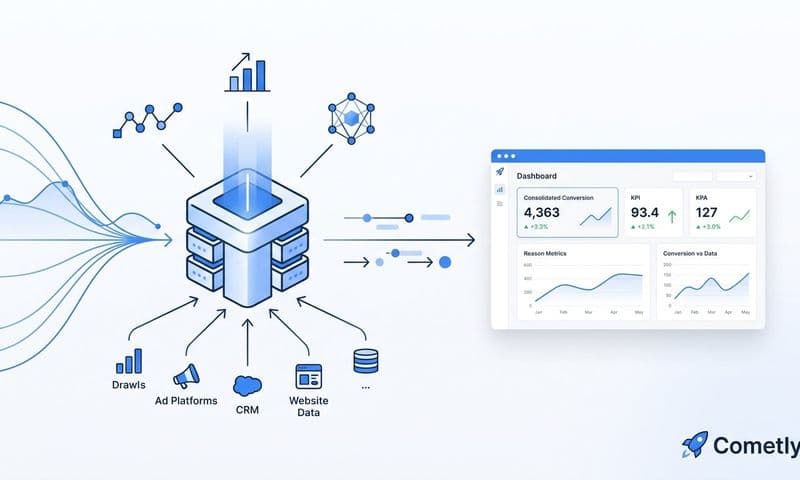
Start with a unified attribution layer: The foundation of any wasted ad spend analytics framework is connecting all of your data sources into a single view. That means your ad platforms, your CRM, your website event data, and your revenue data need to be feeding into one attribution system. When these sources are siloed, you can't trace a customer journey from first ad click to closed-won revenue. When they're unified, every touchpoint becomes visible and attributable.
This unified view is what makes it possible to ask the right questions. Which campaigns are generating leads that convert to pipeline? Which channels are producing customers with the highest lifetime value? Which creatives drive engagement but consistently fail to influence closed revenue? Without a single attribution layer, these questions are unanswerable.
Segment campaigns by revenue contribution, not just activity: Once you have unified data, the next step is to segment your campaigns by their actual contribution to pipeline and revenue rather than by clicks, impressions, or surface-level conversion counts. This segmentation immediately separates campaigns that are producing real business outcomes from campaigns that are generating activity without impact.
The goal is to build a clear picture of cost-per-pipeline-opportunity by campaign and channel. Campaigns with high costs and low pipeline contribution are your primary waste candidates. Campaigns with strong pipeline conversion rates, even if their surface-level metrics look modest, deserve more investment.
Use AI-driven pattern recognition: Modern attribution platforms can surface patterns in campaign data that are difficult to spot manually. AI can identify, for example, that a specific ad creative consistently drives high engagement and strong click-through rates but produces leads with unusually low pipeline conversion rates. Or that a particular audience segment generates leads that progress quickly through the funnel and close at higher rates than average.
These patterns are often non-obvious. A human analyst reviewing campaign dashboards might miss them entirely. AI-driven insights bring them to the surface, giving growth teams actionable signals rather than raw data to interpret.
Create a regular audit cadence: A wasted ad spend analytics framework isn't a one-time project. It's an ongoing practice. Building a regular cadence for reviewing pipeline contribution by channel, comparing attribution model outputs, and auditing tracking completeness ensures that new waste doesn't accumulate undetected between reviews.
The teams that consistently improve their ad efficiency aren't the ones who run the biggest budgets. They're the ones who look at their data most honestly and act on what they find.
What Happens When You Fix the Data
Fixing attribution and tracking gaps doesn't just improve your reporting. It creates a compounding set of downstream improvements that affect campaign performance, budget allocation, and revenue growth.
The most immediate impact is on ad platform algorithms. When you send enriched, accurate conversion signals back to Meta, Google, and other platforms via server-side events, their machine learning models have better data to work with. They learn which types of users actually convert to pipeline and revenue, not just which ones click or fill out a form. Over time, this improves targeting precision, reduces wasted impressions on low-quality audiences, and increases the efficiency of every dollar spent.
This is a feedback loop with compounding benefits. Better data produces better targeting. Better targeting produces higher-quality leads. Higher-quality leads produce more accurate conversion signals. And those signals further improve targeting. Teams that invest in data quality to drive business growth tend to see their ad efficiency improve progressively over time, while teams running on degraded tracking data find it increasingly difficult to scale without proportionally increasing waste.
The second major impact is on budget allocation decisions. When you can connect ad spend data to pipeline velocity and closed-won revenue, scaling decisions become far more confident. Instead of reallocating budget based on platform-reported ROAS or gut instinct, you can point to specific campaigns with documented revenue influence and make the case for increased investment with evidence.
Equally important, you can identify campaigns that have been consuming budget without contributing to revenue and reallocate those dollars toward channels with proven impact. This kind of data-driven reallocation often produces meaningful efficiency gains without requiring any increase in total spend.
This is exactly the problem that Cometly is built to solve. Cometly connects your ad platforms, CRM events, and Stripe revenue data into a single attribution layer, giving B2B SaaS teams a true single source of truth for their marketing performance. Instead of reconciling conflicting reports from multiple platforms, you get one clear view of which campaigns are driving leads, which leads are converting to pipeline, and which pipeline is closing into revenue.
Cometly's AI-driven insights surface patterns in your campaign data that would take hours to find manually, flagging underperforming creatives, audiences, and channels so you can act quickly. And with server-side tracking and Conversion API integration built in, the conversion signals feeding back to your ad platforms are accurate, enriched, and complete, giving platform algorithms the data they need to optimize toward your actual revenue goals.
For growth teams tired of running campaigns in the dark, the ability to see the full customer journey from first click to closed deal changes everything about how decisions get made.
Putting It All Together
Wasted ad spend is not a budgeting problem. It's a data problem. When tracking is fragmented, attribution is incomplete, and ad platform reporting is taken at face value, waste becomes invisible. It accumulates silently across campaigns, masked by metrics that measure activity rather than revenue impact.
The good news is that data problems have data solutions. When you build a unified attribution layer, implement complete server-side tracking, compare attribution models to find gaps, and segment campaigns by their actual contribution to pipeline and revenue, waste stops being invisible. It becomes identifiable, measurable, and fixable.
Start by auditing your current tracking setup. Are your ad platforms, CRM, and website events connected into a single view? Are you losing conversion data to browser-level blocking? Is your attribution model reflecting the reality of a long, multi-touch B2B buying cycle, or is it crediting the last click and ignoring everything that came before?
If any of those questions surface gaps, that's where your budget is leaking. And those gaps are exactly what a modern attribution platform is designed to close.
Get your free demo today and see how Cometly gives B2B SaaS teams the complete attribution, AI-driven insights, and revenue-connected data they need to find their budget leaks, fix them, and scale with confidence.