
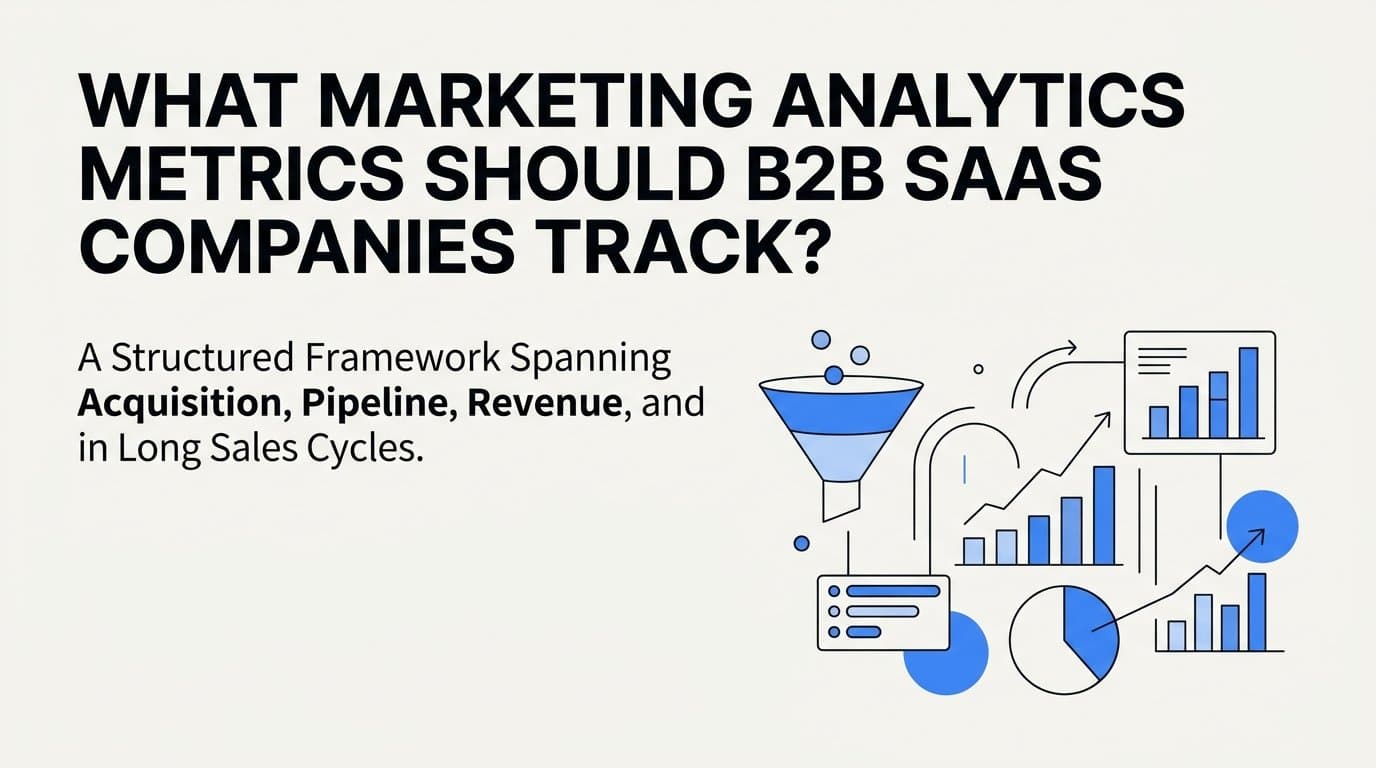
B2B SaaS companies should track metrics across four core categories: acquisition (CAC, MQL volume, CPL), pipeline (SQL conversion rate, pipeline velocity, opportunity-to-close rate), revenue (ARR influenced, LTV, payback period), and attribution (channel ROI, multi-touch contribution, revenue per campaign). If you are looking for a single platform to connect all of these dots, Cometly is built specifically for this, linking ad spend directly to pipeline and closed-won revenue using multi-touch attribution and server-side tracking.
The challenge with B2B SaaS analytics is that the buying journey is long, involves multiple stakeholders, and the conversion event often happens weeks or months after the first marketing touchpoint. GA4 alone cannot tell you which LinkedIn campaign influenced a deal that closed 90 days later. That requires a dedicated attribution layer, a reliable data pipeline, and the right metrics framework.
This article covers the essential metrics every B2B SaaS marketing team should monitor, the tools built to track them, and answers to the related questions growth leaders commonly ask.
The Core Metrics Framework for B2B SaaS Marketing
Before diving into tools, it helps to understand the four metric categories that matter most for B2B SaaS marketing teams.
Acquisition Metrics: Cost Per Lead (CPL), Cost Per MQL, MQL volume by channel, and Customer Acquisition Cost (CAC). These tell you how efficiently you are generating pipeline-ready demand, not just traffic.
Pipeline Metrics: MQL-to-SQL conversion rate, SQL-to-opportunity rate, pipeline velocity, and cost per opportunity. These measure lead quality and how fast deals move through the funnel.
Revenue Metrics: ARR influenced by marketing, Lifetime Value (LTV), LTV:CAC ratio, and payback period. These connect marketing activity to actual business outcomes and help justify budget allocation.
Attribution Metrics: Revenue per channel, multi-touch attribution by campaign, first-touch vs. last-touch comparison, and pipeline attribution. These answer the question every CMO eventually asks: which programs are actually driving revenue?
Now, here are the top tools built to help you track and analyze these metrics.
1. Cometly
Best for: B2B SaaS teams that need end-to-end attribution from first ad click to closed-won revenue.
Cometly is a marketing attribution platform built specifically for B2B SaaS companies that connects ad spend, CRM events, and Stripe revenue into a single attribution view with multi-touch modeling and server-side tracking.
 What marketing analytics metrics should b2b saas companies track?
Where This Tool Shines
Most analytics tools show you what happened on your website. Cometly shows you what that activity was worth in actual revenue. By connecting your ad platforms, CRM, and Stripe subscription data, it gives you a single source of truth that answers which campaigns generated pipeline and which ones closed deals.
The server-side tracking and Conversion API integration with Meta and Google also solve a real problem for B2B SaaS teams: data loss from browser restrictions and ad blockers. When your attribution data is incomplete, your optimization decisions are too. Cometly's AI ads manager surfaces high-performing campaigns and recommends budget shifts based on real revenue data, not just click-through rates.
Key Features
Multi-Touch Attribution: Distributes credit across all touchpoints in the buying journey using 70+ native integrations with ad platforms, CRMs, and data tools.
Server-Side Conversion Tracking: Captures conversion events server-side to reduce data loss from browser restrictions, ad blockers, and iOS privacy changes.
Stripe Revenue Integration: Pulls actual subscription revenue into attribution reports so you can tie ARR directly to the campaigns that influenced it.
AI Ads Manager: Identifies high-performing ads and campaigns across channels, then surfaces budget shift recommendations grounded in revenue data.
Real-Time Customer Journey Analytics: Tracks every touchpoint from first ad click through CRM stages to closed-won, giving your team a complete view of the buying journey.
Best For
Growth marketers, CMOs, and demand generation teams at B2B SaaS companies who are running paid campaigns and need to see which channels and campaigns are driving actual revenue, not just leads. Particularly strong for teams using Stripe for billing and running ads across Meta and Google.
Pricing
See current plans at cometly.com/pricing. Pricing scales based on your data volume and feature requirements.
2. HubSpot Marketing Hub
Best for: Teams already in the HubSpot ecosystem who want CRM and marketing attribution in one platform.
HubSpot Marketing Hub is an all-in-one marketing platform with native attribution reporting tied to HubSpot CRM deal stages and revenue.
 What marketing analytics metrics should b2b saas companies track?
Where This Tool Shines
If your sales team already lives in HubSpot CRM, Marketing Hub removes a major integration headache. Contact-level attribution is built directly into the platform, meaning you can see which campaigns touched a contact before they became a deal, without stitching together separate tools.
The revenue attribution reports on Professional and Enterprise tiers let you compare attribution models side by side, which is useful when you are trying to make the case for top-of-funnel investment or evaluate which channels are actually closing business.
Key Features
Contact-Level Multi-Touch Attribution: Tracks individual contact interactions across campaigns and ties them to deal stages in HubSpot CRM.
Revenue Attribution Reports: Available on Professional and Enterprise tiers, these reports show which campaigns influenced closed-won revenue using multiple attribution models.
Campaign Analytics: Unified reporting across email, ads, landing pages, and forms within a single campaign view.
Native CRM Integration: Pipeline and revenue data live in the same platform as your marketing data, eliminating the need for a separate data connector.
Best For
B2B SaaS companies that use HubSpot as their primary CRM and want to reduce tool sprawl. Less suited for teams running complex paid media programs that need granular ad-level attribution across many channels.
Pricing
Marketing Hub Professional starts at $800/month. Enterprise starts at $3,600/month. Revenue attribution reporting requires Professional tier or above.
3. Google Analytics 4
Best for: Teams that need free, event-based web analytics with strong Google Ads integration and data export capabilities.
Google Analytics 4 is Google's free, event-based web analytics platform with predictive metrics, BigQuery export, and broad integration with Google Ads.
 What marketing analytics metrics should b2b saas companies track?
Where This Tool Shines
GA4's event-based data model is a significant improvement over its predecessor. You can track virtually any on-site or in-app interaction without relying on default pageview data, which matters when your key conversion events are form submissions, demo requests, or trial sign-ups.
The BigQuery export is where GA4 becomes genuinely powerful for data-forward teams. If you have an analyst who can write SQL, you can build custom attribution queries, combine GA4 data with CRM exports, and create reporting that goes well beyond what the GA4 interface offers natively.
Key Features
Event-Based Data Model: Tracks any on-site or in-app interaction as a configurable event, giving you flexibility in defining what counts as a conversion.
BigQuery Export: Exports raw event data to BigQuery for custom SQL analysis and data warehouse integration.
Google Ads Integration: Campaign-level traffic and conversion data flows directly between GA4 and Google Ads for closed-loop reporting.
Exploration Reports: Funnel analysis, path exploration, and segment overlap reports for deeper behavioral analysis.
Best For
Any B2B SaaS team as a foundational web analytics layer. Note that GA4 does not natively connect to CRM or revenue data, so pipeline and revenue attribution require additional tools or custom data pipeline work.
Pricing
GA4 is free. GA4 360 (enterprise tier with higher data limits and SLA guarantees) uses custom pricing through Google's sales team.
4. Salesforce Marketing Cloud Intelligence
Best for: Large enterprise marketing teams managing complex, multi-channel media mixes who need unified data aggregation.
Salesforce Marketing Cloud Intelligence (formerly Datorama) is an enterprise data aggregation and analytics platform that unifies marketing data from ad platforms, CRMs, and BI tools into a single dashboard.
 What marketing analytics metrics should b2b saas companies track?
Where This Tool Shines
The core value proposition here is data harmonization at scale. When you are pulling data from dozens of ad platforms, each with different naming conventions, different attribution windows, and different metric definitions, Marketing Cloud Intelligence automates the process of making that data consistent and comparable.
For Salesforce CRM users, the native integration means pipeline and revenue data can flow directly into your marketing dashboards without a custom connector, which is a meaningful time saver for enterprise operations teams.
Key Features
Multi-Source Data Aggregation: Connects data from dozens of ad platforms, CRMs, and data warehouses into a unified view.
Automated Data Harmonization: Standardizes metrics and naming conventions across sources with different data structures.
Custom KPI Dashboards: Build cross-channel performance views tailored to your specific reporting requirements.
Native Salesforce CRM Integration: Pipeline and revenue data from Salesforce CRM feeds directly into marketing dashboards.
Best For
Enterprise B2B SaaS companies with large marketing operations teams, significant media budgets across many channels, and existing Salesforce CRM infrastructure. Not the right fit for early-stage or mid-market teams given the cost and implementation complexity.
Pricing
Custom enterprise pricing. Contact Salesforce directly for a quote based on your data volume and use case.
5. Looker Studio
Best for: Teams that want free, customizable dashboards built on top of their existing data sources.
Looker Studio is Google's free data visualization tool that connects to GA4, Google Ads, BigQuery, Sheets, and third-party sources to build custom, shareable dashboards.
 What marketing analytics metrics should b2b saas companies track?
Where This Tool Shines
Looker Studio is the go-to choice when you have data in multiple places and need a single, stakeholder-friendly view without paying for a BI tool. It does not store data itself. Instead, it visualizes data from connected sources in real time, which keeps reports fresh without manual updates.
The drag-and-drop builder is accessible enough for marketers who are not data engineers, and the ability to share or embed reports makes it useful for weekly performance reviews with leadership or clients.
Key Features
Free to Use: No cost, no data storage limits on connected sources, and no seat-based pricing.
Drag-and-Drop Builder: Charts, tables, scorecards, and filters without requiring SQL or coding skills.
Broad Connector Library: Native connections to GA4, Google Ads, BigQuery, and Sheets, plus third-party connectors for platforms like Meta and LinkedIn.
Shareable and Embeddable Reports: Reports can be shared via link or embedded in internal tools and client portals.
Best For
Marketing analysts and agencies who already have data infrastructure (GA4, BigQuery, or a data warehouse) and need a reporting layer on top of it. Not a standalone analytics solution since it depends entirely on the quality of your connected data sources.
Pricing
Free for all users. Some third-party connectors from the Looker Studio partner marketplace carry their own fees.
6. Mixpanel
Best for: Product-led growth SaaS companies that need to connect marketing acquisition to in-product activation and retention.
Mixpanel is a user-level event tracking and product analytics platform that helps PLG SaaS companies understand what happens after a user signs up.
 What marketing analytics metrics should b2b saas companies track?
Where This Tool Shines
Most marketing analytics tools focus on what happens before a user converts. Mixpanel focuses on what happens after. For PLG SaaS companies where trial-to-paid conversion and product activation are key metrics, this is where Mixpanel adds unique value.
You can build funnel reports that show exactly where users drop off between sign-up and activation, then segment those funnels by acquisition source to see which channels bring users who actually stick around. That kind of insight changes how you allocate budget across channels.
Key Features
User-Level Event Tracking: Tracks any in-app action at the individual user level for granular behavioral analysis.
Funnel Analysis: Shows conversion and drop-off rates between any sequence of steps you define.
Retention Cohort Reports: Segments retention curves by acquisition source, signup date, or any user property.
User Journey Mapping: Visualizes paths users take from first visit through activation and beyond.
Best For
PLG B2B SaaS companies where product activation, feature adoption, and trial-to-paid conversion are core marketing metrics. Less suited for sales-led organizations where the key conversion events happen in a CRM, not in the product.
Pricing
Free plan available for up to 20 million monthly events. Growth plan starts at $28/month. Enterprise pricing is custom based on data volume and feature requirements.
7. Dreamdata
Best for: B2B companies with long, multi-stakeholder sales cycles that need account-level attribution tied to CRM revenue.
Dreamdata is a B2B revenue attribution platform that uses account-level multi-touch attribution to track long buying journeys from first touch to closed-won revenue.
Where This Tool Shines
Individual-level attribution breaks down when three people from the same company all interact with your marketing before a deal closes. Dreamdata's account-level model treats the buying group as a unit, which gives you a much more accurate picture of how marketing influenced a deal when multiple stakeholders are involved.
The platform supports multiple attribution models including linear, time-decay, and data-driven, and ties them directly to CRM deal stages. This makes it possible to see not just which channels touched an account, but which touchpoints are most common among accounts that actually close.
Key Features
Account-Level Attribution: Groups individual touchpoints by company account to handle multi-stakeholder buying journeys accurately.
Multiple Attribution Models: Supports linear, time-decay, first-touch, last-touch, and data-driven models for flexible analysis.
Pipeline and Revenue Attribution: Ties attributed touchpoints directly to CRM deal stages and closed-won revenue.
Ad Platform Integrations: Connects to major ad platforms for cross-channel ROI reporting at the account level.
Best For
Mid-market and enterprise B2B SaaS companies with average deal sizes above $10,000 and sales cycles longer than 30 days, where individual-level attribution consistently misses the full picture of how marketing influences revenue.
Pricing
Team plan starts at $999/month. Business and Enterprise plans are custom. Best suited for companies where the revenue impact justifies the investment.
8. Supermetrics
Best for: Analysts and agencies who need to pull raw marketing data from 100+ sources into their own reporting environment.
Supermetrics is a data connector tool that pulls marketing data from 100+ sources into spreadsheets, Looker Studio, data warehouses, or BI tools for custom reporting.
Where This Tool Shines
Supermetrics is not an analytics platform. It is the pipe that moves data from where it lives to where you want to analyze it. If you are managing multiple ad accounts across Google, Meta, and LinkedIn, and you want all of that data in a single Google Sheet or BigQuery table, Supermetrics handles the extraction and refresh automatically.
For agencies managing multiple client accounts or in-house analysts who have built custom reporting in Looker Studio or a BI tool, Supermetrics eliminates the manual data export work that would otherwise consume hours each week.
Key Features
100+ Source Connectors: Covers Google Ads, Meta, LinkedIn, TikTok, HubSpot, Salesforce, and many more marketing and CRM platforms.
Flexible Destinations: Sends data to Google Sheets, Excel, Looker Studio, BigQuery, Snowflake, Redshift, and other warehouses.
Automated Refresh Schedules: Keeps reports current without manual data pulls, with configurable refresh intervals.
No-Code Setup: Most connectors are configured through a UI without requiring engineering support.
Best For
Marketing analysts, BI teams, and agencies who have existing reporting infrastructure and need a reliable data pipeline to feed it. Not a standalone analytics solution since it does not provide attribution modeling or analysis natively.
Pricing
Plans vary by destination and number of data sources. The basic Google Sheets connector starts around $29/month. Higher tiers covering data warehouse destinations are priced significantly higher.
Related Questions Marketing Leaders Ask
How often should B2B SaaS marketing teams review their metrics?
Review cadence should match the decision cycle for each metric category. Weekly reviews are typically focused on ad performance, spend pacing, and CPL to catch budget waste before it compounds. Monthly reviews cover pipeline contribution, MQL-to-SQL rates, and CAC by channel to assess overall program health. Quarterly reviews address LTV, payback period, and attribution model accuracy to inform strategic budget allocation decisions.
What attribution model works best for B2B SaaS companies?
It depends on your sales cycle length. For cycles under 30 days, last-touch or linear attribution models provide reasonable accuracy. For cycles of 30 to 180 days or longer, multi-touch models such as W-shaped, time-decay, or data-driven attribution give more accurate credit distribution across the full buying journey. For account-based buying with multiple stakeholders, account-level attribution is more accurate than individual-level tracking because multiple people from the same company may interact with marketing before a deal closes.
What is the LTV:CAC ratio and why do investors care about it?
LTV:CAC is a ratio that compares the lifetime revenue a customer generates (LTV) against what it cost to acquire them (CAC). It is a common benchmark for SaaS business health because it signals whether your marketing investment is generating durable, profitable growth. Investors and boards use it to assess marketing efficiency and scalability, particularly during fundraising or growth planning conversations.
Can GA4 alone handle B2B SaaS marketing attribution?
GA4 is a strong foundational layer for web analytics, but it does not natively connect to CRM or revenue data. This means it cannot show you which campaigns influenced pipeline or closed-won ARR without additional tools or custom data pipeline work. For B2B SaaS teams that need to connect ad spend to revenue, GA4 works best as one input in a broader attribution stack, not as the sole attribution solution.
Which Tool Is Right for Your Team?
The right tool depends on what your biggest attribution gap is today. Here is a quick guide to help you choose.
If you need to connect ad spend directly to closed-won revenue and want a platform built specifically for B2B SaaS attribution, start with Cometly. The combination of server-side tracking, Stripe revenue integration, and multi-touch attribution across 70+ integrations makes it the most complete solution for teams running paid campaigns and tracking subscription revenue.
If your team already runs on HubSpot CRM and you want to minimize tool sprawl, HubSpot Marketing Hub's native attribution reporting is a logical choice. For PLG companies where product activation is a core metric, Mixpanel fills a gap that most attribution tools leave open.
If you have an analyst and existing data infrastructure, Looker Studio and Supermetrics together can build a highly customized reporting layer at a low cost. For enterprise teams with complex media mixes and Salesforce as their CRM, Salesforce Marketing Cloud Intelligence or Dreamdata are built for that scale.
GA4 belongs in almost every B2B SaaS analytics stack, but rarely as the only tool. It is the foundation, not the full picture.
The metrics that matter most in B2B SaaS marketing are the ones that connect your campaigns to pipeline and revenue. The tools that surface those connections most clearly are the ones worth investing in. If you are ready to see exactly which ads and channels are driving your pipeline and revenue, Get your free demo of Cometly and start capturing every touchpoint across the full customer journey.